Salesforce Headless 360: CRM Without the Chrome
⏱ 6 min read
Salesforce Headless 360: Discover how Salesforce is redefining the future of enterprise software with Headless 360 – an API-first, AI-native platform architecture built for the Agentic Enterprise. Whether you are asking what is Salesforce Headless 360, how does Salesforce Headless 360 work, or how to implement Salesforce Headless 360 for your business, this comprehensive guide covers everything: Salesforce APIs, Agentforce, Data 360, MCP tools, Slack-native workflows, and autonomous AI agents that automate workflows, accelerate development, modernize customer experiences, and scale enterprise operations – without relying on traditional browser-based interfaces.
100+
New MCP Tools & Skills Available
40%
Faster Development Cycles with AI DevOps
300%
Growth in Slack AI Agent Usage
12 Days
Production AI Agent Deployment Timeline
What Is Salesforce Headless 360? An Introduction
For more than two decades, businesses interacted with Salesforce through dashboards, consoles, forms, and manual workflows. Teams logged into Salesforce, clicked through interfaces, updated records, processed approvals, and completed tasks one screen at a time. This model created bottlenecks – human attention became the limiting factor in enterprise operations.
That model is fundamentally changing, and understanding what Salesforce Headless 360 is has become a strategic priority for every enterprise technology leader in 2026.
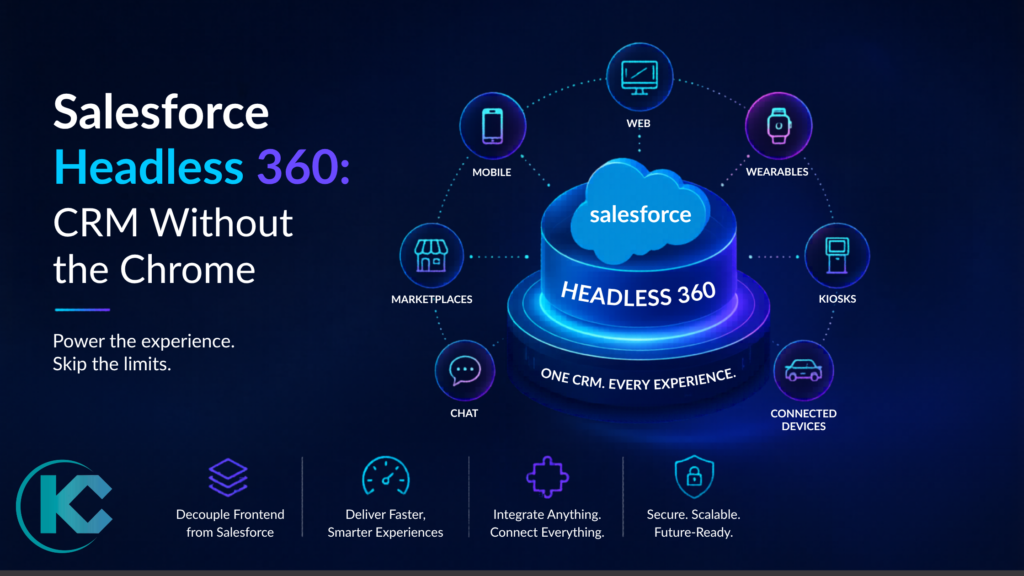
Salesforce officially introduced Salesforce Headless 360, a revolutionary API-first platform architecture designed for the new era of AI-powered enterprise operations. Instead of relying on humans navigating user interfaces, Salesforce exposes its entire ecosystem as APIs, MCP tools, and CLI commands that AI agents can interact with directly – no browser required.
If you have been exploring how Agentforce fits into your Salesforce roadmap, Headless 360 is the infrastructure layer that makes Agentforce truly enterprise-grade and programmable at scale.
What makes Salesforce Headless 360 different from traditional CRM?
- Every Salesforce capability becomes programmable and accessible via API
- AI agents can discover, access, and execute workflows without any browser UI
- Slack becomes the primary operational engagement layer for human-AI collaboration
- Developers gain live platform access through AI-powered coding agents
- Businesses can deploy AI-powered workflows across any surface – web, mobile, chat, or voice
- Unlike traditional CRM that requires human-in-the-loop for every action, Headless 360 enables end-to-end autonomous execution
The Rise of the Agentic Enterprise: Why Headless 360 Matters Now
Salesforce Headless 360 is architected for what Salesforce calls the Agentic Enterprise – a future where AI agents autonomously execute workflows, interact with enterprise systems, and collaborate with humans across all operational environments. This is not a distant vision; early adopters are already reporting 40–50% reductions in manual task volume within the first quarter of deployment.
A common question we hear from clients is: how does Salesforce Headless 360 compare to traditional Salesforce CRM? The contrast is stark. Traditional enterprise software requires a human to open a browser, navigate a UI, and take action. The Agentic Enterprise model removes that dependency entirely.
Traditional Enterprise Salesforce CRM
- Human-driven workflows requiring manual input at every stage
- Browser-based interactions that bottleneck on user availability
- Manual approvals, record updates, and pipeline management
- UI-centric operations with limited automation beyond flows
- Disconnected communication tools requiring context-switching
- Reactive – teams respond to data after the fact
Salesforce Headless 360 – The Agentic Enterprise
- AI-powered orchestration that executes without human initiation
- API-first architecture accessible by agents, apps, and services
- Autonomous workflows that complete end-to-end processes
- Slack-native engagement bringing action to where teams already work
- Real-time intelligent execution across all channels simultaneously
- Proactive – agents act on data signals before issues escalate
The 3 Major Innovations in Salesforce Headless 360
1. MCP Tools & Coding Skills for AI Agents
Salesforce now provides more than 60 new MCP (Model Context Protocol) tools and 30+ preconfigured coding skills that give coding agents live, authenticated access to Salesforce environments. These tools answer the common developer question: how do I connect an AI coding agent to Salesforce without writing custom integration code?
Supported AI coding agents include:
- Claude Code – Anthropic’s agentic coding environment
- Cursor – AI-first code editor with deep context awareness
- Codex – OpenAI’s code generation and execution model
- Windsurf – Codeium’s IDE with cascading agent capabilities
- GPT-5-powered development agents – for enterprise code generation at scale
For a hands-on walkthrough, see our guide on setting up Salesforce MCP tools with AI coding agents – including authentication, toolset selection, and your first agent-driven deployment.
2. Agentforce Experience Layer
The new Agentforce Experience Layer answers a critical architectural question: how does Salesforce Headless 360 deliver outputs to users if there is no browser interface? The answer is by completely separating what an AI agent does (its actions and decisions) from how it appears to end users (the rendered experience). This means the same agent logic can power a Slack message, a WhatsApp notification, a mobile app screen, and a chatbot response – simultaneously.
3. Enterprise AI Governance & Observability
One of the most frequently asked questions about AI agent adoption is: how do enterprises maintain control and compliance when AI is making autonomous decisions? Salesforce Headless 360 directly addresses this with a layered governance framework that gives IT and compliance teams full visibility into every agent action.
Testing Center
Simulate agent interactions and identify logic gaps, edge cases, and policy violations before any production launch – eliminating costly rollbacks.
Session Tracing
Full step-by-step audit trail of every agent decision, tool call, and data access – essential for regulated industries like financial services and healthcare.
A/B Testing API
Deploy multiple agent versions simultaneously against live traffic to compare performance, accuracy, and business outcomes before full rollout.
How Does Salesforce Headless 360 Work? The Architecture Explained
Understanding API-First Enterprise Software
Headless architecture decouples the backend (data, workflows, business logic) from the frontend (UI and presentation layer). In Salesforce Headless 360, this means every capability – from Customer 360 workflows to Data 360 analytics – is accessible via APIs, MCP tools, or CLI commands. There is no mandatory screen, no required login session, no UI rendering overhead.

Think of it this way: traditional Salesforce is a building where every room has a locked door you open manually. Salesforce Headless 360 is the same building but with every room exposed via a universal key system – AI agents hold those keys and can move through every room autonomously, at machine speed.
Key Components: MCP Tools, Agentforce, and Data 360 Deep Dive
1. Model Context Protocol (MCP) Tools – The Developer Gateway
Model Context Protocol (MCP) is an open standard that lets AI assistants connect to external tools and data sources without custom integration code. Salesforce’s MCP server (
@salesforce/mcp) ships directly with the Salesforce DX toolchain and exposes 60+ tools across metadata, data, testing, and DevOps categories. For a complete setup walkthrough, Salesforce Trailhead offers guided learning paths on MCP configuration.Install and configure via NPX:
npx -y @salesforce/mcp –orgs myDevOrg –toolsets metadata,data,testing
Once configured, your AI coding agent picks up those tools automatically. From that point, the agent can query your org, deploy an Apex class, run tests, and inspect results – without the developer ever leaving their coding environment. This is exactly how Salesforce Headless 360 accelerates developer productivity in practice. For advanced integration patterns, see our guide on Salesforce API integration best practices for enterprise teams.
2. Agentforce – AI Agent Orchestration at Enterprise Scale
Agentforce is Salesforce’s native AI orchestration platform and the beating heart of Headless 360. It goes well beyond simple automation – Agentforce coordinates multiple specialized agents, routes tasks based on context and priority, and enforces governance policies across every autonomous action. Many enterprises ask: is Salesforce Headless 360 ready for regulated industries? Agentforce’s governance layer is specifically designed to answer yes.
- Agent Script DSL – Define deterministic agent behavior with declarative scripts that guarantee consistent, predictable outcomes even in complex multi-step workflows
- Intelligent Agent Routing – Automatically direct tasks to the most capable agent based on context, complexity, and workload – with built-in human escalation triggers
- Agent Evaluation Framework – Continuously measure agent performance against business KPIs and automatically surface underperforming workflows for review
- Agentforce Experience Layer – Omnichannel output system that renders agent results natively across Slack, Teams, WhatsApp, and AI chat interfaces
3. Data 360 – The Intelligence Foundation
Data 360 is what separates Salesforce Headless 360 from generic AI agent platforms – it provides every agent with a unified, real-time view of enterprise data that is always accurate, always current, and always contextualized to the specific customer or account being worked on. Without a reliable data foundation, AI agents make confident mistakes. Data 360 eliminates that risk.
- Unified Customer 360 View – Every agent has access to the complete customer record: purchase history, service cases, engagement data, and predictive scores – all in one API call
- Real-Time Data Synchronization – Changes in any connected system propagate instantly, ensuring agents always act on the most current information
- API-Based Data Virtualization – Access data across external databases, data lakes, and third-party systems without copying or replicating it into Salesforce
- AI-Ready Data Preparation – Built-in data quality scoring, deduplication, and enrichment ensures the data feeding your agents is clean and reliable
API-First Integration Patterns: How to Connect Salesforce Headless 360
Three Access Methods – Choosing the Right Approach for Your Use Case
1. REST & SOAP APIs
Traditional but substantially enhanced APIs with agent-aware documentation and improved error messaging. Base URL:
/services/data/v63.0/Best for: Custom integrations, existing middleware layers, and scenarios requiring fine-grained control.
- OAuth 2.0 authentication with JWT support
- 100K API calls/24hrs (Enterprise edition)
- Named Credentials for secure credential management
2. MCP Tools
60+ preconfigured integrations purpose-built for AI agents. No custom integration code required – agents discover and use tools automatically.
Best for: Developer productivity, AI-assisted coding, and rapid prototyping.
- Model-agnostic (Claude, GPT, Gemini, Mistral)
- Secure tool access with org-level permission enforcement
- Automatic rate limiting and retry handling
3. Salesforce CLI
Command-line interface for scriptable operations, CI/CD pipelines, and batch automation without any UI dependency.
Best for: DevOps pipelines, automated testing, and scheduled batch operations.
- Agent spec generation from natural language prompts
- Automated test execution and reporting
- Full metadata deployment and retrieval
AI Agents and Autonomous Workflows: Real-World Use Cases
Autonomous AI agents in Salesforce Headless 360 execute entire business processes without human intervention. They are not chatbots responding to questions – they are active participants in business operations that perceive signals, make decisions, take actions, and report outcomes. Here are the most impactful use cases enterprises are deploying today:
- Autonomous Lead Qualification: Agents score, route, and follow up on inbound leads 24/7 – using Data 360 for account context, Customer 360 workflows for routing rules, and Slack for rep notifications
- Contract Processing & Approval Routing: Agents extract contract terms, check against pre-approved templates, route exceptions to the right approver via Slack, and update Salesforce records upon completion
- Customer Service Escalation Management: Service agents monitor open cases, predict escalation risk using sentiment and SLA data, proactively resolve common issues, and escalate complex cases with full context attached
- Continuous DevOps Deployment: Using MCP tools, coding agents write Apex code, deploy to sandbox, run all tests, and promote to production – entirely autonomously on a scheduled cadence
Agent Governance Framework – Keeping Autonomous AI Accountable
Slack-Native Operations: How Salesforce Headless 360 Brings AI to Your Team
Slack becomes the operational engagement layer in Salesforce Headless 360 – not just a messaging app, but the primary surface where AI agents surface insights, request decisions, and complete workflows. The Agentforce Experience Layer enables a true build-once, deploy-everywhere model. See the full Salesforce + Slack integration overview for how this works at the platform level.
Build Once, Deploy Everywhere – Practical Examples
Create a single agent workflow – for example, a discount approval process – and deploy it across every customer-facing and employee-facing channel without duplicating code. Here is where that single workflow can appear simultaneously:
Slack & Teams
Sales reps receive discount approval requests as interactive Slack messages with one-click approve/reject – no Salesforce login required
WhatsApp & Mobile
Field sales teams get the same approval flow on WhatsApp, with inline customer context pulled from Data 360 in real time
ChatGPT & Gemini
Enterprise AI assistants surface the same workflow inside ChatGPT or Gemini interfaces for users who prefer those environments
Key Benefits of Salesforce Headless 360 for Enterprise Organizations
Enterprises evaluating whether Salesforce Headless 360 is right for their business consistently cite four areas where the ROI is most measurable and most rapid. Our clients who have implemented Agentforce and Headless 360 together typically see results within the first 90 days.
AI-Powered Automation
- Autonomous workflow execution across sales, service, and ops
- 40–50% reduction in manual task volume within 90 days
- 24/7 operations that never pause for holidays or time zones
- Consistent, error-free execution of high-volume repetitive processes
Developer Productivity
- 40% faster development cycles through AI-assisted coding
- Natural language DevOps – describe what to build, agents do it
- Real-time org access means less context-switching for developers
- Automated test execution eliminates manual QA bottlenecks
Enterprise Scalability & Governance
- Multi-channel deployment without multiplicative engineering cost
- Granular permission governance aligned to existing Salesforce profiles
- Complete observability and audit trails for regulated industries
- Policy enforcement built into every agent action, not bolted on after
Cost Optimization & ROI
- Significant reduction in manual operations headcount requirements
- Faster execution means more deals closed, cases resolved, and orders processed
- Lower integration costs with MCP replacing custom middleware
- Consumption-based pricing scales cost with actual usage – not seat licenses
The Four Systems Powering Salesforce Headless 360
Conclusion: Salesforce Headless 360 Is Redefining What Enterprise Software Can Do
Salesforce Headless 360 represents one of the most consequential platform shifts in modern enterprise technology. It does not just add AI features to Salesforce – it fundamentally reimagines the relationship between human operators and enterprise software. Instead of people serving the software (logging in, clicking, updating), the software now serves business outcomes directly through autonomous AI agents.
Organizations that understand what Salesforce Headless 360 is and move quickly to implement it will gain compounding competitive advantages as their agents improve over time. Those that wait will find themselves managing manual workflows in an increasingly automated enterprise landscape.
- 100+ new AI tools and skills for enterprise automation – available now via the Salesforce DX toolchain
- 40% faster development cycles with AI coding agents and Natural Language DevOps
- Slack-native AI operations – approve, decide, and complete work without ever opening Salesforce
- Enterprise-grade governance with full session tracing, A/B testing, and custom evaluation metrics
- Unified architecture across Data 360, Customer 360, Agentforce, and Slack – four systems, one coherent platform
- Model-agnostic MCP tools compatible with Claude, GPT-5, Gemini, and any MCP-standard AI agent
At Kizzy Consulting, we help organizations modernize Salesforce ecosystems for AI-first operations, intelligent automation, and scalable enterprise transformation. Whether you are just beginning to explore how to implement Salesforce Headless 360 or are ready to deploy your first production agent, our team brings hands-on experience across Agentforce, Data 360, and Headless CRM architecture.
Ready to Build Your AI-Powered Salesforce Ecosystem?
Kizzy Consulting helps enterprises modernize Salesforce with Agentforce, Data 360, Slack automation, Headless CRM architecture, and AI-powered workflow orchestration – enabling scalable, secure, and intelligent enterprise operations that deliver measurable ROI within 90 days.
Explore how Salesforce Headless 360 can transform your business operations: