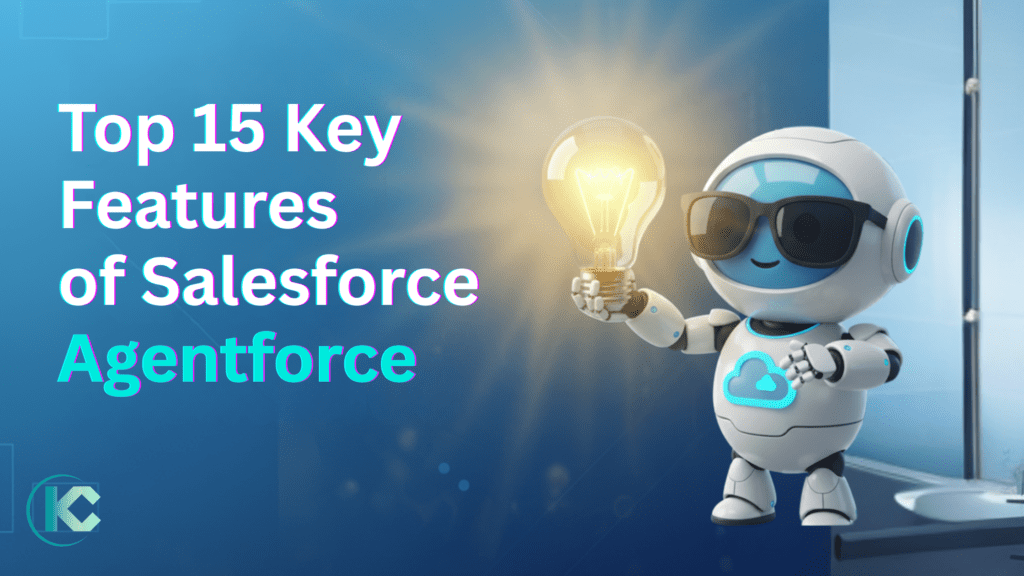
The 15 Most Impactful Agentforce Features for Smarter & Faster Growth
⏱ 5 min read
SALESFORCE AGENTFORCE • AI AGENTS
Contents
hide
1
Top 15 Key Features of Salesforce Agentforce for Smarter AI Automation
Top 15 Key Features of Salesforce Agentforce for Smarter AI Automation
The future of business automation is here and it is powered by Salesforce Agentforce. Discover the key Agentforce features helping organizations deploy autonomous AI agents across sales, service, marketing, operations, and other business functions.
Introduction: Why Salesforce Agentforce Matters
As industries become increasingly competitive in the digital era, businesses are turning to AI-driven solutions that go beyond simple workflow automation. Salesforce Agentforce enables organizations to build and deploy intelligent AI agents capable of understanding context, accessing business data, taking actions, and supporting workflows across departments.
With AI-powered reasoning, Salesforce data connectivity, automation, and integration across the Customer 360 ecosystem, Agentforce is changing how teams approach customer service, sales operations, marketing, and business process automation.
In this guide, we explore the top 15 Salesforce Agentforce features, how Agentforce AI agents work, where businesses can use them, and how organizations can maximize their value with the right implementation strategy.
Executive Quick Answer: What Makes Salesforce Agentforce Different?
Salesforce Agentforce is an AI agent platform that allows businesses to deploy agents capable of reasoning over trusted business information, responding to customers, and taking actions within connected workflows. Unlike traditional chatbots that primarily provide scripted responses, Agentforce is designed to work with Salesforce data, business rules, automation, and actions to support more dynamic business processes.
15
Key Agentforce Features
24/7
AI Agent Availability
360°
Connected Customer Data
What Is Salesforce Agentforce?
Salesforce Agentforce is an AI agent capability within the Salesforce ecosystem designed to help organizations build and deploy autonomous agents across different business functions. These agents can work with business context, retrieve relevant information, follow defined instructions, and perform actions through connected Salesforce capabilities.
Agentforce goes beyond the traditional chatbot model. Instead of only responding to predefined questions, an Agentforce AI agent can combine language understanding, business context, trusted data, reasoning, and actions to support end-to-end workflows.
Understand Context
AI agents can interpret conversational context and business instructions to understand what a user needs.
Access Trusted Data
Agents can use relevant Salesforce and connected business information to ground their responses and actions.
Take Action
Agents can trigger workflows, update records, retrieve information, and support business processes.
Why Choose Salesforce Agentforce for AI Automation?
Businesses increasingly need customer support and operational processes that are responsive, scalable, connected, and available beyond traditional working hours. Salesforce Agentforce AI is designed to address these requirements while remaining connected to the Salesforce CRM environment.
Fast to Start
Organizations can use available agent capabilities and customize instructions, actions, and workflows around specific business requirements.
Scalable AI Agents
Agentforce provides an architecture for deploying AI-powered experiences across growing volumes of customer and business interactions.
Deep Salesforce Integration
Agents can operate within the Salesforce ecosystem, helping organizations connect AI interactions with CRM data and business workflows.
Ready to explore an Agentforce implementation? Learn more about Kizzy Consulting’s Agentforce consulting services.
Top 15 Salesforce Agentforce Features
The following Agentforce features demonstrate how Salesforce is extending CRM automation with AI agents that can reason, retrieve information, interact with customers, and perform business actions.
1. Agent Builder for Low-Code AI Agent Development
Agentforce provides tools for creating and configuring AI agents without requiring every agent workflow to be built entirely from traditional code. Teams can define instructions, connect actions, and tailor agents to specific business requirements, making Salesforce AI agent development more accessible to business and technical teams.
2. Pre-Built Agent Skills & Actions
Pre-built capabilities can accelerate common AI use cases such as customer support, lead qualification, information retrieval, and workflow automation. Businesses can start with existing capabilities and adapt them to their operating model instead of creating every workflow from scratch.
3. Advanced Reasoning, Retrieval & Context
Agentforce can use retrieval and contextual information to help agents identify relevant information before generating responses or taking actions. This approach helps connect AI responses with enterprise knowledge and Salesforce business context.
4. Native Salesforce CRM Integration
One of Agentforce’s major advantages is its connection to the Salesforce platform. Agents can work with relevant CRM information and business processes across products such as Sales Cloud, Service Cloud, and other Salesforce capabilities.
5. Agentforce Testing & Evaluation
Testing is essential before deploying autonomous AI into customer-facing workflows. Agentforce provides testing capabilities that allow teams to evaluate agent behavior across different scenarios and identify areas that require refinement before production deployment.
6. AI-Powered Service Agent Optimization
Agentforce can support service teams by handling repetitive customer questions and routine tasks. This allows human service professionals to spend more time on complex cases that require judgment, empathy, or specialized expertise.
7. Flexible Business Use Cases
Agentforce can support a broad range of departmental workflows, including sales, customer service, marketing, commerce, operations, IT support, and industry-specific processes. This flexibility allows businesses to create AI agents around their highest-value workflows.
8. Autonomous Actions & Brand-Aligned Conversations
Agentforce agents can do more than generate text. They can use configured actions and workflows to support business processes while following defined instructions and communication guidelines. This makes it possible to design AI interactions that remain aligned with an organization’s operating model and brand voice.
9. Multi-Channel & Multi-Platform Deployment
AI agents can be designed for customer and employee experiences across digital channels such as websites, portals, messaging experiences, and other supported Salesforce engagement surfaces. This helps businesses create a more consistent omnichannel AI experience.
10. Real-Time Business Data Connectivity
AI agents become more useful when they can work with current business information. Agentforce is designed to connect agent experiences with relevant Salesforce data and workflows, helping agents provide responses and actions based on the business context available to them.
11. Scalable Architecture & Atlas Reasoning
Agentforce uses Salesforce’s Atlas reasoning architecture to support AI agent interactions and decision-making. The architecture is designed to connect reasoning, business context, data, and actions as organizations expand their use of AI agents.
12. Agentforce Partner Ecosystem
The broader Agentforce ecosystem can provide access to partner-built solutions, templates, actions, and specialized capabilities. This can help organizations extend AI agents into more specific business processes without building every capability independently.
13. Agent Analytics & Reporting
Organizations need visibility into how AI agents perform after deployment. Analytics and reporting can help teams examine interactions, outcomes, usage patterns, and areas where agents need refinement. These insights create a feedback loop for ongoing AI agent optimization.
14. Autonomous 24/7 Operation
One of the defining concepts behind Agentforce is the ability for agents to operate beyond traditional working hours. Depending on the use case and configuration, AI agents can handle routine interactions, retrieve information, initiate supported actions, and escalate situations that require human involvement.
15. AI Governance, Security & Trust
Enterprise AI requires more than intelligence. Organizations also need appropriate security, access controls, trusted data, governance, monitoring, and human oversight. Agentforce can operate within the broader Salesforce security and governance framework, helping businesses establish responsible AI workflows.
For more on this topic, explore Kizzy’s guide to AI governance trends in 2026.
Ready to Build AI Agents with Salesforce Agentforce?
The value of Agentforce depends on more than activating AI. The right use cases, data foundation, actions, integrations, testing, governance, and rollout strategy all matter.
Real-World Salesforce Agentforce Use Cases
Agentforce can be applied across industries and departments. The best starting point is usually a workflow where repetitive interactions, data retrieval, decision support, or task execution consumes significant team time.
Nonprofit AI Agents
AI agents can support donor engagement, case management, constituent communication, volunteer workflows, and other nonprofit processes connected to Salesforce.
Real Estate AI Agents
AI agents can understand property preferences, surface relevant listings, answer questions, support lead engagement, and automate parts of the property journey.
Case Management Agents
An AI agent can identify customer intent, retrieve relevant contact information, create or update cases, summarize conversations, and assist with case workflows.
AI Travel Assistants
AI travel agents can understand preferences, recommend experiences, retrieve relevant information, and support booking-related workflows through connected systems.
What Changed with Agentforce 2.0?
Agentforce 2.0 expanded the platform’s capabilities across agent creation, reasoning, integration, and deployment. Organizations evaluating Agentforce 2.0 should consider how these capabilities fit into their existing Salesforce architecture and AI strategy rather than treating the technology as a standalone chatbot.
- Expanded agent capabilities: More options for building and configuring AI-powered workflows.
- Improved reasoning and retrieval: Better support for context-rich interactions.
- Broader integration: Greater flexibility for connecting AI agents with Salesforce workflows.
- Expanded deployment options: Support for additional Salesforce-connected experiences.
How to Maximize Salesforce Agentforce ROI
1. Define Clear Business Goals
Decide whether the priority is reducing response times, automating repetitive tasks, improving service capacity, or increasing operational efficiency.
2. Start with Focused Use Cases
Choose workflows where AI agents can deliver measurable value instead of trying to automate everything at once.
3. Build on Trusted Data
Agent performance depends heavily on the quality, accessibility, and governance of the information available to the agent.
4. Test and Iterate
Continuously evaluate responses, actions, edge cases, escalations, and failure scenarios before and after deployment.
5. Connect Agentforce to the Wider Ecosystem
Integrate relevant CRM, marketing, service, communication, data, and automation systems so agents have the context required to support real workflows.
Before launching an AI agent strategy, organizations can also evaluate their readiness with Kizzy’s Agentforce readiness guide.
How Kizzy Consulting Helps with Agentforce Implementation
Implementing Agentforce successfully requires more than configuring an AI agent. Organizations need a clear use case, reliable Salesforce data, appropriate actions, integrations, testing, governance, and an operating model for continuous optimization.
AI Strategy
Identify high-value AI agent opportunities and align them with measurable business objectives.
Agent Development
Design agent instructions, actions, workflows, prompts, integrations, and business logic around specific use cases.
Data & Integration
Connect agents with the Salesforce data and external systems they need to operate effectively.
Testing & Governance
Evaluate agent behavior, establish guardrails, monitor performance, and create processes for continuous improvement.
Explore Kizzy’s AI Agents & Automation Development and AI Integration & Implementation services.
Wrapping Up: The Future of AI Agents with Salesforce
Salesforce Agentforce represents a shift from traditional automation toward AI agents that can understand context, work with business data, perform configured actions, and support customers and employees across connected workflows.
Features such as AI agent building, reasoning, Salesforce integration, testing, autonomous actions, real-time data connectivity, analytics, and governance make Agentforce a platform worth evaluating for organizations building an enterprise AI strategy.
Frequently Asked Questions About Salesforce Agentforce
What is Salesforce Agentforce?
Salesforce Agentforce is an AI agent capability within the Salesforce ecosystem that enables organizations to build and deploy agents that can understand business context, retrieve information, interact with users, and perform configured actions across business workflows.
What are the main features of Salesforce Agentforce?
Key Agentforce features include agent building, pre-built capabilities, contextual reasoning and retrieval, Salesforce integration, testing, autonomous actions, multi-channel deployment, real-time data connectivity, analytics, scalability, and enterprise governance.
How is Agentforce different from a traditional chatbot?
Traditional chatbots often rely heavily on predefined conversational flows. Agentforce is designed to combine AI reasoning, business context, connected data, instructions, and configured actions so an agent can support more dynamic workflows.
Can Agentforce work with Salesforce CRM data?
Yes. Agentforce is designed to operate within the Salesforce ecosystem and can use relevant Salesforce data and configured business actions, subject to the organization’s permissions, configuration, and governance controls.
Can Salesforce Agentforce agents work 24/7?
Agentforce is designed to support AI-powered interactions beyond traditional business hours. The actual availability and scope of automation depend on the specific agent configuration, channels, integrations, and business processes.
What industries can use Salesforce Agentforce?
Agentforce can be applied across many industries and departments, including sales, customer service, real estate, nonprofits, financial services, healthcare, retail, travel, and other business environments where connected AI automation can support defined workflows.
How can a business prepare for Agentforce?
Start by identifying a measurable business problem, reviewing data quality, mapping the required workflows and actions, defining governance requirements, and testing the proposed agent against realistic scenarios. A structured Agentforce readiness assessment can help identify implementation gaps.
Does Agentforce replace human employees?
Agentforce is designed to automate and assist with defined tasks and workflows. Organizations can configure escalation and human handoff processes for situations that require human judgment, specialized expertise, or additional oversight.
Ready to Unlock Salesforce Agentforce?
Build, deploy, and optimize AI agents around your real business workflows with the right Salesforce architecture, data, integrations, testing, and governance.
Email: [email protected]
Build Your Agentforce Strategy
Tell us about your business workflow and explore where Salesforce Agentforce can add value.