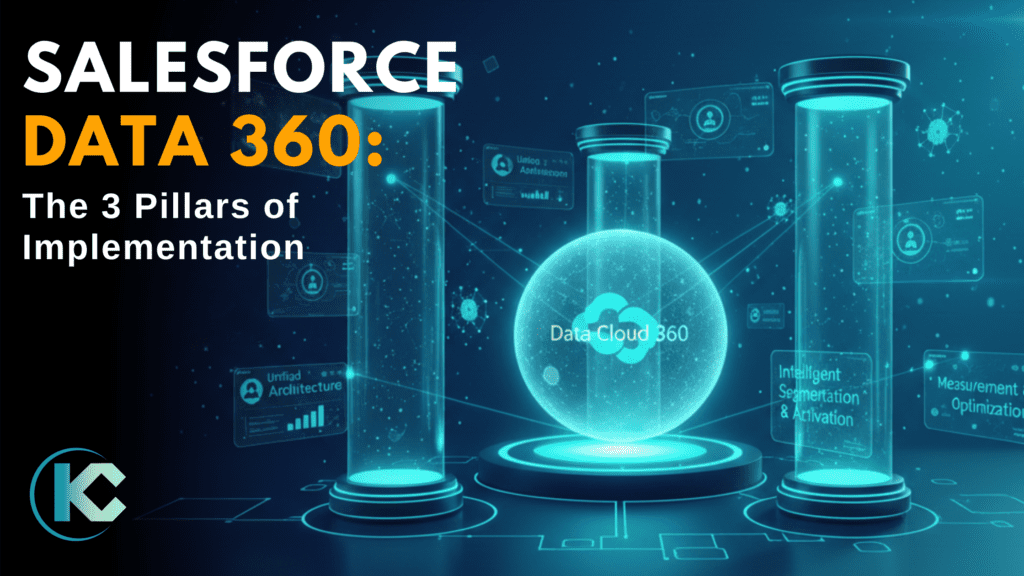
Salesforce Data 360: The Three Cs of Data Modeling, Connectivity & Cost
⏱ 6 min read
SALESFORCE DATA 360
A practical guide to Salesforce Data 360 architecture, data unification, real-time connectivity, consumption-based costs, AI readiness, and the strategic decisions organizations should make before scaling.
Over 20 years in marketing automation, across agencies, technical partners, and corporations, I’ve seen plenty of platforms promise simplicity and deliver complexity. Salesforce Data 360, formerly Data Cloud, is no exception. It’s powerful, yes. Essential, even. But simple? Not quite.
Data 360 introduces a new paradigm: one that blends real-time data orchestration with enterprise-grade architecture. It also uses a consumption-based, pay-as-you-go model, which is standard in cloud computing but still unfamiliar to many MarTech teams. And it’s not just a technical shift; it’s a strategic one.
More importantly, Data 360 is increasingly becoming a foundational layer for Salesforce innovations such as Marketing Cloud Next and Agentforce. That makes decisions around data modeling, connectivity, governance, and cost much more important than simply getting the platform configured.
Contents
hide
Executive Quick Answer: What Is Salesforce Data 360?
Salesforce Data 360 is Salesforce’s approach to collecting, unifying, and activating customer and business data across different systems. It can bring together CRM, ERP, marketing, commerce, IoT, databases, and other external data sources to create more useful customer and business context.
A successful Data 360 strategy depends on three connected decisions: Consistency, Connectivity, and Cost. Organizations need a strong data model, the right integration pattern for each use case, and a clear understanding of consumption economics before scaling Data 360 across the enterprise.
Salesforce Data 360: What This Guide Covers
What Is Salesforce Data 360?
Salesforce Data 360 is Salesforce’s approach to collecting, unifying, and activating customer data across different systems and departments.
At its core is Salesforce Data Cloud, which brings together data from sources such as:
CRM Systems
ERP Platforms
Marketing Tools
E-commerce Platforms
IoT Devices
External Databases
The goal is simple: give sales, service, marketing, commerce, and other teams a more complete and timely view of the customer.
But getting there requires more than connecting a few data sources. Organizations need a deliberate approach to data architecture, activation, integration, governance, and cost management.
The Three Cs of Salesforce Data 360
Three factors determine whether a Data 360 implementation becomes a strategic asset or an expensive technology project: Consistency, Connectivity, and Cost.
01
Consistency
Create reliable data models, identity rules, schemas and quality standards so downstream systems can trust the information.
02
Connectivity
Choose the right combination of real-time, batch, APIs and zero-copy patterns according to business requirements.
03
Cost
Understand consumption across ingestion, processing, unification, querying and activation before scaling the architecture.
These three areas are closely connected. Poor data modeling affects activation. Poor connectivity decisions can increase latency and consumption. And poorly designed architectures can quickly create unnecessary costs.
1. Consistency: Data Modeling Is Everything
Think of data modeling as the foundation of your house. If the foundation is weak, everything built on top of it becomes harder to maintain.

Understanding Data Unification
Data 360’s promise is to unify customer information into a single, actionable view across systems. But it is important to understand what unification actually means.
Unification is not necessarily the same thing as creating a traditional golden record.
Golden Record
Typically represents a cleaned, verified master record that may be written back to source systems.
Data 360 Unification
Combines information from multiple sources into a unified view without necessarily changing or overwriting the original source data.
The result is a dynamic customer view that can be used for analytics, segmentation, personalization, automation, and AI activation.
Technical Implications
Identity Resolution: Define how records from different systems should be matched. Rules that are too strict can miss relationships, while rules that are too loose can create incorrect matches.
Data Ingestion: Determine which data needs to enter Data 360, how frequently it needs to be refreshed, and which external sources introduce additional consumption costs.
Schema Design: Model data around the business use cases that need to consume it. Poor modeling can create bloated profiles and inefficient queries.
Data Quality: Establish rules for completeness, consistency, duplication, and accuracy before the data becomes part of downstream automation.
Why Consistency Matters
A unified customer view is only useful when the underlying data can be trusted. If customer records are duplicated or inaccurate, the same problems simply move into your personalization, reporting, automation, and AI workflows.
The principle:
Design Data 360 around activation and business outcomes — not simply data collection.
Design Data 360 around activation and business outcomes — not simply data collection.
2. Connectivity: Real-Time Isn’t Always the Right Time
Data 360 can work with different integration patterns, including real-time data, batch processing, APIs, and zero-copy approaches. Each option has different implications for performance, freshness, architecture, and cost.

Real-Time Streaming
Real-time data is valuable when an immediate response creates meaningful business value. For example, a customer abandoning a high-value purchase may justify an immediate personalization or sales action.
But real-time does not automatically mean better. Streaming every possible event can increase consumption and architecture complexity.
Batch Ingestion
Batch processing can be more appropriate when data does not need to be updated immediately. It can reduce unnecessary processing while still providing the information required for reporting, segmentation, and other business processes.
Zero-Copy Integration
Zero-copy approaches can allow organizations to work with data in external systems without physically ingesting all of that data into Data 360.
However, avoiding storage does not necessarily eliminate cost. The connected platform may still incur compute or query costs. The key is to understand where the workload and associated cost are actually being created.
APIs and Integration Governance
APIs provide flexibility, but they also require governance. Poorly designed integrations can create unnecessary data movement, duplicate processing, performance issues, and unexpected consumption.
The wrong question: “Can we connect this system?”
The better questions: “Why does this data need to be connected, how fresh does it need to be, and what business outcome does that freshness enable?”
For organizations connecting Salesforce with external applications, APIs, and AI systems, a strong integration architecture becomes critical.
3. Cost: Every Interaction Has a Price
This is one of the most overlooked aspects of Data 360.
Unlike a traditional flat-rate platform model, Data 360 uses consumption-based economics. Data ingestion, processing, unification, segmentation, querying, and activation can all affect overall usage.

Understanding Usage-Based Costs
Data Ingestion
Bringing external data into the platform can affect consumption.
Data Processing
Transformations and processing workloads need to be considered when designing the architecture.
Unification
Identity resolution and profile unification can contribute to overall usage.
Activation
Sending data into downstream systems, journeys, analytics, or other workflows can create additional consumption.
Querying
Large-scale data access and complex queries need to be designed with performance and economics in mind.
The Crawl-Walk-Run Approach
CRAWL
Start with one clearly defined, high-value use case. Learn how ingestion, unification, activation, and consumption behave.
WALK
Expand to additional segments, systems, or channels while measuring cost and business performance.
RUN
Scale the architecture once the organization understands the economics and can demonstrate measurable value.
This approach reduces unnecessary complexity and gives teams the opportunity to prove ROI before scaling the platform across the organization.
Why Salesforce Data 360 Requires More Than Implementation
Data 360 is not a platform that most organizations should treat as a simple plug-and-play deployment. It requires strategic thinking, technical architecture, data expertise, governance, and ongoing optimization.
The challenge is that Data 360 sits across multiple disciplines. Teams need to understand customer data, Salesforce architecture, integration patterns, analytics, AI activation, and the economics of consumption.
What the Right Salesforce Data 360 Partner Should Help With
Designing efficient data ingestion pipelines
Modeling data for activation rather than reporting alone
Defining identity resolution and unification rules
Selecting the right integration pattern for each use case
Building governance and data quality processes
Optimizing consumption without sacrificing business performance
Preparing the data foundation for AI and Agentforce use cases
Why Data Foundation Matters Before AI
AI systems need clean, governed and accessible business context. Kizzy’s Data Foundation for AI offering focuses on data quality, identity resolution, unified data architecture, integration, governance, security and AI readiness.
The Strategic Shift: From Campaigns to Architectures
Salesforce Data 360 changes how organizations think about customer data.
The shift is from fragmented data silos toward unified customer profiles, from periodic updates toward real-time orchestration where it makes business sense, and from isolated campaigns toward connected customer experiences.
That also changes the role of MarTech and Salesforce teams.
- From campaign builders to data architects
- From media planners to cost optimizers
- From MarTech executors to strategic advisors
- From isolated automation to connected AI-driven workflows
As Data 360 increasingly supports Salesforce’s broader AI and marketing ecosystem, organizations need to understand not only how to configure it, but how to build a reliable data foundation for what comes next.
Data 360 and the Future of Salesforce AI
The importance of Data 360 extends beyond customer segmentation and personalization. A trusted, accessible data foundation is increasingly important for AI-powered workflows and agents.
AI systems need access to relevant business context, reliable customer information, appropriate permissions, and well-defined processes. Without that foundation, adding AI can simply accelerate the wrong decisions.
Data 360 → Context → Agentforce → Business Action
A reliable data foundation can provide the context required for AI systems and agents to retrieve information, reason over business data, and execute workflows within defined permissions and governance boundaries.
Before introducing more advanced Salesforce AI capabilities, it is worth assessing whether the underlying Salesforce environment is ready.
For organizations moving from experimentation to production, Kizzy’s AI Agent Implementation Guide also covers architecture, integrations, security, guardrails, testing, monitoring and rollout considerations.
Bringing the Three Cs Together
Consistency, Connectivity, and Cost cannot be treated as separate workstreams.
A technically sophisticated architecture is not useful if the data model is inconsistent. A perfectly unified profile is not valuable if the organization cannot activate it effectively. And a powerful real-time architecture can become difficult to sustain if its consumption economics were never considered.
C1
Consistency
Can we trust the data?
C2
Connectivity
Can the right systems access it at the right time?
C3
Cost
Can we operate the architecture sustainably?
The organizations that succeed with Salesforce Data 360 treat it as a business transformation program, not simply a technology implementation.
They invest in governance, people, processes, and platform configuration together. They start with high-impact, well-scoped use cases and expand methodically.
Most importantly, they continually ask two questions:
“What does the data tell us?”
“What should we do differently because of it?”
KIZZY CONSULTING
Build a Stronger Data Foundation for Salesforce AI
Data 360 becomes significantly more strategic when it is treated as part of a broader data and AI architecture. Kizzy Consulting’s Data Foundation for AI offering focuses on data quality, unified data layers, identity resolution, integrations, governance, security, lineage and AI readiness.
Data Quality
Clean and structured enterprise data
Clean and structured enterprise data
Data Unification
Customer 360 and identity resolution
Customer 360 and identity resolution
Integration
APIs, event streams and external systems
APIs, event streams and external systems
AI Readiness
Data foundation for Agentforce and AI
Data foundation for Agentforce and AI
Final Thoughts
Salesforce Data 360 represents a major opportunity for organizations that want to move from fragmented customer data toward unified, actionable intelligence.
But the value does not come from connecting every possible data source or choosing real-time processing for everything. It comes from making deliberate decisions about how data is modeled, how it moves, how it is activated, and how much that architecture costs to operate.
Data 360 is powerful, but it is not plug-and-play. The organizations that get the most value from it are the ones that embrace the complexity early, build a strong foundation, and scale based on measurable business outcomes.
Frequently Asked Questions About Salesforce Data 360
What is Salesforce Data 360?
Salesforce Data 360 is Salesforce’s approach to collecting, unifying, and activating customer data across different systems. It creates a unified and actionable view of customer information that can support analytics, personalization, automation, and AI-powered experiences.
What is the difference between Salesforce Data 360 and Data Cloud?
Salesforce Data Cloud is the technology foundation for bringing together and activating customer data, while Data 360 represents Salesforce’s broader data strategy and capabilities around unified, actionable data across its platform ecosystem.
What are the three pillars of a successful Salesforce Data 360 strategy?
The three critical areas are Consistency, Connectivity, and Cost. Consistency focuses on data modeling and quality, Connectivity focuses on how data moves between systems, and Cost focuses on understanding and optimizing consumption.
Is real-time data always better in Salesforce Data 360?
No. Real-time data is valuable when freshness directly supports a business outcome, but it can introduce additional consumption and architectural complexity. Batch processing or other integration patterns may be more appropriate for use cases that do not require immediate updates.
How does Salesforce Data 360 handle customer data unification?
Data 360 uses identity resolution and data modeling to combine information from multiple sources into a unified customer view. This unified view does not necessarily overwrite the original source records and is designed to make customer data available for activation and downstream experiences.
Is Salesforce Data 360 expensive?
Data 360 uses a consumption-based model, so costs depend on factors such as data ingestion, processing, unification, querying, and activation. The best approach is to start with a focused use case, measure consumption and business value, and then scale the architecture based on proven ROI.
Why do companies need a partner for Salesforce Data 360?
A Data 360 implementation requires more than platform configuration. Organizations often need expertise across data modeling, identity resolution, integrations, governance, Salesforce architecture, AI readiness, and consumption optimization. An experienced partner can help design the architecture and avoid costly implementation mistakes.
How does Data 360 support Salesforce AI and Agentforce?
Data 360 can provide the unified and actionable business context that Salesforce AI capabilities and agents need. Reliable data, appropriate permissions, integrations, and governance are important foundations for deploying AI and Agentforce effectively.
What is Salesforce Data 360 data modeling?
Data modeling in Data 360 defines how information from different systems is structured, related, matched, and prepared for downstream activation. Good modeling helps organizations create useful customer profiles while avoiding unnecessary complexity and inefficient data usage.
What is zero-copy integration in Salesforce Data 360?
Zero-copy approaches allow organizations to work with data in external systems without necessarily physically ingesting all of that data into Data 360. The appropriate architecture depends on the use case, connected platform, performance requirements, governance and associated consumption economics.
How should companies approach Salesforce Data 360 implementation?
A practical approach is to begin with a clearly defined business use case, establish the required data model and quality standards, choose the appropriate integration pattern, measure consumption, validate business value, and then expand the architecture in stages.
Ready to Explore How Salesforce Data 360 Can Transform Your Customer Data Strategy?
Talk with Kizzy Consulting about your data architecture, Salesforce integration, AI readiness, Data 360 roadmap, and the foundation required for Agentforce.