Salesforce Revenue Cloud Implementation Guide 2026
⏱ 4 min read
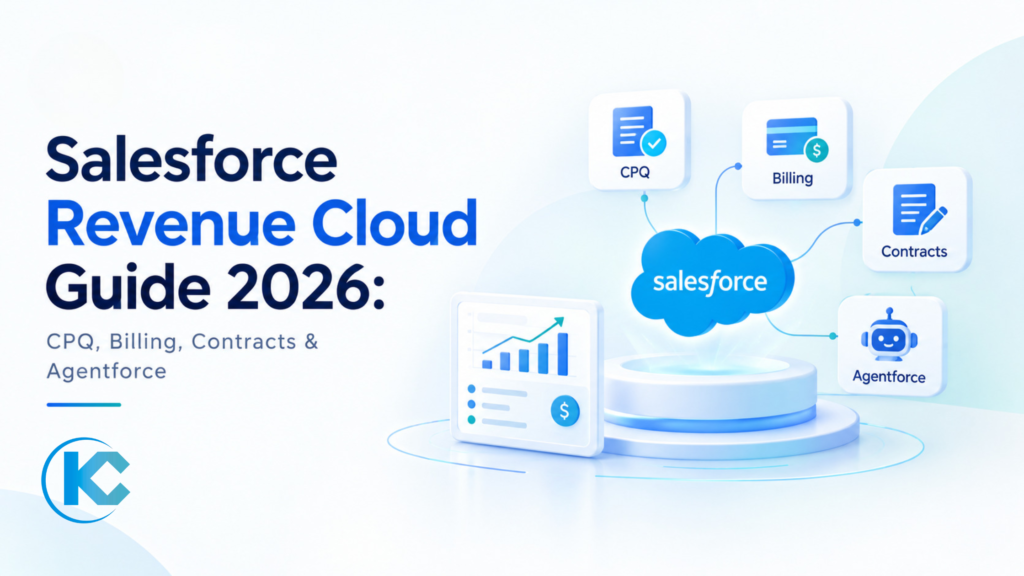
Salesforce Revenue Cloud (now Agentforce Revenue Management) unifies CPQ, billing, contracts, order management, and revenue recognition on a single, AI-powered platform. This guide breaks down what Revenue Cloud is, how Revenue Cloud Advanced differs from legacy CPQ, core features, architecture, pricing, and a practical implementation roadmap for 2026.
Salesforce Revenue Cloud
Revenue Cloud Advanced
Agentforce Revenue Management
Quote-to-Cash
CPQ
Revenue Cloud Advanced
Agentforce Revenue Management
Quote-to-Cash
CPQ
What Is Salesforce Revenue Cloud?
Salesforce Revenue Cloud is Salesforce’s unified revenue lifecycle management (RLM) platform. It replaces the standalone Salesforce CPQ managed package with a native, API-first system covering product catalog, pricing, CPQ, contract lifecycle management, order management, billing, and revenue recognition – all in one connected data model.
The current edition, Revenue Cloud Advanced (also marketed as Agentforce Revenue Management), adds built-in Agentforce AI agents that automate quoting, renewals, dunning, and revenue-recognition tasks. Most organizations start with one revenue process (usually quoting or billing), build a trusted data foundation, then expand into full quote-to-cash automation.
CPQ
Configure, price, quote
RLM
Revenue lifecycle mgmt
ASC 606
Revenue recognition compliance
Agentforce
AI-driven revenue agents
What Is Salesforce Revenue Cloud?
Salesforce Revenue Cloud is part of the Salesforce Customer 360 / Agentforce 360 Platform. It supports the entire revenue lifecycle – from product catalog and pricing, through CPQ, contracting, order fulfillment, subscription billing, and revenue recognition – in one connected data model shared with Sales Cloud and Service Cloud.
Revenue Cloud began as Salesforce CPQ (formerly Apttus/SteelBrick), a standalone quoting tool. As subscription, usage-based, and hybrid revenue models grew more common, Salesforce consolidated CPQ, Billing, Revenue Recognition, and Order Management into Revenue Lifecycle Management (RLM), later rebranded Revenue Cloud Advanced, and now often referred to as Agentforce Revenue Management following the addition of native AI agents.
Unlike legacy Salesforce CPQ, which shipped as a managed package with UI and scalability limitations, Revenue Cloud Advanced is built directly on the core Salesforce platform – giving it deeper customization, tighter Agentforce integration, and a single data model across quote, order, subscription, invoice, and revenue-recognition objects.
Salesforce CPQ vs. Revenue Cloud Advanced
Legacy Salesforce CPQ was excellent at one thing: building accurate quotes fast. But once a quote was won, it was handed off to billing, fulfillment, and finance teams manually – via PDF or CSV export – introducing delays, errors, and reconciliation work. For a deeper look at how Salesforce CPQ works and where it fits in the modern revenue lifecycle, see our Salesforce CPQ guide.
Salesforce has confirmed the end of sale for the legacy Salesforce CPQ managed package. Existing customers can still renew and receive support, but new investment and roadmap innovation is focused entirely on Revenue Cloud Advanced – making migration planning a near-term priority for CPQ customers.
Revenue Cloud Readiness Check
Migrating from Salesforce CPQ to Revenue Cloud Advanced?
Kizzy Consulting helps teams assess CPQ-to-Revenue-Cloud migration paths, data readiness, and Agentforce Revenue Management use cases. See our Agentforce Consulting Services and AI Integration & Implementation offerings.
Get a Revenue Cloud Migration Assessment
Tell us about your current CPQ, billing, and revenue recognition setup.
Core Features of Salesforce Revenue Cloud Advanced
Revenue Cloud Advanced bundles the entire quote-to-cash and cash-to-recognition lifecycle into one connected platform.
1. Product Catalog & Pricing
A single catalog powers direct sales, partner sales, and self-service channels. Dynamic attributes remove the need for individual SKUs per variation, and declarative Pricing Procedures support fixed, tiered, volume, matrix, and usage-based pricing models – simulated before activation, similar to debugging a Flow.
2. Configure, Price, Quote (CPQ)
A constraint-based configurator (with Constraint Modeling Language support) handles nested bundles, multi-year ramp deals, and scheduled uplifts. The Transaction Line Editor offers an Excel-like, spreadsheet interface with unlimited columns, freezing, sorting, and filtering. Agentforce quoting lets reps generate compliant quotes from natural-language prompts. If your organization is still evaluating or implementing Salesforce CPQ, see Kizzy’s Salesforce CPQ Services for implementation, customization, and migration support.
3. Contract Lifecycle Management (CLM)
CLM is included natively – clause libraries, template management, generative-AI clause drafting, and real-time collaborative redlining, without a separate SKU or third-party tool.
4. Order Management & Orchestration
The Dynamic Revenue Orchestrator (DRO) decomposes orders into fulfillment plans, tracks dependencies, and coordinates with downstream systems and partners in real time.
5. Subscription, Usage & Consumption Billing
Revenue Cloud Billing supports subscription, one-time, and usage-based/consumption models with proration, dunning, tax calculation, and rollover policies for unused usage grants – passing data to an ERP where needed.
6. Revenue Recognition Automation
Built-in revenue recognition follows ASC 606, FASB, and IFRS 15 standards, automatically calculating deferred and recognized revenue from delivery milestones or contract terms, with full audit trails.
7. Agentforce Revenue Management (AI Agents)
Native Agentforce agents listen for events across the revenue data model: a quote is approved → an agent creates the order; an invoice goes past due → an agent sends a reminder and flags collections; a billing term changes → an agent updates the revenue-recognition schedule.
Salesforce Revenue Cloud Pricing
Salesforce Revenue Cloud pricing depends on the selected edition, user requirements, transaction volumes, billing complexity, and implementation scope. Available licensing options vary by product and contract, so confirm current pricing directly with Salesforce before budgeting. The following overview highlights the main considerations when evaluating Revenue Cloud for 2026.
What Influences Revenue Cloud Pricing?
Salesforce Revenue Cloud Architecture: How It Works
Revenue Cloud Advanced runs on a composable, API-first architecture: each component – quoting, billing, revenue recognition, order management – scales independently and communicates via modular APIs.
Opportunity
↓
Quote (CPQ)
Order
Subscription / Asset
Invoice
↓
Agentforce Agents
ERP (SAP/NetSuite/Oracle)
Payment Processors
Tableau Next Analytics
↓
Revenue Recognized (ASC 606 / IFRS 15)
For organizations connecting Revenue Cloud to ERP systems, payment gateways, or custom APIs, Kizzy’s Salesforce Integration Services and Data Foundation for AI services help build the clean, governed data layer Revenue Cloud and its Agentforce agents depend on.
Why Businesses Are Moving to Salesforce Revenue Cloud
Faster Deal Cycles
Automated quote-to-order handoffs typically compress deal closure by 3–5 days versus manual CPQ processes.
Fewer Revenue Adjustments
Automated, compliant revenue recognition reduces manual journal entries and quarter-end scrambles.
Unified Revenue Data
Quote, order, subscription, invoice, and revenue-recognition objects share one schema – no reconciliation between disconnected tools.
Built for Subscriptions & Usage
Native support for recurring, usage-based, and hybrid revenue models – not retrofitted from older transactional software.
Salesforce Revenue Cloud Pricing
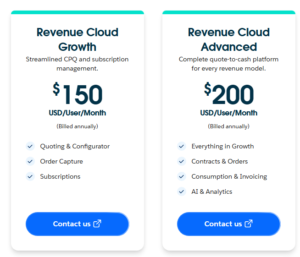
Salesforce Revenue Cloud pricing is generally structured per user/transaction/subscription volume rather than a flat fee, and varies by edition, Agentforce agent licensing, and implementation scope. Approximate market ranges seen across mid-market and enterprise deployments:
Revenue Cloud Growth
Streamlined CPQ and subscription management. Quoting, order capture, and subscriptions. Entry point for small-to-mid market teams.
Streamlined CPQ and subscription management. Quoting, order capture, and subscriptions. Entry point for small-to-mid market teams.
Revenue Cloud Advanced
Full quote-to-cash platform: contracts, orders, consumption, and billing. Built for mid-market to enterprise, multi-cloud, complex billing scenarios.
Full quote-to-cash platform: contracts, orders, consumption, and billing. Built for mid-market to enterprise, multi-cloud, complex billing scenarios.
Enterprise / Custom
Unlimited subscriptions, full Agentforce suite, dedicated success team. Custom pricing based on transaction and ARR volume.
Unlimited subscriptions, full Agentforce suite, dedicated success team. Custom pricing based on transaction and ARR volume.
Because Salesforce Revenue Cloud pricing depends heavily on subscription volume, transaction volume, and Agentforce licensing, get a tailored quote through Kizzy Consulting rather than relying on list price alone.
Ready to Implement Salesforce Revenue Cloud?
From CPQ migration to full Agentforce Revenue Management rollout, Kizzy Consulting helps you design a revenue architecture built for accuracy, compliance, and scale. Explore our Salesforce Consulting Services or our guide to becoming an Agentic Enterprise.
Salesforce Revenue Cloud Implementation: A Practical Roadmap
01. Process Mapping
Document your current quote-to-cash process, handoffs, and bottlenecks (2–3 weeks).
Document your current quote-to-cash process, handoffs, and bottlenecks (2–3 weeks).
02. Data Readiness
Audit and clean quote, order, and invoice data; standardize SKUs and pricing tables.
Audit and clean quote, order, and invoice data; standardize SKUs and pricing tables.
03. Configuration
Build quoting rules, pricing procedures, billing setup, and order workflows (4–6 weeks).
Build quoting rules, pricing procedures, billing setup, and order workflows (4–6 weeks).
04. Agentforce Design
Define Agentforce agent rules, guardrails, and human escalation paths from the start.
Define Agentforce agent rules, guardrails, and human escalation paths from the start.
05. Testing & UAT
Validate billing rules, proration, tax treatment, and dunning workflows in sandbox (2–3 weeks).
Validate billing rules, proration, tax treatment, and dunning workflows in sandbox (2–3 weeks).
06. Cutover & Go-Live
Parallel run, data migration, and phased rollout by product line or segment (1 week+).
Parallel run, data migration, and phased rollout by product line or segment (1 week+).
Typical Salesforce Revenue Cloud implementation timelines run 8–12 weeks for a net-new org, or 4–8 weeks when adding Revenue Cloud Advanced to an existing Salesforce instance. For a deeper readiness checklist, see Kizzy’s AI Agent Implementation Guide, which applies directly to Agentforce Revenue Management agent rollouts.
Governance, Compliance & Security in Revenue Cloud
Giving Agentforce agents access to quote, billing, and revenue-recognition data raises the stakes on governance. An agent that can read a quote is different from one that can generate an invoice or trigger a contract amendment.
- ASC 606 / IFRS 15-compliant revenue recognition with full audit trails
- Least-privilege access for Agentforce agents and integration users
- Role-based permissions on quote, order, and billing objects
- Human approval workflows for high-risk billing and contract actions
- Multi-currency, multi-entity, and multi-GAAP support for global orgs
Kizzy’s AI Strategy & Advisory and AI Trust Architecture guide cover how to set guardrails for autonomous revenue agents before go-live.
Frequently Asked Questions About Salesforce Revenue Cloud