Salesforce SFR-AutoR&D: How Autonomous Agents Improve AI Models
⏱ 3 min read
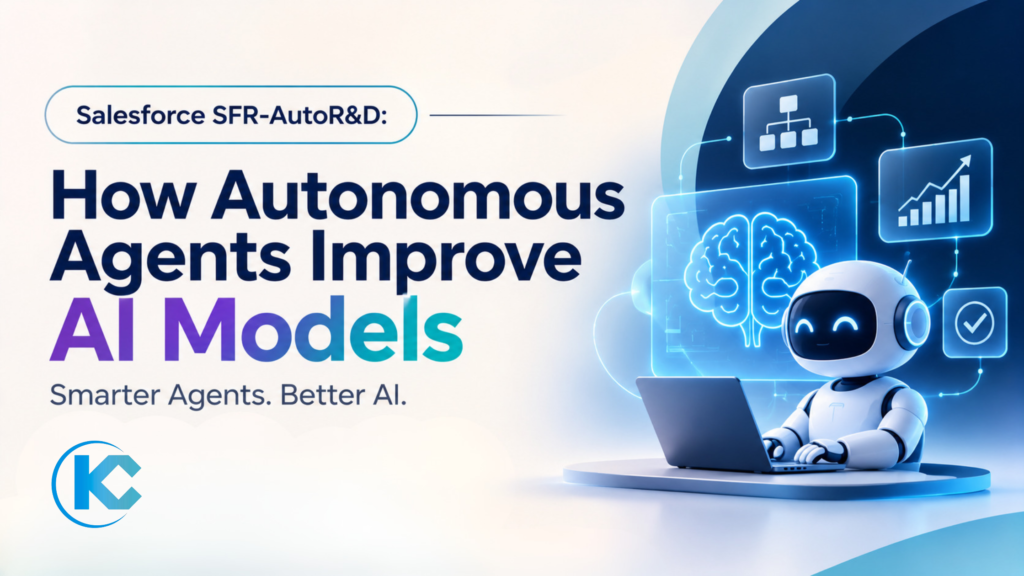
Building and refining high-performing AI models has traditionally required months of manual experimentation, hyperparameter tuning, and iterative evaluation by specialized machine learning teams. With the introduction of SFR-AutoR&D, Salesforce AI Research is shifting that paradigm by using autonomous AI agents to improve AI models. This guide explains what SFR-AutoR&D is, how autonomous research agents accelerate model development, what this shift means for enterprise AI and Agentforce deployments, and how organizations can prepare their AI governance frameworks for self-improving agentic workflows.
TL;DR: Salesforce SFR-AutoR&D at a Glance
- SFR-AutoR&D is a Salesforce AI Research initiative focused on autonomous agents that design, run, evaluate, and iterate on machine learning experiments to improve AI models.
- Autonomous R&D loop: Instead of relying solely on manual trial and error, agents generate hypotheses, write and execute training or evaluation code, analyze results, and refine their next iteration.
- Faster innovation cycles: Automating repetitive experimentation allows human researchers and ML engineers to focus on architecture strategy, safety, and domain alignment.
- Enterprise impact: Stronger, more specialized models directly strengthen enterprise AI platforms like Agentforce, improving accuracy, reasoning, and task reliability.
- Governance remains essential: Self-improving agentic pipelines still require human oversight, reproducible benchmarks, compute guardrails, and strict data security controls.
01
Hypothesize
Propose model improvements
02
Experiment
Code, train, and test
03
Iterate
Evaluate and optimize
What Is Salesforce SFR-AutoR&D?
SFR-AutoR&D (Salesforce Research Autonomous Research and Development) is an agentic framework developed by Salesforce AI Research that uses AI agents to automate and accelerate the machine learning research lifecycle. Rather than treating AI models as static artifacts tuned exclusively by humans, SFR-AutoR&D deploys specialized agents that systematically test ideas, debug code, run evaluations, and uncover better model configurations.
In traditional AI development, researchers spend a significant portion of their time writing boilerplate training scripts, diagnosing failed runs, comparing metrics across experiments, and manually adjusting architectures or data pipelines. Autonomous research agents take over these structured, iterative loops so teams can explore a much wider solution space in a fraction of the time.
Why “Agents Improving Models” Is a Turning Point
Most enterprise AI agents today focus on business workflows – such as answering customer cases, qualifying leads, or summarizing meetings. SFR-AutoR&D applies that same agentic reasoning directly to the underlying AI engineering process itself, turning model optimization into a continuous, structured engineering loop.
Traditional AI R&D vs. Agentic AI R&D (SFR-AutoR&D)
| Dimension | Traditional Model R&D | Agentic R&D with SFR-AutoR&D |
|---|---|---|
| Experiment Design | Manually drafted hypotheses and linear testing | Agents generate, prioritize, and test multiple hypotheses in parallel |
| Code & Debugging | Engineers manually write scripts and fix runtime errors | Agents write experiment code, inspect logs, and self-correct failures |
| Iteration Speed | Constrained by human review cycles and working hours | Continuous, automated experimentation across evaluation benchmarks |
| Role of Human Researchers | Split between high-level strategy and repetitive tuning | Focused on problem framing, safety guardrails, and strategic breakthroughs |
How Autonomous Agents Improve AI Models Step by Step
An autonomous R&D system does not blindly guess parameters. Instead, it mirrors the scientific method used by experienced machine learning engineers, structured into repeatable stages.
1. Problem Analysis and Hypothesis Generation
The agent reviews baseline model performance, error patterns, and research objectives to propose targeted improvements – such as adjusting data curation, loss functions, prompting strategies, or model architectures.
2. Automated Implementation and Execution
Once a hypothesis is selected, the agent translates it into executable code, configures the training or fine-tuning pipeline, and launches controlled experiments inside a sandboxed environment.
3. Self-Debugging and Error Recovery
When an experiment fails due to dependency conflicts, memory limits, or syntax issues, the agent reads the stack trace, diagnoses the root cause, patches the script, and re-runs the job automatically.
4. Quantitative Evaluation and Feedback
The agent measures the resulting model against predefined evaluation benchmarks, compares gains against compute cost and latency, and records what worked and what did not.
5. Iterative Refinement
Using insights from previous runs, the agent discards underperforming approaches and compounds successful changes in subsequent cycles until it reaches target performance thresholds.
Important distinction: Autonomous R&D does not mean unguided AI. Every experiment is anchored to explicit evaluation metrics, sandbox boundaries, and human-defined research goals.
Salesforce AI & Enterprise Security
Ready to Deploy Governed AI Agents Across Your Enterprise?
From Salesforce Agentforce architecture to enterprise cybersecurity and AI governance, Kizzy Consulting helps organizations build scalable, secure, and production-ready AI workflows.
Why SFR-AutoR&D Matters for Salesforce Customers and Enterprise AI
Even if your organization does not train foundation models from scratch, breakthroughs in autonomous AI R&D directly shape the capabilities, reliability, and economics of the enterprise software you use every day.
1. More Reliable Domain-Specific Models
Enterprise workflows in sales, service, commerce, and finance require high precision and low hallucination rates. Faster automated experimentation enables AI research teams to optimize smaller, specialized models that perform better on structured CRM tasks at lower inference costs.
2. Stronger Agentforce Reasoning and Tool Use
As autonomous research agents improve underlying reasoning, planning, and function-calling capabilities, downstream enterprise agents built on platforms like Salesforce Agentforce become better at handling multi-step business logic and complex API orchestrations.
3. Shorter Gap Between Research and Production
Traditionally, promising research techniques take months to validate across real-world benchmarks. Automating ablation studies and performance validation helps bring proven model improvements into enterprise products faster.
Governance and Guardrails for Autonomous AI Workflows
Whenever AI agents are given the autonomy to write code, execute experiments, or optimize systems, governance becomes non-negotiable. Engineering and security leaders adopting agentic automation should enforce four core guardrails:
- Sandboxed execution environments: Isolate code execution so agents cannot access production databases, credentials, or external networks outside approved boundaries.
- Strict evaluation integrity: Prevent reward hacking or benchmark overfitting by separating training data from held-out validation sets and auditing evaluation scripts.
- Compute and budget caps: Set hard limits on token usage, GPU hours, and experiment loops to prevent runaway costs from recursive agent runs.
- Human-in-the-loop checkpoints: Require human review before any agent-generated model, prompt, or code change is promoted to a production environment.
Related Read
Explore More Salesforce AI & Security Insights
Stay ahead with practical guides on enterprise AI governance, Salesforce architecture, and cybersecurity.
Conclusion: The Next Phase of Enterprise AI Engineering
Salesforce’s release of SFR-AutoR&D highlights a major milestone in how AI systems are built. By pairing autonomous research agents with structured evaluation and human oversight, AI engineering is evolving from slow, manual iteration into a scalable, continuous optimization discipline.
Key Takeaways
- Agents are now building better AI: SFR-AutoR&D automates hypothesis testing, coding, debugging, and evaluation loops.
- Humans remain in command: Researchers set goals, verify safety, and approve production releases while agents handle high-volume iteration.
- Enterprise platforms benefit directly: Faster model improvements translate into more accurate, cost-efficient AI agents for CRM and business operations.
- Governance scales with autonomy: Sandboxing, evaluation audits, and compute limits are essential for safe agentic workflows.
Frequently Asked Questions About Salesforce SFR-AutoR&D
1. What is Salesforce SFR-AutoR&D?
SFR-AutoR&D is a Salesforce AI Research framework that uses autonomous AI agents to conduct machine learning research and development – generating hypotheses, writing and running experiment code, evaluating results, and iteratively improving AI models.
2. How do AI agents improve other AI models?
They operate in a structured loop: analyzing baseline errors, proposing targeted changes to training or architecture, executing experiments in sandboxed environments, debugging failures automatically, and keeping only the changes that improve benchmark performance.
3. Does SFR-AutoR&D replace human AI researchers?
No. It automates repetitive experimentation, scripting, and tuning so human researchers and ML engineers can focus on high-level problem framing, novel architectures, safety alignment, and strategic decision-making.
4. How does this impact Salesforce Agentforce and CRM users?
Faster, automated model optimization leads to stronger, more accurate, and more cost-efficient underlying models. For Salesforce customers, that translates into more reliable reasoning, better tool execution, and improved performance across Agentforce workflows.
5. What guardrails are needed when using autonomous R&D agents?
Organizations should enforce sandboxed code execution, strict data isolation, independent benchmark validation to prevent overfitting, compute budget caps, and human-in-the-loop approval before deploying any changes to production.
Want to Build Secure, High-Impact AI Agents on Salesforce?
Whether you are planning an Agentforce rollout, connecting AI assistants to your CRM data, or establishing enterprise AI governance, getting the architecture right from day one makes all the difference.
Talk to Kizzy Consulting about your Salesforce AI strategy, architecture, and implementation roadmap.