AI SDLC: How AI Is Transforming Software Development
⏱ 6 min read
By Sanjeet Mahajan Founder & CEO, Kizzy Consulting
Executive Quick Answer
The AI Software Development Lifecycle (AI SDLC) uses artificial intelligence to assist with requirements, architecture, coding, testing, deployment and maintenance. An Agentic SDLC extends this approach by allowing AI agents to execute connected tasks, use development tools and validate changes within defined permissions and approval processes. Enterprise teams need more than code generation: they need reliable context, security, testing, governance and measurable delivery outcomes.
What Is AI SDLC?
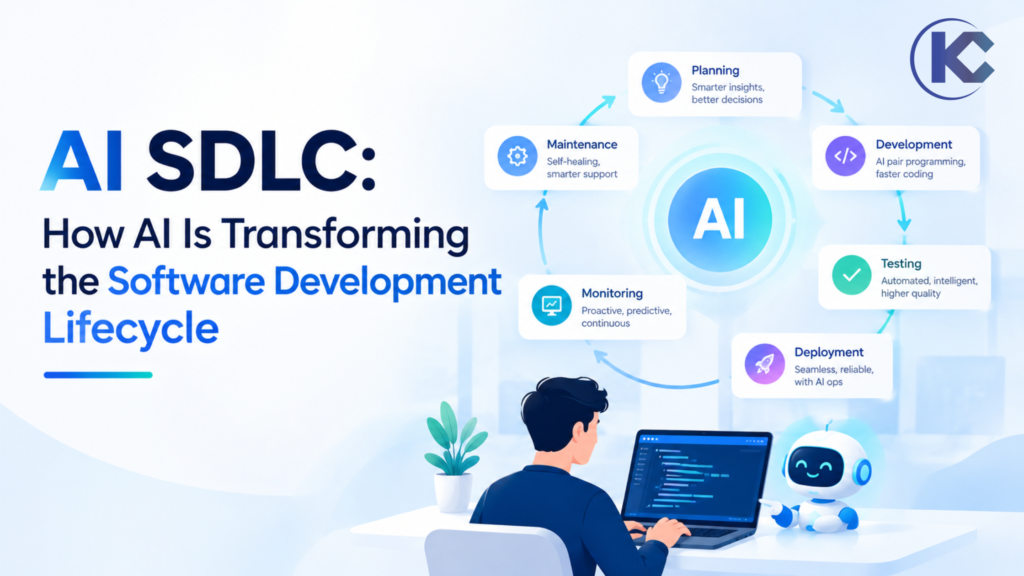
The AI Software Development Lifecycle is the use of AI across the activities involved in planning, designing, building, testing, deploying and maintaining software. It can include conventional AI coding assistants, generative AI models, repository-aware coding agents and automated engineering workflows.
Traditional software development already uses automation through version control, continuous integration, automated testing and deployment pipelines. AI adds capabilities such as understanding natural-language requirements, summarizing unfamiliar codebases, generating test cases and helping engineers investigate failures.
The goal is not to remove engineering discipline. It is to reduce repetitive work while giving engineers more time to focus on architecture, system behavior, security, verification and business requirements.
Traditional SDLC
People lead engineering activities, supported by defined processes and conventional automation.
People lead engineering activities, supported by defined processes and conventional automation.
AI-Assisted SDLC
AI helps engineers complete individual tasks such as coding, documentation, analysis and testing.
AI helps engineers complete individual tasks such as coding, documentation, analysis and testing.
Agentic SDLC
AI agents can plan and execute multi-step tasks across tools, with bounded permissions and human oversight.
AI agents can plan and execute multi-step tasks across tools, with bounded permissions and human oversight.
AI SDLC vs. AI/ML Lifecycle
These terms describe related but different concerns. AI SDLC focuses on using AI in software engineering. The AI/ML lifecycle focuses on building and operating machine-learning systems, including data preparation, model training, evaluation and monitoring.
| Area | AI SDLC | AI/ML Lifecycle |
|---|---|---|
| Focus | Software engineering workflows | Data and model development |
| Core activities | Design, coding, testing and releases | Data preparation, training and evaluation |
| Operations | Application health, reliability and releases | Model performance, drift and retraining |
An application containing machine-learning models may need both lifecycles. For model-specific practices, see our Data Foundation for AI solutions.
How AI Is Used Across the Software Development Lifecycle
AI can support each stage of software delivery. The right implementation depends on the sensitivity of the code, the quality of available context, the maturity of engineering practices and the risk of the action being automated.
1. Planning and Requirements Analysis
AI can turn meeting notes, product requests, support tickets and business documentation into draft requirements. It can identify ambiguous statements, suggest acceptance criteria and summarize dependencies for engineering teams.
- Summarize stakeholder discussions and existing documentation.
- Draft user stories and acceptance criteria.
- Identify missing details, contradictions and potential dependencies.
- Help engineers connect business requirements to technical tasks.
Human check: Product owners and engineers must validate assumptions, priorities and acceptance criteria before implementation begins.
2. Architecture and Design
AI can help teams explore design options, understand dependencies and document existing systems. It can also draft API specifications, database structures and architecture diagrams for review.
- Summarize repository structure and system dependencies.
- Compare potential design patterns and trade-offs.
- Draft API documentation and technical specifications.
- Check proposed designs against documented engineering standards.
Architecture decisions still require engineers to consider reliability, security, maintainability, cost and business constraints.
3. Coding and Implementation
AI coding assistants can suggest code, explain unfamiliar functions, generate documentation and help refactor existing modules. Coding agents can go further by examining a repository, editing multiple files, running commands and responding to test results.
- Generate code from clear specifications.
- Explain unfamiliar code and legacy behavior.
- Draft refactoring changes and migration scripts.
- Generate documentation and implementation plans.
- Assist with routine fixes and repetitive engineering tasks.
Generated code must be reviewed and tested. A successful generation step does not prove that a change is correct, secure or production-ready.
4. Testing, Code Review and Quality Assurance
AI can draft unit tests, suggest edge cases, explain failing test output and provide a first-pass review of code changes. These capabilities can complement conventional testing tools and human review.
- Generate candidate unit and integration tests.
- Analyze failed tests and suggest likely causes.
- Review pull requests for potential bugs and maintainability issues.
- Help identify security concerns for further investigation.
Use deterministic tests, static analysis, dependency scanning and security testing alongside AI review. AI feedback should not be treated as a substitute for verification.
5. Deployment and DevOps
AI can help engineers interpret CI/CD failures, summarize release changes, review infrastructure configuration and investigate deployment risks. Agents may initiate approved workflows when connected to development tools with suitable permissions.
- Summarize pipeline failures and build logs.
- Draft configuration files and deployment documentation.
- Identify potential release risks for human review.
- Support approved rollback and release procedures.
6. Monitoring and Maintenance
After deployment, AI can summarize logs, cluster related alerts, assist incident triage and help engineers investigate production behavior. Any automated remediation should be limited to actions that have been tested and explicitly authorized.
- Summarize incidents and operational signals.
- Identify recurring error patterns.
- Suggest likely causes and troubleshooting steps.
- Support bounded remediation and post-incident documentation.
AI SDLC Tools by Development Phase
The following products are concrete examples of tools that can support parts of the lifecycle. They are not interchangeable, and availability, integrations and licensing can change. Confirm current capabilities and organizational eligibility in each vendor’s official documentation before choosing a tool.
| Phase | Example tools | Potential use |
|---|---|---|
| Planning and coding | GitHub Copilot | Code assistance, explanations and supported agent workflows. |
| Repository-level tasks | Claude Code | Explore codebases, edit files, run commands and assist with tests. |
| Version control and reviews | GitHub Copilot code review | First-pass pull-request feedback and suggested fixes. |
| Continuous integration | GitHub Actions | Automate builds, tests and defined release workflows. |
| Code security | Snyk Code | Static application security testing and investigation of code issues. |
Tool examples are illustrative, not a recommendation to adopt every product. Select tools based on your stack, data-handling requirements, security posture and existing engineering workflow.
What Is Agentic SDLC?
Agentic SDLC describes an approach in which AI agents can perform connected software engineering tasks rather than responding only to individual prompts. Depending on their configuration, agents may inspect a repository, create a plan, edit files, invoke development tools, run tests and prepare changes for review.
For example, a team could assign a bounded task to a coding agent: investigate a failing test, identify the likely cause, propose a change, implement it on a separate branch, run the test suite and prepare a pull request. The agent’s output still needs to be checked against the requirements and the repository’s security and quality standards.
A Governed Agentic Workflow
1. Define
Set the goal, constraints and acceptance criteria.
Set the goal, constraints and acceptance criteria.
2. Plan
Break the task into reviewable steps.
Break the task into reviewable steps.
3. Execute
Use approved tools and modify a controlled workspace.
Use approved tools and modify a controlled workspace.
4. Verify
Run tests and inspect the changes.
Run tests and inspect the changes.
5. Approve
Require human approval for consequential changes.
Require human approval for consequential changes.
The shift is not simply from human coding to AI coding. It is from isolated assistance toward coordinated workflows with shared context, verification and accountability.
For the wider business model, read Kizzy’s article on the Agentic Enterprise and emerging AI workflows.
What Research Says About AI in Software Engineering
AI can improve parts of software development, but the outcome depends on the task, the developer, the tools and the surrounding engineering system. Research should be read in context rather than treated as a universal productivity guarantee.
DORA: AI and software delivery performance
The 2024 DORA research reported that AI adoption was associated with benefits such as individual productivity and flow, alongside potential trade-offs in software delivery stability and throughput. The practical lesson is to measure delivery outcomes and maintain strong testing, small changes and reliable processes.
Source: DORA, Accelerate State of DevOps Report 2024.
AI-generated code and security
A 2023 empirical study of code snippets from GitHub projects found security weaknesses in some code generated by tools including GitHub Copilot, CodeWhisperer and Codeium. The researchers reported that 29.5% of the sampled Python snippets and 24.2% of the sampled JavaScript snippets were affected. These figures describe that study’s dataset and should not be interpreted as universal rates for all AI-generated code.
Read the study: Security Weaknesses of Copilot-Generated Code in GitHub Projects: An Empirical Study.
Practical implication: use code review, automated tests, static analysis and dependency scanning whether code is written by a person, generated by AI or produced collaboratively.
Security risks beyond generated code
The Center for Security and Emerging Technology’s report, Cybersecurity Risks of AI-Generated Code, examines risks that include insecure code generation, attacks against code-generation systems and downstream security effects.
Source: Georgetown University’s Center for Security and Emerging Technology, November 2024.
Together, these sources support a balanced approach: evaluate AI against real engineering tasks, measure delivery quality and maintain security controls throughout the lifecycle.
Challenges of AI in the Software Development Lifecycle
Incorrect Output
AI may misunderstand requirements, invent APIs or propose changes that do not work in the target environment.
Security Exposure
Generated changes can contain vulnerabilities or introduce unsafe dependencies and configuration choices.
Missing Context
An agent may lack access to important business rules, architecture decisions or undocumented dependencies.
Review Bottlenecks
Generating changes quickly can create more work for code reviewers and quality assurance teams.
Technical Debt
Poorly reviewed changes can increase complexity and make future maintenance harder.
Governance Gaps
Unclear permissions, data handling and approval rules can expose enterprise systems to unnecessary risk.
Human oversight should match risk.
Low-risk documentation tasks may need lightweight review. Changes affecting authentication, sensitive data, financial operations, compliance or production infrastructure should have stronger verification and approval gates.
Low-risk documentation tasks may need lightweight review. Changes affecting authentication, sensitive data, financial operations, compliance or production infrastructure should have stronger verification and approval gates.
AI SDLC Governance and Security Best Practices
Governance should be built into the development workflow rather than added after an agent has been deployed. Enterprises should define what data an AI system can access, which actions it can perform and which decisions require human approval.
Essential Controls
- Use role-based access and least-privilege permissions.
- Restrict agents to approved repositories, tools and environments.
- Protect credentials, confidential code and sensitive data.
- Run automated tests, security scans and dependency checks.
- Record important agent actions and changes for auditability.
- Require approval for consequential production actions.
- Maintain rollback and incident-response procedures.
For related guidance, see Kizzy’s AI Operations and Governance services and our AI Governance Trends 2026 guide.
How to Measure AI SDLC Success
Code volume and AI usage counts do not show whether software delivery has improved. Establish a baseline before introducing AI, run a controlled pilot and compare results over a meaningful period.
| Metric | What to measure |
|---|---|
| Cycle time | Time from work starting to a change being delivered. |
| Review time | Time required to review and approve changes. |
| Defect rate | Defects identified before and after release. |
| Change failure rate | Share of deployments that require remediation or cause incidents. |
| Rework | Effort spent correcting or rewriting AI-assisted output. |
| Business outcome | Whether delivery improvements produce useful, reliable business value. |
Use a consistent measurement method and compare similar work. Results can vary by task complexity, developer experience, codebase and review practices. DORA’s research on software delivery performance is a useful starting point for understanding why throughput and stability should be assessed together.
How to Implement AI SDLC in an Enterprise
PHASE 01
Assess
Identify repetitive work, delivery bottlenecks, existing tools and security constraints.
PHASE 02
Pilot
Start with bounded tasks such as documentation, test drafting or code explanations.
PHASE 03
Integrate
Connect approved tools, repositories, issue tracking, tests and CI/CD workflows.
PHASE 04
Govern
Establish permissions, data-handling rules, audit trails and human approval gates.
PHASE 05
Orchestrate
Connect suitable agent workflows across implementation, testing and review.
PHASE 06
Optimize
Compare results against the baseline and improve workflows based on evidence.
Kizzy Implementation Example: Add Verified Project Results
To make this article more useful, include a short first-party example from a Kizzy project where AI agents assisted with test generation, pull-request review or another software delivery task.
Publishing note: This is an editorial placeholder, not a customer case study. Replace this block with a verified example before publishing.
Document the task, tools used, evaluation period, baseline, measured outcome and human-review process. Only publish numerical claims when the underlying project records support them.
Conclusion: Build a More Reliable AI SDLC
AI is changing more than the coding stage of software development. Teams can use AI to analyze requirements, explore architecture, draft code, create tests, investigate pipeline failures and support maintenance. Agentic workflows extend these capabilities by connecting tasks across development tools.
However, increased automation does not automatically translate into better software. The strongest implementations combine useful context, clear specifications, automated verification, access controls and human accountability. Teams should measure delivery speed alongside defects, reliability, review effort and business outcomes.
The practical objective is not to maximize autonomy. It is to identify where AI can reliably improve engineering work, establish the controls needed for higher-risk tasks and expand adoption based on measured results.
Frequently Asked Questions About AI SDLC
What is AI SDLC?
AI SDLC is the use of artificial intelligence to assist with software planning, requirements, design, coding, testing, deployment and maintenance.
What is the difference between AI SDLC and Agentic SDLC?
AI SDLC is the broader use of AI in software engineering. Agentic SDLC emphasizes agents that can plan and execute multi-step tasks using tools and approved permissions, with verification and human oversight.
Which tools can support an AI SDLC?
Examples include GitHub Copilot for coding assistance, Claude Code for repository-level coding tasks, GitHub Copilot code review for pull-request feedback, GitHub Actions for CI/CD and Snyk Code for code security analysis. Suitability depends on the team’s requirements and environment.
Can AI agents write and test code independently?
Some coding agents can edit files, run commands and execute tests. Their ability to complete a task depends on available context, permissions, tooling and task complexity. Outputs should be validated, and consequential changes should require appropriate review.
Is AI-generated code secure?
Not automatically. AI-generated code can contain errors or vulnerabilities. Use code review, automated tests, static analysis, dependency scanning and security checks before deploying changes.
How should enterprises measure AI SDLC success?
Track cycle time, review time, defects, change failure rate, rework and business outcomes. Compare results against a baseline rather than relying only on code volume or tool usage.
Why is governance important in an Agentic SDLC?
Governance defines the data agents can access, the tools and actions they can use, the changes that require approval and the records needed to investigate failures. These controls help keep automated workflows within acceptable risk boundaries.
Modernize Your Software Development Lifecycle
Kizzy Consulting helps organizations explore AI-powered workflows, agentic automation, enterprise integrations and governance practices. Identify practical use cases that fit your technology environment and engineering priorities.
Ready to Explore AI for Engineering?
Discuss your engineering workflow, identify suitable AI use cases and determine where automation can improve delivery without compromising quality or control.