Reducing AI hallucinations in business workflows in 2026
⏱ 4 min read
AI Reliability • AI Governance • Agentic AI
AI agent hallucinations become especially dangerous when an autonomous system can call tools, modify records, make decisions, or execute business workflows. Learn how to reduce hallucinations with grounded retrieval, semantic tool routing, validation, database-driven guardrails, and controlled agent steering.
Executive Quick Answer
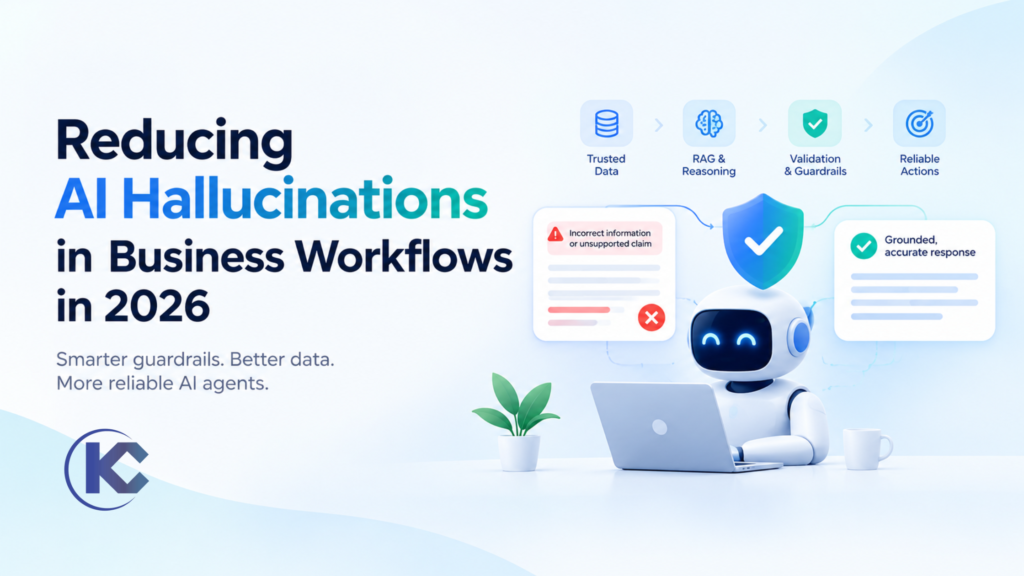
An AI agent hallucination occurs when an LLM-powered agent generates unsupported information, chooses the wrong tool, violates a business rule, or takes an incorrect action with too much confidence. The most reliable approach is not a better prompt alone. Production AI agents need multiple layers of protection around the model.
A practical anti-hallucination architecture combines grounded retrieval, semantic tool routing, multi-agent or rule-based validation, database-driven guardrails, and hard execution controls. Together, these techniques make AI systems more reliable without requiring every decision to be manually reviewed.
01. Ground the agent
Use RAG or Graph-RAG so factual answers come from trusted data instead of model guesses.
02. Control tools
Use semantic routing and validation to reduce incorrect tool selection and execution.
03. Enforce rules
Separate rules the agent may adapt to from constraints it must never bypass.
04. Observe everything
Track tool calls, failures, latency, validation results, and recurring hallucination patterns.
What Are AI Agent Hallucinations?
An AI hallucination happens when an AI system produces information that is false, unsupported, misleading, or impossible to verify while presenting it as reliable. With a conventional chatbot, this might mean inventing a statistic or citation. With an autonomous AI agent, the consequences can be much more serious.
An AI agent can hallucinate by fabricating data, selecting an inappropriate tool, misunderstanding a user request, violating business rules, or taking an action based on incorrect assumptions. Because agents can interact with databases, APIs, payment systems, CRM platforms, and business applications, hallucinated reasoning can become a real operational error.
This is why AI hallucination prevention should be treated as an architecture problem rather than simply a prompt-engineering problem.
Why Do AI Agents Hallucinate?
Large language models generate likely responses from learned patterns. They do not automatically know whether every generated statement is true, current, authorized, or appropriate for a particular business workflow.
Incomplete context
The model lacks the current information required to answer accurately.
Ambiguous instructions
Broad or conflicting instructions can produce unreliable reasoning.
Tool confusion
Agents may select a tool that is semantically related but operationally incorrect.
Missing constraints
The model may not reliably enforce financial, legal, or operational rules on its own.
Building AI that is reliable in production?
Explore practical approaches to AI integration, data foundations, and production-ready enterprise architecture.
5 Production-Ready Techniques to Reduce AI Agent Hallucinations
TECHNIQUE 01
Ground Responses with RAG and Graph-RAG
Retrieval-Augmented Generation (RAG) connects the model to trusted external or internal information before it generates an answer.
For questions involving relationships, counts, aggregations, or connected entities, Graph-RAG can be even more useful. A knowledge graph allows structured queries to calculate results instead of asking an LLM to estimate them.
For example, instead of asking a model to guess how many hotels have a pool, a graph database can execute a query against verified hotel records and return the exact result.
TECHNIQUE 02
Use Semantic Tool Routing
AI agents often have access to many tools. Giving the model every possible function can increase tool-selection errors and unnecessary context.
Semantic tool routing matches an agent’s intended action with the most relevant available tool. Modern gateway and MCP-based architectures can provide this capability without requiring every application to maintain its own custom vector index.
The result is cleaner tool discovery, simpler agent code, and fewer incorrect tool calls.
TECHNIQUE 03
Validate High-Risk Actions
A single agent should not always be trusted to validate its own decisions.
A separate validation layer can check proposed actions against structured data and business rules before execution. This can be implemented with another model, deterministic code, a serverless validation function, or a combination of these approaches.
The important principle is separation: the component proposing an action should not be the only component deciding whether that action is safe.
TECHNIQUE 04
Move Business Rules Into Data
Business rules change. Hardcoding every threshold inside an agent creates unnecessary redeployment cycles.
Instead, rules such as capacity limits, cancellation windows, eligibility requirements, or approval thresholds can be stored in a database and evaluated before sensitive actions.
This creates database-driven AI guardrails that operations teams can update without changing the agent’s core logic.
TECHNIQUE 05
Separate Hard Blocks From Soft Steering
Not every business rule should produce a hard failure.
Hard guardrails should stop actions involving financial, legal, compliance, or security risk. Soft steering can help the agent adjust an operational decision and continue the workflow.
For example, an unpaid booking should never be confirmed. A request for 15 guests when the limit is 10 may instead be corrected to 10 with the user’s knowledge.
Hard Guardrails vs Soft Steering
| Layer | Mechanism | Best For | Can the LLM bypass it? |
|---|---|---|---|
| Hard guardrail | Execution is blocked before the tool runs | Financial, legal, compliance and security constraints | No |
| Soft steer | Agent receives corrective guidance | Capacity, dates, preferences and operational rules | The action can adapt, but policy should still be validated |
| Prompt instruction | System or developer prompt | Style, workflow guidance and communication | Potentially |
What Does a Production Anti-Hallucination Architecture Look Like?
A scalable AI agent architecture separates reasoning from execution controls. A typical production flow looks like this:
User / Application
→
AI Agent
→
Policy & Validation
→
Tool Gateway
→
Serverless Tools / APIs
→
AI Agent
→
Policy & Validation
→
Tool Gateway
→
Serverless Tools / APIs
Knowledge layer
RAG, vector stores, structured databases and knowledge graphs.
Policy layer
Rules, authorization, validation and business constraints.
Execution layer
APIs, Lambda functions, databases and enterprise systems.
Observability
Traces, tool calls, errors, latency, policy violations and outcomes.
How Can Businesses Detect AI Hallucinations?
There is no single hallucination detector that can identify every incorrect AI response. Reliable detection combines technical controls with human and process-based verification.
- Ground important answers in trusted sources. Prefer verified databases, internal systems, official documentation and authoritative references.
- Validate high-impact actions. Check proposed changes before they reach production systems.
- Monitor suspicious patterns. Look for unsupported statistics, nonexistent references, contradictory answers and unusual tool calls.
- Track recurring failures. Hallucination logs can reveal weak prompts, poor retrieval, missing tools or inadequate business rules.
- Keep humans in the loop for high-risk decisions. AI should accelerate judgment, not eliminate accountability.
Moving from AI experiments to governed production?
Follow Kizzy for practical insights on AI architecture, governance, automation, and enterprise AI implementation.
Why AI Hallucinations Are a Business Risk
Hallucinations become significantly more expensive when AI moves from content generation into operational workflows.
Financial Risk
Incorrect pricing, payments, forecasts or transaction decisions can create direct financial exposure.
Compliance Risk
An agent may provide incorrect policy, regulatory or contractual information.
Operational Risk
Incorrect tool calls can modify records, trigger workflows or create downstream errors.
Trust Risk
Repeated inaccurate answers can damage customer confidence and brand credibility.
Prompt Engineering Still Matters, But It Is Not Enough
Well-designed prompts can reduce ambiguity, define acceptable behavior, request citations, and encourage the model to acknowledge uncertainty. However, prompts should not be the only defense for critical workflows.
A useful anti-hallucination prompt can instruct an AI system to:
- Use only the supplied or retrieved information when answering factual questions.
- State clearly when evidence is insufficient.
- Separate verified facts from assumptions or recommendations.
- Ask for clarification when critical information is missing.
- Explain relevant assumptions and decision criteria.
- Identify possible failure modes before executing a high-impact action.
But if an instruction is critical enough that the business cannot tolerate the model ignoring it, enforce it outside the prompt.
How to Implement AI Hallucination Prevention
01. Map AI workflows
Identify where agents retrieve information, call tools, make decisions, and change business data.
02. Classify risk
Separate low-risk informational tasks from financial, legal, security and compliance actions.
03. Ground the model
Connect the agent to authoritative structured and unstructured data.
04. Add guardrails
Implement deterministic validation, authorization and execution controls.
05. Monitor behavior
Track hallucinations, tool selection, validation failures, latency and business outcomes.
06. Continuously evaluate
Test real scenarios, edge cases and adversarial inputs as models and business rules evolve.
The Goal Is Not Zero Hallucinations. It Is Reliable AI.
AI hallucinations cannot be eliminated completely. But organizations can dramatically reduce their impact by designing AI systems where the model is not the only source of truth and is not the final authority for high-risk actions.
The strongest production architecture combines grounded knowledge, semantic tool routing, independent validation, database-driven rules, hard execution controls, observability, and human oversight.
The principle is simple: let AI reason, but do not let AI reasoning alone determine what is allowed to happen. That distinction is what turns an impressive AI demo into a trustworthy enterprise system.
Frequently Asked Questions About AI Hallucinations
Build More Reliable AI
Ready to move from AI experiments to trustworthy production systems?
Kizzy helps businesses design, integrate, govern, and scale AI systems with practical architecture, automation, data foundations, and AI governance.