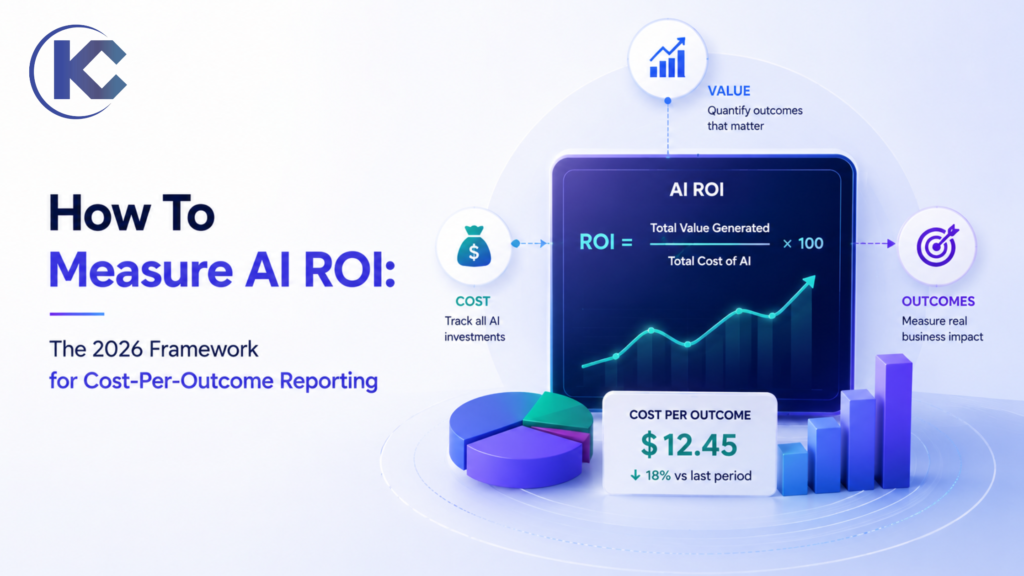
How To Measure AI ROI: The 2026 Framework for Cost-Per-Outcome Reporting
⏱ 4 min read
Most enterprises have not solved AI ROI – they have solved AI purchasing. Licenses are signed, pilots are running, and boards have been briefed, yet 95% of organizations still report zero measurable return. The gap is rarely the model’s capability. It is the absence of a disciplined, per-outcome measurement strategy that links AI cost directly to business value.
This guide explains how to measure AI ROI by comparing business value to AI cost on a per-outcome basis. We cover the core cost metrics engineering, product, and finance teams should track, why the “LLMflation” trap hides rising bills behind falling token prices, a 30-day plan for building a measurement practice, and a six-step business framework – with real enterprise examples – for turning that measurement into a case the board will fund.
By Sanjeet Mahajan – CEO/Founder of Kizzy Consulting
Executive Quick Answer
What is AI ROI and how do you measure it?
AI ROI is the ratio of value generated by an AI system to its total running cost, measured per outcome – per inference, per feature, or per customer – rather than as an aggregate monthly bill. A $200,000 monthly spend is meaningless on its own. If it powers a feature that retains $4 million in revenue, the ROI is strong. If it powers a feature few customers use, the same bill is a loss. You cannot tell the two apart from a spend chart alone – only from cost per outcome.
95%
Share of organizations investing in generative AI that report zero measurable return (MIT Project NANDA, 2025).
2.8x
Average amount AI bills run over the original forecast, as usage scales with adoption in unmodeled ways (Opslyft, 2026).
82%
Reduction in cost per answer – from $0.41 to $0.07 – achieved through model routing and prompt caching (Opslyft, 2026).
Why Most Companies Cannot Measure AI ROI
The gap is not closing on its own. FinOps teams confirm the pattern from the inside: the share of practitioners now managing AI spend jumped to 98% in 2026, up sharply from prior years, yet determining AI value and ROI remains their top unsolved challenge (FinOps Foundation, State of FinOps 2026). One practitioner in that report summed it up bluntly – nobody can yet say whether their AI is actually paying off.
Three structural properties make AI ROI harder to pin down than traditional cloud ROI, and each one breaks a method that used to work:
- Cost is variable and demand-driven: a traditional service costs roughly the same whether one user or a thousand hit it. An LLM feature costs per token, so spend moves with every prompt, retry, and context window.
- Spend is multi-model: one feature may route across several providers and a self-hosted model, each with different pricing and a different waste profile.
- Attribution is missing: most teams cannot say which customer or feature drove a given inference, which turns the value side of the ratio into a guess.
Not sure what your real cost per outcome is?
Kizzy Consulting runs a free 30-minute AI cost audit – we’ll pull your token and inference spend and show you where routing or caching would cut it fastest.
How Do You Calculate AI ROI?
The formula itself is simple. The discipline is in the inputs. Push the standard ROI ratio down to the unit level, and it becomes cost per outcome: the fully loaded AI cost of producing one unit of business value – one answer, one summary, one resolved ticket, one served customer.
Work it in three steps:
- Compute the AI cost of the outcome, including input tokens, output tokens, retries, and any GPU or provisioned-throughput overhead.
- Attribute the value the outcome creates – revenue retained, hours saved, tickets deflected.
- Divide. The result is a cost-per-outcome figure you can trend over time and compare across models.
The Four AI Cost Metrics Worth Tracking
Four metrics carry most of the signal across your organization. Track these and you can answer a CFO, a product lead, and an engineer from the same underlying data.
| Metric | What It Answers | Who Reads It | Action |
|---|---|---|---|
| Cost per inference | Is each model call efficient? | Engineering | Flatten via routing and caching |
| Cost per feature | Does this feature earn its spend? | Product | Cut or re-scope if cost exceeds value retained |
| Cost per customer | Which accounts are margin-negative? | Finance, RevOps | Review pricing on flagged accounts |
| AI gross margin | Is the AI line profitable? | CFO, board | Ensure it rises quarter over quarter |
Related Insight – Salesforce Managed Services: Maximize CRM Performance and ROI
The “LLMflation” Trap: Why Cheaper Tokens Mean Higher Bills
The price of a token is collapsing. For a model of equivalent performance, cost has fallen roughly 10x every year – a benchmark that cost around $60 per million tokens in late 2021 cost about $0.06 by late 2024, a 1,000x reduction in three years (a16z, 2024). Yet total enterprise bills keep climbing.
The reason: cheaper tokens invite far more usage. Context windows grow, agents make multi-step calls, and adoption scales faster than per-unit price falls. Measuring AI success as “we spent less per token” is exactly how teams miss a rising bill. The honest measure is cost per outcome, which holds the unit of business value constant while everything else moves around it.
Turning Measurement Into Better ROI
Measurement is only half the job. A cost-per-outcome number only raises ROI when someone acts on it and then re-measures the same unit. The loop is simple: measure, act, re-measure – run it every billing cycle, not once a year.
The tactics that move the number most are model routing, prompt caching, and batch inference. Prompt caching alone has cut input cost by 75 to 90% on repeated-context workloads in benchmark testing, before any change to the underlying model (Opslyft, 2026). Visibility into the number is not the win – acting on it and reporting the delta is.
Build an AI ROI Practice in 30 Days
You do not need a six-month transformation program. A focused month gets you to a defensible number and your first optimization win:
- Week 1, Instrument: connect AI spend across every model and tag inferences to features. Start with your highest-spend workflow.
- Week 2, Allocate: split shared model cost across features and customers. Accept roughly 70% allocation accuracy now over perfect tagging never.
- Week 3, Baseline: compute cost per inference, per feature, and per customer. Establish your own equivalent of the $0.41 baseline.
- Week 4, Improve & Prove: apply model routing or prompt caching to the top feature, re-measure the exact same unit of value, and report the delta.
A Six-Step Framework for Proving AI Business Impact
The metrics above tell you whether a feature is efficient. The steps below tell you whether the business case holds up in front of a board. Together they cover both sides of the AI ROI equation.
| Step | Focus | Real-World Example |
|---|---|---|
| 1. Align | Tie the initiative to a metric the business already tracks | Delta Air Lines – workforce AI tied to customer experience |
| 2. Model | Quantify ROI across cost, revenue, risk, and decision quality | Microsoft – cut manual supply chain planning roughly in half |
| 3. Baseline | Document current KPIs before deployment | Chobani – roughly 75% reduction in expense processing time |
| 4. Track | Measure before/after KPIs and adoption post-launch | Nestlé – manual expense handling nearly eliminated |
| 5. Include Qualitative | Count retention, talent, and speed gains, not just dollars | Multiple orgs – large productivity gains on routine tasks |
| 6. Loop | Feed outcomes back into the model and the next use case | SA Power Networks – roughly $1M saved in year one |
Frequently Asked Questions
What is a good AI ROI?
There is no universal number, since the “cost” side varies by model mix and the “value” side varies by use case. A more useful bar is trend, not threshold – cost per outcome should be flat or falling as volume grows, and AI gross margin should rise quarter over quarter. A feature is underperforming when its cost per outcome exceeds the value it demonstrably retains or generates.
How do you calculate cost per inference?
Add the input token cost, the output token cost (typically 4 to 5 times the input rate), any retry cost, and a share of infrastructure overhead for that call. Divide by the number of inferences to get a per-call figure you can track over time.
Why can’t most companies measure AI ROI?
Because AI cost is variable and demand-driven, spread across multiple models with different pricing, and rarely attributed cleanly to a specific customer or feature. Without that attribution, the value side of the ROI ratio is a guess rather than a number.
What is the difference between AI cost and AI ROI?
AI cost is the bill – what you spent running models. AI ROI is that bill measured against the value it produced, at the level of a single outcome. A rising AI cost is not automatically bad news, and a falling one is not automatically good news, until you know what it produced.