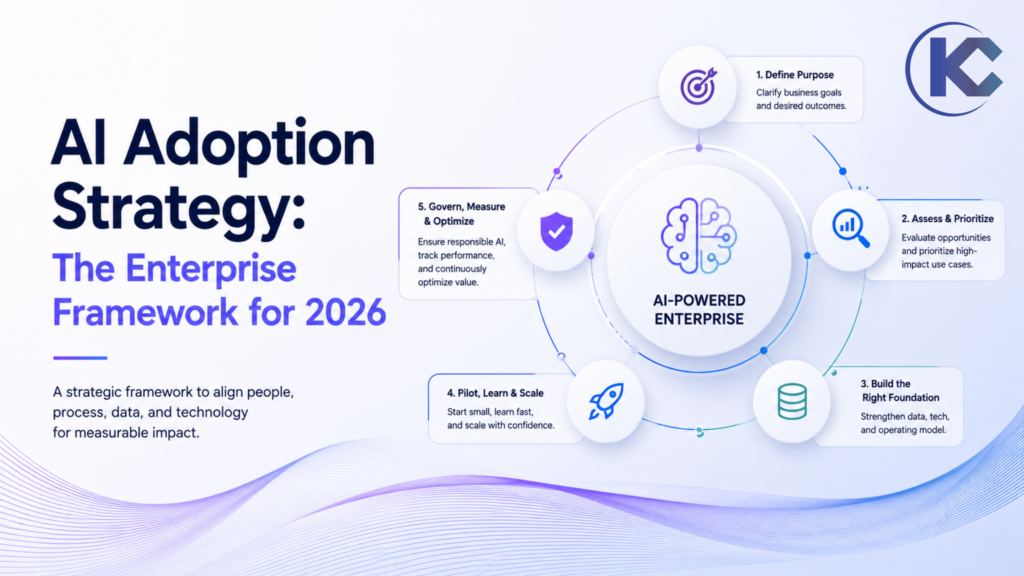
AI Adoption Strategy: The Enterprise Framework for 2026
⏱ 4 min read
Most enterprises have not solved AI adoption – they have solved AI purchasing. Licenses are signed, pilots are running, and boards have been briefed, yet the line on the P&L that AI was supposed to move stays flat. The gap is rarely the model. It is the absence of a disciplined AI adoption strategy that aligns business outcomes, data readiness, governance, and workforce capability before technology is scaled.
This guide gives an original, enterprise-grade framework for enterprise AI adoption – covering readiness assessment, use case prioritization, change management, governance, operating model design, and the KPI systems that separate organizations compounding AI value from those stuck in permanent pilot mode.
By Sanjeet Mahajan, Founder & CEO, Kizzy Consulting – AI Expert
Executive Quick Answer
What is an effective AI adoption strategy?
70/30
The effort split BCG identifies among AI pacesetters: ~70% on people and process, only 30% on algorithms and technology – nearly the inverse of most enterprise AI budgets.
6%
Share of organizations McKinsey classifies as AI high performers – those attributing over 20% of EBIT to AI use.
70-85%
Estimated share of enterprise AI pilots that never reach production, usually from weak data, unclear ownership, or absent change management.
Why AI Adoption Is Still Failing in Many Organizations
Consultant Recommendation
Before approving another AI pilot, ask your team to name the specific job the workflow is trying to accomplish, the quality standard it must hit, and what currently happens when it goes wrong. If nobody can answer clearly in under two minutes, the initiative is not ready to be redesigned around AI – it needs a discovery pass first.
None of this means the technology investments already made were wasted. It means the next dollar needs to go somewhere different: toward the readiness, governance, and change management work that turns a working model into an adopted one.
Current Enterprise AI Adoption Landscape
Enterprise AI adoption in 2026 is at a turning point. Most enterprises have tested generative AI, but far fewer have deployed it at scale with proper governance. Early adopters continue to pull ahead by building reusable AI capabilities.
Three trends define the market:
- Business-led adoption: AI budgets are shifting from IT to business teams that own operational KPIs.
- Governance by default: Compliance, security, and risk management are now essential before AI reaches production.
- Workflow-driven AI: Organizations are embedding AI into business processes, not just providing standalone tools, requiring new skills and operating models.
What AI Adoption Really Means
AI adoption is the sustained, measured integration of AI capability into how an organization actually operates – not the number of licenses purchased. A model employees route around in daily practice has been installed, not adopted.
Adoption vs. Implementation
Implementation is connecting a model to data and interfaces. Adoption is the outcome of people relying on it and the business measurably benefiting. Flawless engineering can still fail to adopt if the workflow around it was never redesigned.
Experimentation vs. Transformation
Experimentation is a bounded, low-stakes proof of concept. Transformation is redesigning a core process around AI and retraining the people who own it. Most organizations stay stuck in experimentation because nobody graduates a pilot into a funded, governed initiative.
The Enterprise AI Adoption Framework
1. Business Strategy Alignment
Every initiative traces to a named business outcome with a baseline metric captured before deployment.
2. Executive Sponsorship
A named sponsor removes cross-functional blockers and signals strategic priority, not an IT experiment.
3. Data Readiness
Readiness means discoverable, governed data – not perfectly clean data.
4. AI Governance
Access controls, monitoring, audit trails, and an escalation path before AI touches production data.
5. Technology Foundation
Orchestration and API-first integration prevent every use case from needing a bespoke build.
6. People & Change Management
Training and embedded AI champions determine whether employees actually use what was built.
7. AI Operating Model
A steering committee and Center of Excellence define who approves and owns each use case.
8. Continuous Measurement & Optimization
Fixed-cadence KPI review, with weak use cases retired rather than left running on inertia.
The AI Adoption Roadmap: From Assessment to Continuous Optimization
A phased roadmap manages risk while validating returns. Skipping the readiness assessment, or jumping straight from pilot to full deployment, is why promising initiatives stall in year one.
1. Business Assessment
↓
2. AI Readiness Assessment
↓
3. Use Case Prioritization
↓
4. Pilot Selection
↓
5. Governance Setup
↓
6. AI Development
↓
7. Testing
↓
8. Deployment
↓
9. User Adoption
↓
10. Continuous Optimization
AI Use Case Prioritization Matrix
The best demos are rarely the best candidates. Score every use case 1–5 across six dimensions before committing engineering time.
Designing the AI Operating Model
An operating model gives AI adoption a permanent home in the organization instead of leaving each initiative to reinvent its own approval process. Most enterprises converge on a three-tier structure.
Executive Steering Committee
↓
AI Center of Excellence (Governance, Platform, MLOps)
↓
Business Units
IT
Security
Legal
Data Teams
Operations
Where Enterprise AI Adoption Is Headed
As foundation models continue to commoditize, the competitive gap between enterprises will widen along a different axis entirely: how quickly an organization can turn a working model into a governed, adopted, measurable part of its operating model. Standardized protocols for connecting AI systems to internal data, referenced by consultancies including McKinsey and Gartner, will reduce the technical friction of integration further – which only raises the relative importance of the organizational work this guide has focused on.
Frequently Asked Questions about AI Adoption:
What is an AI adoption strategy?
An AI adoption strategy is a structured plan that aligns AI investment with business outcomes, sequences readiness across data, technology, and governance, and builds the workforce capability needed for AI to actually be used, trusted, and measured in daily operations.
Why do most enterprise AI pilots fail to scale?
Most pilots fail to scale because organizations underinvest in the people, process, and governance work required for adoption, treating AI as a technology rollout rather than an organizational transformation that happens to be enabled by technology.
What is the difference between AI adoption and AI implementation?
Implementation is the technical act of connecting a model to data and interfaces. Adoption is the organizational outcome of employees actually relying on that model’s output and the business measurably benefiting as a result.
What are the key pillars of an enterprise AI adoption framework?
Business strategy alignment, executive sponsorship, data readiness, AI governance, technology foundation, people and change management, an AI operating model, and continuous measurement and optimization.
How should enterprises prioritize AI use cases?
Score each candidate use case against business value, technical complexity, data availability, adoption readiness, risk level, and expected ROI timeline, then sequence high-value, high-feasibility use cases first.
Why is change management so important to AI adoption?
Because AI adoption is fundamentally about employees changing how they work. Without training, communication, and embedded champions addressing legitimate concerns, even a technically excellent AI system goes unused.
What does AI readiness actually mean?
AI readiness means data is discoverable and governed, technical infrastructure supports API-based integration, the workforce has baseline AI literacy, and governance structures exist before deployment begins – not that every system is already perfect.
Conclusion: Building an AI Adoption Strategy That Compounds
Enterprise AI success isn’t determined by the best AI model, but by strong readiness, governance, and workforce adoption. This framework provides a structured approach to scaling AI through eight pillars, a phased roadmap, prioritization, and measurable KPIs.
Organizations that treat AI as a business transformation, not just a technology purchase, are the ones that achieve lasting ROI. Others remain stuck in the pilot stage.