FDE vs Solutions Engineer: Roles, Responsibilities and When to Hire
⏱ 5 min read
AI DELIVERY · TEAM STRUCTURE · 2026
Forward deployed engineer vs solutions engineer is a staffing decision, not just a title debate. This guide helps CTOs and engineering leaders decide who should deliver an AI project, while helping professionals understand the differences between these career paths.
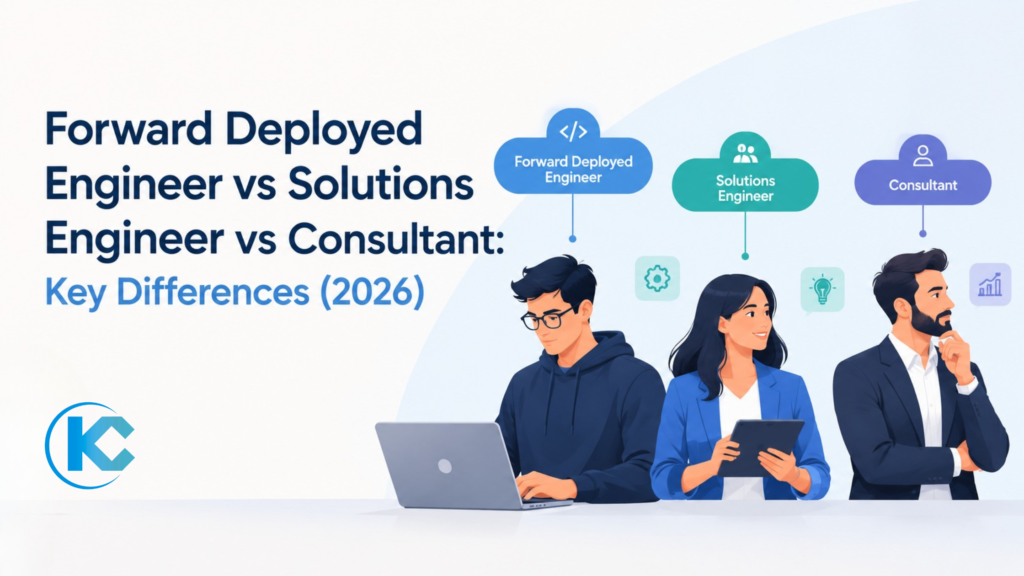
A solutions engineer validates technical fit. A consultant helps define the business problem. A forward deployed engineer (FDE) builds and deploys the solution in the customer’s environment, with production ownership at the center of the role.
SM
THE QUICK ANSWER
The difference comes down to the work and the outcome owned. A forward deployed engineer builds, integrates and deploys production software. A solutions engineer usually validates technical fit during the sales process through discovery, demonstrations and proofs of concept. A consultant diagnoses a business problem and recommends a path forward. A solutions architect designs the target system, while staff augmentation adds engineering capacity to a team that retains delivery ownership.
How the Five Roles Compare
The most useful comparison is the deliverable, not the job title. An FDE is typically responsible for getting a solution into production. A solutions engineer validates whether a product can meet a customer’s needs. A consultant provides analysis and recommendations, a solutions architect defines the technical design, and a staff-augmentation engineer adds capacity under an existing delivery structure.
| Criteria | Forward Deployed Engineer | Solutions Engineer | Consultant | Solutions Architect | Staff Augmentation |
|---|---|---|---|---|---|
| Primary purpose | Deliver a working solution in the customer’s environment | Validate product fit and technical feasibility | Clarify the problem and recommend a course of action | Design the system and technical approach | Increase available engineering capacity |
| Typical phase | Implementation, integration and production rollout | Evaluation, discovery and pre-sales | Discovery, diagnosis and planning | Architecture and technical planning | Any delivery phase where extra capacity is needed |
| Production coding | Usually a core responsibility | Usually focused on demos, prototypes and validation | Depends on the engagement; often not the main deliverable | May review or prototype; implementation varies | Usually codes to the team’s assigned backlog |
| Typical deliverable | Deployed integration, application or AI workflow | Technical demonstration or proof of concept | Assessment, business case or roadmap | Architecture, design decisions and implementation guidance | Completed tasks within the agreed team plan |
| Ownership model | May own delivery through production; confirm the agreed scope | Technical validation and pre-sales support | Quality of analysis and recommendations | Quality and viability of the architecture | Client retains prioritization and overall outcome ownership |
| Hire when | The direction is clear, but production delivery needs an owner | You need to validate a product before committing | The business problem or investment case is unclear | You need a target architecture or design decisions | Your team can manage delivery but lacks capacity |
These are typical patterns, not universal job descriptions. Responsibilities overlap by company and engagement. Confirm production ownership, handoff expectations, acceptance criteria and post-launch support in the statement of work.
Is Your Business Ready for AI?
Assess your data, infrastructure, workflows and use cases before choosing the implementation approach. An AI readiness assessment can help identify dependencies and decide what should be tested first.
Code, Scope and Production Ownership
The practical difference becomes clearer after a demonstration or proof of concept. Who connects the system to live data? Who handles authentication, permissions, edge cases, monitoring and user acceptance testing? Who is responsible for getting the workflow adopted? Those questions reveal whether you need delivery engineering, technical validation, architecture, advisory work or extra capacity.
Who Writes Production Code?
An FDE commonly writes production code, builds integrations, works with APIs and data pipelines, and debugs behavior against real enterprise systems. A solutions engineer often builds demonstrations, scripts or prototypes to establish feasibility. A solutions architect focuses on system design and technical decisions; depending on the organization, the architect may also contribute code or oversee implementation.
These boundaries are not absolute. Some solutions engineers write substantial code, and some FDEs spend considerable time on discovery and architecture. The key question is what the role is expected to deliver and who owns the production result.
Consultant vs FDE: Advice or Implementation?
A consultant helps an organization understand a problem, compare options, establish a business case and decide what to do. A strong consulting engagement can include detailed process analysis, risk assessment, architecture recommendations and an implementation roadmap. Some consulting engagements also include hands-on delivery, so the contract should specify where advisory work ends and implementation begins.
An FDE is useful when the direction is sufficiently clear and the remaining challenge is making the solution work within the customer’s actual environment. That can include adapting an application to legacy systems, integrating enterprise data, adding security controls, evaluating AI output and resolving operational issues that a prototype did not expose.
Solutions Architect vs FDE: Design vs Delivery
A solutions architect defines how components should fit together, including integrations, security, scalability, reliability and technology choices. An FDE may use that architecture as a starting point, then implement and adapt it as real-world constraints emerge. In smaller teams, one person may cover both functions. In larger programs, separating architecture and implementation can provide clearer technical oversight.
Where the FDE Role Came From
The forward-deployed engineering model is closely associated with Palantir, where engineers worked directly with customers to solve complex operational problems in their environments. The approach became more visible across enterprise software and AI as organizations needed engineers who could bridge the gap between general-purpose technology and customer-specific systems.
DELIVERY EXAMPLE
What an FDE Delivery Can Look Like in Eight Weeks
The following is an illustrative engagement pattern, not a verified Kizzy client case study. Actual timelines depend on data access, integration complexity, security reviews, stakeholder availability and the number of systems involved.
Weeks 1-2
Discovery and access
Map the workflow, confirm success measures, review data and access requirements, and agree on a production acceptance plan.
Weeks 3-4
Build the workflow
Implement the core integration or AI workflow, connect the required systems and test representative data and failure cases.
Weeks 5-6
Validate and harden
Run user acceptance tests, resolve defects, add appropriate logging and monitoring, and validate security and permissions.
Weeks 7-8
Deploy and hand over
Roll out to the agreed users or workflow, document operational procedures, train stakeholders and review agreed acceptance measures.
What should be measured? Define baseline and target values before work begins. Depending on the project, these might include task completion rate, processing time, integration error rate, adoption, manual-review rate or the percentage of workflows successfully completed without intervention. Do not report improvements until they have been measured against a documented baseline.
When to Hire Each Role
Match the role to the stage of the project rather than choosing based on the popularity of a job title.
- Choose a consultant if the problem is unclear, leadership needs a business case, or you need an independent assessment of vendors and options. Kizzy’s AI strategy and advisory services address this stage.
- Choose a solutions engineer if you are evaluating a product and need a technical demonstration or proof of concept before making a commitment.
- Choose a solutions architect if the project needs a coherent technical design, integration decisions, security boundaries or a scalable target architecture.
- Choose an FDE if the problem and direction are understood, but you need an engineer to integrate, build, test and deploy the solution into your real operating environment. For an early feasibility test, consider an AI proof of concept or MVP first.
- Choose staff augmentation if your team already owns the roadmap and technical decisions but needs additional engineering capacity to execute the backlog.
Related Read
Explore the FDE role in more depth, including core skills, implementation responsibilities and a practical career roadmap.
FDE Salary and Market Context
Compensation depends on location, seniority, technical depth, industry and how much customer-facing responsibility the role carries. US salary data should not be treated as a benchmark for India or another market without adjusting for location and employer type.
As one dated US benchmark, Indeed’s US Forward Deployed Engineer salary page reported an average base salary of $178,483 per year, updated October 19, 2026, based on salary information from job postings over the previous 36 months. This is a platform-reported average, not a guaranteed offer or a universal market rate.
For a broader discussion of FDE skills and career development, see Kizzy’s Forward Deployed Engineer guide. Hiring teams should compare current local postings and define the expected level of production ownership before setting a compensation band.
Common Hiring Mistakes
One frequent mistake is buying a demo or a strategy document when the project actually needs an owner for production implementation. MIT NANDA’s 2025 report, The GenAI Divide: State of AI in Business 2025, reported that 95% of organizations in its analysis were getting no measurable return from their GenAI pilots. This finding is specific to that study’s scope and methodology; it should not be read as a universal failure rate for every enterprise AI project.
- Hiring a solutions engineer to own the entire rollout. The role may support validation and prototypes, but production implementation needs explicit ownership.
- Paying for strategy when the next step is already clear. If the business case and solution direction are established, focus the engagement on implementation and acceptance criteria.
- Calling staff augmentation an FDE engagement. Additional engineers can increase capacity, but capacity alone does not transfer responsibility for the end result.
- Confusing architecture with implementation. A good design is important, but the project still needs a plan for coding, integration, testing, deployment and operational support.
- Skipping data and access checks. Confirm permissions, system access, data quality, security reviews and stakeholder availability before setting a production deadline. Kizzy’s AI integration and implementation services cover implementation considerations.
An FDE is not always the best option. If requirements are stable and the work is standard configuration, a fixed-scope implementation team may be more efficient. Choose the delivery model that fits the uncertainty, technical complexity and ownership your project actually needs.
Frequently Asked Questions
Key Takeaways
- An FDE typically builds and deploys production software; a solutions engineer commonly validates technical fit.
- Consultants clarify business problems, solutions architects design technical systems, and staff augmentation adds capacity.
- The titles can overlap, so define deliverables, production ownership, acceptance criteria and support responsibilities in advance.
- Before setting an AI delivery deadline, verify data access, integration dependencies, security requirements and stakeholder availability.
If your AI project has a clear direction but still needs production implementation, explore Kizzy’s Forward Deployed Engineer services.
Not Sure Which Delivery Role Your AI Project Needs?
Tell us where your project stands, what is already built and what needs to reach production. Kizzy Consulting can help you assess the next implementation step.
Sources and Further Reading