Forward Deployed Engineer (FDE) Guide 2026: Roadmap, Tech Stack, Skills and Salary
⏱ 8 min read
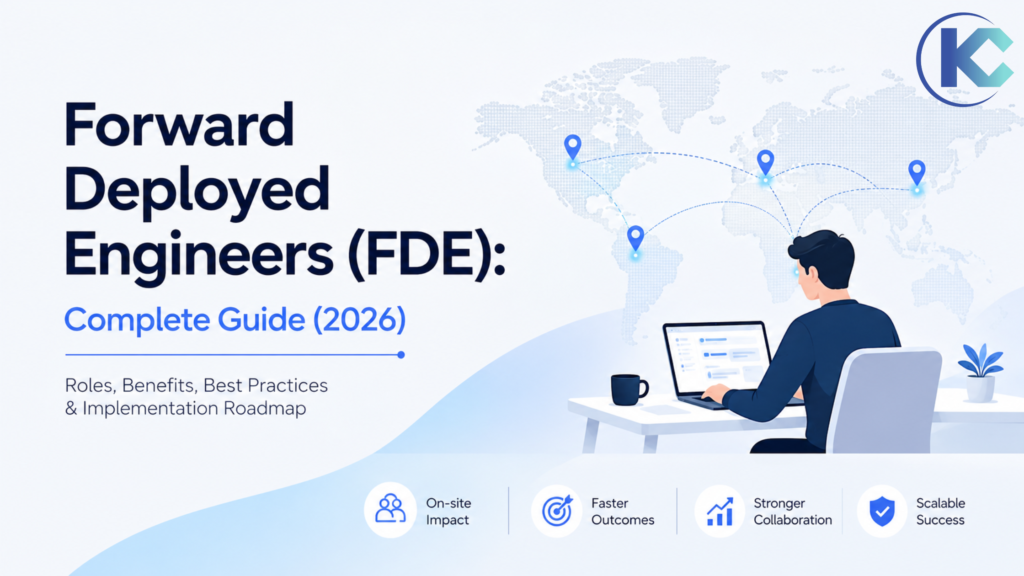
Forward Deployed Engineers (FDE) are transforming enterprise software integration. Instead of passing software over the wall, a Forward Deployed Engineer embeds directly with the customer to solve complex, high-stakes business problems using the company’s core technology. This hybrid role combines deep full-stack engineering, architecture design, and client-facing consulting. As businesses rapidly adopt advanced Generative AI, Agentic AI workflows, and enterprise SaaS, the demand for a Forward Deployed AI Engineer has skyrocketed. This guide covers the FDE roadmap, tech stack, skills, salary and how FDE engagements work, for engineers planning the career and for CTOs, CIOs and enterprise leaders hiring for it.
Quick Answer
A forward deployed engineer (FDE) is a software engineer who embeds with a customer to build, integrate and deploy a platform or AI system inside the customer’s environment, writing production code and owning the outcome. The FDE roadmap runs from engineering foundations through cloud, integration, AI and agentic engineering to enterprise delivery and customer leadership.
Contents
hide
Need an FDE Team for Your AI Rollout?
Get an experienced engineering team embedded with your business to move from AI strategy to production. Skip the learning curve and accelerate time-to-value.

$220K
median US total compensation for forward deployed engineers
7 stages
in the FDE roadmap below
90 days:
typical first Kizzy FDE engagement from discovery to production
Source: 2026 Tech Hiring & AI Enterprise Integration Trends
What Does ‘Forward Deployed’ Mean?
The term Forward Deployed Engineer (FDE) originated from military terminology, where personnel are stationed at the edge of operations. In enterprise technology, “forward deployed” means embedding the engineer directly into the client’s operational environment.
The Palantir Origin Story
Palantir Technologies popularized the FDE role. They discovered that highly complex software platforms (like Gotham and Foundry) could not just be sold as self-service SaaS. They required an elite class of engineers who could parachute into government agencies, untangle legacy data silos, and write custom integration code on the spot.
Today, AI companies such as OpenAI, Anthropic and Databricks hire forward deployed engineers to adapt foundation models and data platforms to enterprise data and workflows.
Accelerate AI with Kizzy Consulting’s FDE Engagement
Don’t let complex integrations stall your enterprise digital transformation. Kizzy Consulting provides elite Forward Deployed Engineers who integrate directly with your in-house teams to turn AI strategy into production-grade reality.
120+
Projects Delivered
85+
AI Agents Built
98%
Client Satisfaction
How Our FDE Engagement Works:
- 1. Discover: We understand your business, technology, and AI goals.
- 2. Plan: We define priorities and create a 90-day delivery plan.
- 3. Embed: Kizzy engineers work seamlessly alongside your existing internal tech teams.
- 4. Build: We develop, integrate, and test the AI solution inside your native tech stack (Salesforce, AWS, Snowflake).
- 5. Scale: We move successful solutions into production with ongoing iterative engineering support.\
See how an engagement runs on our forward deployed engineer services page, talk to our FDE consultants about your rollout, or compare roles in FDE vs solutions engineer vs consultant.
Forward Deployed Engineer Roadmap: 7 Stages to Become an FDE (2026)
If you are searching for a forward deployed engineer roadmap, FDE roadmap, FDE engineer roadmap, or a roadmap to become a Forward Deployed Engineer, the most useful approach is to build capabilities in layers rather than trying to learn every technology at once.
FDEs need enough technical depth to build and deploy production systems, but they also need enough business and communication skill to understand ambiguous customer requirements. The forward deployed engineer roadmap has seven stages. Build them in layers: each stage adds a capability you will use on customer deployments, and the later stages only work once the earlier ones are solid. The table shows what to learn at each stage and what you should be able to do afterward.
| Roadmap Stage | What to Learn | What You Should Be Able to Do |
|---|---|---|
| 1. Engineering Foundations | Python, TypeScript, Git, Linux, HTTP, APIs, SQL | Build applications, debug issues, work with APIs and databases |
| 2. Systems & Cloud | AWS, Azure, GCP, Docker, Kubernetes, networking, CI/CD | Deploy and operate applications reliably |
| 3. Data & Integration | REST APIs, webhooks, OAuth, ETL, databases, data warehouses | Connect enterprise systems and move data securely |
| 4. AI Engineering | LLMs, embeddings, RAG, vector databases, evaluation | Build reliable AI applications around live business data |
| 5. Agentic AI | AI agents, tools, memory, MCP, orchestration, guardrails | Build AI systems capable of executing business workflows |
| 6. Enterprise Delivery | Security, architecture, compliance, UAT, observability | Move solutions from prototype to production |
| 7. Customer Leadership | Discovery, communication, presentations, documentation | Translate business problems into technical solutions |
Which Roadmap Stage Should You Start From?
- Software engineers:stage 1 is likely covered. Start at stage 2 or 3 and spend most of your time on integration, AI engineering and customer leadership.
- Solutions or sales engineers:you already have customer leadership. Close the gap on production code, cloud deployment and observability (stages 1, 2 and 6). Our comparison of FDE vs solutions engineer vs consultant shows how the scope changes.
- Data engineers:stages 3 and 4 will feel familiar. Focus on agentic AI, enterprise delivery and customer-facing skills.
- Consultants:you know discovery and stakeholders. Invest in stages 1–2 and 4–6 so you can ship and own production code.
The 45-Day FDE Roadmap (If You Already Code)
A 45-day plan cannot turn a beginner into a senior FDE overnight, but it can create a structured foundation for someone who already has software or technical experience.
Days 1-10
Strengthen Python or TypeScript, Git, APIs, SQL, Linux and debugging.
Days 11-20
Build integrations using REST APIs, OAuth, webhooks, databases and cloud services.
Days 21-30
Build an LLM application using RAG, embeddings, vector search and evaluation.
Days 31-40
Add agents, tools, MCP, observability, security and production deployment.
Days 41-45
Create a portfolio case study showing the problem, architecture, implementation and business outcome.
Forward Deployed Engineer Salary (2026)
On Levels.fyi, the median self-reported US total compensation for a forward deployed engineer is $220,000: 25th percentile $175,000, 75th percentile $300,000, 90th percentile $362,000 (updated 19 October 2026). Total compensation includes base salary, annualized stock and bonus, so the base ranges posted in job ads are usually lower.
Pay depends on the employer, the level, the location and the equity mix. Compare offers on total compensation, not base salary alone.
FDE Tech Stack: Tools by Layer (2026)
The Forward Deployed Engineer tech stack is broad because FDEs operate across the application, infrastructure, integration, data and AI layers. There is no single mandatory FDE tech stack. Strong FDEs learn transferable engineering concepts first and then adapt to the customer’s environment.
Common searches such as FDE tech stack, forward deployed engineer tools, what tools do FDEs use and FDE framework all point toward the same principle: the best tool is the one that solves the customer’s production problem reliably.
| Layer | Examples | Why It Matters |
|---|---|---|
| Languages | Python, TypeScript, JavaScript, Java, Go | Application and integration development |
| APIs | REST, GraphQL, webhooks | Connect enterprise systems |
| Cloud | AWS, Azure, Google Cloud | Infrastructure and deployment |
| Containers | Docker, Kubernetes | Portable application deployment |
| Data | PostgreSQL, MySQL, MongoDB, warehouses | Business data access and transformation |
| AI | LLMs, embeddings, RAG, vector databases | Enterprise AI applications |
| Orchestration | LangChain, LangGraph and agent frameworks | Multi-step AI workflows |
| Agents | Tool calling, agent runtimes, MCP | AI-driven task execution |
| Operations | CI/CD, logging, tracing, monitoring | Production reliability |
Forward Deployed Engineer Architecture
An FDE doesn’t just write scripts; they design the holistic system architecture bridging the vendor platform and the client’s network.
Client-Side Architecture Responsibilities
- Discovery & Knowledge Acquisition: Mapping out the client’s legacy systems, DB schemas, and security postures.
- System Design: Planning microservices, API gateways, and load balancing configurations.
- Data Pipelines: Constructing ETL (Extract, Transform, Load) pipelines to feed vector databases.
- Governance & Security: Implementing RBAC (Role-Based Access Control) and ensuring SOC2/HIPAA compliance during model inference.
- Continuous Feedback Loop: Passing architectural constraints back to the core R&D product team to improve the base platform.
The FDE Framework: Forward Deployed Engineering Lifecycle
The FDE framework is the six-step lifecycle most forward deployed engagements follow: discovery and scope, architecture and design, hands-on implementation, validation and deployment, monitoring and iteration, and scaling with handover.
1. Discovery & Scope
Identifying the core business problem, mapping data sources, and defining the MVP (Minimum Viable Product).
2. Architecture & Design
Drafting technical specifications, API contracts, and securing InfoSec approval from the client’s CISO.
3. Hands-On Implementation
Writing the integration code, setting up infrastructure (Docker/Kubernetes), and configuring data ingestion.
4. Validation & Deployment
Running UAT (User Acceptance Testing), load testing AI inference limits, and pushing to production environments.
5. Monitoring & Iteration
Tracking AI observability metrics (latency, token costs, hallucination rates) and tuning prompts dynamically.
6. Scaling & Support
Handing over operational playbooks to the client’s internal platform engineering team for long-term support.
Forward Deployed AI Engineer Workflow
A day in the life of an FDE involves extreme context switching between highly technical implementation and business consulting.
Daily & Weekly Workflow Mechanics
- Morning (Client Syncs): Standups with the client’s data engineers to unblock access to Snowflake or an on-prem Oracle DB.
- Mid-Day (Core Coding): Writing Python integration scripts, designing LangChain prompt templates, and adjusting embeddings.
- Afternoon (Testing & Optimization): Evaluating Agentic AI traces using tools like LangFuse or Phoenix to squash reasoning loop errors.
- Weekly (Stakeholder Alignment): Presenting an executive summary to the CIO demonstrating how the deployed AI solution moved the agreed KPI.
Forward Deployed Engineer Skills and Technical Requirements
The defining characteristic of an FDE is breadth. A strong FDE does not necessarily need to be the world’s best specialist in every technology. Instead, the engineer needs enough depth to make decisions, build working systems, debug failures and collaborate with specialists when deeper expertise is required.
Core Technical Skills
- Software engineering fundamentals
- API development and integration
- SQL and data handling
- Cloud infrastructure
- System design
- Authentication and authorization
- CI/CD and deployment
- Debugging and troubleshooting
- Observability and monitoring
AI Engineering Skills
- LLM APIs and model selection
- Prompt engineering
- Retrieval-augmented generation
- AI evaluation
- Agentic workflows
- Guardrails and security
- AI observability
Customer-Facing Skills
- Technical discovery
- Executive communication
- Technical presentations
- Problem decomposition
- Managing ambiguity
- Documentation
- Stakeholder management
FDE vs Solutions Architect vs Other Engineering Roles
For a deeper comparison of scope, code ownership and when to hire each, read forward deployed engineer vs solutions engineer vs consultant.
Forward Deployed Engineers in Agentic AI
The paradigm shift from predictive AI to Agentic AI is the number one driver for FDE demand today. Unlike traditional chat interfaces, AI Agents possess autonomy: they execute plans, utilize memory, reason through obstacles, and use external tools.
Orchestrating the Agentic Enterprise
- Agent Orchestration: FDEs use frameworks like LangGraph or Semantic Kernel to build multi-agent systems where a “Planner Agent” delegates tasks to “Research Agents” and “Execution Agents.”
- Tool Use & Autonomous Execution: Configuring APIs so current frontier models from the Claude, GPT and Gemini families can securely perform write actions (e.g., updating a Salesforce record via Agentforce).
- Memory Systems: Implementing Checkpointing to give agents short-term conversational memory, and integrating vector stores for long-term semantic memory.
Forward Deployed Engineers and Agentic RAG
Retrieval-Augmented Generation (RAG) is the backbone of Enterprise AI. However, standard RAG fails at complex, multi-hop reasoning. FDEs are tasked with architecting Agentic RAG pipelines.
Agentic vs Traditional RAG
- Traditional RAG: Retrieve top-k documents > Pass to LLM > Generate output. (Prone to hallucinations if context is missing).
- Agentic RAG: Retrieve > Evaluate Relevance > If irrelevant, rewrite query > Search again > Extract > Synthesize. It is self-correcting. Go deeper in agentic RAG explained.
- Graph RAG: FDEs integrate Knowledge Graphs (like Neo4j) to help LLMs understand hard entity relationships, preventing the semantic overlap failures common in pure vector search.
The FDE’s job in building an AI Knowledge Base Agent involves mastering advanced chunking strategies, choosing the right embedding models (like Cohere or text-embedding-3), and implementing re-ranking (Cross-Encoders) to optimize LLM context windows.
Looking for FDE Engineers for Your AI Projects?
Before you bring in an FDE team, understand exactly what your AI initiative needs to succeed. Our AI Readiness Assessment evaluates your data, infrastructure, workflows, and AI use cases – so you know where expert engineering support can make the biggest impact.
Model Context Protocol (MCP) for FDEs
The Model Context Protocol (MCP), pioneered by Anthropic, is fundamentally changing how FDEs connect LLMs to enterprise data sources.
Why MCP Matters for Deployments
Historically, integrating an AI assistant into a client’s Slack, GitHub, and Postgres databases required writing brittle, custom API wrappers. MCP standardizes this architecture:
- MCP Server: Lightweight services that expose internal Resources, Prompts, and Tools in a to “standard JSON-RPC format over stdio or Streamable HTTP. Compare MCP with agent-to-agent protocols in MCP vs A2A.
- Security & Authentication: FDEs use MCP to keep sensitive data on the client’s network. The AI (Client) simply negotiates with the MCP Server, respecting the enterprise’s existing access controls.
- Ecosystem: FDEs rapidly deploy open-source GitHub MCP servers for LangChain, Gemini, and Claude, collapsing integration timelines from months to days.
Checkout – Context Engineering vs Prompt Engineering
Mastering LangChain and LangGraph
Any AI Implementation Engineer must master the LangChain ecosystem to orchestrate modern LLM logic.
LangChain (The Primitives)
- LCEL (LangChain Expression Language): Declarative way to chain components (Prompt > Model > Output Parser).
- Retrievers: Interfaces that connect vector databases into chains.
- Tools: Python functions that the LLM is given permission to execute dynamically.
LangGraph (The Orchestrator)
- State Graph: Treating the AI workflow as a state machine with Nodes and Edges.
- Human in the Loop (HITL): Adding Interrupts so a human must approve a tool execution before the agent proceeds.
- Persistence: Built-in SQLite/Postgres checkpointing for durable AI memory management.
Enterprise Knowledge Base Integration
FDEs do not just connect to clean databases; they tame unstructured corporate chaos. A Document Analysis Agent requires robust ingestion pipelines connecting SharePoint, Confluence, Salesforce, and Google Drive.
Best Practice: Ensure deep metadata tagging during document ingestion. Without accurate timestamps and authorship metadata attached to document chunks, your LLM will retrieve outdated compliance policies and confidently present them as current facts.
AI Frameworks Comparison for Deployments
Open Source AI & Orchestration
High-security clients (defense, healthcare) cannot send data to OpenAI APIs. An FDE must know how to self-host such as Llama, Mistral or Qwen models) using inference engines like vLLM or Ollama, unified behind an API gateway like LiteLLM.
Workflow Orchestration ensures these models operate reliably. FDEs implement retry logic for rate limits, fallback models if a primary model goes down, and use LangFuse or Phoenix for step-by-step LLMOps evaluation to trace every decision an autonomous agent makes.
Hiring FDEs? What a 90-Day Engagement Looks Like
A typical Kizzy FDE engagement moves from discovery and architecture to a production deployment in about 90 days, followed by iterative improvement or managed support. See the phase-by-phase plan on our forward deployed engineer services page, or explore FDE as a service for ongoing AI delivery.
Forward Deployed Engineer GitHub Portfolio: What Should You Build?
If you search for forward deployed engineer GitHub, forward deployed engineer roadmap GitHub or FDE projects, the most valuable portfolio is not a collection of toy applications. It should demonstrate that you can solve an end-to-end business problem.
Project 1: Enterprise RAG Application
Build a document search and question-answering system with ingestion, retrieval, citations, evaluation and access control.
Project 2: AI Agent
Build an agent that can use multiple tools, call APIs, maintain workflow state and handle failures safely.
Project 3: Enterprise API Integration
Connect two applications through authenticated APIs and demonstrate retries, error handling, logging and data validation.
Project 4: Production AI Deployment
Deploy an AI application using Docker and cloud infrastructure, then add monitoring and basic evaluation.
Project 5: Business Workflow Automation
Choose a real business workflow and show the before-and-after process, technical architecture and measurable outcome.
What recruiters should see:
architecture decisions, production code, integrations, deployment, documentation, tests, failure handling and a clear explanation of the business problem.
architecture decisions, production code, integrations, deployment, documentation, tests, failure handling and a clear explanation of the business problem.
Forward Deployed Engineer Career Opportunities
FDE roles are appearing across enterprise software, AI, cloud, data and cybersecurity companies. The role is particularly relevant where customers need significant implementation work before a platform can deliver value.
The growth of enterprise AI is also increasing the need for engineers who can bridge AI capabilities and customer environments. This is especially important in markets such as the United States and India, where enterprise AI adoption and production deployment are expanding.
Depending on the company, FDE work can be remote, hybrid, customer-site or travel-heavy. The exact working model should therefore be evaluated from the individual job description rather than assumed from the title.
On Levels.fyi, the median self-reported US total compensation for a forward deployed engineer is $220,000: 25th percentile $175,000, 75th percentile $300,000, 90th percentile $362,000 (updated 19 October 2026). Total compensation includes base salary, annualized stock and bonus, so the base ranges posted in job ads are usually lower.
Pay depends on the employer, the level, the location and the equity mix. Compare offers on total compensation, not base salary alone.
Tools Comparison Matrix
FDEs must rapidly select the right vendors based on the client’s budget and security posture.
Best Practices for Forward Deployed Engineers
1. Caching and Inference Efficiency
- Implement semantic caching (for example with Redis) at the API gateway layer to avoid duplicate LLM calls and cut response latency.
2. Security & Guardrails
- Never give an Agentic workflow blind Write permissions. Always use a Human-in-the-Loop mechanism for database mutations.
3. RAG Optimization
- Stop over-relying on basic vector search. Use Query Rewriting (HyDE) and dense/sparse Hybrid Search to improve exact-match recall on enterprise acronyms.
Forward Deployed Engineer Frequently Asked Questions
1. What is a forward deployed engineer (FDE)?
A forward deployed engineer is a software engineer who embeds directly with a customer, on-site or remotely, to customize, integrate and deploy complex software or AI systems inside the customer’s environment. FDEs write production code, build data pipelines and APIs, and stay accountable for the solution working in production.
2. What is the forward deployed engineer roadmap?
The FDE roadmap has seven stages: engineering foundations (Python or TypeScript, Git, SQL, APIs), systems and cloud, data and integration, AI engineering (LLMs, RAG, evaluation), agentic AI (tools, MCP, orchestration, guardrails), enterprise delivery (security, UAT, observability) and customer leadership. Most engineers build these layers while shipping portfolio projects.
3. What tech stack does a forward deployed engineer use?
There is no single mandatory FDE tech stack. Most FDEs work across Python or TypeScript, REST and GraphQL APIs, AWS, Azure or Google Cloud, Docker and Kubernetes, SQL databases and warehouses, LLM APIs with vector databases, LangChain or LangGraph for orchestration, MCP for tool access, and tracing and evaluation tools.
4. How much does a forward deployed engineer earn?
On Levels.fyi, the median self-reported US total compensation for a forward deployed engineer is $220,000, with the 25th to 75th percentile between $175,000 and $300,000 and the 90th percentile at $362,000 (October 2026). Pay varies by employer, level, location and the equity mix.
5. Do FDEs write production code?
Yes. Unlike technical support engineers or management consultants, forward deployed engineers write production-grade integration code, data pipelines and APIs that must meet enterprise software standards, and they stay involved through testing, deployment and the first iterations in production.
6. What is the difference between an FDE and a software engineer?
A product software engineer builds the core platform inside the vendor’s own team. An FDE takes that platform into customer environments and adapts it through integrations, data work and custom builds. FDEs need the same engineering depth plus customer-facing skills such as discovery, communication and stakeholder management.
Conclusion: The Ultimate Technical Hybrid Role
The Forward Deployed Engineer is no longer a niche title reserved for big data platforms. As AI solutions become more capable but harder to implement securely, the FDE role is becoming one of the most important positions in enterprise software.
Implementation Takeaways:
- For Candidates: Master both your coding environment and your presentation skills. You must be equally comfortable debugging LangGraph in an IDE and pitching architecture in a boardroom.
- For Startups: Hire FDEs early. Do not wait until a major enterprise client churns because they couldn’t integrate your API.
- For Enterprises: When buying complex AI solutions, demand a dedicated deployment team to manage the implementation lifecycle and ensure rapid time-to-value.
Whether you are building data pipelines, configuring LLMs or navigating corporate security audits, the forward deployed model makes sure software works where it matters most: in production, inside the customer’s business.
Need Expert AI Implementation?
Don’t let complex integrations stall your enterprise digital transformation. Our experienced Forward Deployed Engineers deploy, customize, and scale AI workflows, Agentic systems, and SaaS directly into your business architecture seamlessly.
Accelerate your AI deployment with Kizzy Consulting today.