Agentic RAG Explained (2026): Architecture, Examples, Cost, Frameworks & Best Practices
⏱ 5 min read
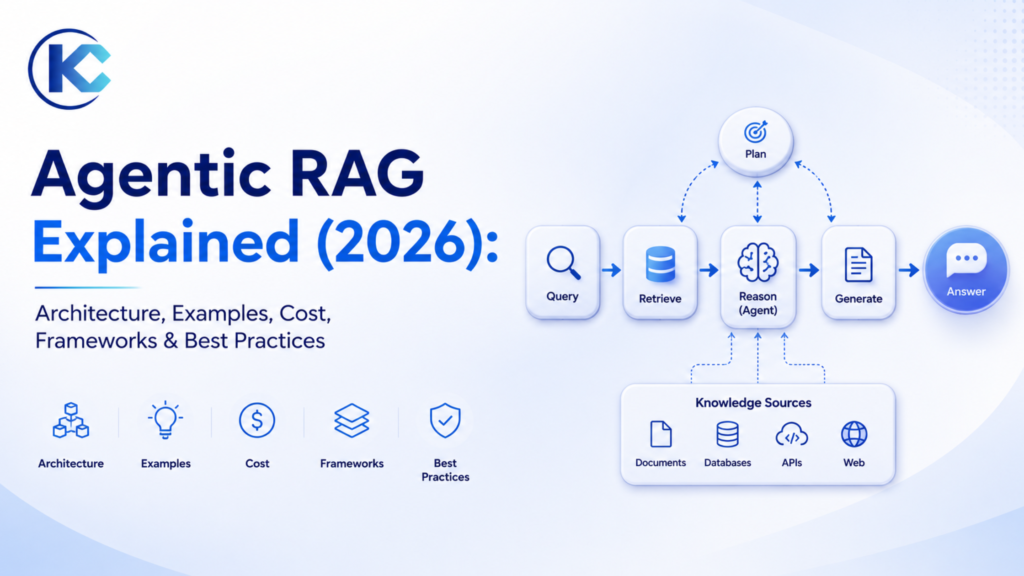
Agentic RAG (Retrieval-Augmented Generation) completely transforms enterprise AI search by replacing static lookups with autonomous AI agents. In traditional RAG, an LLM performs a single semantic search and answers based on that one retrieval. Agentic RAG introduces an orchestrator that plans, executes, evaluates, and loops through multiple retrieval steps until a complex, multi-hop query is fully resolved.
For the CTO, CIO, and AI Architect, adopting Agentic RAG means shifting from basic chat interfaces to highly capable AI pipelines and AI workflow automation. This guide provides the complete blueprint for building, scaling, and optimizing an Enterprise RAG architecture, including deep dives into MCP (Model Context Protocol), LangGraph, vector databases, and multi-agent orchestration frameworks.
Quick Answer
What is Agentic RAG? Agentic RAG is an advanced AI architecture where autonomous agents control the retrieval process. Instead of a single semantic search, planning agents decompose complex questions, tool-calling agents query vector databases and APIs, and reflection agents grade the retrieved data. This multi-hop reasoning loop solves enterprise knowledge problems that traditional RAG fails at, though it requires robust LLM orchestration and higher token costs.
3 to 10×
The token cost increase compared to traditional RAG due to multi-hop reasoning loops.
85%
Improvement in answering complex, multi-document enterprise queries vs static search.
40%
Of agentic AI projects fail without proper LLM orchestration guardrails and observability.
Agentic AI Core Definitions & Entities
To understand Enterprise Agentic RAG, you must understand the underlying semantic entities driving AI orchestration.
Traditional RAG
A linear AI pipeline that embeds a user query, performs a single nearest-neighbor semantic search in a vector database, and passes those documents to an LLM to generate an answer.
Multi-Agent AI
An architecture where multiple specialized LLMs (or one LLM playing different roles) collaborate. A Supervisor Agent routes tasks to a Search Agent, which passes data to a Summarization Agent.
Multi-hop Reasoning
The ability of an AI to answer a complex question by chaining multiple pieces of information together. The agent retrieves a document, extracts a clue, and uses that clue to formulate a second, distinct search query.
Model Context Protocol (MCP)
An open standard connecting AI models to external data sources and tools. MCP standardizes how Agentic RAG systems authenticate and call internal enterprise APIs securely.
What is Agentic RAG?
Agentic RAG is a paradigm shift in Knowledge Base AI. Instead of treating the Large Language Model (LLM) as a simple text generator at the end of a search pipeline, Agentic RAG treats the LLM as the “brain” orchestrating the entire pipeline.
When a user submits a query, a Planning Agent decomposes the request. It determines which internal databases (Vector DB, Knowledge Graph, SQL) to search. A Tool Calling mechanism fetches the data. Finally, a Reflection Agent reviews the retrieved data. If the data is insufficient or irrelevant, the agent automatically rewrites the query and searches again-executing autonomous, multi-step reasoning.
Traditional RAG vs Agentic RAG
Why Traditional RAG Fails in the Enterprise
Teams often deploy a basic RAG system, watch it answer simple questions perfectly, and then see it completely fail on complex business logic. Traditional RAG relies on semantic similarity. If the answer requires connecting a CRM record in Postgres to an unstructured PDF policy in Milvus, single-pass systems break down.
The “Compare and Contrast” Failure
- User Query: “Compare the Q3 revenue of Product A to Product B and tell me which had a higher profit margin based on our vendor cost PDFs.”
- Traditional RAG Result: It searches for the whole sentence, retrieves a mix of random financial docs based on keyword overlap, and fails to do the math.
- Agentic RAG Result: The Planner Agent splits the query into three steps: 1) Query SQL for Product A Q3 revenue. 2) Query SQL for Product B Q3 revenue. 3) Query Vector DB for vendor cost PDFs. The Reasoning Agent does the math.
Complete Agentic RAG Architecture
An Enterprise AI Architecture for Agentic RAG involves multiple decoupled layers. Here is the technical breakdown of the stack.
1. User & Interface Layer
The entry point. Receives the prompt, handles authentication, and maintains session context. Interfaces often include chatbots, Copilots, or API endpoints.
2. AI Orchestrator (Supervisor)
Built on LangGraph or CrewAI, this is the central brain. It receives the prompt, spins up sub-agents, manages State, and dictates conditional routing.
3. Planning & Memory Layer
AI Memory stores past interactions (Thread Checkpointing). The Planner uses Chain of Thought (CoT) to decompose the task into a Directed Acyclic Graph (DAG) of steps.
4. Tool Calling & MCP
The execution layer. Agents output structured JSON (Function Calling) to trigger tools via the Model Context Protocol (MCP), accessing internal data securely.
5. Multi-Retrieval Layer
Combines Semantic Search (Vector DBs like Milvus/Qdrant), Graph RAG (Neo4j for entity relationships), and traditional Keyword search (Elasticsearch/Hybrid Search).
6. Evaluator & Reflection Layer
Before presenting the answer, a Self-Reflection agent grades the response against the retrieved context to ensure Grounding and zero hallucinations.
HTML Architecture Diagram: The Agentic Pipeline
User Query
↓
Supervisor Agent (LangGraph)
↓
SQL Tool Agent
Vector DB Agent
API Tool Agent
↓
Reflection & Grading Agent
↻ (Loops if failed)
↓
Final Answer Generation
Model Context Protocol (MCP) in Agentic RAG
What is MCP? The Model Context Protocol is an open-source standard created by Anthropic that standardizes how AI assistants connect to local and remote data sources. Before MCP, integrating an Agentic RAG pipeline with Jira, Slack, Postgres, and local file systems required writing custom API wrappers for every tool.
MCP Architecture
- MCP Hosts: The application initiating the connection (e.g., LangChain, Claude Desktop, Cursor).
- MCP Clients: 1:1 connections that sit inside the Host and negotiate with servers.
- MCP Servers: Lightweight, standardized servers that expose Resources (files), Prompts (templates), and Tools (executable functions).
Enterprise Benefits of MCP: By deploying MCP servers inside your VPC, your Multi Agent AI can securely authenticate via standard transports (stdio, SSE) and access internal knowledge without exposing raw database credentials to the LLM orchestrator. It is the missing link for secure Enterprise Search tool calling.
Enterprise Knowledge Base & Data Pipeline Architecture
Agents are only as smart as the data they can retrieve. Enterprise Knowledge Management requires a highly optimized data ingestion pipeline before agents ever touch the data.
- Document Pipeline & Chunking: Raw PDFs, Word docs, and HTML must be parsed (via tools like Unstructured.io) and broken into semantically meaningful “chunks” (e.g., recursive character splitting with overlap).
- Embedding Models: Chunks are vectorized using high-dimension embedding models (e.g., OpenAI text-embedding-3-large, Cohere, Nomic).
- Metadata Injection: Crucial for Agentic RAG. Every chunk must include metadata (date, author, department). Agents will use “Self-Querying” tools to filter by metadata before running semantic searches.
- Hybrid Search: Combining dense vector search (semantic meaning) with sparse keyword search (BM25) to ensure accurate retrieval of specific nouns, SKUs, and IDs.
- Re-ranking: A cross-encoder model (like Cohere Rerank) re-orders the retrieved chunks to put the most mathematically relevant context at the very top of the prompt.
Agent Framework Comparison: LangGraph vs CrewAI vs AutoGen
Building Autonomous AI requires specialized orchestration libraries. Basic LangChain LCEL chains are insufficient for cyclical, agentic reasoning.
Deep Dive: LangGraph Concepts
In a LangGraph architecture, your Agentic RAG is defined as a State Graph. Nodes are Python functions or LLM calls (e.g., `retrieve_data()`, `grade_documents()`). Edges dictate the flow between nodes. Conditional Routing allows the system to evaluate state (“Did we find the answer?”) and route back to the retrieval node if necessary. Checkpointing enables memory persistence across conversations.
The Enterprise Agentic Tech Stack
Databases & Storage
Vector DBs: Milvus, Qdrant, Pinecone, Weaviate, FAISS.
Graph DBs: Neo4j (for Graph RAG).
Relational: Postgres (pgvector).
Caching: Redis.
Models & Inference
Proprietary LLMs: OpenAI GPT-4o, Anthropic Claude 3.5 Sonnet, Google Gemini 1.5 Pro (large context windows).
Open Source: Llama 3, Mistral hosted via vLLM or Ollama.
Router: LiteLLM.
Observability & Evaluation
Tracing: LangSmith, LangFuse, Phoenix, OpenTelemetry. Agentic systems must be traced at every step to debug reasoning loops and monitor latency/costs.
Optimization & Advanced Techniques
To prevent latency bottlenecks and cost overruns, AI Architects employ several specific algorithmic techniques within the Agentic pipeline:
- Query Rewriting (HyDE): The agent generates a hypothetical answer to the user’s prompt, and uses the embeddings of that hypothetical answer to perform the vector search, improving semantic match rates.
- Corrective RAG (CRAG): A lightweight evaluator agent grades retrieved documents. If they are irrelevant, it triggers an external web search (via Tavily/SerpAPI) to supplement the internal Knowledge Base.
- Context Compression: Passing 50 retrieved PDFs into the context window is too expensive and degrades LLM focus. The agent runs a prompt to compress and extract only the relevant paragraphs before passing it to the final reasoning step.
- Semantic Caching: Storing the embeddings of previous agent responses in Redis. If a similar query arrives (high cosine similarity), return the cached answer instantly without triggering the expensive multi-agent loop.
Enterprise Solutions & Industry Applications
Healthcare & Life Sciences
Agentic RAG queries massive genomic databases, cross-references patient EHRs (structured SQL), and searches clinical trial PDFs (vector stores) to assist researchers in finding multi-variable drug interactions.
Supply Chain & Manufacturing
Using Graph RAG alongside agentic planners to navigate complex supplier hierarchies. An agent can answer, “If Supplier X is delayed by 3 days, which downstream retail products will miss their launch date?”
Salesforce AI & CRM Automation
Agents that can look up a customer in Salesforce (using MCP/API tools), read their past support tickets (Vector), and draft highly contextualized renewal proposals autonomously.
Implementation Guide: The 10-Week Rollout Plan
Deploying multi-agent systems requires strict planning. Follow this practical, 10-week roadmap to transition from traditional RAG to an enterprise-grade Agentic RAG architecture.
Phase 1: Discovery & Data Preparation (Weeks 1–3)
- Identify high-value multi-hop queries failing in traditional RAG.
- Clean unstructured data and structure metadata schemas.
- Select chunking strategies and generate vector embeddings.
Phase 2: Architecture & Orchestration Wiring (Weeks 4–6)
- Select an orchestration framework (LangGraph for strict DAG control).
- Develop robust Tool Calling schemas and integrate via MCP.
- Program the Supervisor agent’s routing logic.
Phase 3: Evaluation, Guardrails & Security (Weeks 7–8)
- Implement hard loop caps to prevent runaway token billing.
- Use frameworks like Ragas or TruLens to evaluate groundedness.
- Red-team the system to test for prompt injection vulnerabilities.
Phase 4: Deployment & Observability (Weeks 9–10)
- Deploy agents as FastAPI microservices behind secure API gateways.
- Monitor agentic traces (using LangSmith) to catch infinite loops.
- Tune retry caps and routing logic based on real-world latency.
Cost Analysis & AI Security Management
The recurring failure of Agentic RAG is a cost that climbs without per-request limits, fed by reasoning loops that never stop. You must implement robust infrastructure observability.
1. Manage the Token Multiplier
- The Risk: One complex prompt expands into 15 model calls, crushing your API budget.
- The Solution: Semantic Routing. Send simple queries to traditional RAG. Only trigger multi-agent reasoning for complex logic. Set hard iteration limits (max_retries = 3) in your LangGraph state machine.
2. Prevent Prompt Injection
- The Risk: A malicious instruction hidden in a retrieved PDF document hijacks the tool-calling agent.
- The Solution: Isolate retrieved facts from the LLM’s core system prompt. Use explicit Read-Only permissions for search tools, and require a Human-in-the-Loop for any write/execution tools.
“Without tracing tools like LangSmith, an agentic system is a black box you cannot debug. And a black box that spends money on every autonomous step is a massive corporate liability.”
Enterprise Agentic RAG FAQs
1. What is Agentic RAG?
Agentic RAG allows autonomous AI agents to plan, orchestrate, execute, and self-correct data retrieval steps to answer complex questions, surpassing the limitations of single-pass semantic search.
2. How does Graph RAG integrate with Agentic AI?
Graph RAG uses graph databases (like Neo4j) to map entity relationships. Agents use Cypher tools to traverse this graph, providing explicit hierarchical logic alongside vector similarity search.
3. What is Model Context Protocol (MCP)?
MCP is an open standard that allows LLMs to connect to external data safely via standardized servers, providing agents with tools to query APIs, databases, and internal systems seamlessly.
4. Why use LangGraph over LangChain for Agents?
LangChain LCEL is a linear chain. LangGraph introduces cycles, state machines, and conditional routing—making it possible to build loops where an agent corrects itself and retries failed tasks.
5. What is a runaway agent loop?
It occurs when a Reflection Agent continuously rejects the output of a Search Agent but cannot find the right answer, spinning indefinitely and consuming API tokens. Solved by setting `recursion_limit` caps.
6. What are the cost implications of Agentic RAG?
It typically costs 3x to 10x more per query than traditional RAG because a single user prompt might result in 5+ separate LLM calls (Planning, SQL Querying, Summarizing, Grading, Generating).
7. How do you implement Semantic Routing?
Place a fast, lightweight classification model at the edge. It reads the prompt and routes it either to a cheap RAG pipeline (for simple lookups) or the expensive LangGraph agent network (for complex logic).
8. Can Agentic RAG handle structured data?
Yes. Unlike standard vector RAG which struggles with tabular data, Agentic RAG gives the agent a Text-to-SQL tool, allowing it to natively query structured enterprise databases (Postgres, Snowflake).
9. What is Chain of Thought (CoT) in Agents?
CoT is a prompting technique where the LLM is forced to output its step-by-step reasoning (“First I need to find X. Then I will use X to query Y.”) before taking action, drastically reducing logic errors.
10. How is Agentic AI evaluated?
Using framework libraries like Ragas or specialized LLM-as-a-judge approaches to evaluate metrics like Context Precision, Answer Relevance, and Groundedness, while tracing step latency.
Conclusion: Build Agentic RAG Selectively
Agentic RAG is the future of enterprise search, but it is a complex architecture requiring serious engineering discipline. The organizations finding the highest ROI are not abandoning traditional RAG – they are building Adaptive RAG pipelines where intelligent orchestrators dynamically route tasks based on query complexity.
Invest deeply in your data pipeline, enforce strict agent guardrails using tools like LangGraph, monitor token costs religiously, and you will unlock multi-step AI reasoning that fundamentally changes how your business accesses internal knowledge.
Planning an Agentic RAG Deployment?
Don’t let runaway agent loops and poor routing destroy your AI budget. Get an expert architecture review to ensure your enterprise AI system is secure, scalable, and cost-effective.
Talk to our AI Systems Engineering team today.