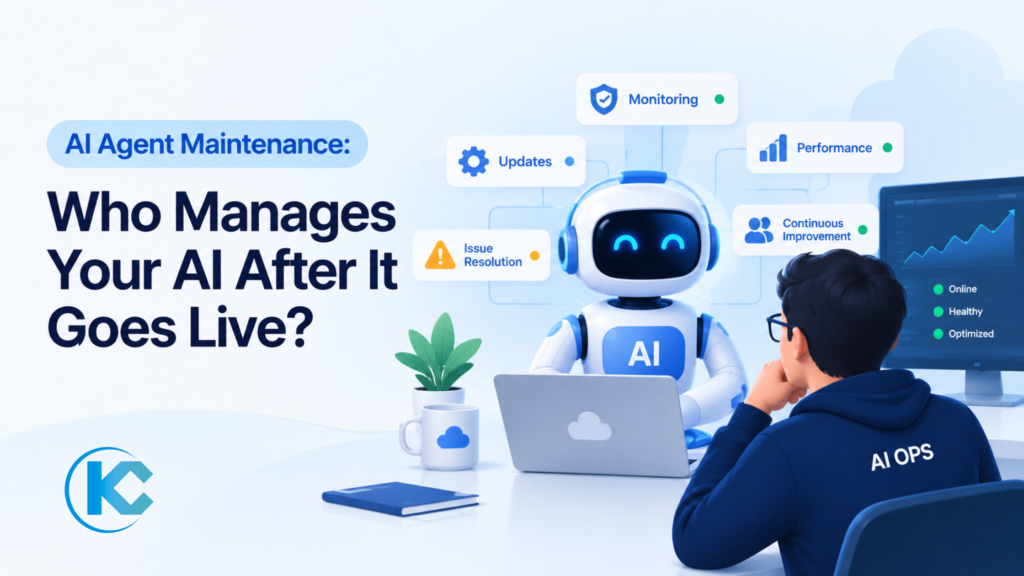
AI Agent SLAs and Maintenance: Who Manages Your AI After It Goes Live?
⏱ 5 min read
Launching an AI agent is not the finish line – and once it’s live, someone has to be contractually accountable for it. This guide focuses on the piece most teams skip: defining the AI agent SLA that governs uptime, incident response, and knowledge freshness, and understanding what AI agent managed services actually cost once you move from ad hoc support to a formal operating model.
Quick Answer: What Goes Into an AI Agent SLA, and What Does It Cost?
An AI agent SLA should define availability, response time, incident escalation, resolution targets, knowledge freshness, security monitoring, and reporting cadence – then assign each to an owner, whether that’s an internal AI operations team, a managed services partner, or a hybrid split.
Budget-wise, plan for roughly 15–30% of initial development cost annually for maintenance and support, scaling up based on whether you need business-hours coverage or 24×7 managed AI operations – details below.
This post focuses specifically on SLA structure and managed services pricing. If you’re looking at reducing token and inference spend, see AI Agent Cost Optimization. If you’re deciding what infrastructure and tooling to build on before launch, see The AI Agent Tech Stack.
AI Agent Maintenance at a Glance
24/7
Production Monitoring
7+
Maintenance Areas
AI + Data
Continuous Optimization
SLA
Ownership & Escalation
Why AI Agent Maintenance Matters
Traditional software maintenance often focuses on uptime, bugs, infrastructure, and security patches. AI agents introduce another dimension: behavior can change even when the underlying application has not crashed.
Prevent Quality Drift
Detect changes in accuracy, relevance, tone, retrieval quality, and task completion before users lose trust.
Control AI Costs
Track token usage, model selection, retries, tool calls, and inefficient agent loops.
Keep Integrations Working
Maintain APIs, CRM connections, databases, tools, and workflows as surrounding systems evolve.
Protect the Business
Maintain permissions, guardrails, audit trails, human approvals, and security controls.
What Can Go Wrong After an AI Agent Goes Live?
An AI agent can degrade without producing a traditional application error. Several layers of the system can change independently.
- Model drift: A model provider may release a newer version or change model behavior.
- Prompt drift: Business processes evolve while the agent instructions remain unchanged.
- Knowledge drift: Policies, documents, product information, or database records become outdated.
- Tool failures: APIs change schemas, authentication expires, or an external service becomes unavailable.
- Integration failures: CRM, ERP, database, or middleware changes can break agent workflows.
- Cost spikes: Excessive retries, long contexts, or inefficient tool calls increase inference spend.
- Security risks: New attack patterns, prompt injection attempts, or excessive permissions can create operational risk.
What Does AI Agent Maintenance Actually Include?
1. Prompt Maintenance
Review and update system instructions, business rules, tool descriptions, and response behavior.
2. Model Management
Evaluate model updates, performance, latency, reliability, and cost before changing production models.
3. Knowledge & RAG
Refresh documents, embeddings, vector stores, retrieval logic, and enterprise knowledge sources.
4. Tool & API Maintenance
Validate tool schemas, authentication, API versions, permissions, and downstream dependencies.
5. Evaluation
Run regression tests and evaluate production outputs against business-specific quality benchmarks.
6. Observability
Monitor latency, failures, tool calls, token usage, costs, traces, and agent outcomes.
Is Your AI Agent Ready for Long-Term Production?
Find out where your AI agent may need stronger monitoring, governance, data maintenance, integration support, SLA coverage, or continuous optimization.
AI Agent Observability: More Than Uptime Monitoring
Traditional monitoring can tell you whether an application is running. AI agent observability needs to answer a much broader question: Is the agent actually doing the right thing?
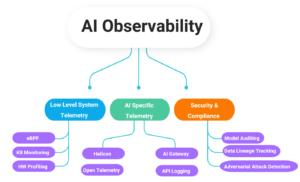
| Metric | What to Monitor | Why It Matters |
|---|---|---|
| Accuracy | Correctness of responses and actions | Protects business outcomes |
| Task Completion | Successful completion of workflows | Measures actual agent effectiveness |
| Latency | Response and workflow execution time | Impacts user experience |
| Tool Success | API calls, errors, retries | Detects integration problems |
| Token & Cost Usage | Model calls, tokens, retries | Controls AI operating costs |
| Safety | Policy violations and risky actions | Reduces operational and security risk |
Who Should Manage an AI Agent?
The answer depends on the complexity and risk of the agent. A simple internal assistant may be managed by a small engineering team, while a customer-facing enterprise agent connected to CRM, ERP, payments, or sensitive data needs broader ownership.
AI Engineer
Owns agent logic, prompts, tool definitions, evaluation, and behavior improvements.
Data / RAG Engineer
Maintains knowledge sources, retrieval pipelines, embeddings, vector databases, and data quality.
Cloud / MLOps Engineer
Manages deployment, infrastructure, monitoring, model versions, CI/CD, and reliability.
Business Owner
Defines KPIs, approves changes, reviews outcomes, and ensures the agent continues solving the right problem.
For example, a customer-facing Salesforce voice or service agent may require stricter production ownership than an internal knowledge assistant because failures can directly affect customer conversations and case handling. If your organization is already operating Salesforce voice workflows, see our Salesforce Service Cloud Voice implementation guide for additional context on the underlying customer-service architecture.
What Should an AI Agent SLA Include?
An AI agent SLA (Service Level Agreement) defines how a production AI system will be monitored, supported, and maintained after launch. Unlike a traditional application SLA that may focus primarily on uptime and incident response, an AI agent SLA can also cover model performance, latency, tool reliability, knowledge freshness, escalation, and AI-specific failures.
| SLA Area | What It Defines | Example Target |
|---|---|---|
| Availability | Agent and supporting infrastructure uptime | Defined uptime target based on business criticality |
| Response Time | Expected response or workflow execution latency | Business-specific latency threshold |
| Incident Response | How quickly incidents are acknowledged and investigated | Priority-based response targets |
| Resolution | Target timeframe for restoring affected functionality | Defined by incident severity |
| Knowledge Freshness | How quickly important source data is refreshed | Based on business and data requirements |
| Security | Monitoring, escalation, access and policy controls | Continuous monitoring for critical systems |
| Reporting | Operational and business performance reporting | Weekly, monthly, or quarterly reviews |
The exact SLA should depend on the agent’s business impact. A low-risk internal assistant may only need business-hours support, while a customer-facing voice agent, financial workflow, or mission-critical enterprise agent may require 24×7 monitoring and defined incident escalation.
AI Agent Maintenance Cadence: What Should Your SLA Cover?
AI agent maintenance should follow a defined operational cadence rather than an ad hoc “fix it when something breaks” approach. Your SLA should establish what is monitored continuously, what is reviewed weekly or monthly, and what requires a deeper quarterly business and architecture review.
| Cadence | Maintenance Activity |
|---|---|
| Continuous | Health, latency, failures, costs, security events, and critical alerts |
| Weekly | Review failed conversations, edge cases, user feedback, and prompt performance |
| Monthly | Audit tools, integrations, costs, knowledge sources, and production changes |
| Quarterly | Review model strategy, evaluation benchmarks, security posture, and business ROI |
The exact cadence should be based on agent risk, traffic, business impact, model changes, and how frequently the underlying data and workflows change.
How Much Do AI Agent Managed Services Cost?
Want a deeper breakdown of token spend, model costs, and inference optimization? Check out our full guide: AI Agent Cost Optimization.
The cost of AI agent managed services depends on the number of agents, required SLA, support coverage, integrations, model usage, data infrastructure, security requirements, traffic volume, and level of ongoing optimization. A simple internal assistant may require limited support, while a customer-facing enterprise agent may need continuous monitoring, rapid incident response, and dedicated engineering resources.
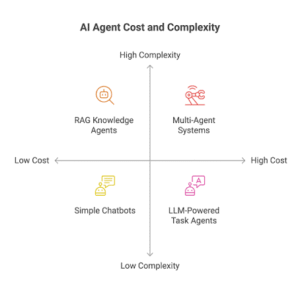
One industry estimate suggests budgeting approximately 15–30% of the initial AI development cost annually for ongoing maintenance, infrastructure, monitoring, retraining, and optimization. Treat this as a planning benchmark rather than a universal pricing rule.
Support Coverage
Business-hours support, extended coverage, or 24×7 production operations.
AI Usage
Model inference, tokens, embeddings, retrieval, tool calls, and workflow execution.
Engineering
Prompt optimization, integrations, evaluation, troubleshooting, and feature improvements.
SLA & Governance
Monitoring, incident response, security reviews, reporting, compliance, and escalation.
| Support Model | Typical Coverage | Best For | Cost Consideration |
|---|---|---|---|
| Ad Hoc | Issue-based support | Low-risk internal agents | Lower recurring commitment, less predictable support |
| Business Hours | Scheduled monitoring and support | Internal and non-critical workflows | Moderate managed-service requirement |
| Extended Support | Broader monitoring and incident coverage | Customer-facing enterprise agents | Higher recurring operational cost |
| 24×7 Managed AI Operations | Continuous monitoring, alerting and escalation | Mission-critical AI workflows | Highest support requirement and strongest SLA coverage |
AI Agent Managed Services: What Are You Actually Paying For?
AI managed services are not simply a monthly support contract. The recurring cost typically covers some combination of production monitoring, SLA management, incident response, AI evaluation, prompt optimization, knowledge maintenance, integration support, security reviews, cost optimization, and continuous improvement.
Not every organization needs to hire a dedicated AI engineer, MLOps engineer, data engineer, and support team for every agent. A managed AI service can provide a specialized team responsible for the operational lifecycle.
A strong AI Managed Services model can include:
- Production monitoring and alerting
- AI agent SLA management
- Prompt and workflow optimization
- Model version management
- RAG and knowledge-base maintenance
- API and integration maintenance
- AI evaluation and regression testing
- Security and governance reviews
- Performance and cost optimization
- Incident response and troubleshooting
- Operational reporting and continuous improvement
The goal is not simply to keep the agent online. It is to keep the agent useful, reliable, secure, and aligned with business outcomes as the organization changes.
From AI Deployment to Continuous AI Operations
Kizzy Consulting approaches AI as a lifecycle rather than a one-time implementation. Our AI Pod Services combine architecture, AI engineering, product thinking, prompt engineering, evaluation, and deployment for production-focused AI systems.
For Salesforce environments, Agentforce consulting and implementation can be extended into ongoing optimization of agents, actions, Data Cloud connections, workflows, and business processes.
And when an AI agent needs to interact with CRM, ERP, databases, APIs, or other enterprise applications, AI integration and implementation helps keep those connections secure and maintainable.
Conclusion
AI agent maintenance is the hidden operating layer behind successful enterprise AI. Once an agent goes live, the work continues: models change, prompts evolve, data becomes stale, APIs are updated, costs fluctuate, and new edge cases appear.
For production AI, organizations should define more than technical ownership. They need a clear operating model covering SLAs, monitoring, incident response, evaluation, security, integrations, knowledge maintenance, cost control, and continuous optimization.
Managed AI services can provide this operational layer when maintaining a dedicated internal team is impractical. The right model depends on the agent’s business criticality, complexity, traffic, integration footprint, and required support coverage.
The real question is therefore not “Who built our AI agent?” but “Who owns its performance six months after launch – and what SLA governs that ownership?”
Frequently Asked Questions About AI Agent SLAs and Maintenance
Do AI agents need maintenance after deployment?
Yes. Production AI agents need ongoing monitoring, evaluation, prompt updates, knowledge refreshes, integration maintenance, security reviews, cost optimization, and troubleshooting.
Who is responsible for maintaining an AI agent?
Depending on the architecture, responsibility can be shared between AI engineers, data engineers, MLOps or cloud engineers, security teams, and business owners. Smaller organizations can combine these responsibilities or use an AI managed services partner.
What is an AI agent SLA?
An AI agent SLA defines the expected service and support levels for a production AI system. It can cover availability, response time, incident response, resolution targets, security, knowledge freshness, monitoring, escalation, and operational reporting.
What is AI agent observability?
AI agent observability is the practice of monitoring not only uptime and latency, but also agent behavior, tool calls, retrieval, output quality, task completion, token usage, costs, and failures.
How often should an AI agent be updated?
There is no universal schedule. Production monitoring should be continuous, while prompts, tools, knowledge sources, integrations, models, and evaluation benchmarks should be reviewed according to usage, risk, business changes, and observed performance.
How much do AI agent managed services cost?
AI agent managed services pricing varies based on agent complexity, support coverage, SLA requirements, traffic, model usage, integrations, security requirements, and engineering effort. Business-hours support generally requires less operational coverage than extended or 24×7 managed AI operations.
Can AI agent maintenance be outsourced?
Yes. Organizations can use managed AI services for monitoring, infrastructure, prompt optimization, RAG maintenance, integration updates, evaluation, security, incident response, and ongoing AI optimization while retaining internal ownership of business decisions.
Who Is Managing Your AI Agent After Launch?
Kizzy Consulting helps businesses move beyond AI deployment with continuous monitoring, optimization, integration maintenance, evaluation, governance, SLA management, and managed AI operations. Whether you are running Salesforce Agentforce, custom AI agents, RAG applications, or multi-agent workflows, we can help build an operating model that keeps your AI reliable as it scales.
Explore Kizzy AI Managed Services or contact Kizzy Consulting to discuss your AI agent maintenance, SLA, support, and optimization requirements.