GraphRAG vs Vector RAG: Architecture, Accuracy, Use Cases & Hybrid Retrieval
⏱ 4 min read
AI RETRIEVAL ARCHITECTURE · 2026 GUIDE
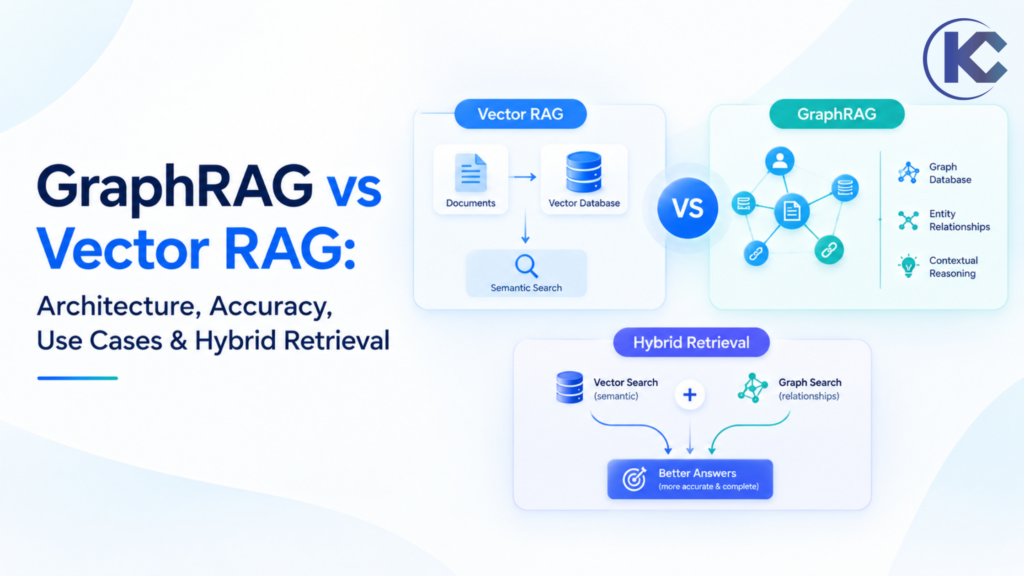
Retrieval-Augmented Generation (RAG) has become a core architecture for grounding AI systems in enterprise data. But not every question can be answered effectively with semantic similarity alone. This guide explains GraphRAG vs Vector RAG, how their retrieval architectures differ, where each approach fits, and why many enterprise AI systems combine vector and graph retrieval.
Contents
hide
Executive Quick Answer: GraphRAG vs Vector RAG
Vector RAG retrieves content primarily according to semantic similarity between a query and indexed chunks or documents. It is highly useful for questions where the answer exists in one or a few semantically relevant passages.
GraphRAG adds an explicit representation of entities and relationships, making it useful when answers depend on connecting multiple entities, following relationship paths, understanding dependencies, or synthesizing information across a large knowledge base. For enterprise AI, a hybrid RAG architecture can combine vector retrieval for semantic recall with graph retrieval for relationship-aware context.
What Is RAG (Retrieval-Augmented Generation)?
Retrieval-Augmented Generation (RAG) is an AI architecture that retrieves relevant information from external or enterprise knowledge sources and provides that context to a large language model before it generates a response.
Instead of relying only on information encoded in a model’s training data, RAG allows an AI application to retrieve information from sources such as enterprise documents, knowledge bases, CRM records, databases, policies, product information and internal systems.
Traditional RAG commonly uses semantic or vector search to retrieve relevant information. More advanced architectures can combine vector search, knowledge graphs, APIs, SQL databases and AI agents to solve complex multi-step questions.
R
Want to Understand RAG in More Detail?
For a deeper look at how modern RAG architectures evolve from static retrieval into agent-driven, multi-step retrieval, see Kizzy Consulting’s complete guide to Agentic RAG architecture, examples, frameworks, costs and best practices.
01
Retrieve
Find relevant information from connected data sources.
02
Augment
Add retrieved context to the model’s input.
03
Generate
Generate a response using the retrieved evidence.
The important architectural question is not simply whether to use RAG.
It is how the retrieval layer represents knowledge and determines which context should reach the model.
It is how the retrieval layer represents knowledge and determines which context should reach the model.
What Is Vector RAG?
Vector RAG uses embeddings to represent documents, passages or other content as numerical vectors. A user’s query is also converted into an embedding, and the retrieval system searches for content whose vector representation is semantically similar to the query.
This approach is especially effective when the information needed to answer a question is contained within semantically related documents or passages.
Vector RAG Pipeline
Documents
→
Chunking
→
Embeddings
→
Vector Index
→
Semantic Retrieval
→
LLM
How Vector Embeddings Improve Retrieval
Embeddings convert text into a mathematical representation that captures aspects of its meaning. This allows a retrieval system to find passages that are conceptually related even when the exact words in the query do not appear in the source document.
For example, a question about employee reimbursement rules can retrieve a policy document that uses different terminology but discusses the same concept.
What Is GraphRAG?
GraphRAG is a retrieval architecture that combines generative AI with a knowledge graph or graph-based representation of entities and relationships. Instead of treating retrieved content primarily as independent chunks, the system can use relationships between entities to identify and organize relevant context.
A graph can represent concepts such as customers, products, suppliers, employees, contracts, transactions, locations, accounts, policies and systems as entities connected by explicit relationships.
GraphRAG Retrieval Pipeline
Source Data
→
Entity Extraction
→
Knowledge Graph
→
Graph Retrieval
→
LLM
GraphRAG vs Vector RAG: Key Differences
| Factor | Vector RAG | GraphRAG |
|---|---|---|
| Primary representation | Embeddings and indexed chunks | Entities, relationships, graph structures and supporting content |
| Retrieval mechanism | Semantic similarity / nearest-neighbor retrieval | Relationship-aware graph traversal, graph queries and/or graph-informed retrieval |
| Context | Strong for locally relevant passages | Strong when relationships across entities are important |
| Multi-hop reasoning | Can require additional retrieval and orchestration | Explicit relationships can support multi-hop retrieval |
| Unstructured content | Very effective | Can incorporate unstructured content alongside graph data |
| Relationship reasoning | Not explicit in the embedding itself | Explicitly represented in graph relationships |
| Traceability | Usually based on retrieved chunks and metadata | Can expose entity and relationship paths in addition to source evidence |
| Implementation complexity | Generally simpler to deploy | Requires graph modeling, entity resolution and relationship maintenance |
Vector RAG: Advantages, Limitations & Best Use Cases
Advantages of Vector RAG
- Effective semantic search across large document collections.
- Works well with unstructured text and document-heavy knowledge bases.
- Relatively straightforward embedding and retrieval pipeline.
- Can use mature vector databases and approximate nearest-neighbor indexes.
- Useful for support, documentation and knowledge-base assistants.
Limitations of Vector RAG
- Semantic similarity does not inherently represent explicit relationships.
- Relevant chunks can be retrieved without preserving the relationship needed to answer a multi-hop question.
- Chunking strategy can strongly affect retrieval quality.
- Large amounts of context can increase token and inference costs.
- Metadata filtering and reranking may be needed for more precise retrieval.
When Is Vector RAG a Good Fit?
Vector RAG is often a practical choice when users mainly ask questions about documents, policies, manuals, product information, FAQs, technical documentation or other content where semantic relevance is the primary retrieval signal.
GraphRAG: Advantages, Limitations & Enterprise Use Cases
Advantages of GraphRAG
- Represents relationships between entities explicitly.
- Supports relationship-aware and multi-hop retrieval patterns.
- Can connect information distributed across documents and systems.
- Can improve traceability by exposing entity and relationship paths.
- Useful for complex enterprise knowledge domains.
Limitations of GraphRAG
- Graph construction and entity extraction introduce additional engineering work.
- Entity resolution and relationship quality affect retrieval quality.
- Graph updates need to be managed as source systems change.
- Architecture and query design can be more complex than basic vector search.
- A graph does not automatically guarantee accurate answers or eliminate hallucinations.
When Is GraphRAG a Good Fit?
GraphRAG can be valuable when the business domain contains dense relationships between entities and users ask questions involving dependencies, hierarchies, networks, transactions, ownership, supply chains, organizational structures or multi-step connections.
GraphRAG vs Vector RAG Use Cases
Vector RAG Use Cases
- Enterprise knowledge-base assistants
- Customer support documentation
- Product manuals and technical documentation
- Employee policy assistants
- Contract and document search
- Research and content discovery
- Semantic search applications
GraphRAG Use Cases
- Supply-chain intelligence
- Customer and account relationship analysis
- Fraud and risk investigation
- Knowledge graphs and enterprise search
- Dependency and impact analysis
- Organizational knowledge discovery
- Complex research across connected entities
Go Beyond Static RAG With Agentic Retrieval
When a query requires planning, multiple retrieval steps, tool calls, query rewriting or iterative evaluation, an Agentic RAG architecture can orchestrate those steps dynamically.
How to Design a Production RAG Architecture
Choosing GraphRAG or Vector RAG is only one part of the architecture. Production retrieval quality also depends on data quality, indexing, chunking, metadata, entity resolution, query transformation, evaluation and governance.
1. Data Foundation
Identify authoritative sources and establish ownership, freshness and data quality.
2. Retrieval Design
Choose vector, graph, keyword, structured or hybrid retrieval according to query patterns.
3. Context Engineering
Control how retrieved evidence is filtered, ranked, compressed and passed to the model.
4. Evaluation
Test retrieval relevance, answer correctness, citation quality, latency and failure modes.
5. Security
Apply identity, permissions, tenant isolation and source-level access controls before retrieval.
6. AI Operations
Monitor data freshness, retrieval quality, model behavior, cost, latency and production failures.
Why Data Foundation Matters for GraphRAG and Vector RAG
Retrieval architecture cannot compensate for unreliable source data. Duplicate entities, stale records, inconsistent identifiers, missing relationships and poor document structure can reduce retrieval quality regardless of whether the system uses vectors, graphs or both.
For enterprise AI, the retrieval layer should therefore be designed together with data integration, governance and access control rather than treated as an isolated search component.
RAG, APIs and AI Agents: Connecting Retrieval to Business Systems
A production AI system often needs more than retrieval. An AI agent may need to retrieve context from documents, query structured records through APIs, perform calculations, update CRM data or trigger an approved business workflow.
That makes the distinction between retrieval and action important. Vector and graph retrieval can provide context, while APIs and tools allow an AI agent to interact with systems of record.
GraphRAG Accuracy: What Enterprise Benchmarks Can and Cannot Tell You
GraphRAG discussions often reference vendor or research benchmarks showing improvements on questions that require structured relationships. These results can be useful, but they should be interpreted in the context of the benchmark design, dataset, question types, graph quality and retrieval implementation.
Important Benchmark Context
Results reported by individual vendors or benchmark authors should not be interpreted as universal accuracy guarantees. A GraphRAG system can outperform a vector-only system on relationship-heavy questions while a vector system can remain highly effective for document-centric semantic retrieval. Production evaluation should use representative questions from the organization’s own data and workflows.
GraphRAG vs Vector RAG: How to Choose the Right Architecture
| If your application mainly needs… | Consider… |
|---|---|
| Semantic search across documents | Vector RAG |
| Answers grounded in manuals, policies and knowledge articles | Vector RAG |
| Multi-hop questions across connected entities | GraphRAG or hybrid RAG |
| Complex entity relationships and dependencies | GraphRAG or hybrid RAG |
| Documents plus structured enterprise relationships | Hybrid RAG |
| Different query types across one enterprise knowledge system | Hybrid retrieval with routing |
From RAG Architecture to Production AI
The retrieval layer is only one component of a production AI system. Successful implementation also requires clear business scope, reliable enterprise data, integrations, permissions, security, guardrails, evaluation, monitoring and cost controls.
Frequently Asked Questions About GraphRAG vs Vector RAG
What is the main difference between GraphRAG and Vector RAG?
Vector RAG primarily retrieves semantically similar content using embeddings, while GraphRAG uses explicit entities and relationships to support relationship-aware retrieval. Hybrid RAG can combine both approaches.
What is the main reason standard vector embeddings can struggle with complex queries?
Standard vector embeddings primarily capture semantic similarity rather than explicitly representing relationships between entities. Complex multi-hop questions may require connecting several entities or following relationship paths that are not directly encoded in the embedding.
What is Vector RAG used for?
Vector RAG is commonly used for semantic search and question answering across documents, policies, manuals, knowledge bases, support content and other unstructured or semi-structured information.
What is Agentic RAG?
Agentic RAG extends retrieval with AI-driven planning and orchestration. Instead of relying on one retrieval step, agents can decompose complex questions, select tools or data sources, retrieve information multiple times and evaluate whether the available evidence is sufficient.
Learn more about Agentic RAG →
Planning a GraphRAG, Vector RAG or Hybrid AI Architecture?
Kizzy Consulting can help assess your enterprise data, retrieval requirements, integrations and AI use cases to determine whether Vector RAG, GraphRAG, Agentic RAG or a hybrid architecture fits your workflow.