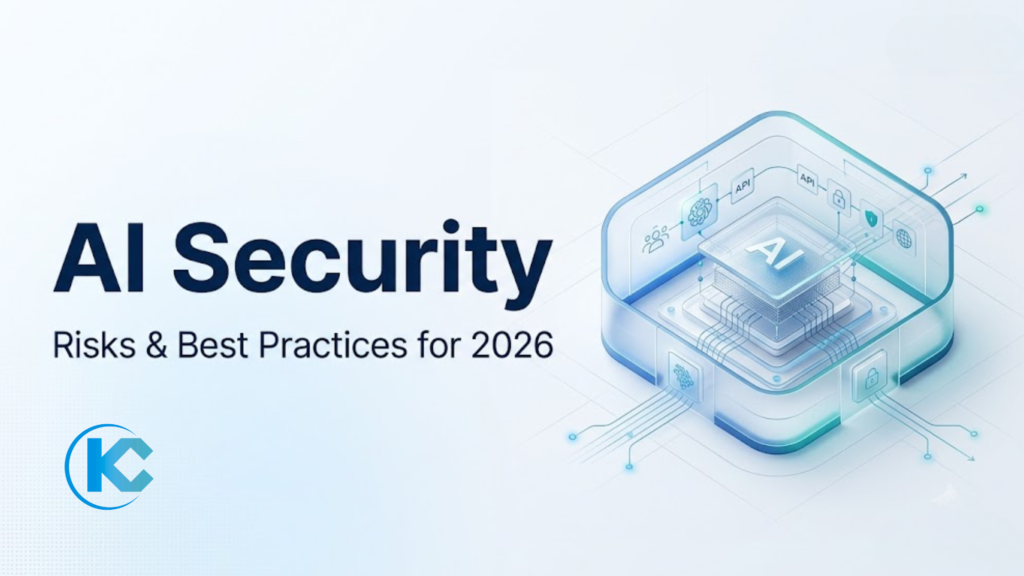
AI Security: 2026 Guide to Common Risks and Best Practices for Securing AI Models and Agents
⏱ 4 min read
AI SECURITY · CYBERSECURITY · 2026 GUIDE
A practical guide to AI security, covering common risks such as prompt injection, model poisoning, RAG poisoning, shadow AI, insecure agents, MCP security, AI governance, compliance, and best practices for protecting AI models and agents.
Executive Quick Answer
AI security is the practice of securing AI systems, models, applications, agents, data, and supporting infrastructure throughout their lifecycle. Traditional cybersecurity controls remain important, but AI introduces additional risks such as prompt injection, training-data poisoning, RAG poisoning, model extraction, shadow AI, insecure agents, MCP vulnerabilities, and unsafe agent-to-agent communication. Organizations should address these risks through governance, threat modeling, input and output validation, access controls, secure data practices, monitoring, human oversight, and continuous security testing.
What Is AI Security?
AI security is the practice of securing AI systems, workloads, and infrastructure, including generative AI applications and AI and machine learning systems.
The fundamentals of AI security overlap with cybersecurity in general. Hardening systems against attack, monitoring for threats, protecting sensitive data, controlling access, and responding to incidents remain essential. AI systems can also inherit risks from third-party code, libraries, models, datasets, APIs, and other components in the software and AI supply chain.
At the same time, AI introduces unique security challenges that require additional controls. Organizations increasingly use AI-specific security frameworks and governance processes to identify, assess, and manage these risks throughout the AI lifecycle.
Why Does AI Security Matter?
AI adoption is expanding across organizations, including security operations, customer service, software development, analytics, and business workflows. As more sensitive information and business processes move through AI systems, organizations need visibility and controls specifically designed for AI-related risks.
01
Sensitive Data
AI applications may process customer, employee, business, source-code, security, or other sensitive information.
02
New Attack Paths
Prompt injection, data poisoning, model extraction, and agent vulnerabilities create attack paths that require specialized controls.
03
AI Agents
AI agents can interact with tools, APIs, databases, and business systems, increasing the potential impact of compromised or manipulated behavior.
04
Continuous Change
AI architectures, models, vendors, agents, integrations, and threats evolve quickly, making continuous monitoring important.
Common AI Security Risks
AI workloads can be affected by a wide range of security threats. Understanding the major categories helps security teams determine where additional controls and monitoring may be required.
Prompt Injection
Attackers use malicious instructions or content to influence an AI model into bypassing intended controls, exposing information, or performing unintended actions.
Model Poisoning
Model poisoning involves manipulating training data or other model inputs in ways that can influence model behavior or output.
RAG Poisoning
Attackers can attempt to manipulate information retrieved by retrieval-augmented generation systems, potentially influencing responses produced from external knowledge sources.
Insecure AI Agents
Agents can inherit vulnerabilities from code, libraries, APIs, permissions, tools, and third-party components used within their execution environment.
MCP Servers
Model Context Protocol servers can connect AI models with external tools, data sources, and services. Risks include tool poisoning, prompt injection through tool inputs, supply-chain vulnerabilities, and unauthorized actions.
Agent-to-Agent Communication
Communication between agents and models can become a vector for data leakage or manipulation when data and requests are not adequately protected.
7 Generative AI Cybersecurity Best Practices to Know
Much of the risk in generative AI comes not from the technology itself, but from how it is deployed. Tools added without agreed rules for data, access, and oversight can create additional security exposure. The following practices can help organizations establish a more controlled approach to generative AI in security operations.
1
Set a Policy for AI in Security Operations
A usage policy defines which AI-powered threat detection tools analysts may use, for which tasks, and on what data. It should establish accountability for decisions informed by AI and identify situations where human review is required. Clear documentation turns scattered experimentation into consistent and accountable practice.
2
Guard Against Prompt Manipulation and Data Exfiltration
Security teams may send log extracts, alert details, suspicious emails, or other sensitive material to AI systems. Organizations should control what information reaches external tools and sanitize untrusted content before analysis to reduce the risk of data exposure and prompt manipulation.
3
Keep Humans in the Loop on AI Outputs
Generative models can produce fluent but incorrect output. An AI system might draft a flawed detection rule, misinterpret an alert, or recommend an inappropriate response. AI-generated findings, rules, and response actions should be reviewed by an appropriate analyst before they take effect.
4
Vet AI Tools Before Deployment
Before adding an AI tool to the security stack, assess how it processes, stores, and protects the data it receives. Organizations should understand provider data practices, retention, model-training policies, required permissions, integrations, and access requirements before approving a tool.
5
Align With Recognized AI Security Frameworks
Rather than creating every control from scratch, security teams can use established guidance such as the NIST AI Risk Management Framework and ISO/IEC 42001 as reference points for managing AI risks, governance, and controls.
6
Log and Audit Every AI Interaction
Logging prompts, outputs, relevant user context, and security events can help organizations reconstruct how AI influenced a decision. Audit trails also support incident investigation, governance, and applicable compliance requirements.
7
Train Analysts on Safe AI Use
Analysts need to understand where generative models can fail, what information should not be entered into external tools, and how prompt injection can appear in content being analyzed. Training helps teams use AI with appropriate judgment rather than misplaced trust.
The Growing Role of Generative AI in Cybersecurity Teams
Generative AI is becoming an increasingly common part of security workflows. As AI security trends continue to reshape how attacks are initiated and defended, security teams need a defined approach to managing AI-related risk.
The practical response is to combine AI adoption with clear policies, human oversight, security testing, data governance, monitoring, and recognized frameworks. AI can support security teams while remaining subject to the same principles of accountability and controlled access that apply to other critical technologies.
AI Security Tools and Technologies
Specialized AI security solutions are increasingly being developed to address risks associated with AI systems, models, sensitive data, and autonomous agents.
Depending on the architecture, organizations may use controls that monitor model inputs and outputs, track agent behavior, detect suspicious activity, manage access, protect data, and connect AI security events with existing security operations.
Input Monitoring
Inspect prompts and external content before they reach AI systems.
Output Monitoring
Validate model responses and identify sensitive or unsafe information.
Agent Monitoring
Track agent behavior, tool calls, permissions, and interactions.
SIEM Integration
Connect AI-related events with existing security monitoring and response workflows.
OWASP AI Security Guidance
AI security standards and guidance have matured as organizations have adopted large language models and agentic AI applications. OWASP has published security guidance covering risks associated with large language models and agentic AI.
OWASP guidance can provide a useful starting point for developing an AI security strategy. Organizations should still adapt security controls to their own architecture, data, threat model, regulatory environment, and business requirements rather than treating generic guidance as a complete security program.
TIPS FROM THE EXPERT
Practical AI Security Tips
The following recommendations focus on improving visibility, data protection, security monitoring, and operational readiness as AI deployments expand.
Continuously discover and inventory exposed AI services.
AI model APIs, inference endpoints, MCP servers, and agent orchestration layers can represent internet-facing assets and should be included in appropriate exposure-management processes.
AI model APIs, inference endpoints, MCP servers, and agent orchestration layers can represent internet-facing assets and should be included in appropriate exposure-management processes.
Choose AI models and vendors carefully.
Evaluate vendor security architecture, data-handling practices, privacy commitments, access requirements, and applicable contractual protections.
Evaluate vendor security architecture, data-handling practices, privacy commitments, access requirements, and applicable contractual protections.
Know and secure your data.
AI systems depend on the data they receive, making data governance, access control, classification, and protection important parts of AI security.
AI systems depend on the data they receive, making data governance, access control, classification, and protection important parts of AI security.
Leverage AI to help detect AI risks.
AI-based controls can assist with validating inputs and outputs and identifying potentially risky information or behavior.
AI-based controls can assist with validating inputs and outputs and identifying potentially risky information or behavior.
Continuously evolve the AI security toolset.
AI architectures and threats change quickly, so security capabilities should be reviewed and updated as the environment evolves.
AI architectures and threats change quickly, so security capabilities should be reviewed and updated as the environment evolves.
Update SOC processes.
Security Operations Center workflows may need additional processes for detecting, investigating, and responding to AI-specific risks.
Security Operations Center workflows may need additional processes for detecting, investigating, and responding to AI-specific risks.
AI Risk Management Framework
A comprehensive risk management framework provides a structured approach to identifying, assessing, and mitigating security risks associated with AI systems and models throughout their lifecycle.
01 · IDENTIFY
Assess AI Risks
Evaluate risks across models, training data, applications, agents, integrations, infrastructure, and deployment environments.
02 · MITIGATE
Apply Controls
Implement technical controls, access restrictions, data protections, validation, monitoring, and process improvements.
03 · MONITOR
Continuously Review
Monitor AI systems and update security measures as threats, models, vendors, regulations, and architectures change.
04 · GOVERN
Maintain Accountability
Define roles, responsibilities, policies, approvals, audit requirements, and escalation procedures for AI systems.
NIST provides a widely used AI Risk Management Framework, while organizations may also use additional industry frameworks and internal risk-management approaches depending on their requirements.
Conclusion
AI security is becoming an essential extension of modern cybersecurity. Traditional application, cloud, identity, network, and data-security controls remain important, but they need to be complemented by controls that address AI-specific risks.
Organizations should approach AI security as an ongoing process rather than a one-time deployment exercise. Governance, threat modeling, secure data practices, input and output validation, monitoring, access controls, human oversight, and continuous testing can help organizations manage risks across AI models, applications, agents, and supporting infrastructure.
As AI adoption expands, security teams will need visibility into where AI is being used, what data it can access, what actions it can take, and how those systems behave over time.
Frequently Asked Questions About AI Security
What is AI security?
AI security is the practice of protecting AI models, applications, agents, data, infrastructure, and related systems against security threats throughout their lifecycle.
What are the most common AI security risks?
Common risks include prompt injection, model poisoning, RAG poisoning, extraction attacks, shadow AI, insecure AI agents, MCP security issues, and insecure communication between agents and models.
What is prompt injection in AI security?
Prompt injection occurs when malicious instructions or content influence an AI model to bypass intended behavior, disclose information, or perform actions outside its intended purpose.
What are AI agents and why do they create security risks?
AI agents are software systems capable of using AI models to perform tasks or interact with tools and external systems. Their security risk can increase when they have access to sensitive data, APIs, business applications, or privileged actions.
How can organizations secure AI models and agents?
Organizations can use threat modeling, input and output validation, access controls, secure data handling, encryption, rate limiting, monitoring, secure supply-chain practices, human oversight, and continuous security testing.
AI SECURITY · AI GOVERNANCE · AI AGENTS
Building AI Systems With Security in Mind?
AI security requires more than securing the model. Review your data, agents, integrations, governance, access controls, and operational workflows to build a security approach that fits your AI environment.