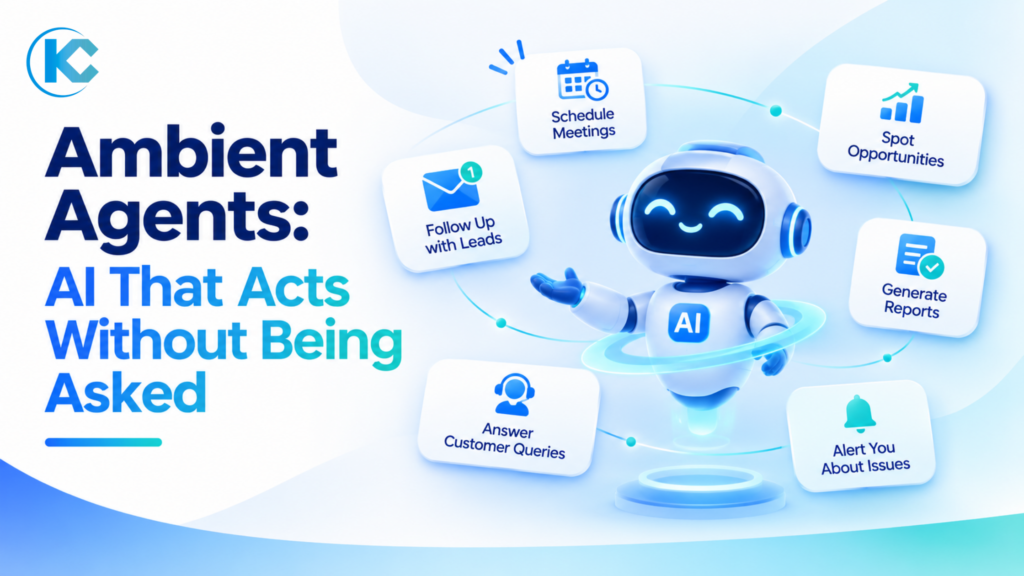
Ambient Agents: AI That Acts Without Being Asked
⏱ 3 min read
AGENTIC AI • AI AUTOMATION • ENTERPRISE AI
Chatbots wait for prompts. Ambient agents observe business context, recognize meaningful signals, and step in when action is useful. Here is how this new generation of proactive AI works, where it fits, and what enterprises need to get right before deploying it.
Proactive AI
Context-Aware
Agentic Workflows
Context-Aware
Agentic Workflows
By Sanjeet Mahajan · Kizzy Consulting
Executive Quick Answer
Ambient agents are AI systems that work from context instead of waiting for a user prompt.
They continuously monitor approved signals such as CRM events, emails, documents, tickets, application activity, conversations, or operational data. When a meaningful condition is detected, the agent can notify someone, ask for clarification, recommend an action, or execute an approved workflow.
The important shift is not simply from chat to automation. It is from reactive AI to proactive intelligence: the AI watches the workflow so the human does not have to.
What Are Ambient Agents?
Most AI assistants follow a simple pattern: human asks → AI responds. That works well when a user knows what they need and has time to ask.
Ambient agents use a different interaction model. They operate in the background, observe relevant events, understand context, and decide whether something requires attention. Instead of forcing employees to constantly search, monitor dashboards, or remember follow-ups, the agent can surface the right information at the right moment.
Think of an ambient agent as a proactive layer sitting across existing business systems. It does not necessarily replace your CRM, help desk, ERP, email, or collaboration tools. It connects signals from those systems and helps move work forward.
Ambient Agents vs. Chatbots vs. Traditional Agents
Chatbots
Wait for a user message and generate an answer. Best suited to conversational questions and on-demand assistance.
Action Agents
Perform tasks after receiving a request, such as updating records, creating tickets, or sending information.
Ambient Agents
Monitor approved context and proactively determine when to notify, ask, recommend, or act.
How Ambient Agents Work
A production-ready ambient agent is more than an LLM connected to a trigger. It needs a controlled pipeline that can understand context, evaluate policy, decide whether intervention is justified, and execute the appropriate response.
01. Observe
Collect approved events from applications, databases, conversations, documents, sensors, or business workflows.
02. Understand
Combine the event with relevant business context, history, policies, and knowledge.
03. Judge
Determine whether the situation is meaningful enough to justify an intervention.
04. Act
Notify, ask, recommend, escalate, or execute an approved workflow with appropriate controls.
This event-driven approach is especially useful when the cost of constantly checking for changes is high. The agent can watch the workflow while employees focus on higher-value work.
AI becomes more valuable when it understands the workflow.
Before adding autonomy, identify the signals, systems, decisions, and handoffs that actually matter.
Ambient Agent Use Cases
Sales
Detect stalled opportunities, enrich leads, surface account context, recommend follow-ups, and flag important changes before a seller notices them.
Customer Success
Monitor product usage, support activity, renewal signals, and customer health to trigger proactive intervention.
IT Operations
Watch operational signals, summarize incidents, route issues, and alert the right teams when conditions cross defined thresholds.
HR & Recruiting
Track interview workflows, missing inputs, onboarding requirements, and approvals to prevent process delays.
Finance
Identify incomplete reconciliations, missing submissions, approval bottlenecks, and other exceptions before close is affected.
Customer Support
Recognize escalation signals, retrieve relevant knowledge, summarize conversations, and recommend the next best action.
The Hardest Part: Knowing When to Stay Silent
The biggest mistake with ambient AI is assuming that more intervention means more value. It does not.
An agent that constantly sends alerts quickly becomes another source of noise. The quality of an ambient agent should therefore be measured not only by what it catches, but also by what it correctly ignores.
Silence is a product feature.
A useful ambient agent should intervene when the expected value of intervention is higher than the cost of interruption.
Human-in-the-Loop Is Still Essential
Proactive does not have to mean fully autonomous. In fact, the strongest enterprise designs give humans clear control over decisions with higher risk.
Notify
Tell the user something important happened without taking action.
Ask
Request missing information instead of guessing when context is insufficient.
Review
Require human approval before high-impact actions are executed.
Security and Governance Cannot Be Added Later
Ambient agents operate continuously and may have access to sensitive business context. That makes governance a core architectural layer, not a final checklist.
- Data minimization: only expose the information required for the workflow.
- Least privilege: give agents only the permissions they actually need.
- Policy enforcement: validate actions against business rules before execution.
- Observability: log decisions, retrieved context, tool calls, and outcomes.
- Human approval: gate high-impact or irreversible actions.
- Kill switches: make it possible to quickly disable an agent or workflow.
Building the right data foundation for AI is equally important. An agent cannot make reliable decisions from fragmented, stale, or poorly governed data.
Moving from an AI experiment to production?
The model is only one layer. Data, integration, evaluation, security, observability, and governance determine whether an agent is actually production-ready.
A Practical Ambient Agent Architecture
Events & Signals
Context & Memory
Policy & Guardrails
Reasoning
Human Approval
Action & Feedback
For complex enterprise workflows, this architecture can connect CRM, communication tools, data platforms, knowledge bases, APIs, and business applications. Kizzy’s enterprise AI agent architecture approach focuses on making those layers observable, secure, and scalable.
When Should a Business Use an Ambient Agent?
Good Fit
- Important events happen continuously.
- Employees repeatedly monitor systems.
- Delays create measurable business cost.
- Actions can be clearly governed.
- Relevant context exists in business systems.
Poor Fit
- There is no reliable event or data source.
- The workflow is highly ambiguous.
- Every action requires complex human judgment.
- There is no clear owner for exceptions.
- The organization cannot monitor agent behavior.
The Future of Ambient AI
Ambient agents point toward a different model of human-AI interaction. Instead of opening an AI application every time assistance is needed, intelligence becomes embedded into the systems where work already happens.
Sales teams may receive account intelligence while working an opportunity. Support teams may get relevant knowledge while handling a customer issue. Operations teams may receive incident context before opening a dashboard. Finance teams may be alerted to exceptions before they affect the close.
The long-term opportunity is not to make AI more visible. It may actually be to make AI less visible but more useful.
KIZZY PERSPECTIVE
First Fix the Flow. Then Add Intelligence.
Ambient AI should not begin with “Where can we put an agent?” It should begin with “Where does work repeatedly slow down, and what signals tell us that it is happening?”
Start with one measurable workflow. Define the signals. Connect trusted data. Establish permissions and approval rules. Measure intervention quality. Then expand autonomy carefully.
Frequently Asked Questions
What is an ambient agent?
An ambient agent is a context-aware AI system that monitors approved signals and proactively intervenes when it identifies a meaningful opportunity, problem, or workflow event.
How is an ambient agent different from a chatbot?
A chatbot waits for a user prompt. An ambient agent can begin work from events and context, while using policies to decide whether and when human attention is required.
Are ambient agents fully autonomous?
Not necessarily. Good enterprise systems use different autonomy levels, including notifications, questions, recommendations, and human approval for high-risk actions.
What industries can use ambient agents?
Sales, customer support, IT, finance, HR, healthcare, insurance, manufacturing, logistics, and other environments with continuous workflows and reliable data signals can benefit.
Are ambient agents secure?
Security depends on architecture and governance. Data minimization, least-privilege access, policy enforcement, audit logs, monitoring, human approvals, and clear shutdown mechanisms are essential.
How should a company start with ambient AI?
Start with a narrow, measurable workflow. A focused AI PoC or MVP can validate the trigger, data, agent behavior, business value, and governance model before broader deployment.
BUILD WITH CONFIDENCE
Ready to Explore Ambient AI?
Kizzy can help identify the workflows where proactive AI can create measurable value, then design the data, integration, agent, and governance layers required to move from experiment to production.