Salesforce Experience Cloud Implementation: Portals, Steps and Cost (2027)
Quick answer
A Salesforce Experience Cloud implementation builds a secure portal or website on top of your Salesforce data, such as a customer self-service portal, a partner portal or a help centre. It covers user types and licences, sharing and security, pages and branding, knowledge, and integrations. Most portals are scoped as a focused implementation, which at Kizzy Consulting typically costs $15,000 to $50,000. Salesforce licences are billed separately.
Common Experience Cloud portals
| Portal | Users | What they do |
|---|---|---|
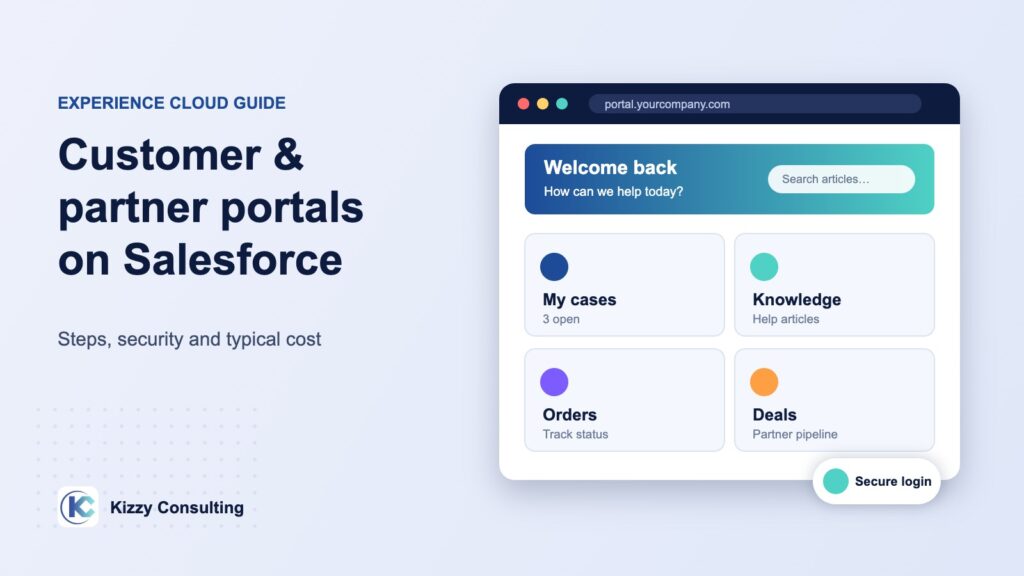
| Customer portal | Customers | Log and track cases, search knowledge, update details, view orders |
| Partner portal | Resellers, distributors | Register deals, share leads, access price lists and sales material |
| Member or patient portal | Members, patients, students | Manage applications, bookings, records and communications |
| Help centre | Anyone (public) | Searchable knowledge articles and support forms |
Experience Cloud implementation steps
- Define users and goals. Who logs in, what they need to do, and how you will measure success (fewer support calls, faster partner deals).
- Choose licences. Customer, partner or external app licences depend on what users need to see and do.
- Design security first. Sharing sets, sharing rules, profiles and guest user access, reviewed before any page is built.
- Build pages. Start from a standard template and components, and add custom Lightning Web Components only where needed.
- Add content. Knowledge articles, FAQs and branded pages.
- Integrate. Single sign-on, your website, and order or billing systems if users need that data.
- Test and launch. Test as each user type, including a logged-out guest, then roll out in stages.
Free Salesforce Org Health Check
Planning a customer or partner portal?
Our certified consultants review your org, including guest user and sharing settings, and send you the top fixes ranked by business impact, plus a scoped estimate for your portal. It’s free, there’s no obligation, and we reply within 1 business day.
Prefer to send us a quick message?
Tell us what you need help with. A Salesforce consultant will reply within 1 business day.
Mistakes to avoid
- Giving guest users more access than they need.
- Building custom pages for things standard components already do.
- Launching with an empty knowledge base.
- Not testing as each type of user before go-live.
- No owner for portal content after launch.
What it costs
Price depends on the number of user types, custom pages, integrations and the complexity of data sharing. At Kizzy Consulting, focused implementations typically cost $15,000 to $50,000, and larger multi-cloud programmes $50,000 to $150,000+. See the Salesforce consulting cost guide for what drives price. For ongoing changes after launch, managed services start from $2,000 a month.
Why work with Kizzy Consulting
Kizzy Consulting is a Salesforce Select Partner with certified consultants and delivery from India, with overlap in US working hours. We design security before pages and use standard components before custom code. Learn more about our Salesforce implementation services, read the Service Cloud implementation guide, or see how to choose a Salesforce consulting partner.
Experience Cloud implementation FAQs
What is Salesforce Experience Cloud used for?
Experience Cloud builds secure websites and portals connected to your Salesforce data: customer self-service help centres, partner portals for resellers and distributors, and member or patient portals.
How much does an Experience Cloud implementation cost?
Most Experience Cloud portals are scoped as a focused implementation. At Kizzy Consulting, focused implementations typically cost $15,000 to $50,000, depending on the number of user types, custom pages, integrations and data sharing rules. Salesforce licences are billed separately.
How long does it take to launch an Experience Cloud portal?
A portal built mostly from standard templates and components launches faster than one with custom Lightning Web Components, integrations and complex sharing. Your partner should give you a timeline in a written scope.
Customer portal or partner portal: what is the difference?
A customer portal lets customers log cases, search knowledge and see their own records. A partner portal lets resellers or distributors register deals, share leads and access sales material. They use different licence types and sharing models.
Is Experience Cloud secure?
Yes, when it is set up correctly. The biggest risks come from guest user access and sharing settings. A good implementation reviews guest user permissions, sharing sets and object access before go-live.
Do we need Service Cloud for a customer portal?
For case management and self-service support, a customer portal is usually paired with Service Cloud and Knowledge. Our Service Cloud implementation guide explains that side of the setup.