How to Choose a Salesforce Consulting Partner in 2027: 12 Questions to Ask
Quick answer
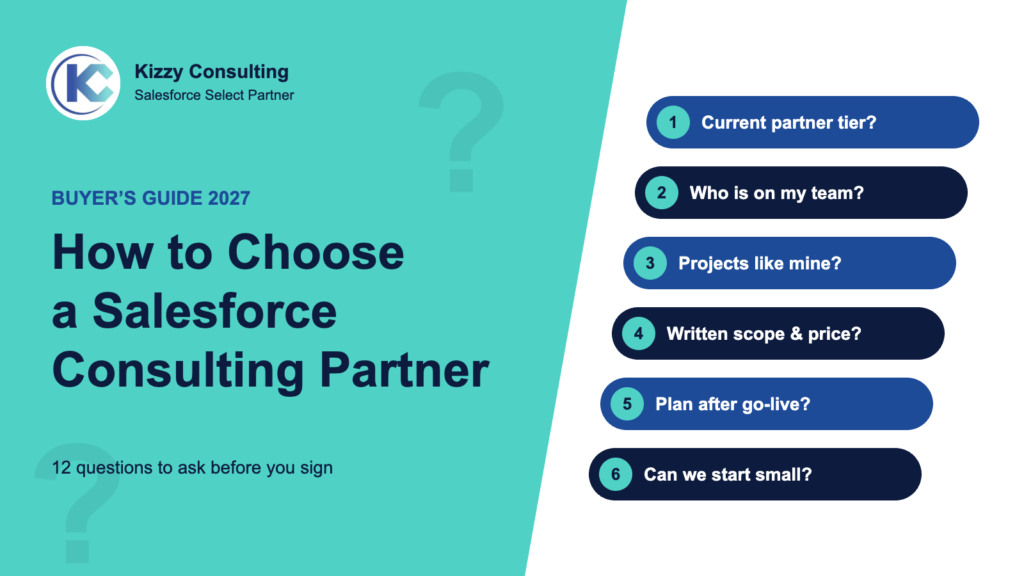
To choose a Salesforce consulting partner, check their current Salesforce partner listing, meet the actual team, ask for projects like yours, and insist on a written scope and price. Then start with a small, fixed-scope piece of work before you commit to a large project. The 12 questions below help you compare partners side by side.
Why the choice of partner matters
Most Salesforce projects that go over budget or fail to get adopted do so for the same few reasons: an unclear scope, a team without experience in the right cloud, poor data migration, and no plan after go-live. The partner you pick controls all four. A careful selection process costs a few hours. A wrong choice can cost months.
12 questions to ask a Salesforce consulting partner
- Are you a current Salesforce partner, and at what tier? Ask for their listing in the Salesforce partner directory on AppExchange. It shows the tier, specialisations and reviews from real customers.
- Who exactly will work on my project? Ask for the names, roles and certifications of the team, not just the company’s total certification count. Check that the lead consultant has done your cloud before.
- Have you delivered projects like mine? Ask for examples in your industry or with your clouds and integrations. A good partner can explain the problem, the approach and what went live, even if client names are confidential.
- What will you deliver, and what is out of scope? Insist on a written scope with deliverables, assumptions, a timeline and a change-request process. Vague scopes are the main cause of budget overruns.
- How do you price the work? Fixed price suits clear scopes such as quickstarts. Time and materials suits evolving programmes. Ask which model they recommend for you and why. See our Salesforce consulting cost guide for typical ranges.
- Do you use configuration first, or code first? Flows and standard features are cheaper to build and maintain than custom Apex. A good partner uses code only where configuration cannot do the job.
Free Salesforce Org Health Check
Test us before you hire us
Our certified consultants review your org and send you the top fixes ranked by business impact, plus a scoped estimate. It’s free, there’s no obligation, and we reply within 1 business day.
Prefer to send us a quick message?
Tell us what you need help with. A Salesforce consultant will reply within 1 business day.
- How will you handle our data migration? Ask how they clean, de-duplicate, map and test data, and who signs off before go-live.
- How do you test, and who does user acceptance testing? Look for a test plan, sandbox strategy and time set aside for your users to test real scenarios.
- How will you train our team and drive adoption? Go-live is not the finish line. Ask about role-based training, guides and a plan to measure adoption in the first 90 days.
- What happens after go-live? Ask about hypercare, managed services and how they handle the three Salesforce releases each year.
- How do you communicate, and in which time zone? Agree on a weekly status call, a shared tracker and working-hour overlap, especially with offshore delivery.
- Can we start small? The best partners are happy to prove themselves on a small, fixed-scope piece of work first, such as an Org Health Check or a quickstart.
Red flags to watch for
- A price given before anyone has looked at your org or your processes.
- No named team, or a sales team that disappears after signing.
- A scope with no assumptions, exclusions or change-request process.
- Heavy custom code proposed for things Salesforce does out of the box.
- No mention of testing, training or support after go-live.
- Results quoted with no way to check them.
Large consultancy or smaller partner?
Large global consultancies suit very large, multi-country transformations with many workstreams. For most single-cloud and multi-cloud projects, small and mid-sized partners usually give you more senior attention, faster decisions and a lower total cost. Choose the partner whose experience matches your scope, not the one with the biggest logo.
A simple scorecard to compare partners
| Criterion | What good looks like |
|---|---|
| Partner status | Current listing in the Salesforce partner directory |
| Team | Named consultants certified in your clouds |
| Experience | Similar projects they can walk you through |
| Scope | Written deliverables, assumptions and exclusions |
| Price | Clear model (fixed or time and materials) with a range |
| Delivery | Sprints, demos and a shared tracker |
| After go-live | Hypercare and a managed services option |
Score each partner from 1 to 5 on every line. The highest total, not the lowest price, is usually the safest choice.
How Kizzy Consulting works
Kizzy Consulting is a Salesforce Select Partner with certified consultants and delivery from India, with overlap in US working hours. We publish our price ranges: quickstarts from $5,000 (Sales and Service Cloud from $6,500), focused implementations from $15,000 to $50,000, enterprise programmes from $50,000 to $150,000+, and managed services from $2,000 a month. Every engagement starts with a written scope. Learn more about our Salesforce consulting services and Salesforce implementation services, or run our 20-point org health check checklist yourself.
Choosing a Salesforce partner: FAQs
What should I look for in a Salesforce consulting partner?
Look for a current Salesforce partner listing, certified consultants in the clouds you use, relevant project examples, a written scope with clear deliverables, a named team, and a plan for support after go-live.
How do I check if a Salesforce partner is genuine?
Search for the company in the Salesforce partner directory on AppExchange. It shows the partner’s tier, specialisations and customer reviews. Then ask for the certifications of the people who will actually work on your project.
Should I choose a large Salesforce consultancy or a smaller partner?
Large consultancies suit very large multi-country programmes. Smaller and mid-sized partners usually give you more senior attention, faster decisions and lower cost for most single-cloud or multi-cloud projects. Choose based on fit with your scope, not company size.
How much does a Salesforce consulting partner cost?
At Kizzy Consulting, quickstarts start from $5,000 (Sales and Service Cloud from $6,500), focused implementations run $15,000 to $50,000, enterprise programmes $50,000 to $150,000+, and managed services start from $2,000 a month.
Is an offshore Salesforce partner a good idea?
It can be, if the partner overlaps with your working hours, gives you a named project lead, and works in short sprints with regular demos. Offshore delivery usually lowers the blended rate without lowering quality.
What is the safest first step with a new Salesforce partner?
Start with a small, fixed-scope piece of work, such as a free Org Health Check or a quickstart. You see how the team communicates and delivers before you commit to a larger project.