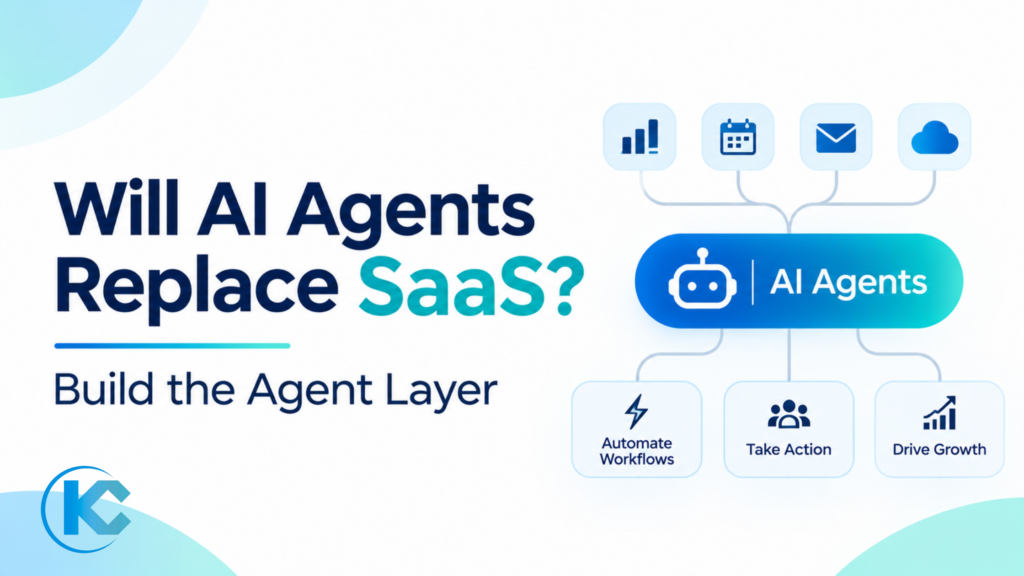
Will AI Agents Replace SaaS? How to Build the Agent Layer on Your Salesforce Stack
⏱ 3 min read
AI Agents • Salesforce • Agentforce
Don’t wait for AI agents to replace your SaaS. Put them to work on it.
Leaders keep hearing that AI agents will replace SaaS. The practical answer is simpler: your systems of record stay, and an agent layer takes over the cross-system work your people do between them. Kizzy designs, builds and governs that layer on Salesforce, so your team stops operating tools and starts supervising outcomes.
50+
AI agents built
120+
Projects delivered
98%
Client satisfaction
Salesforce
Ridge Partner
Will AI agents replace SaaS? The short answer
Not wholesale, and not on the headline timeline. SaaS keeps the data and the rules. Agents take over the work that happens between your systems. Microsoft CEO Satya Nadella suggested in a December 2024 interview that business applications could “collapse” as logic moves to an AI tier, while a venture investor quoted in the same coverage expects legacy systems to persist for years.
The real risk is poor execution. Gartner predicts that over 40% of agentic AI projects will be canceled by the end of 2027. The safest move is a governed agent layer on the stack you already run, built by a team that has done it before.
Three Ways to Respond to AI Agents
Most teams end up choosing one of these paths, whether they decide on purpose or not.
| Factor | Wait and watch | Agent layer on your stack | Rip and replace |
|---|---|---|---|
| Who does cross-system work | People, in every tool | Agents, supervised by people | Agents, after a rebuild |
| Your data and rules | Stay in SaaS | Stay in SaaS | Migrated and rebuilt |
| Time to first result | None | Weeks. An AI Pod build is typically scoped at about 4 to 8 weeks | Long, and tied to migration |
| Main risk | Competitors move first | Contained, because each agent has a scoped job | Disruption to live operations |
| Governance | Shadow AI grows unchecked | Designed in from day one | Has to be rebuilt too |
AI Agents Kizzy Builds on Top of Your Stack
Each agent has one clear job, connects to the systems you already use, and keeps people in the loop where it matters.
AI Voice Agent
Answers inbound calls, qualifies leads, books appointments and saves the transcript to Salesforce.
AI Knowledge Base Agent
Answers employee questions from your SOPs, HR policies and contracts, with a citation to the source document.
AI Document Analysis Agent
Extracts data from PDFs, scans, invoices and contracts, applies your rules and syncs it to Salesforce. Anomalies go to a person.
AI Case Reporting Agent
Records and analyzes calls and meetings, then produces reports with decisions, action items and risks.
Agentforce Agents
Design, configure and deploy Agentforce agents inside your Salesforce workflows, from advisory through implementation.
Something custom?
If the job is not on this list, we scope and build a custom agent around it.
From Idea to Live Agent in Four Steps
1
Assess
Score your readiness across data, systems, governance and skills, and rank the use cases worth building first.
2
Prove
Test the highest-value use case with a proof of concept or MVP before committing to a full build.
3
Build and integrate
A dedicated AI Pod, with an AI architect, AI engineers, a product specialist and a prompt and evals specialist, builds and launches the agent.
4
Govern and run
Monitor, tune and govern the agent after launch, or hand the upkeep to our managed services team.
Security and Governance Come First
Agents act across systems at machine speed, so every connection is a place where permissions, logging and approvals have to hold. That is why governance is part of step one, not an afterthought:
- Least-privilege access. An agent should reach only the objects and fields its job needs. Start with our guide to Salesforce security controls.
- Human approval points. Anything that changes records, money or customer commitments can require a person to confirm.
- Classified data. Know which data an agent may use before it touches it. See our AI data classification guide.
- Ongoing oversight. Logging, monitoring and review through AI ops and governance.
Questions Leaders Ask Before Starting
Will AI agents replace SaaS applications?
Not wholesale. SaaS remains the system of record, and agents take over execution across those systems. Some leaders expect business logic to move to an AI tier over time, but experts quoted in the coverage expect existing systems to persist for years, so the practical path is to add an agent layer rather than replace your stack.
Do we need to replace Salesforce to use AI agents?
No. Agents work on top of Salesforce, either natively through Agentforce or as custom agents that integrate through APIs. Your data, objects and rules stay where they are.
Where should we start?
With one high-volume process that has clear rules and a number you can measure. The free AI readiness check gives you an instant score, and the consultant-led audit ranks your use cases and sequences a pilot-to-scale roadmap.
How long does it take to get an agent live?
It depends on scope, integrations, data and testing. Kizzy scopes AI Pod builds at approximately 4 to 8 weeks.
How do you keep agents safe and accurate?
By scoping each agent to a narrow job, limiting its permissions, grounding answers in your own data, adding human approval for sensitive actions and monitoring it after launch.
Which platforms do you build on?
Kizzy is a Salesforce Ridge Partner and a certified Agentforce implementation partner, and also a Claude Partner and OpenAI member, so we choose the model and platform that fit the job.
What does it cost?
It depends on the agent, the integrations and the data involved. We scope after a discovery call, and the free readiness check is a no-cost way to start.
Book Your AI Agent Strategy Call
Tell us which process eats your team’s time. We will tell you whether an agent fits, which kind, and what it takes to get it live. No obligation, and we work with teams in the USA and Australia.
1. Send the form2. We review your use case3. You get a clear recommendation
Prefer to start on your own? Run the free 3-minute AI readiness check or contact us.