Forward Deployed Engineer vs Solutions Engineer vs Consultant: Key Differences (2026)
⏱ 3 min read
AI DELIVERY · TEAM STRUCTURE · 2026
Forward deployed engineer vs solutions engineer is a staffing decision, not a title debate. This guide is for CTOs and engineering heads deciding who should deliver AI projects, and for professionals weighing these career paths.
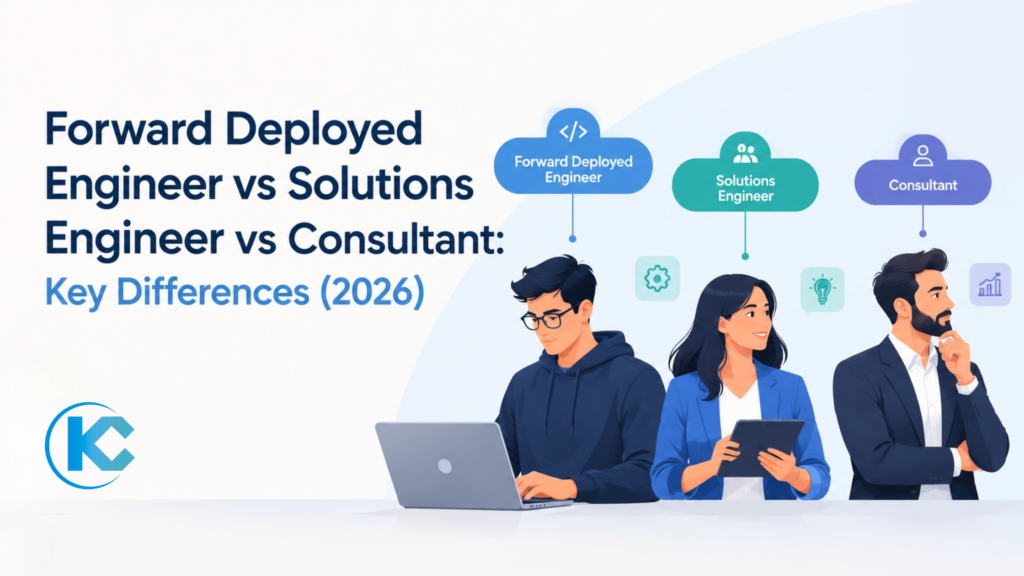
Each role answers a different question. A solutions engineer asks whether the product can work. A consultant asks what the business should do. A forward deployed engineer (FDE) asks how to make it run in production.
SM
By Sanjeet Mahajan, Founder & CEO, Kizzy Consulting · LinkedIn
Published: October 13, 2026 · Modified: October 13, 2026
THE QUICK ANSWER
Forward deployed engineer vs solutions engineer comes down to ownership. An FDE writes production code inside the client’s environment and stays until the system runs live. A solutions engineer proves technical fit before the sale, then hands off. A consultant diagnoses the problem and delivers a roadmap or audit, usually leaving the build to others.
Forward Deployed Engineer vs Solutions Engineer vs Consultant: Side-by-Side Comparison
The clearest forward deployed engineer vs solutions engineer comparison is by deliverable. The FDE ships live software, the solutions engineer (SE) proves feasibility, and the consultant delivers advice. Use this Kizzy hiring matrix to compare role, scope, ownership, billing and when to hire which.
| Criteria | Forward Deployed Engineer | Solutions Engineer | Consultant |
|---|---|---|---|
| Core deliverable | Working software in production | Architecture design and proof of concept | Strategy, business case or roadmap |
| Primary phase | Post-sale build and deployment | Pre-sale scoping and validation | Discovery, diagnosis and advisory |
| Production code | Yes, daily | Rarely; prototypes and scripts | No |
| Where the work happens | Embedded in the client’s team and systems | Customer-facing during scoping | Interviews and workshops, often remote |
| Accountable for | A live, adopted system | A technical win | A recommendation or audit |
| Typical billing | Outcome, story-point or phase-based | Absorbed in vendor sales cost | Retainer or fixed project fee |
| Hire when | Nothing is live and nobody owns production | You must validate a product before committing | The problem or business case is undefined |
Is Your Business Ready for AI?
Our AI Readiness Assessment evaluates your data, infrastructure, workflows and use cases so you know where to start.
Forward Deployed Engineer vs Solutions Engineer: Scope, Code and Ownership
The main difference is who owns the result after the demo. The FDE owns it. The solutions engineer and the consultant hand it to someone else.
Forward Deployed Engineer vs Solutions Engineer: Who Writes Production Code?
An FDE commits production code, builds data pipelines and debugs integrations against live data. A solutions engineer builds prototypes and proofs of concept to show what is possible. The work then moves to an implementation team, and context can get lost in that handoff. A solutions architect works the same way: the role designs the system but rarely ships it.
FDE vs Solutions Engineer vs Consultant: Who Owns the Outcome?
In an FDE vs consultant comparison, the consultant exits when the recommendation is accepted. A consultant is judged on the quality of the advice. An FDE is judged on whether the system works in production. Consultants bring an outside view and patterns from other industries, which helps when the problem is still undefined. The limit is that a roadmap does not run itself.
Forward Deployed Engineer Role vs Solutions Engineer: How Scope Changes
The forward deployed engineer role starts from an operational outcome, not a fixed specification. Once code meets live data, edge cases appear that no requirements document captured. The FDE adapts the build and updates the requirements as the work proceeds.
Forward Deployed Engineer vs Solutions Engineer: When to Hire Which
Match the role to the stage your AI project is in. Use these choose-if rules as a decision guide.
- Choose a consultant if the problem is undefined, leadership needs a business case, or you want an independent vendor assessment. Our AI strategy and advisory work covers this stage.
- Choose a solutions engineer if you are evaluating a product and need a proof of concept before committing. An AI PoC and MVP build tests feasibility cheaply.
- Choose an FDE if contracts are signed but nothing is live, time to value matters, and the system must fit your data, authentication and compliance limits.
- Choose staff augmentation if your team has a clear roadmap and needs capacity only. You keep the backlog and the outcome.
Related Read
See why pilots stall without a production owner, and what to fix before you scale.
Forward Deployed Engineer vs Solutions Engineer: Common Hiring Mistakes
The most common mistake is buying advice or demos when the project needs production ownership. MIT NANDA’s 2025 GenAI Divide report, as covered by Fortune, found that about 95% of enterprise generative AI pilots show no measurable business impact. It pointed to brittle workflows rather than weak models.
- Hiring a solutions engineer to deliver. SEs validate fit and rarely own production.
- Buying a roadmap when the strategy is clear. Pay for the build instead.
- Calling staff augmentation an FDE engagement. Added capacity is not outcome ownership.
- Skipping access and data checks. An FDE needs system access and close collaboration, so plan for both before rollout through AI integration and implementation.
An FDE is not always the answer. If requirements are stable and the work is standard configuration, a fixed-scope implementation team can cost less.
Forward Deployed Engineer vs Solutions Engineer: Frequently Asked Questions
Forward Deployed Engineer vs Solutions Engineer: Key Takeaways
- The forward deployed engineer vs solutions engineer difference is ownership: production delivery versus pre-sale proof.
- Hire a consultant when the problem is undefined, and an FDE when the problem is clear and nothing is live.
- Match the role to the project stage, and check data and access readiness before you engage any of them.
If nothing is live and nobody owns production, explore Kizzy’s forward deployed engineer services.
Not Sure Whether You Need a Forward Deployed Engineer or a Solutions Engineer?
Tell us where your AI project stands. Kizzy Consulting will help you match the right role to your stage, from strategy to production.