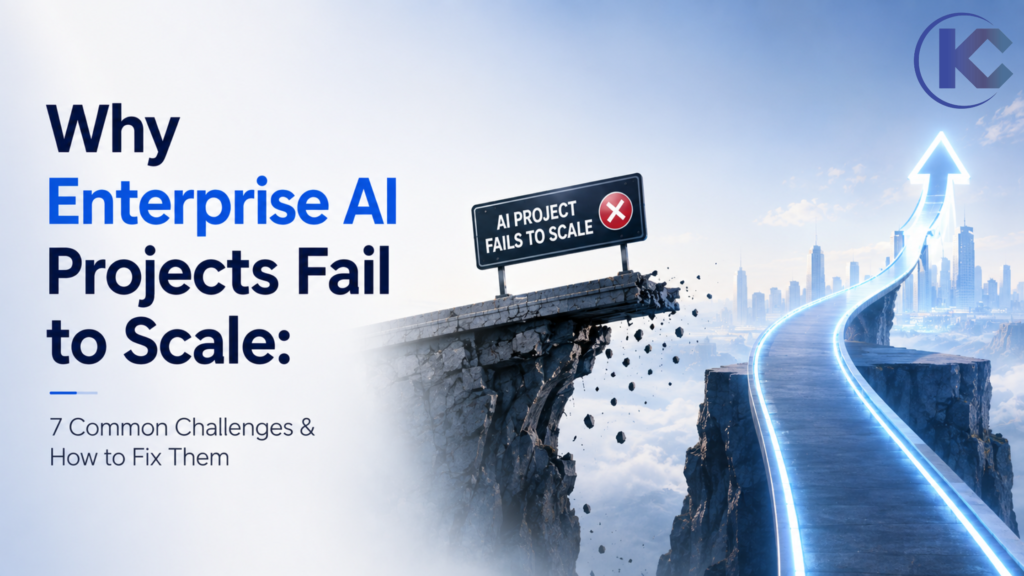
Why Enterprise AI Projects Fail to Scale: 7 Common Challenges & How to Fix Them
⏱ 6 min read
Enterprise AI projects often succeed in a pilot but struggle when they reach production. Poor data quality, unclear business outcomes, disconnected systems, rising costs, and weak governance can prevent promising experiments from delivering lasting value. This guide explains why enterprise AI projects fail to scale and how organizations can move from isolated pilots to reliable, measurable business workflows.
The challenge is increasingly about execution, not simply access to AI. Deloitte’s 2026 State of AI in the Enterprise research found that 25% of respondents had moved 40% or more of their AI experiments into production. In McKinsey’s 2025 State of AI survey, 88% reported regular AI use in at least one business function, while 39% reported some enterprise-level EBIT impact from AI.
These findings measure different things, but point to the same practical challenge: adoption alone does not guarantee business value. Scaling AI requires reliable data, clear ownership, workflow integration, appropriate controls, skilled teams, and measurable outcomes.
By Sanjeet Mahajan, Founder & CEO of Kizzy Consulting
Executive Quick Answer
Contents
hide
Why do enterprise AI projects fail to scale?
Enterprise AI projects often struggle to scale because the surrounding business environment is not ready for production. Common barriers include fragmented or unreliable data, unclear ROI, weak integration, uncontrolled operating costs, skills gaps, low user adoption, and insufficient governance. Organizations improve their chances of success by designing AI around complete workflows, accountable owners, production controls, and measurable business outcomes rather than treating a successful pilot as the finish line.
What the Research Says About Enterprise AI at Scale
25%
Of Deloitte 2026 respondents had moved 40% or more of their AI experiments into production.
88%
Of McKinsey 2025 survey respondents reported regular AI use in at least one business function.
39%
Of McKinsey 2025 survey respondents reported some enterprise-level EBIT impact from AI.
These are survey findings with different definitions and measures. They should not be interpreted as a single enterprise AI failure rate or as proof that every organization will achieve the same results.
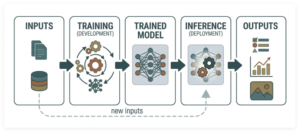
Why Enterprise AI Projects Struggle to Scale
Enterprise AI projects often begin with strong momentum. A company builds a predictive model, launches a generative AI assistant, creates a customer service agent, or automates a document-heavy process. The pilot performs well, and leadership sees the potential.
The difficulty appears when the solution needs to become part of everyday operations.
Production AI must work with real enterprise data, existing applications, security controls, business rules, users, approvals, APIs, compliance requirements, monitoring systems, and changing workloads. A prototype can bypass some of these requirements. A production system cannot.
This creates the pilot-to-production gap: the distance between proving that AI can work and making it reliable, secure, maintainable, and useful at enterprise scale.
Before committing to a broader rollout, organizations should evaluate their AI readiness, including data quality, architecture, governance, workforce capability, and business alignment.
The Pilot Trap: Why Early AI Success Is Not Enough
AI pilots are useful because they let teams test feasibility and reduce uncertainty. The mistake is assuming that a successful pilot automatically proves production readiness.
A pilot may use a small dataset, a limited user group, a simplified workflow, manual intervention, and a temporary technical environment. Production removes many of those safety nets.
What Makes AI Pilots Look Better Than They Really Are?
- The clean-data illusion: Pilot data may be filtered and prepared manually. Production data can contain duplicates, missing fields, outdated records, inconsistent definitions, and information scattered across systems.
- Limited scalability: A model that works for one team, region, product, or workflow may behave differently as volume and complexity increase.
- Manual workarounds: Teams may resolve errors manually during a pilot. Those workarounds become expensive and unreliable at higher volumes.
- Limited integration: The pilot may generate a useful answer without updating CRM, ERP, ticketing, finance, or operational systems.
- A narrow user group: Motivated early adopters may succeed while the wider organization lacks the training or confidence to use the system.
- Missing operational ownership: Teams may not have defined who monitors performance, handles incidents, manages costs, and approves changes after launch.
7 Common Challenges That Stop Enterprise AI From Scaling
Most enterprise AI scaling problems fall into seven connected areas. Addressing one while ignoring the others can simply move the bottleneck somewhere else.
1. Poor Data Quality and Low Data Readiness
Enterprise AI depends on reliable, well-governed data. But information often sits across CRMs, ERPs, warehouses, spreadsheets, legacy systems, and third-party platforms. Duplicates, inconsistent definitions, outdated records, and unclear data ownership can make outputs unreliable.
Organizations should establish data ownership, quality checks, access controls, and integration standards before relying on AI for important business decisions.
2. Unclear Business Value and Weak AI Objectives
Start with the business problem, not the technology. A valuable AI use case should target a measurable outcome such as lower processing costs, faster service, fewer errors, improved conversions, or better employee productivity.
Define the baseline, target, measurement method, and accountable business owner before development. For a deeper framework, see our guide to enterprise AI adoption strategy.
3. Difficulty Moving Beyond the Pilot
A proof of concept demonstrates technical feasibility. Production AI must also be secure, integrated, scalable, testable, monitorable, and maintainable. That requires production architecture, evaluation, exception handling, integration testing, and operational ownership from the beginning.
Use a defined transition plan with acceptance criteria for reliability, security, performance, business value, and support readiness.
4. Rising AI Costs and Weak Cost Control
Production costs can grow through model usage, cloud infrastructure, data storage, integrations, monitoring, security, and compliance. Total spending alone does not show whether a system is economical.
Track cost per successful task, customer, case, or completed workflow. Our guide to AI agent cost optimization explains how model selection, token use, retrieval, retries, and execution controls affect spending.
5. AI Skills Gaps and Limited Internal Expertise
Enterprise AI needs more than data scientists. AI engineers, data engineers, architects, integration and security teams, product owners, domain experts, and business users must work together.
Without cross-functional expertise, even technically capable systems can struggle with workflow integration, testing, support, and user adoption. Role-based AI training and enablement can help teams use approved tools responsibly and effectively.
6. Organizational Resistance and Unclear Ownership
AI projects often span departments, creating gaps in decision-making and accountability. Clear business ownership, executive sponsorship, cross-functional collaboration, and human oversight help keep implementation aligned.
Change management should include employee training, communication about how AI affects existing work, clear escalation paths, and ongoing feedback. Adoption should be measured rather than assumed.
7. Weak AI Governance, Security, and Risk Management
Production AI may handle sensitive information or take actions in business systems. Organizations need appropriate controls for privacy, security, access, auditability, fairness, human review, monitoring, compliance, and incident response.
Build governance into the architecture from the start. Kizzy’s AI governance and operations services provide a starting point for defining operational controls and accountability.
Why Workflow-First AI Produces Better Enterprise Outcomes
A workflow-first approach begins with how work moves through the organization, including triggers, decisions, systems, people, approvals, and exceptions.
Consider invoice processing. A task-based solution may extract the invoice amount. A workflow-first solution designs the entire process around extraction, validation, exception handling, approval, and the update of financial systems.
01
Extract
Capture information from documents and source systems.
02
Validate
Apply business rules and check data quality.
03
Route
Send exceptions and approvals to the right people.
04
Update
Write approved information back to business systems.
The system should also log decisions, monitor failures, and provide a controlled route for human intervention. This is the difference between generating an AI output and delivering an operational outcome.
The 4 Pillars of Scaling Enterprise AI
Moving from a pilot to production requires a balanced operating model. Four pillars help organizations build that foundation.
1. Data-Ready
- Defined data ownership
- Reliable data sources
- Consistent schemas
- Quality monitoring
- Secure access controls
2. Outcome-Driven
- Clear business problem
- Defined KPIs
- Baseline measurements
- ROI tracking
- Outcome-based design
3. Collaborative
- Business ownership
- IT and security alignment
- Domain expert involvement
- User feedback
- Change management
4. Governed
- Executive sponsorship
- Risk-based controls
- Human oversight
- Auditability
- Continuous monitoring
How to Fix Enterprise AI Scaling Problems
The answer is not to abandon AI pilots. It is to design the path from pilot to production before the pilot becomes a dead end.
1. Run an AI Readiness and Data Audit
Assess data quality, system dependencies, integration architecture, governance, security, workforce skills, and business priorities. Ask whether the proposed system can operate safely and reliably in the environment where it will actually be used.
Use a structured AI readiness assessment to identify gaps and prioritize remediation before making a major production commitment.
2. Define Business Metrics Before Building
Do not wait until launch to decide whether the project succeeded. Establish a baseline for processing time, error rate, cost, conversion, employee workload, customer response time, or another relevant measure.
Set a target and define how the outcome will be measured after deployment. For a broader adoption framework, see our guide to enterprise AI adoption strategy.
3. Map the Full Workflow Before Automating
Document the process from trigger to final outcome. Identify systems, people, decisions, approvals, exceptions, and handoffs. This prevents the common mistake of automating a task while leaving the actual bottleneck untouched.
4. Build Integration Into the Architecture
Enterprise AI should connect securely to the systems where work already happens. Depending on the use case, this may include Salesforce, ERP platforms, data warehouses, document systems, ticketing platforms, APIs, and internal knowledge bases.
Design permissions, error handling, retries, audit logs, and data validation alongside the integration itself.
5. Keep Humans in the Loop Where They Add Value
Not every AI decision should be autonomous. High-risk, unusual, or low-confidence cases should be routed to people with the right expertise and context.
Define the conditions that require human review, what information reviewers need, and how their decisions feed back into system evaluation.
6. Establish Governance Before Production
Define acceptable use, data access, security controls, audit requirements, escalation paths, monitoring, and accountability before deployment. Governance should be part of the AI architecture rather than an approval step added at the end.
Explore Kizzy’s AI governance and operations services for help establishing operational controls.
7. Create a Repeatable AI Scaling Model
Once the first production use case works, reuse what can be standardized: architecture patterns, integrations, governance controls, evaluation methods, data pipelines, deployment processes, and monitoring.
A repeatable delivery model helps organizations expand successful use cases without rebuilding every component from scratch.
How Kizzy Approaches the Pilot-to-Production Gap
Kizzy Consulting approaches enterprise AI as a business and engineering challenge, combining readiness, architecture, integration, evaluation, and operational controls.
1. Assess
Evaluate readiness, data, infrastructure, governance, workflows, and business priorities.
2. Architect
Design AI, data, integration, security, and workflow architecture around the target outcome.
3. Build and Scale
Build and evaluate the solution, integrate it into business systems, and monitor it after launch.
Published Kizzy project example
From RAG proof of concept to an AI support MVP
In a published, anonymized engagement for a mid-market B2B manufacturer, Kizzy describes building a retrieval-augmented generation (RAG) proof of concept for technical support using 500 schematics. The project reported 92% retrieval accuracy during the proof-of-concept stage, followed by a pilot MVP that reported a 65% reduction in technical support ticket resolution time.
These are results from that specific engagement, not a guaranteed outcome for other projects. The published case describes a three-week proof-of-concept phase; it does not establish a universal pilot-to-production timeline or a reduction in AI cost per workflow.
What This Means for Agentforce and Salesforce AI
The same scaling principles apply to Salesforce AI and Agentforce. Turning on an AI capability is only the beginning. Agentforce needs reliable Salesforce data, clearly defined business processes, appropriate permissions, well-governed actions, integrations, testing, and user adoption.
Before expanding an Agentforce deployment, validate the workflows the agent can access, the actions it is allowed to take, when it must ask for approval, and how the organization will monitor outcomes and exceptions.
For organizations evaluating Salesforce-specific deployment risks, see Kizzy’s AI Readiness Assessment 2026 guide.
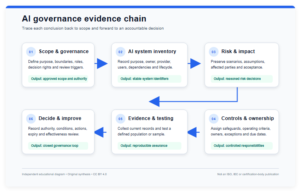
Enterprise AI Scale-Readiness Checklist
Before moving an AI project from pilot to production, leadership should be able to answer “yes” to most of these questions:
- Business: Is the business outcome specific and clearly owned?
- ROI: Are baseline KPIs defined, with a reliable method for measuring business impact?
- Data: Is the required data accurate, accessible, governed, and current?
- Integration: Can the AI system securely interact with the applications where work happens?
- Workflow: Is the complete process mapped from trigger to outcome, including exceptions?
- Governance: Are privacy, security, compliance, auditability, and human review requirements defined?
- People: Do users understand the system and know how to escalate problems?
- Operations: Can the organization monitor performance, costs, failures, and adoption after launch?
- Cost: Can the organization track cost per successful workflow and control unexpected usage?
- Scale: Is there a repeatable architecture for expanding successful use cases?
Conclusion: Enterprise AI Needs More Than a Successful Pilot
Enterprise AI projects can struggle not because a model cannot produce an impressive result, but because the surrounding data, systems, workflows, governance, and operating model are not ready for production.
The path from pilot to production requires a different mindset: do not build AI as an isolated experiment. Build it as part of the way the business works.
Start with a measurable business problem. Assess readiness, prepare the data foundation, map the complete workflow, design secure integrations, establish governance, prepare users, and measure outcomes after deployment.
McKinsey’s 2025 State of AI research highlights the gap between widespread AI use and enterprise-level financial impact. Deloitte’s 2026 research also illustrates the challenge of moving AI experiments into production.
Kizzy Consulting helps organizations move from experimentation toward production-ready AI through readiness assessments, AI strategy, data foundations, enterprise integrations, custom AI agents, workflow automation, Agentforce implementation, governance, and ongoing optimization.
Frequently Asked Questions About Why Enterprise AI Projects Fail
Why do enterprise AI projects fail?
Enterprise AI projects often struggle because of poor data quality, unclear business goals, weak integration, rising costs, skills gaps, organizational resistance, and insufficient governance. These issues become more visible when a pilot must operate with real users, production data, business systems, and ongoing operational requirements.
Why do AI pilots fail to reach production?
Pilots often use limited datasets, small user groups, simplified workflows, and temporary infrastructure. Production requires secure integrations, reliable performance, governance, monitoring, scalability, user adoption, and clear operational ownership. A transition plan should define these requirements before the pilot ends.
What is the biggest challenge when scaling enterprise AI?
There is no single challenge for every organization. Data readiness, workflow integration, business alignment, and governance are common constraints. A strong model cannot compensate for unreliable data, unclear ownership, disconnected systems, or a lack of controls for handling errors and exceptions.
How can companies move AI from pilot to production?
Start with a readiness assessment and measurable business outcomes. Audit the data foundation, map the full workflow, design integrations, establish governance, test real-world performance, prepare users, and assign operational ownership. Monitor costs, reliability, adoption, and business results after launch.
What is workflow-first AI?
Workflow-first AI is designed around a complete business process rather than one isolated task. It connects AI capabilities with business rules, data, systems, approvals, people, exception handling, and measurable outcomes so the organization can evaluate the entire process rather than just the model’s output.
How should enterprises measure AI success?
Choose metrics tied to the workflow, such as processing time, error rate, cost per successful task, customer response time, employee hours saved, or conversion rate. Record a baseline before deployment and compare it with results after launch. Also monitor reliability, security, adoption, and ongoing operating costs.
Can Kizzy Consulting help scale an enterprise AI project?
Kizzy Consulting supports enterprise AI readiness, strategy, data foundations, AI agents, workflow automation, Salesforce and Agentforce integration, governance, and ongoing optimization. The appropriate approach depends on the existing system, business objective, data readiness, risk requirements, and production constraints.
Is Your AI Project Ready to Scale?
If your AI pilot works but production keeps getting delayed, the issue may be your data, workflows, architecture, governance, or operating model. Kizzy Consulting can help identify the gaps and create a practical path from pilot to production.
Assess data, technology, governance, skills, and strategy.
Connect AI to the systems and workflows your teams already use.