AI Data Classification for AI Agents: Methods, Controls and Salesforce Best Practices (2026)
⏱ 4 min read
AI DATA SECURITY GUIDE 2026
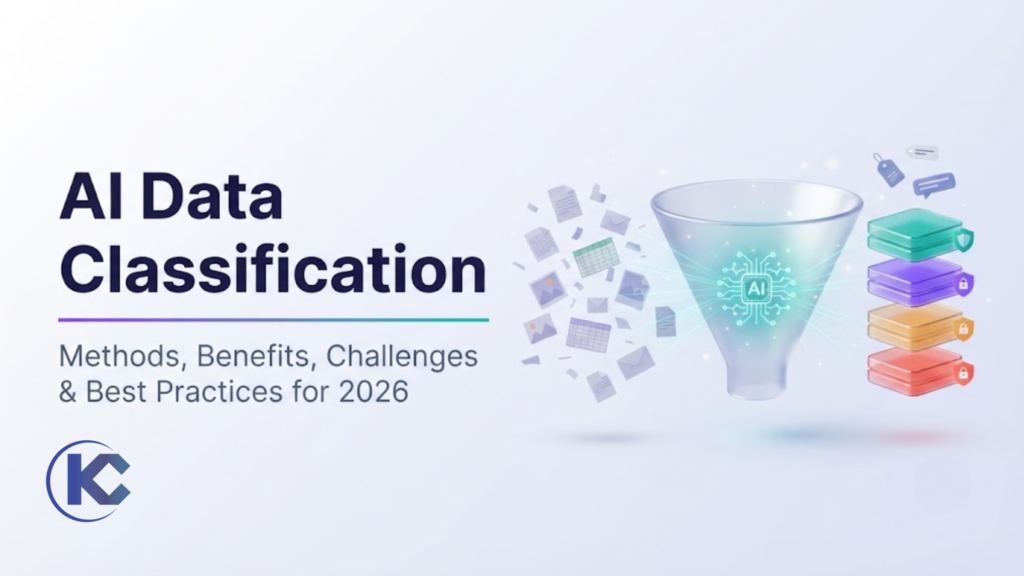
AI data classification helps organizations identify sensitive information and determine how it should be protected. For Salesforce and AI agents, the important question is not only what a field contains, but whether an agent should be allowed to retrieve that information in the first place.
Executive Quick Answer
What Is AI Data Classification?
AI data classification uses machine learning, language models and context to label sensitive data, such as personal, financial and health records, and to attach a confidence score. Those labels drive access, masking, retention and DLP rules. For AI agents, classify before data reaches the model, because a missed label becomes exposed context.
AI Data Classification Is a Decision About Uncertainty
Traditional security rules look for predictable patterns. AI classifiers make predictions, and those predictions carry uncertainty. A system might identify a document as containing personal information or determine that a database probably contains payment records.
The challenge is deciding when a prediction is reliable enough to trigger an action. Confidence thresholds, precision, recall, false positives and false negatives therefore matter as much as the classification model itself.
A label can influence access permissions, encryption, retention, data loss prevention (DLP), compliance reporting and AI governance. Incorrect classifications can create security gaps or disrupt legitimate business activity.
What Does AI Data Classification Identify?
AI classification uses rules, machine learning, embeddings, language models and contextual signals to determine what information represents and how it should be categorized.
Personal Data
Names, addresses, identifiers and contact information.
Financial Data
Payment details, account information and financial records.
Health Data
Medical records, diagnoses and protected health information.
Confidential Business Data
Contracts, forecasts, intellectual property and internal plans.
Contextual classification can also identify M&A documents, vendor security assessments, payroll workbooks and customer escalation reports.
Classification is not enforcement. It identifies what data appears to contain. DLP, access controls, encryption and retention policies determine what happens next.
How AI Classification Differs From Other Security Controls
AI can help apply classification across the large volumes of information held in cloud environments, collaboration platforms, databases and AI applications. Three related disciplines have different responsibilities.
Data Loss Prevention
DLP detects and restricts unauthorized sharing, movement or exposure of information.
Data Security Posture Management
DSPM connects sensitive-data discovery with exposure, permissions and configuration risks.
AI Security
AI security protects models, prompts, agents, identities, infrastructure and workflows.
The Six-Stage Classification Pipeline
A production classification pipeline usually includes six stages. The precise implementation depends on data sources, file formats, risk requirements and the controls that consume the resulting labels.
01. Discover
Inventory databases, files, cloud resources and applications.
02. Extract
Parse text, metadata, tables and image content using OCR where required. For more detail, see OCR vs. IDP.
03. Classify
Apply rules, machine learning, embeddings or language models.
04. Score
Evaluate confidence against category-specific policy thresholds.
05. Label
Attach labels and supporting evidence to data objects or fields.
06. Enforce
Apply appropriate security and governance controls.
Coverage sets what the classifier can inspect. Encrypted files, unsupported formats, inaccessible storage and images without OCR can prevent inspection. A missing classification result does not necessarily mean data is safe; the system may not have been able to examine it.
Cloud classification should also account for information moving between production systems, development environments, backups, SaaS applications and AI tools.
Four Classification Methods and When to Use Each
Enterprise systems often combine several classification methods rather than relying on a single model.
Pattern and Rule-Based Detection
Uses regular expressions, dictionaries, checksums and schemas to identify predictable information.
Best for: payment cards, identifiers and API keys.
Supervised Machine Learning
Learns from labeled examples to categorize new content.
Best for: contracts, HR documents and financial records.
Embeddings and Semantic Models
Compare meaning rather than relying only on exact words or patterns.
Best for: unstructured text and custom business categories.
Language Models and Human Review
Interpret ambiguous content and route uncertain results for validation.
Best for: context-heavy documents and high-impact decisions.
KIZZY AI DOCUMENT ANALYSIS
Applying Document Intelligence to Sensitive Business Data
AI data classification becomes more useful when document content, sensitivity and downstream access requirements are considered together. Contracts and other business documents can contain confidential terms, personal information, financial details and deadlines that require appropriate handling before the information enters an automated workflow.
Kizzy’s DocSense is an AI document analysis solution designed for real-estate documents, including purchase agreements and leases. Its document analysis workflow can extract information such as contract clauses, contingency dates, disclosures and risk terms for downstream business processes.
Where Classification Fits
A document intelligence workflow can support a broader data protection process by identifying document types, extracting relevant content and routing information for the appropriate review or handling process.
- Identify: Determine the document type and extract relevant information.
- Review: Assess sensitive fields and business-critical terms where supported by the implementation.
- Control: Apply approved access, retention and disclosure policies through the relevant downstream systems.
- Validate: Route uncertain or high-impact findings for human review when required.
Implementation note: Document extraction and data classification are separate capabilities. Confirm with the DocSense delivery team whether classification of document types or sensitive data is an explicit, deployed product capability before describing it as a feature. Similarly, include measured accuracy, time savings or other performance results only when supported by the documented live-deployment methodology.
Security Benefits of AI Data Classification
Sensitive Data Discovery
Locate personal information, credentials, intellectual property and regulated data.
Stronger Access Control
Align permissions with data sensitivity and business requirements.
Improved DLP
Detect sensitive information before unauthorized sharing or transfer.
Compliance Evidence
Maintain clearer records of where regulated data exists.
Faster Incident Response
Understand the sensitivity of data involved in security incidents.
Reduced Analyst Noise
Use context to prioritize meaningful findings over irrelevant matches.
AI Data Classification Use Cases
Shadow Data Discovery
Find sensitive information in forgotten storage, backups and unmanaged repositories.
Generative AI Protection
Inspect prompts, uploads and retrieved content before it reaches AI models.
Development Security
Identify production data or credentials copied into test environments.
M&A Data Discovery
Assess sensitive information in newly acquired environments.
Insider Risk
Combine data sensitivity with identity and behavioral signals.
Compliance Automation
Identify information relevant to privacy and security requirements.
EMERGING AI SECURITY BOUNDARY
AI Data Classification for MCP and AI Agents
Model Context Protocol (MCP) can enable AI agents to retrieve information from CRMs, knowledge bases, repositories and document systems. Retrieved information may then enter a model’s context window or flow into another tool.
Scanning data only at rest may not identify every sensitive payload retrieved at runtime. AI architectures should consider classifying information during retrieval and before it reaches a model or downstream system. Depending on policy, runtime controls can redact, block, log or route sensitive information for approval.
On the Salesforce hosted MCP server, tool calls run with the permissions of the user who authorized the connection. Field-level security, object permissions and sharing rules therefore remain relevant. Scoped SObject servers, Named Queries and Apex invocable methods can narrow which data a tool returns.
For agent architectures, classification should be paired with least-privilege access and traceable controls. Read more in Kizzy’s AI Trust Architecture guide and AI Integration & Implementation Services.
How Salesforce Classifies Data for AI Agents
Salesforce stores classification as field metadata, and several controls read it. The following table summarizes what each layer does and where its limits are. Confirm product licensing and org-specific availability before implementation.
| Layer | What it does | Limits and considerations |
|---|---|---|
| Data classification metadata | Records Data Owner, Data Sensitivity Level, Compliance Categorization and Field Usage on standard and custom fields. | Labels fields but does not enforce access on its own. Labels must be set and maintained. |
| Shield Data Detect | Scans supported text fields for predefined or custom patterns and keywords, and can help update field classification from scan results. | Requires the applicable Shield or Data Detect license. Confirm supported field types and current scan behavior. |
| Einstein Trust Layer data masking | Can replace detected sensitive values in supported prompts with placeholders and restore values in the response. Field-based masking can use classification metadata. | Salesforce documents that LLM data masking is disabled for agents. Detection models do not guarantee perfect identification. |
| Hosted MCP server | Runs tool calls under the authorizing user’s permissions, including applicable field-level security, object access and sharing rules. | Use scoped servers, Named Queries and Apex invocable methods where appropriate to narrow the data returned. |
| Salesforce Data Mask | Masks selected fields in sandbox and other supported non-production data copies. | Designed for non-production data protection; it is not a replacement for runtime agent access controls. |
For implementation details, review Salesforce’s Data Classification Metadata Fields, its Data Detect scan guidance and Hosted MCP server best practices.
AI Data Classification and AI Governance
When AI models and agents connect to enterprise information, governance teams need to understand which data is accessible, which categories require protection and how model activity is monitored.
Classification can support:
RBAC and least privilege
PII masking policies
Audit trails
Human approval
Prompt protection
AI observability
On Salesforce, Einstein Trust Layer masking is off for agents, so field classification and scoped data access carry more of the load. Masking should not be treated as a substitute for access controls.
For the wider control framework, read AI Governance Trends 2026 and explore Kizzy’s AI Ops & Governance Services.
Frequently Asked Questions About AI Data Classification
What is the difference between AI and traditional data classification?
Traditional methods rely heavily on manual labels, keywords and fixed rules. AI adds machine learning and semantic analysis to interpret unstructured content and context-dependent information.
Can AI data classification work across AWS, Azure and Google Cloud?
Yes, provided the solution supports the relevant services, connectors, APIs and data formats. A shared taxonomy helps maintain consistent labels across environments.
Can AI classify unfamiliar document formats?
AI can identify document categories through semantic and contextual signals, but unsupported file formats may require additional extraction tools. Results should be validated for unfamiliar categories.
How accurate is AI data classification?
Performance depends on the data, model, training examples and thresholds. Precision and recall reveal more about operational performance than a single accuracy figure.
Can AI detect sensitive information in images?
Yes, when the pipeline includes OCR or suitable image-understanding capabilities to inspect scanned documents, screenshots and photographs.
Does Einstein Trust Layer masking apply to Agentforce agents?
Salesforce documents that LLM data masking is disabled for agents. Masking remains available for supported generative AI features, but its availability depends on the feature and execution path. Agentforce implementations should use appropriate data access permissions, scoped retrieval and guardrails rather than relying on masking alone.
How do you classify data in Salesforce?
Salesforce records classification as field metadata, including Data Owner, Data Sensitivity Level, Compliance Categorization and Field Usage. Shield Data Detect can scan supported text fields for sensitive patterns and help update those labels from scan results. Confirm licensing and supported field types for your org.
Where should classification happen for MCP servers and AI agents?
Classify data before an agent can request it, and validate data again when it is retrieved. The Salesforce hosted MCP server runs tool calls with the authorizing user’s permissions, while scoped servers and Named Queries can limit which objects and fields a tool returns.
Need Help Making Salesforce Data AI-Ready?
Classify before your agents read the data. Talk to Kizzy Consulting about field classification, scoped MCP access and AI agent governance for your Salesforce org.