Why Enterprise AI Projects Fail to Scale: 7 Common Challenges & How to Fix Them
⏱ 5 min read
Enterprise AI adoption is accelerating, but moving from an impressive AI pilot to a reliable production system is still difficult for many organizations. The technology may work. The business case may look promising. The pilot users may be happy. But scaling AI requires much more than a successful model. Deloitte’s 2026 State of AI in the Enterprise research found that only 25% of respondents had moved 40% or more of their AI experiments into production, although 54% expected to reach that level within the next three to six months. McKinsey’s 2025 research also found that 88% of organizations regularly use AI in at least one business function, yet only 39% report enterprise-level EBIT impact.
The lesson is simple: AI adoption is not the same as AI transformation. Enterprises need clean data, clear business goals, scalable infrastructure, governance, skilled teams, strong integrations, and workflows designed around measurable outcomes.
By Sanjeet Mahajan – CEO & Founder of Kizzy Consulting
Executive Quick Answer
Why do enterprise AI projects fail to scale?
Enterprise AI projects usually fail to scale because the organization solves the AI problem but not the surrounding business problem. Common barriers include poor data quality, unclear ROI, weak integration, rising costs, limited AI skills, organizational resistance, and weak governance. Successful enterprise AI programs connect data, people, systems, workflows, governance, and measurable business outcomes before expanding beyond the pilot.
25%
Share of Deloitte 2026 respondents that had moved 40% or more of their AI experiments into production.
88%
Organizations reporting regular AI use in at least one business function in McKinsey’s 2025 survey.
39%
Organizations reporting any enterprise-level EBIT impact from AI in McKinsey’s 2025 survey.
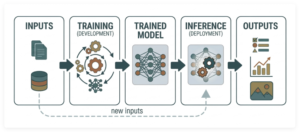
Illustrative AI workflow showing the journey from inputs and training to deployment and outputs.
Why Enterprise AI Projects Struggle to Scale
Enterprise AI projects often begin with strong momentum. A company builds a predictive model, launches a generative AI assistant, creates an AI customer service agent, or automates a document-heavy process. The pilot performs well and leadership sees the potential.
The problem appears when the pilot needs to become part of everyday operations.
Production AI has to work with real enterprise data, existing applications, security controls, business rules, users, approvals, APIs, compliance requirements, monitoring systems, and changing workloads. A prototype can avoid many of these requirements. A production system cannot.
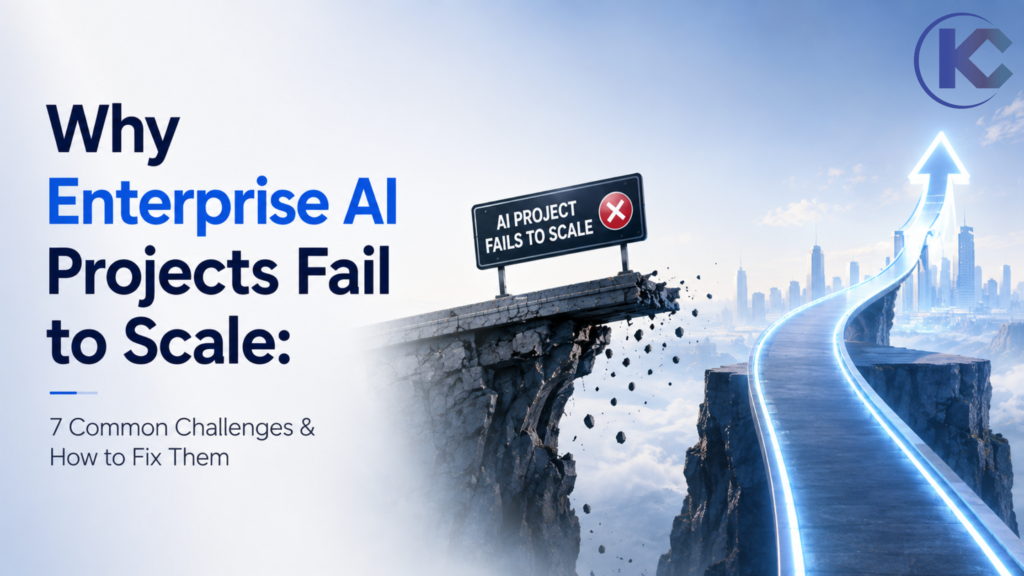
This creates the pilot-to-production gap: the distance between proving that AI can work and building an AI system that can work reliably at enterprise scale.
The Pilot Trap: Why Early AI Success Is Not Enough
AI pilots are useful. They reduce risk and allow teams to test whether an idea is technically possible. The problem is assuming that a successful pilot automatically proves production readiness.
A pilot may use a small dataset, a limited group of users, a simplified workflow, manual intervention, and a temporary technical environment. Production removes those safety nets.
What Makes AI Pilots Look Better Than They Really Are?
- The clean data illusion: pilot data is often filtered and prepared manually, while production data contains duplicates, missing fields, outdated records, conflicting schemas, and information spread across systems.
- Limited scalability: a model that works for one team, region, product, or workflow may behave differently when the volume and complexity increase.
- Manual workarounds: teams often fix gaps manually during a pilot. Those workarounds become expensive and unreliable when thousands of transactions need to be processed.
- Limited integration: the pilot may demonstrate AI output without actually updating CRM, ERP, ticketing, finance, or operational systems.
- Small user base: a pilot can succeed with motivated early adopters while the wider organization may not trust or understand the system.
Is Your Organization Ready to Scale AI?
Find the data, infrastructure, governance, workforce, and strategy gaps that could block your next AI deployment.
7 Common Challenges That Stop Enterprise AI From Scaling
Most enterprise AI scaling problems fall into seven connected areas. Fixing one while ignoring the others often creates another bottleneck.
1. Poor Data Quality and Low Data Readiness
Enterprise AI depends on reliable, well-governed data. But data is often scattered across CRMs, ERPs, warehouses, spreadsheets, legacy systems, and third-party platforms, with issues like duplicates, outdated records, inconsistent definitions, and weak governance. The result: poor-quality data leads to unreliable AI outputs.
2. Unclear Business Value and Weak AI Objectives
Start with the business problem, not the technology. Successful AI use cases should target measurable outcomes like lower costs, faster processes, higher conversions, better accuracy, or improved productivity. With many organizations using AI but seeing limited enterprise-level financial impact, ROI should be defined before development – not after deployment.
3. Difficulty Moving Beyond the Pilot
A proof of concept proves the technology can work, but production AI must also be scalable, secure, integrated, reliable, monitorable, and sustainable. That requires architecture, testing, governance, integration, and clear operational ownership from the start.
4. Rising AI Costs and Weak Cost Control
AI pilots may be inexpensive, but production costs can rise with model usage, cloud infrastructure, data storage, integrations, monitoring, security, and compliance. The focus should not just be on total AI spend, but on cost per workflow, customer, and measurable business outcome.
5. AI Skills Gaps and Limited Internal Expertise
Enterprise AI needs more than data scientists. AI engineers, data engineers, architects, integration and security teams, product owners, domain experts, and business users must work together. Without this cross-functional expertise, even technically strong AI systems may struggle with workflow integration and adoption.
6. Organizational Resistance and Unclear Ownership
AI projects often span multiple departments, creating ownership gaps that can slow progress. Clear business ownership, executive sponsorship, cross-functional collaboration, and human oversight help keep projects aligned. Successful adoption also depends on employee training, change management, and continuous feedback to build trust and reduce resistance.
7. Weak AI Governance, Security, and Risk Management
A pilot may need lighter governance, but production AI handling sensitive data requires controls for privacy, security, access, fairness, human oversight, monitoring, auditability, hallucinations, compliance, and incident response. Governance should be built into the AI architecture from day one, not added as a final approval step.
Need Expert Guidance on Enterprise AI Workflows?
Our team of certified Salesforce consultants and AI architects can help you deploy robust integrations and true workflow automation.
Why Workflow-First AI Produces Better Enterprise Outcomes
A workflow-first approach starts with how work actually moves through an organization.
Consider invoice processing. A task-based approach might use AI to read an invoice and extract the amount. A workflow-first approach asks the AI system to support the entire process:
01
Extract
Read invoices and capture structured data.
02
Validate
Apply business rules and check the information.
03
Route
Send exceptions and approvals to the right people.
04
Update
Push approved information into business systems.
The 4 Pillars of Scaling Enterprise AI
Moving from an AI pilot to production requires a balanced operating model. Four pillars are especially important.
1. Data-Ready
- Data governance
- Unified data sources
- Standardized schemas
- Data quality monitoring
- Real-time validation
2. Purpose-Built
- Clear business problem
- Defined KPIs
- ROI measurement
- High-value use cases
- Outcome-based design
3. Collaborative
- Business ownership
- IT collaboration
- Data and security alignment
- User involvement
- Change management
4. Led With Conviction
- Executive sponsorship
- AI strategy
- Investment priorities
- Governance framework
- Enterprise adoption
How to Fix Enterprise AI Scaling Problems
The solution is not to abandon AI pilots. The solution is to design the path from pilot to production before the pilot becomes a dead end.
1. Run an AI Readiness and Data Audit
Start by assessing the foundation. Review data quality, system dependencies, integration architecture, governance, security, workforce skills, and business priorities.
Ask: Can this AI solution operate safely and reliably in the environment where it will actually be used?
2. Define Business Metrics Before Building
Do not wait until the AI system is live to decide whether it was successful.
Define the baseline first:
- Current processing time
- Current error rate
- Current cost
- Current conversion rate
- Current employee workload
- Current customer response time
Then define the target improvement and track it after deployment.
3. Map the Full Workflow Before Automating
Document every step from trigger to final business outcome. Identify systems, people, decisions, approvals, exceptions, and handoffs.
This prevents the common mistake of automating one task while leaving the real bottleneck untouched.
4. Build Integration Into the Architecture
Enterprise AI should connect to the systems where work already happens. That can include Salesforce, ERP platforms, data warehouses, document systems, ticketing platforms, APIs, and internal knowledge bases.
5. Keep Humans in the Loop Where They Add Value
Not every AI decision should be fully autonomous. High-risk, unusual, or low-confidence cases should be routed to people with the right context.
Human-in-the-loop design can improve trust, reduce risk, and make adoption easier while allowing AI to handle high-volume routine work.
6. Establish Governance Before Production
Define acceptable AI use, data access rules, security controls, audit requirements, escalation paths, model monitoring, and accountability before deployment.
Governance should become part of the AI architecture rather than an approval process added at the end.
7. Create a Repeatable AI Scaling Model
Once the first production use case works, do not rebuild everything from zero. Create reusable architecture, integration patterns, governance controls, evaluation methods, data pipelines, and deployment processes.
This is how organizations move from one successful AI use case to an enterprise AI operating model.
Kizzy’s Enterprise AI Scaling Approach
Kizzy Consulting approaches enterprise AI as a business transformation problem, not simply a model-development project.
1. Assess
Evaluate AI readiness, data, infrastructure, governance, skills, workflows, and business priorities.
2. Architect
Design the AI, data, integration, security, and workflow architecture around the business outcome.
3. Build & Scale
Build production-ready AI agents, integrate them into existing systems, monitor performance, and expand successful workflows.
What This Means for Agentforce and Salesforce AI
The same scaling principles apply to Salesforce AI and Agentforce.Turning on an AI capability is only the beginning. Agentforce needs reliable Salesforce data, clear business processes, appropriate permissions, strong governance, well-defined actions, integrations, testing, and user adoption.
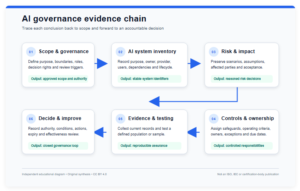
Governance should connect AI scope, risk, controls, evidence, accountability, and continuous improvement.
Enterprise AI Scale-Readiness Checklist
Before moving an AI project from pilot to production, leadership should be able to answer “yes” to most of these questions:
- Business: Do we know the specific business outcome this AI system should improve?
- ROI: Do we have baseline KPIs and a clear way to measure financial impact?
- Data: Is the required data accurate, accessible, governed, and current?
- Integration: Can the AI system securely interact with the applications where work happens?
- Workflow: Have we mapped the complete process from trigger to outcome?
- Governance: Are privacy, security, compliance, auditability, and human review requirements defined?
- People: Do business users understand the system and know how to work with it?
- Operations: Can we monitor performance, costs, failures, and user adoption after launch?
- Scale: Do we have a repeatable architecture for expanding successful use cases?
Conclusion: Enterprise AI Needs More Than a Successful Pilot
Enterprise AI projects rarely fail because the underlying model cannot produce an impressive result. More often, they fail because the surrounding organization, data, systems, workflows, governance, and operating model are not ready for production.
The path from pilot to production requires a different mindset:
do not build AI as an isolated experiment. Build it as part of the way the business works.
That means starting with a measurable business problem, checking AI readiness, preparing the data foundation, mapping the complete workflow, designing secure integrations, establishing governance, preparing users, and measuring outcomes after deployment.
McKinsey’s research shows that workflow redesign is strongly associated with organizations capturing more value from AI, while Deloitte’s 2026 research shows that moving experiments into production remains a major enterprise challenge.
At Kizzy Consulting, we help organizations move from AI experimentation to production-ready AI through readiness assessments, AI strategy, data foundations, enterprise integrations, custom AI agents, workflow automation, Agentforce implementation, governance, and ongoing optimization.
Frequently Asked Questions about Why Enterprise AI Projects Fail
Why do enterprise AI projects fail?
Enterprise AI projects often fail because of poor data quality, unclear business goals, weak integration, rising costs, limited skills, organizational resistance, and weak governance. These problems usually become visible when a pilot needs to operate in the real enterprise environment.
Why do AI pilots fail to reach production?
Pilots usually operate with limited users, clean data, simplified workflows, and temporary infrastructure. Production requires reliable integrations, security, governance, monitoring, scalability, user adoption, and operational ownership.
What is the biggest challenge when scaling enterprise AI?
There is no single challenge for every organization, but data readiness, workflow integration, business alignment, and governance are among the most important. A strong AI model cannot compensate for a weak enterprise foundation.
How can companies move AI from pilot to production?
Start with a readiness assessment, define measurable business outcomes, audit the data foundation, map the complete workflow, design integrations, establish governance, prepare users, and monitor performance after deployment.
What is workflow-first AI?
Workflow-first AI means designing AI around the complete business process instead of automating one isolated task. It connects AI capabilities with business rules, systems, people, approvals, exceptions, and measurable outcomes.