Navigating the Consumer Goods Industry with Salesforce [2026]
⏱ 4 min read
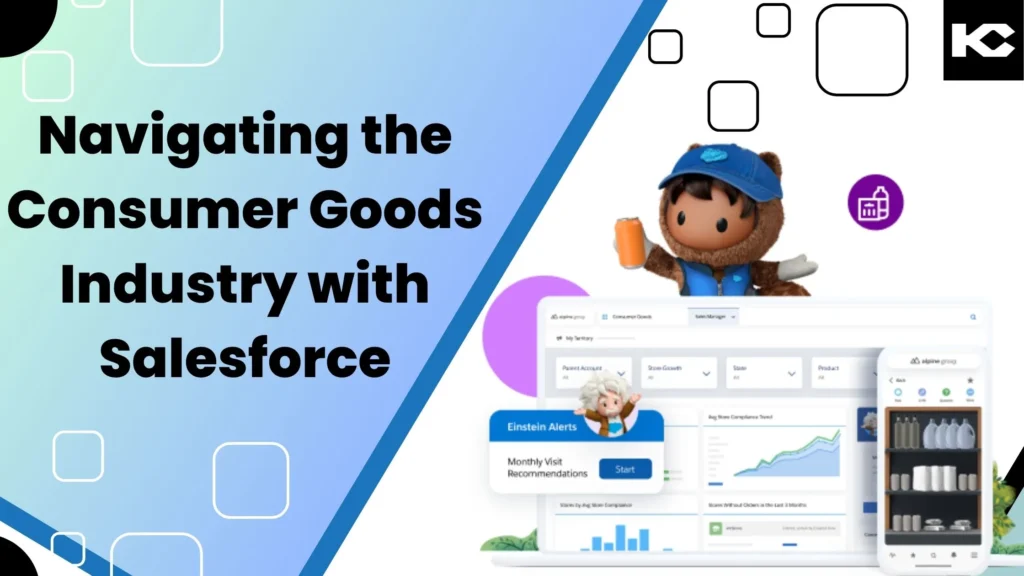
The consumer goods industry is changing rapidly as consumer expectations, retail channels, competition, and technology continue to evolve. Salesforce Consumer Goods Cloud helps consumer goods companies connect data, optimize field sales, improve retail execution, streamline operations, and create more connected customer experiences.
Salesforce Consumer Goods Cloud is an industry-focused Salesforce solution designed to help consumer goods organizations manage retail execution, field sales, customer relationships, data, and operational processes through a connected platform.
Contents
hide
Understanding the Consumer Goods Industry
The consumer goods industry includes a broad range of products used in everyday life, including food and beverages, household products, personal care products, packaged goods, and other consumer products.
Consumer goods companies operate across complex networks of manufacturers, distributors, retailers, suppliers, sales representatives, and consumers. At the same time, customers expect convenient purchasing experiences, relevant engagement, product availability, and consistent service across physical and digital channels.
These requirements make real-time data, efficient supply chain coordination, effective field sales, and strong retail execution increasingly important for consumer goods organizations.
What Is Salesforce Consumer Goods Cloud?
Salesforce Consumer Goods Cloud is a specialized Salesforce industry solution built to address the operational requirements of consumer goods organizations. It brings Salesforce capabilities closer to the workflows involved in retail execution, field sales, account management, product availability, and customer engagement.
By connecting relevant customer, retail, field, and operational data, Consumer Goods Cloud can help teams improve visibility and make more informed decisions. Its Salesforce foundation also provides access to broader capabilities for automation, analytics, integrations, and AI.
Retail Execution
Help field teams manage store activities, capture information, and improve execution across retail locations.
Field Sales
Give field representatives access to relevant customer and store information while working in the field.
Connected Data
Connect data across Salesforce and external systems to provide teams with greater operational visibility.
Analytics & AI
Use analytics and AI capabilities to identify trends, understand performance, and support data-driven decisions.
Current Trends in the Consumer Goods Industry
Consumer goods organizations are adapting to changing customer expectations and increasingly digital retail environments. Several trends are influencing how companies manage customers, sales, distribution, and operations.
01
Omnichannel Retail
Consumers increasingly expect connected experiences across stores, websites, mobile applications, marketplaces, and other channels.
02
Sustainability
Sustainable sourcing, packaging, manufacturing, logistics, and supply chain practices are becoming increasingly important.
03
Personalization
Consumer data is increasingly being used to create more relevant marketing, engagement, and purchasing experiences.
04
Digital Transformation
Companies are adopting cloud platforms, automation, analytics, AI, and connected systems to improve operational efficiency.
Common Challenges Faced by Consumer Goods Companies
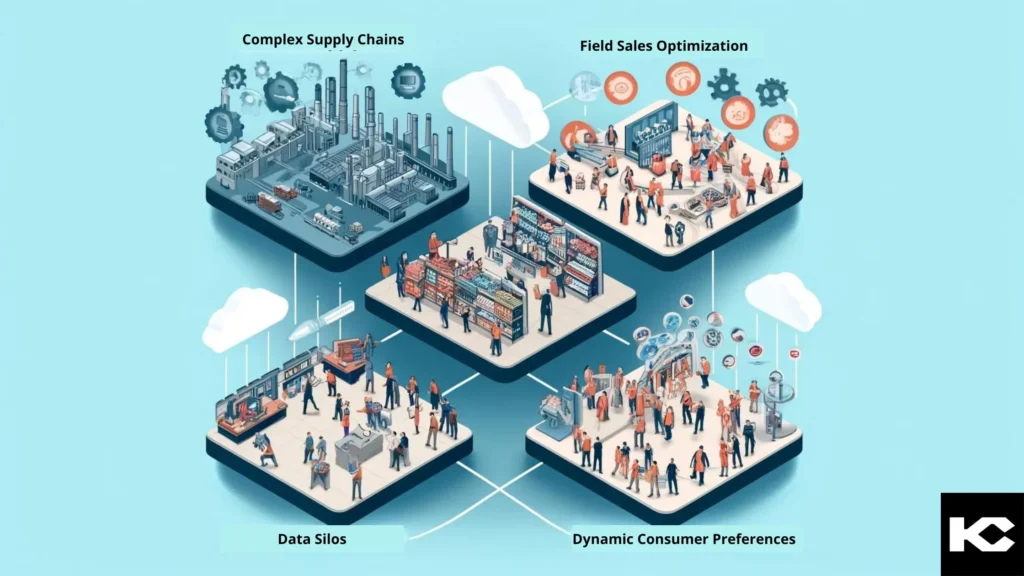
Consumer goods companies often operate across large and distributed networks. Without connected systems and reliable data, teams can struggle to maintain visibility and execute consistently.
- Complex Supply Chains: Multiple suppliers, manufacturers, distributors, and retail partners can make supply chain visibility difficult.
- Field Sales Optimization: Field representatives need timely and accurate information to make effective decisions during store visits.
- Data Silos: Customer, sales, inventory, and operational data may exist across disconnected systems.
- Changing Consumer Preferences: Rapidly changing preferences require companies to respond quickly to market signals.
- Retail Execution: Maintaining consistent merchandising, product availability, promotions, and store-level execution can be challenging at scale.
How Salesforce Consumer Goods Cloud Addresses Industry Challenges
Consumer Goods Cloud is designed to help organizations connect field operations and customer information with broader Salesforce capabilities. This can provide teams with a more consistent view of customers, accounts, retail locations, activities, and operational processes.
Unified Data Management
Connect relevant information from Salesforce and external systems to create a more consistent data foundation.
Retail Execution Tools
Support field representatives with tools for store visits, activities, product information, and retail execution processes.
Analytics & Insights
Analyze operational and customer data to identify trends, measure performance, and support planning.
Cross-Team Collaboration
Connect teams and processes so sales, marketing, operations, and other stakeholders can work from shared information.
Key Benefits of Salesforce Consumer Goods Cloud
Improved Retail Execution
Better visibility into retail activities can help teams improve store-level execution, merchandising, product availability, and compliance.
Streamlined Operations
Connected data and automation can reduce manual processes and help teams coordinate operational activities more efficiently.
Better Customer Insights
A connected view of customer and sales information can help organizations understand relationships, preferences, and engagement.
Mobile Field Productivity
Field teams can access relevant Salesforce information while working across stores, accounts, and territories.
Salesforce Consumer Goods Cloud Architecture
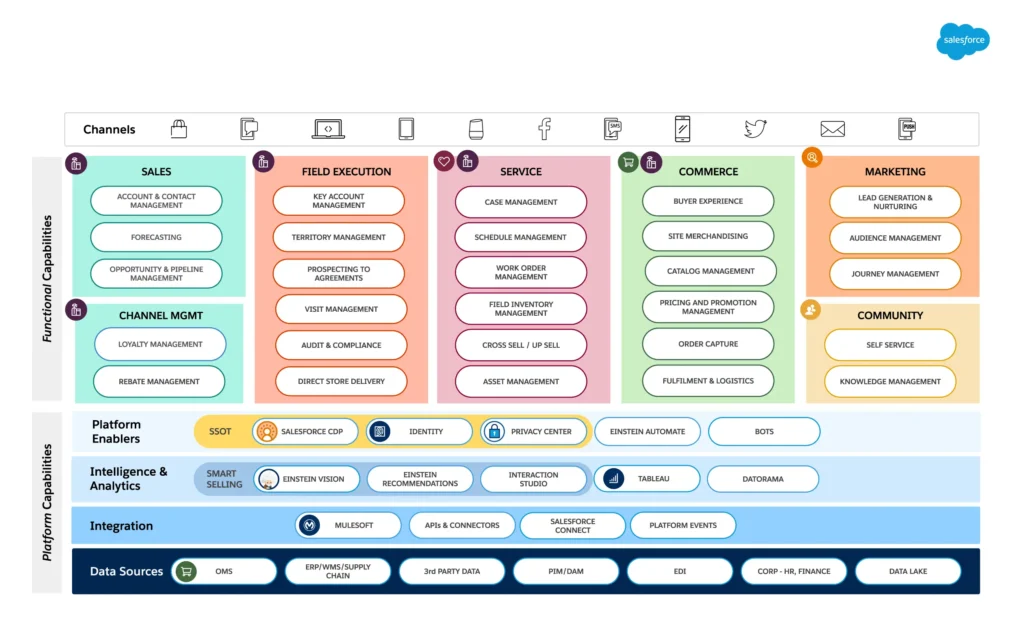
Consumer Goods Cloud operates on the Salesforce platform and can connect with other Salesforce products and external enterprise systems. The overall architecture can include customer data, retail information, integrations, automation, analytics, mobile experiences, and security controls.
01 · Data
Data Integration Layer
Connects relevant information from Salesforce and systems such as ERP, point-of-sale, supply chain, and other enterprise applications.
02 · Intelligence
AI & Analytics
Salesforce analytics and AI capabilities can help teams analyze data, identify patterns, and support decision-making.
03 · Experience
Mobile & Web Experience
Sales and field teams can interact with Salesforce through experiences designed to support work across locations.
04 · Collaboration
Connected Teams
Shared Salesforce data and workflows can improve collaboration between sales, marketing, operations, and other teams.
05 · Governance
Security & Compliance
Salesforce security, permissions, governance, and data controls can be incorporated into the overall solution architecture.
Salesforce Consumer Goods Cloud and Retail Execution
Retail execution is a critical part of consumer goods sales operations. Field representatives may need to visit stores, review product availability, check merchandising, capture observations, manage activities, and communicate information back to the organization.
Salesforce Consumer Goods Cloud can help bring these activities into connected Salesforce workflows. With relevant information available to field teams, organizations can improve visibility into store-level activity and identify execution gaps more efficiently.
Retail Execution Workflows Can Include
- Store visits and field activities
- Product and assortment information
- Merchandising activities
- Product availability checks
- Promotion and execution monitoring
- Field observations and data capture
- Account and retailer information
- Follow-up activities and task management
Looking to Improve Salesforce Retail Execution?
A well-designed Salesforce architecture can connect field sales, customer data, automation, integrations, and analytics to support more efficient consumer goods operations.
Salesforce Consumer Goods Cloud Use Cases
Consumer Goods Cloud can support a variety of workflows across consumer goods sales and operations. Common use cases include:
Field Sales Management
Equip field representatives with customer, account, product, and activity information to support store visits and sales processes.
Retail Account Management
Centralize account information and interactions to help teams manage relationships with retailers and other commercial partners.
Trade Promotion Workflows
Connect relevant promotion information with sales and retail execution processes to improve visibility.
Product Availability
Capture and connect store-level information that can help teams identify availability and execution issues.
Consumer Insights
Connect customer and commercial data to support segmentation, engagement, and data-driven decision-making.
Operational Analytics
Build reports and dashboards that provide visibility into sales activity, retail execution, accounts, and other KPIs.
Salesforce Consumer Goods Cloud Implementation Considerations
Successful implementation requires more than enabling Salesforce features. Consumer goods companies should first understand how data, sales processes, retail execution, integrations, and field operations currently work.
- Define Business Requirements: Identify the processes that need improvement and establish measurable business objectives.
- Map Field Processes: Document store visits, sales activities, merchandising workflows, and other field processes.
- Design the Data Model: Determine how accounts, contacts, products, stores, activities, and other data should be structured.
- Plan Integrations: Identify ERP, POS, supply chain, marketing, data, and other systems that need to connect with Salesforce.
- Configure Automation: Automate repetitive processes while keeping workflows maintainable and easy to govern.
- Enable Analytics: Define the KPIs and dashboards required by sales, operations, leadership, and field teams.
- Focus on Adoption: Design intuitive experiences and provide training so field and office teams can effectively use the platform.
Build the Right Salesforce Foundation
Consumer goods organizations often need connected data before they can effectively scale analytics and AI. Learn more about
Data Foundation for AI
and how a strong data architecture can support intelligent business processes.
Frequently Asked Questions About Salesforce Consumer Goods Cloud
What is Salesforce Consumer Goods Cloud?
Salesforce Consumer Goods Cloud is an industry-focused Salesforce solution designed to support consumer goods organizations with retail execution, field sales, account management, connected data, analytics, and related operational processes.
What is Salesforce retail execution?
Salesforce retail execution refers to using Salesforce capabilities to support store-level and field activities such as store visits, merchandising, product availability, promotions, sales activities, and field data collection.
How does Consumer Goods Cloud help field sales teams?
Consumer Goods Cloud can provide field teams with access to relevant account, store, product, activity, and customer information while supporting workflows for visits, execution, and follow-up activities.
Can Consumer Goods Cloud integrate with ERP and POS systems?
Salesforce can integrate with external enterprise systems, including ERP and point-of-sale environments. The exact integration architecture depends on the systems involved, data requirements, APIs, middleware, security, and business processes.
What are the benefits of Salesforce Consumer Goods Cloud?
Key benefits can include improved retail execution visibility, connected customer and operational data, field productivity, automation, analytics, and better coordination across consumer goods teams.
How should a company approach Consumer Goods Cloud implementation?
Start by documenting business and field requirements, mapping processes, reviewing the data model, planning integrations, designing automation, defining analytics requirements, and preparing users for adoption.
Conclusion: Salesforce Consumer Goods Cloud
The consumer goods industry requires organizations to balance changing consumer expectations with complex sales, retail, distribution, and supply chain operations. Salesforce Consumer Goods Cloud provides an industry-focused Salesforce foundation that can help organizations connect data, field teams, retail execution, analytics, and customer processes.
From improving Salesforce retail execution and field productivity to connecting enterprise data and supporting analytics, Consumer Goods Cloud can help consumer goods companies build more connected operational processes.
The value of the platform ultimately depends on the underlying architecture, data quality, integrations, business processes, and user adoption. A structured implementation approach can help organizations build Salesforce around their actual operational requirements and long-term growth plans.
Looking for a Salesforce Consumer Goods Cloud Implementation Partner?
Kizzy Consulting helps organizations plan and implement Salesforce solutions across data, integrations, automation, AI, and industry-specific business processes.
About Kizzy Consulting
Kizzy Consulting
is a Salesforce Consulting Partner helping organizations with Salesforce consulting, implementation, integration, automation, data, and AI solutions.
Looking for help with Salesforce Consumer Goods Cloud?
Contact us
or email
[email protected].
Related Resource:
Learn more about
Salesforce Implementation Services
and how a structured Salesforce implementation can support connected business operations.