Multi-Agent AI Systems: When Should Enterprises Use Multiple AI Agents in 2026?
⏱ 4 min read
A single AI agent can handle many business tasks. But what happens when the workflow becomes too complex for one agent to manage reliably? That is where multi-agent AI systems come in. Instead of asking one AI agent to research, analyze, make decisions, execute actions, and validate results, enterprises can create a team of specialized AI agents that work together toward one business outcome.
Quick Answer: When Should Enterprises Use Multiple AI Agents?
Enterprises should consider a multi-agent architecture when a single agent becomes difficult to manage because it has too many tools, too much context, too many responsibilities, or too many dependent tasks.
If the workflow is simple, predictable, and handled well by one agent, adding more agents can create unnecessary complexity and cost. The best rule is simple:
use the simplest architecture that can reliably achieve the business outcome.
Multi-Agent AI Systems at a Glance
1 Goal
Shared Business Outcome
N Agents
Secialized Responsibilities
Shared
Context & Coordination
1 System
Coordinated Execution
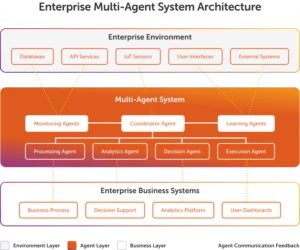
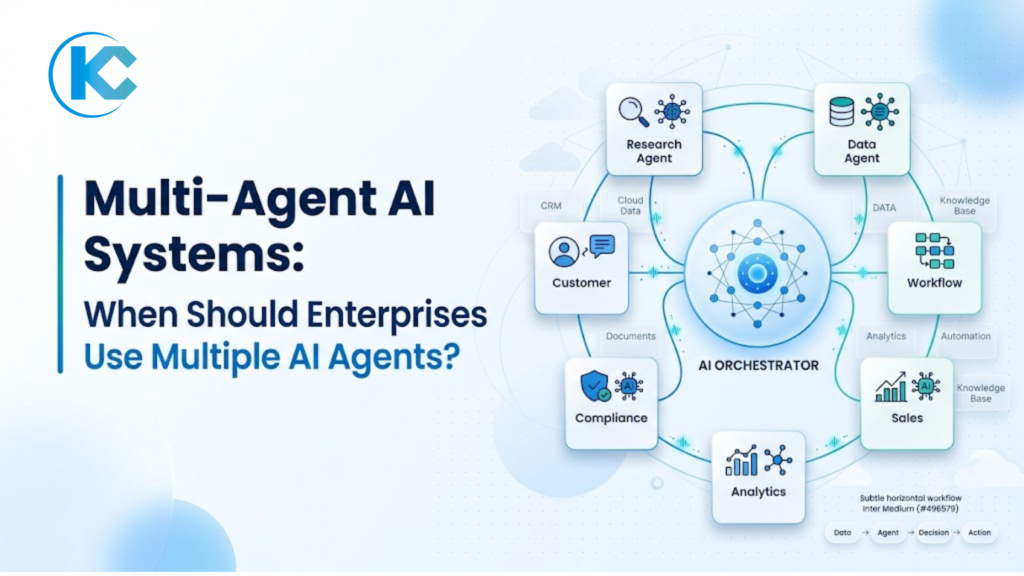
Example of an enterprise multi-agent architecture with coordination, specialized agents, data sources, and business systems.
What Is a Multi-Agent AI System?
A multi-agent AI system is an architecture where multiple AI agents work together to complete a larger task. Each agent has a defined responsibility, access to specific tools or data, and a clear role within the overall workflow.
Think of it like a digital business team. One agent may research information, another may analyze it, another may execute an action, and another may check the result.
Example:
For an enterprise sales workflow, a Research Agent can collect prospect information, a Qualification Agent can score the lead, a CRM Agent can update Salesforce, and a Communication Agent can prepare the next follow-up.
The agents do not need to be identical. In fact, specialization is one of the main reasons to use a multi-agent architecture.
Single Agent vs. Multi-Agent AI
| Factor | Single AI Agent | Multi-Agent System |
|---|---|---|
| Task Complexity | Low to medium | High and multi-step |
| Responsibilities | Broad | Specialized |
| Context | Usually centralized | Can be distributed |
| Parallel Work | Limited | Strong fit |
| Architecture | Simpler | More complex |
| Cost & Operations | Usually lower | Higher management overhead |
7 Signs Your Enterprise Needs Multiple AI Agents
1. One Agent Has Too Many Tools
If an agent has dozens of tools across unrelated systems, choosing the correct tool becomes harder. Splitting responsibilities can make each agent’s job clearer.
2. The Workflow Has Different Domains
Research, finance, legal review, customer service, and technical analysis may require different instructions, tools, and knowledge.
3. Tasks Can Run in Parallel
If several independent tasks can happen simultaneously, specialized agents can work on different branches before the results are combined.
4. Context Is Becoming Too Large
Giving one agent every document, tool, rule, and workflow can make the context difficult to manage. Smaller agent scopes can reduce that burden.
5. Reliability Is Falling
If the agent frequently chooses the wrong tool or loses track of the task, narrower responsibilities may improve reliability.
6. Different Skills Are Required
A workflow that needs research, data analysis, decision-making, execution, and validation may benefit from specialist agents.
7. The Business Value Justifies the Complexity
Multi-agent systems introduce additional model calls, infrastructure, testing, and monitoring. Use them when the expected business value makes that complexity worthwhile.
Not Sure If Your AI Use Case Needs Multiple Agents?
Tell us about your workflow, systems, and desired outcome. We can help determine whether a single agent, multi-agent architecture, or simpler automation approach makes the most sense.
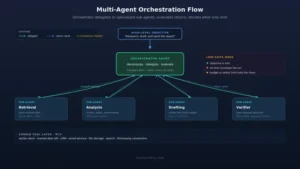
A multi-agent orchestration model where a central workflow layer distributes work among specialized agents.
How Multi-Agent AI Systems Work
Most enterprise multi-agent systems follow a simple idea: break a large goal into smaller responsibilities and give each responsibility to the right agent.
USER REQUEST / BUSINESS GOAL
↓
ORCHESTRATOR / COORDINATOR AGENT
Plans the workflow and selects the right agents
↓
Research Agent
Data Agent
Decision Agent
Execution Agent
↓
VALIDATION / FINAL OUTCOME
Common Multi-Agent Architecture Patterns
Sequential Handoff
Agent A completes its task and passes the result to Agent B, which continues the workflow.
Orchestrator Pattern
A central agent decides which specialist should act and in what order.
Parallel Agents
Several agents work on independent parts of a task at the same time, then their outputs are combined.
Reviewer / Validator
One agent creates an output while another checks it against rules, quality requirements, or business constraints.
Adding more agents does not automatically make an AI system better. The agents need a reliable way to exchange information and understand what has already happened.
Each handoff should ideally define:
- What the agent needs to accomplish
- What information it should receive
- Which tools it is allowed to use
- What format its output should follow
- What the next agent needs to know
- What happens if the task fails
Protocols such as Model Context Protocol (MCP) and emerging agent-to-agent communication approaches can help standardize how agents access tools, exchange information, and hand off work.
For enterprises, this communication layer should also be designed with authentication, permissions, logging, and security controls.
Enterprise Multi-Agent AI Use Cases
Customer Service
An intent agent identifies the issue, a knowledge agent retrieves information, a resolution agent takes action, and an escalation agent handles complex cases.
Sales Operations
Research prospects, qualify opportunities, update CRM records, generate follow-ups, and coordinate sales activities.
Finance
Extract financial data, analyze transactions, detect anomalies, reconcile information, and prepare reports.
Software Development
Use separate agents for planning, coding, testing, code review, documentation, and deployment support.
Research & Intelligence
Multiple research agents can investigate independent sources or topics while a synthesis agent combines the findings.
Operations
Coordinate inventory, logistics, scheduling, alerts, and business system updates through specialized agents.
Multi-Agent AI and Salesforce
Salesforce environments are a strong example of where multiple specialized agents can work together. Instead of creating one massive agent with access to every CRM process, enterprises can divide responsibilities around specific business functions.
- Sales Agent: Lead qualification and opportunity support.
- Service Agent: Case resolution and customer support.
- Data Agent: Customer and business data retrieval.
- Knowledge Agent: Enterprise knowledge and policy retrieval.
- Workflow Agent: Executes approved CRM actions and automation.
- Supervisor Agent: Coordinates tasks and escalates exceptions.
Organizations exploring this architecture can use
Agentforce consulting and implementation
to design specialized Salesforce agents, integrations, workflows, and governance around specific business processes.
Challenges of Multi-Agent AI Systems
Multi-agent AI is powerful, but adding agents also adds engineering and operational complexity.
Higher Cost
More agents can mean more model calls, infrastructure, storage, and monitoring.
Coordination Failures
Poor handoffs can cause duplicated work, missing information, or conflicting decisions.
Debugging Complexity
When several agents contribute to an outcome, identifying the source of an error becomes harder.
Security Risk
Every agent and tool connection needs appropriate authentication, permissions, and audit controls.
Best Practices for Enterprise Multi-Agent AI
- Start with the business problem.
Do not create multiple agents simply because the technology allows it. - Give every agent a clear job.
Each agent should have a defined responsibility, tools, permissions, and expected output. - Keep context focused.
Do not give every agent access to every piece of information. - Use orchestration intentionally.
Define when agents should work sequentially, in parallel, or through dynamic routing. - Build human approval into high-risk actions.
Financial, legal, security, and customer-impacting actions may require human review. - Monitor the complete workflow.
Track individual agent performance as well as the final business outcome. - Evaluate before scaling.
Test realistic tasks, edge cases, failures, tool calls, and agent handoffs before expanding autonomy.
Building a Multi-Agent AI Architecture?
Kizzy Consulting helps enterprises move from AI experiments to production-ready agent systems. Our AI Agent Development Services cover custom agents, multi-agent workflows, integrations, RAG, automation, and enterprise deployment.
When You Should NOT Use Multiple AI Agents
Multi-agent architecture is not automatically better. A single agent or even a traditional workflow may be the better option when:
- The task is simple and well defined.
- There are only a few tools involved.
- The workflow is mostly sequential and predictable.
- All steps require the same context.
- The business value does not justify additional model and infrastructure costs.
- A deterministic automation can solve the problem more reliably.
The practical rule:
Use multiple agents because the problem requires specialization, parallel work, or independent context — not simply because multi-agent AI is trending.
Use multiple agents because the problem requires specialization, parallel work, or independent context — not simply because multi-agent AI is trending.
Enterprise Multi-Agent AI Implementation Roadmap
01. Identify
Find a complex workflow where multiple responsibilities are clearly visible.
02. Decompose
Break the workflow into tasks and determine which responsibilities should become agents.
03. Orchestrate
Design routing, handoffs, shared context, tools, and communication protocols.
04. Evaluate
Test individual agents and the complete system against real business scenarios.
05. Scale
Add agents gradually as new business capabilities justify the additional architecture.
Conclusion
Multi-agent AI systems make sense when an enterprise workflow has enough complexity to benefit from specialized intelligence. Instead of forcing one AI agent to understand every tool, data source, business rule, and task, enterprises can divide the work among focused agents and coordinate them toward one outcome.
But more agents do not automatically mean better AI. Multi-agent architectures introduce additional costs, coordination challenges, security requirements, and testing needs.
The strongest approach is to start with one reliable agent, identify where it becomes overloaded, and introduce additional agents only where specialization, parallelization, or independent context creates measurable business value.
Frequently Asked Questions about Multi-Agent AI Systems :
What is a multi-agent AI system?
A multi-agent AI system is a group of specialized AI agents that communicate and coordinate to complete a larger task or business workflow.
When should an enterprise use multiple AI agents?
Enterprises should consider multiple agents when a single agent has too many tools, responsibilities, context requirements, or complex subtasks, especially when parts of the workflow can be specialized or executed in parallel.
Are multi-agent systems better than single AI agents?
Not always. A single agent is often better for simpler workflows. Multi-agent systems become valuable when specialization, parallel execution, or separate contexts can improve the overall solution.
What is an orchestrator agent?
An orchestrator agent coordinates the overall workflow. It can decide which specialized agents should work on a task, in what order, and how their outputs should be combined.
What are the biggest challenges of multi-agent AI?
The biggest challenges include agent coordination, context management, higher costs, debugging, security, evaluation, and preventing errors from one agent from propagating through the workflow.
Can Salesforce Agentforce support multi-agent workflows?
Yes. Salesforce’s Agentforce architecture supports specialized agents and coordinated agent experiences. Enterprises can also connect Salesforce agents with external systems, APIs, and other AI services depending on the architecture.
Ready to Build a Multi-Agent AI System?
Kizzy Consulting helps enterprises design, build, integrate, evaluate, and scale production-ready AI agents. Whether you need a single AI agent, a coordinated multi-agent workflow, or an Agentforce-based architecture, we can help map the right technology to your business process.
Explore Kizzy AI Pod Services for a dedicated AI engineering team that can architect, build, test, integrate, and prepare your AI agent system for production.