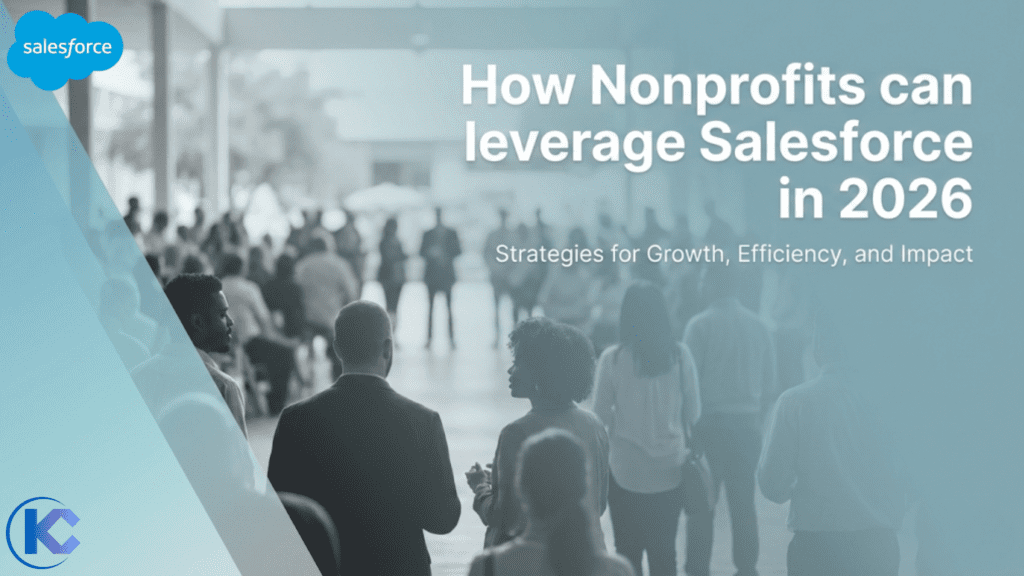
How Nonprofits can leverage Salesforce in 2026
⏱ 2 min read
Nonprofit Technology Guide 2026
Key Salesforce Trends for Nonprofits in 2026
In 2026, running a nonprofit is about working smarter, not harder. Donors expect near-instant communication, grant reporting requires granular precision, and mission-driven teams are continually challenged to do more with constrained resources. Fortunately, Salesforce has evolved into an intelligent operational backbone that handles heavy administrative burdens automatically.
The 2026 Shift
Thriving Beyond Basic Databases
To thrive in 2026, nonprofits must move beyond basic donor databases. Modern impact organizations focus on adopting Artificial Intelligence (AI), unifying fragmented data silos, strengthening cybersecurity, and implementing intelligent automation across programs and fundraising.
5 Key Salesforce Trends Transforming Nonprofits
TREND 01
AI-First Operations with Autonomous Agents (Agentforce)
The defining shift in 2026 is the adoption of Agentforce. Unlike conventional chatbots that rely on rigid decision trees, Agentforce agents act as autonomous, 24/7 digital teammates capable of executing multi-step tasks within governance guardrails:
- Donor Support: Web agents field donor inquiries in real time, outline program funding allocations, verify tax compliance, and instantly issue contribution receipts.
- Program & Volunteer Management: Agents coordinate volunteer shift scheduling, answer intake questions from beneficiaries, and triage support requests.
Why it matters: Small teams achieve the reach and responsiveness of a large organization without increasing overhead.
TREND 02
Unified Architecture with Data Cloud
Nonprofits frequently face fragmented data. Salesforce Data Cloud harmonizes these disconnected sources into a single source of truth:
- True 360-Degree Profiles: Staff gain a unified profile showing every engagement.
- Automated Identity Resolution: Duplicate records are resolved automatically, preventing redundant outreach.
Why it matters: Eliminates manual spreadsheet consolidation and provides reliable data for relationship building.
TREND 03
Hyper-Automation via Next-Gen Flow
Using advanced Salesforce Flow, organizations can automate mission-critical recurring tasks to save hours of manual tracking:
- Instant Donation Receipting: Trigger compliant tax letters immediately upon gift receipt.
- Volunteer Cadences: Deliver SMS reminders 24 hours prior to shifts.
- Grant Milestones: Deploy automated alerts for compliance deadlines.
TREND 04
Predictive Intelligence with Einstein AI
Organizations leverage Einstein AI to forecast outcomes and optimize outreach strategies:
- Donor Retention: Identify donors showing signs of lapse before they stop contributing.
- Optimized Solicitations: Algorithms recommend personalized donation amounts for campaigns.
Why it matters: Maximizes campaign ROI by matching the right ask to the right supporter.
TREND 05
Mobile-First Field Management
For nonprofits running fieldwork, the Salesforce Mobile App ensures staff stay fully connected offsite:
- Offline Data Capture: Field teams log interactions without active connectivity; data synchronizes automatically.
- Speech-to-Text: Case workers can dictate case notes directly from mobile devices.
Why it matters: Eliminates paperwork backlogs and accelerates real-time program reporting.
Strategic Preparation: Action Steps for Nonprofit Leaders
To successfully navigate digital modernization, leadership should follow a structured roadmap:
01
Conduct a Technology Audit
Review existing systems and workflows to identify technical debt and data bottlenecks.
02
Define Outcome Objectives
Tie every technical initiative to measurable goals (e.g., “reduce donor churn by 12%”).
03
Invest in Change Management
Provide role-based training and establish internal champions to drive user adoption.
04
Pilot Incrementally
Roll out new capabilities (like Agentforce) to a single department before scaling globally.
05
Establish a Roadmap
Plan technical investments alongside key fundraising cycles and platform updates.
Planning an Upgrade? For organizations transitioning from legacy architecture, review our comprehensive Salesforce NPSP to Nonprofit Cloud Migration Guide.
Final Thoughts
Operating an efficient nonprofit in 2026 does not require excessive budgets; it requires purpose-built tools and consolidated data. By pairing intelligent automation with predictive insights, your team can minimize administrative overhead and focus on what matters most: advancing your mission.
Explore more technical guides and case studies at Kizzy Consulting.
Frequently Asked Questions: AI & Salesforce for Nonprofits
How does Agentforce help nonprofits with limited staff?
Agentforce acts as an autonomous digital teammate. It can handle routine donor inquiries, schedule volunteer shifts, and process tax receipts 24/7 without manual intervention, allowing small teams to achieve the reach of a large organization.
Why should we move to Salesforce Data Cloud?
Data Cloud solves the problem of fragmented data silos by unifying donor records, volunteer logs, and event metrics into a true 360-degree profile. It automatically resolves duplicate records, preventing inaccurate reporting and redundant outreach.
Does the Salesforce Mobile App work for offline fieldwork?
Yes. The Salesforce Mobile App supports offline data capture, allowing field teams to log interactions, case notes, and inventory without active connectivity. The data synchronizes automatically to the cloud once the device reconnects.
Transform Your Organization
Let’s Build a Smarter, More Efficient Nonprofit Together
Ready to modernize your tech stack? Contact our experts to design a strategic Salesforce implementation that maximizes your impact and minimizes overhead.
Kizzy Consulting helps nonprofit organizations implement Salesforce Agentforce, Data Cloud, and automation to scale their mission.