Context Engineering vs Prompt Engineering: What Enterprises Need in 2026
⏱ 4 min read
Prompt engineering is no longer enough for enterprise AI. As organizations move from simple chatbots to AI agents, RAG systems, agentic workflows, and AI-powered business automation, the bigger challenge is giving AI the right information at the right time.
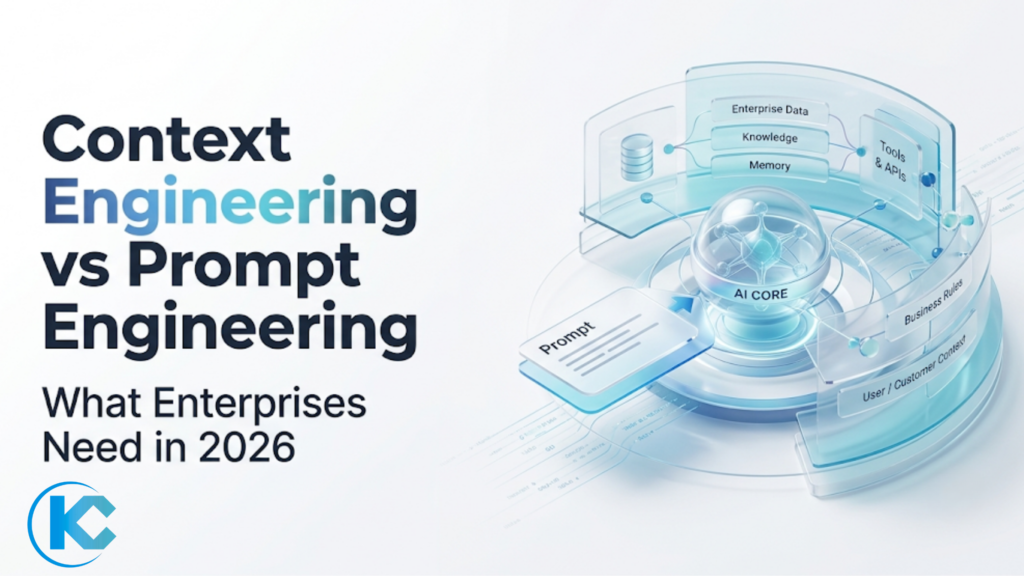
This is where context engineering becomes important. Prompt engineering focuses on how you instruct an AI model. Context engineering focuses on what the AI knows, which data it can access, which tools it can use, what business rules apply, and how that information is delivered during an interaction.
For enterprises in 2026, the answer is not prompt engineering or context engineering. Production AI needs both, but they solve different problems. Prompt engineering improves instructions, while context engineering builds the information and data layer that allows AI agents to operate reliably across real business workflows.
By Sanjeet Mahajan – CEO/Founder of Kizzy Consulting
Executive Quick Answer
What is the difference between context engineering and prompt engineering?
Prompt engineering improves the instructions given to an AI model. Context engineering determines the information, business knowledge, data, tools, policies, and history available to the model when it needs to respond or take action.
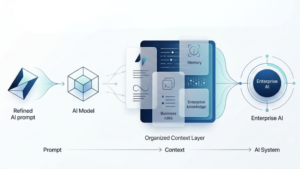
In simple terms: prompt engineering tells AI how to behave; context engineering gives AI what it needs to behave correctly. Enterprises building AI agents, RAG applications, copilots, and agentic workflows need both.
Prompt
Instructions, examples, tone, format and constraints.
Context
Data, knowledge, metadata, history, tools and business rules.
Enterprise AI
Both work together to power reliable production AI.
Contents
hide
What Is Context Engineering?
Context engineering is the practice of designing the information environment an AI model or AI agent receives before it generates an answer or takes an action.
That environment can include enterprise documents, CRM records, customer history, databases, APIs, business rules, metadata, user permissions, previous interactions, real-time information, tool results and retrieved knowledge.
This is especially important for enterprise AI agents. An agent cannot reliably complete a business task simply because it has a good prompt. It needs access to the right systems, accurate information and the right tools.
For example, a customer service agent may need the customer’s Salesforce record, previous cases, product documentation, current order status, pricing rules and escalation policy before answering a question. The prompt alone cannot provide all of this information.
Context Engineering vs Prompt Engineering: What Is the Difference?
Prompt engineering and context engineering are closely related, but they operate at different levels.
| Area | Prompt Engineering | Context Engineering |
|---|---|---|
| Main focus | How AI is instructed | What AI knows and can access |
| Typical assets | Prompts, examples and instructions | Data, RAG, metadata, APIs, tools and knowledge |
| Scope | Usually task or interaction level | System and enterprise level |
| Example | “Summarize this customer case in 5 bullets.” | Give the agent the case, customer history, policies and product knowledge. |
| Enterprise challenge | Prompt sprawl and inconsistent instructions | Data quality, access, governance and context retrieval |
Is Your Enterprise AI Ready for Context Engineering?
Before building AI agents, check whether your data, workflows, integrations and governance can support reliable AI at scale.
Why Prompt Engineering Alone Is Not Enough for Enterprise AI
Prompt engineering is still valuable. A well-designed prompt can improve accuracy, tone, structure, reasoning and consistency. But prompts have a limit: they cannot become the entire enterprise knowledge system.
- Business knowledge changes: pricing, policies, products and processes change. Hard-coding these rules into hundreds of prompts creates maintenance problems.
- Enterprise data is distributed: critical information may live across Salesforce, ERP systems, databases, documents, data warehouses and external applications.
- Agents need tools: modern AI agents need to retrieve information, call APIs, update systems and execute workflows.
- Permissions matter: an AI agent should not automatically see every piece of enterprise information. Context must respect identity, access controls and data security.
- Multiple agents need consistency: sales agents, service agents, knowledge agents and internal copilots should use the same trusted business definitions where appropriate.
This is why enterprise AI architecture increasingly needs a combination of prompt engineering, context engineering, RAG, AI memory, data integration, tool calling, governance and AI evaluation.
Where Does RAG Fit Into Context Engineering?
Retrieval-Augmented Generation, or RAG, is one of the most practical ways to provide enterprise context to an AI system. Instead of expecting an LLM to remember every company document, a RAG system retrieves relevant information when the user asks a question.
For example, an employee asking about a company travel policy could receive information retrieved from the latest approved policy documents. The AI then uses that retrieved context to formulate its response.
Kizzy’s AI Knowledge Base Agent uses this type of approach to connect enterprise knowledge with AI responses.
However, context engineering is broader than RAG. RAG provides retrieved knowledge, while context engineering can also manage user identity, conversation history, metadata, business rules, APIs, tools, permissions, workflow state and real-time data.
How MCP Supports Context Engineering
The Model Context Protocol, or MCP, introduced by Anthropic in November 2024, is becoming relevant to enterprise context engineering because it provides a standardized, open way for AI applications to connect with external tools and data sources.
Instead of building a separate custom connection for every AI application and every data source, MCP’s open specification can provide a consistent interface between AI systems and tools or resources. Since MCP launched, adoption has scaled quickly – the community has built thousands of MCP servers, with SDKs now available across all major programming languages.
For enterprises exploring MCP and modern AI agent protocols, this matters because context is not limited to static documents. Agents increasingly need live access to CRM data, APIs, databases, applications and business tools.
What Should an Enterprise Context Engineering Stack Include?
A practical enterprise context engineering architecture can be thought of as several connected layers:
| Layer | Purpose |
|---|---|
| Data layer | CRM, ERP, databases, Data Cloud, warehouses and operational systems. |
| Knowledge layer | Documents, knowledge bases, policies, SOPs and RAG indexes. |
| Semantic layer | Business definitions, metadata, relationships and terminology. |
| Tool layer | APIs, MCP servers, functions and enterprise applications. |
| Governance layer | Permissions, privacy, security, auditability, human oversight and policies. |
| Prompt layer | Instructions, role definitions, response formats, constraints and task-specific behavior. |
When Should Enterprises Use Prompt Engineering?
Prompt engineering is not going away. It remains useful for task instructions, response formatting, tone, reasoning patterns, examples, guardrails and user interaction design.
For example, a prompt can tell an AI sales assistant to summarize a lead in five bullets, identify buying signals and recommend three next actions. Context engineering then supplies the lead record, previous interactions, account information, product knowledge and relevant sales rules.
The strongest enterprise AI systems therefore combine good prompts with good context. One without the other creates limitations.
Why Context Engineering Matters More in 2026
Enterprise AI is moving from answering questions to taking actions. AI agents can now retrieve information, reason over business data, call tools, update systems and execute multi-step workflows. Gartner projects that 40% of enterprise applications will feature task-specific AI agents by the end of 2026, up from under 5% in 2025 – a shift that makes the underlying context layer, not just the prompt, the deciding factor in whether these agents actually work.
That makes context a business infrastructure issue. An AI agent that cannot access the right customer record, policy, inventory information or workflow state cannot reliably complete its job.
Kizzy’s AI Agents and Automation Development work focuses on connecting agents with enterprise data, APIs, RAG systems and workflows rather than treating AI as a standalone chatbot.
For Salesforce organizations, this is equally important for Agentforce. Before deploying an agent, enterprises need reliable CRM data, defined workflows, appropriate permissions, integrations, governance and testing. Kizzy’s Salesforce Agentforce readiness checklist covers these foundational areas.
How Enterprises Can Start With Context Engineering
- 1. Identify the AI use case: Start with a business workflow and define what the AI system needs to accomplish.
- 2. Map required context: Identify the documents, customer data, systems, APIs, business rules and history the AI needs.
- 3. Check data quality: Remove duplicates, outdated information, conflicting definitions and unnecessary data.
- 4. Build retrieval: Use RAG, semantic search, databases or other retrieval methods to provide relevant information at runtime.
- 5. Connect tools: Give agents secure access to the APIs and systems they need to complete the workflow.
- 6. Add governance: Control permissions, sensitive information, human approval, audit logs and agent actions.
- 7. Evaluate continuously: Test both prompt quality and context quality. Monitor accuracy, retrieval quality, tool usage, cost and business outcomes.
Organizations that need help moving from an AI proof of concept to production can also explore Kizzy’s AI Pod Services, which combines AI architecture, agent development, prompt engineering, evaluation, integrations and deployment.
Frequently Asked Questions about Context Engineering and Prompt Engineering :
Is context engineering replacing prompt engineering?
No. Context engineering and prompt engineering solve different problems. Prompt engineering improves instructions, while context engineering manages the information and resources available to AI. Enterprise AI systems need both.
What is context engineering in AI?
Context engineering is the design and management of the information an AI model or agent receives at runtime. It can include enterprise data, documents, RAG results, APIs, tools, business rules, permissions, memory and workflow state.
How does RAG relate to context engineering?
RAG is one component of context engineering. It retrieves relevant enterprise knowledge and places it into the model’s context. Context engineering can also include data integration, metadata, tools, permissions, memory and business rules.
Why is context engineering important for AI agents?
AI agents need more than instructions. They need accurate business information, access to tools, workflow state, permissions and real-time data to make reliable decisions and complete actions.
What is the role of MCP in context engineering?
MCP, or Model Context Protocol, provides a standardized way for AI applications to connect with external tools and resources. It can therefore become an important part of the tool and data access layer in modern AI agent architectures.