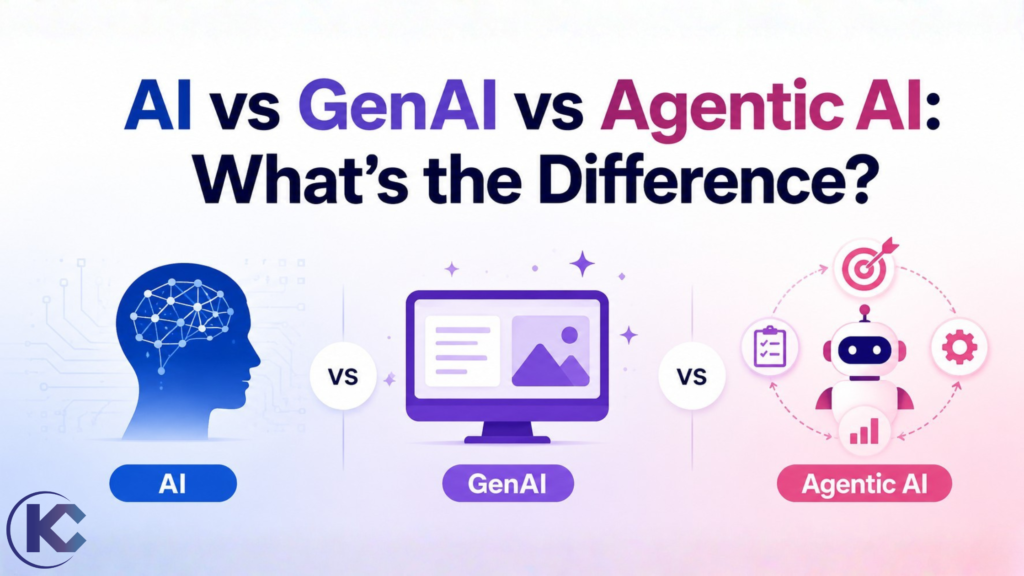
AI vs GenAI vs Agentic AI: What’s the Difference?
⏱ 4 min read
Quick Answer: Automation executes fixed, pre-defined rules. It works best when the process is predictable and every step can be explicitly defined. Agentic AI works toward a goal, evaluates context, chooses actions, and can adapt its approach when conditions change. In Salesforce, a Flow that assigns a lead based on territory is automation. An Agentforce agent that reviews the lead’s history, evaluates intent, drafts a personalized response, updates Salesforce, and escalates to a human when needed is an example of agentic AI.
Machines are doing more work than ever. Workflows trigger automatically, chatbots answer routine questions, CRM records update without manual intervention, and AI agents are beginning to handle more complex business processes.
But automation and agentic AI are not interchangeable. For a founder, CXO, or operations leader, choosing the wrong approach can create unnecessary cost and complexity. Some processes need nothing more than reliable rules. Others require context, judgment, reasoning, and the ability to adapt.
The practical question is not whether automation or agentic AI is better. It is which layer belongs where inside your Salesforce environment.
What Is Automation?
Automation is technology that performs a task according to a predefined set of rules. You define the logic – essentially, “if this, then that” – and the system executes it consistently.
Traditional Salesforce automation can include Flows, scheduled processes, integrations, Apex logic, notifications, record updates, and other deterministic workflows.
Examples of Automation
- An out-of-office auto-responder
- A scheduled database backup
- Assembly-line robots repeating the same operation
- A Salesforce Flow assigning a new lead based on territory
- A workflow updating an opportunity when a specific field changes
- An integration synchronizing records between Salesforce and another system
Think of automation as a highly obedient assistant. It does exactly what you have defined, consistently and at scale. But if the situation falls outside the rules, the workflow generally needs another rule, an exception path, or human intervention.
That makes automation especially valuable for stable, repetitive, high-volume processes.
What Is Agentic AI?
Agentic AI is an AI system designed to pursue a goal rather than simply execute one fixed sequence of instructions. It can interpret context, reason about possible actions, use available tools, execute tasks, evaluate results, and escalate to a human when required.
In Salesforce, this is where technologies such as Agentforce become relevant. Instead of building every possible path into a workflow, an agent can use business context and configured actions to determine an appropriate next step.
Examples of Agentic AI
- An Agentforce service agent that reviews a customer’s history before responding
- A sales agent that evaluates lead context and recommends the next action
- An AI agent that uses enterprise APIs to retrieve information before completing a task
- An AI support agent that resolves straightforward cases and escalates complex cases
- A multi-step agent that coordinates several tools to achieve a business outcome
Automation = Calculator
Give it an input, it applies the defined logic, and it produces the expected output.
Agentic AI = Analyst
Give it a goal and relevant context, and it can evaluate options and determine an appropriate sequence of actions.
Automation vs. Agentic AI: The Core Difference
The biggest difference is how the system handles decisions.
Automation follows a predefined path. Agentic AI is given a goal, relevant context, available tools, and boundaries, then determines how to move toward that goal.
That does not mean an agent should replace every Salesforce Flow. In fact, a strong Salesforce architecture often uses both. Kizzy’s Salesforce x AI approach combines deterministic Salesforce automation with AI-driven decision-making rather than treating them as competing technologies.
A Real Business Example: The Same Lead, Two Ways
Automation Flow
- Lead comes in.
- System assigns the lead according to territory rules.
- A predefined email is sent.
- CRM fields are updated.
- If the lead asks an unusual question, the predefined workflow may require human intervention.
Agentic AI Flow
- Lead comes in.
- Agent reviews CRM history and available context.
- Agent evaluates intent and lead quality.
- Agent drafts a personalized response.
- Agent can recommend or execute an appropriate next action.
- Agent updates relevant CRM information through approved actions.
- Human intervention occurs when the task requires approval, falls outside the agent’s scope, or reaches an escalation condition.
The automation flow executes a predefined process. The agentic flow is designed around an outcome.
That distinction becomes especially important when businesses start connecting AI agents to CRM records, APIs, knowledge bases, and enterprise systems. Kizzy’s recent guide on how to integrate AI agents with business systems covers this shift from standalone AI to connected enterprise agents.
Automation vs. Agentic AI: Side by Side
| Feature | Automation | Agentic AI |
|---|---|---|
| Operational mode | Rule-based execution | Goal-oriented execution |
| Decision-making | Predefined logic | Context-aware reasoning and planning |
| Adaptability | Limited to defined paths | Can adapt its action sequence to context |
| Learning | Requires explicit rule changes | May use feedback, evaluation, or updated instructions depending on implementation |
| Complexity handled | Repetitive, well-defined processes | Ambiguous, multi-step, context-heavy processes |
| Best fit | Stable, high-volume workflows | Dynamic, judgment-heavy workflows |
| Salesforce example | Flow, Apex, scheduled automation, integrations | Agentforce agents and AI-driven actions |
| Primary role | Reliable execution | Reasoning and adaptive execution |
Kizzy Framework
The Execution-Intelligence Stack
We recommend a simple architectural split: automation handles deterministic execution; agentic AI handles context-heavy intelligence.
Salesforce Flow, integrations, scheduled jobs, and Apex can move data reliably and enforce business rules. Agentforce and other AI agents can then operate on top of that foundation where interpretation, prioritization, reasoning, or adaptive decision-making adds value.
This layered model is also reflected in Kizzy’s AI Agents & Automation Development approach, where traditional workflow automation and AI-agent capabilities are used for different classes of problems.
When Should You Use Automation?
- The process repeats consistently. The same task and steps occur again and again.
- The rules are fully definable. You can express the process clearly as conditions and actions.
- No significant judgment is required.
- The workflow is stable. Exceptions are limited and predictable.
- Volume is high. Thousands of similar actions need speed and consistency.
Examples: invoice reminders, CRM field updates, record synchronization, rule-based lead routing, scheduled notifications, and confirmation emails.
When Should You Use Agentic AI?
- A decision has to be made. The system needs to evaluate options rather than execute one fixed rule.
- Context matters. Customer history, previous interactions, documents, or other signals should influence the action.
- The workflow varies. Different inputs can require different actions.
- The process spans multiple steps or tools.
- The goal matters more than the exact sequence.
Examples: behavior-based lead qualification, intelligent sales assistance, personalized follow-up, support resolution, knowledge retrieval, and complex CRM operations.
The Smart Approach: Use Both
The real question is not automation or agentic AI. It is how to layer them correctly.
Automation can handle the structured backbone: sending emails, synchronizing data, updating records, enforcing business rules, triggering notifications, and moving information between systems.
Agentic AI can operate above that foundation where the business process requires interpretation, prioritization, reasoning, or dynamic action selection.
For organizations preparing Salesforce for Agentforce, this distinction becomes especially important. Before adding an agent to an existing workflow, it is worth reviewing the health of the underlying data, automation, permissions, architecture, and governance. Kizzy’s recent guide, Is Your Salesforce Org Ready for Agentforce?, covers these readiness factors in detail.
What Should You Check Before Deploying an AI Agent?
Agentic AI should not be added simply because a process is automated today. The underlying business process, data, integrations, permissions, and escalation model should be ready for an AI system to operate safely.
1. Use Case
Define the exact business outcome the agent should achieve.
2. Data
Make sure the agent has access to reliable, relevant business context.
3. Permissions
Control which records, tools, APIs, and actions the agent can access.
4. Guardrails
Define what the agent can do autonomously and when humans must intervene.
5. Evaluation
Test normal cases, edge cases, failure scenarios, and escalation behavior.
6. Monitoring
Track quality, cost, latency, failures, human escalations, and business outcomes.
For a more detailed production checklist, see Kizzy’s AI Agent Implementation Guide 2026.
Frequently Asked Questions about AI vs Gen AI vs Agentic AI
1. Is agentic AI just a more advanced form of automation?
No. Automation follows predefined rules. Agentic AI is designed to pursue a goal using context, reasoning, tools, and adaptive action selection. They can complement each other, but they solve different classes of problems.
2. Can automation and agentic AI work together in the same Salesforce org?
Yes. In a mature Salesforce architecture, deterministic automation can handle reliable execution while Agentforce or other AI agents handle context-heavy decisions, recommendations, and multi-step tasks.
3. What’s an example of agentic AI in Salesforce?
An Agentforce agent can review a customer case, retrieve relevant account or knowledge information, determine an appropriate response or action, execute approved actions, and escalate the case when it falls outside its defined scope.
4. Is agentic AI more expensive than automation?
It can be. AI agents introduce additional requirements such as model usage, evaluation, guardrails, monitoring, integrations, and governance. That is why agentic AI should be applied where reasoning or adaptive decision-making creates enough business value to justify the additional complexity.
5. How do I know whether my business needs automation or agentic AI?
If the task has stable rules, predictable inputs, and little need for judgment, automation is usually the better fit. If the process requires context, interpretation, changing paths, or goal-oriented decisions, agentic AI may be more appropriate.
6. Should I replace Salesforce Flows with Agentforce?
Not necessarily. Flows remain useful for deterministic business processes. Agentforce is better suited to use cases where the system needs to interpret context, reason about a goal, or select among multiple possible actions. The strongest architecture often combines both.
7. What should I do before implementing Agentforce?
Start with the business use case, then validate data quality, automation architecture, permissions, integrations, security, governance, human escalation, evaluation, and monitoring. Kizzy’s AI Agent Implementation Guide provides a practical production checklist.
Related Kizzy Consulting Insights
AI Agent Implementation Guide 2026
A practical checklist for moving AI agents from proof of concept into production.
How to Integrate AI Agents With Business Systems
Learn how agents connect with CRMs, APIs, databases, knowledge bases, and enterprise workflows.
Is Your Salesforce Org Ready for Agentforce?
Checks data, automation, permissions, architecture, governance, and use-case readiness before Agentforce deployment.
Salesforce x AI
Explore how Agentforce, Salesforce automation, Data Cloud, and AI can work together.
Related Kizzy Services
If you are evaluating where traditional Salesforce automation should end and AI-driven decision-making should begin, these Kizzy Consulting services are directly relevant:
- Agentforce Consulting & Implementation — for designing, implementing, and scaling Agentforce.
- AI Agents & Automation Development — for combining AI agents with business workflows and systems.
- AI Integration & Implementation — for connecting AI capabilities with Salesforce, APIs, enterprise systems, and existing technology.
- Salesforce Integration Services — for connecting Salesforce with external systems, APIs, AI platforms, and enterprise data.
- Salesforce Implementation Services — for Salesforce architecture, workflow automation, Data Cloud, and Agentforce implementation.
Not Sure Where Automation Ends and Agentic AI Should Start?
We can review your current Salesforce workflows, data foundation, integrations, and AI use cases to identify where deterministic automation is enough — and where an Agentforce or custom AI agent can create additional value.