


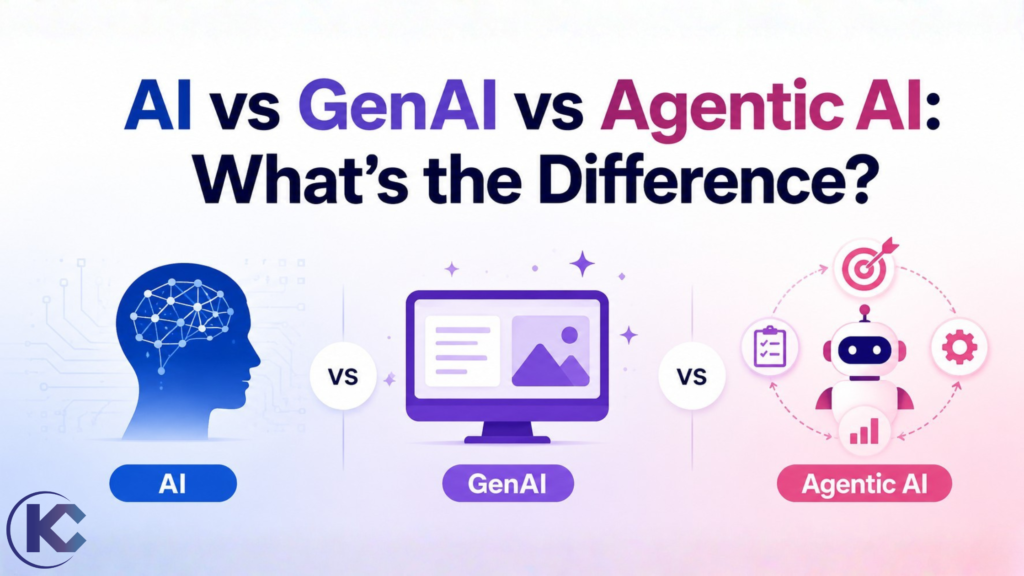
The AI Evolution : While Traditional AI analyzes data to predict outcomes, and Generative AI (GenAI) uses large language models (LLMs) to create brand-new content, Agentic AI marks the shift to autonomous execution. Driven by reasoning loops, computer-use capabilities, and multi-agent collaboration, Agentic AI moves beyond screen outputs to act as an independent digital workforce, executing complex workflows across enterprise applications with minimal human intervention.
To thrive in this new landscape, leaders must understand the structural differences between these three technology layers.
- ✗ Passive responses requiring constant human prompting
- ✗ Confined to a single text box or application interface
- ✗ Limited by context window constraints without memory
- ✗ Incapable of taking actions or changing system states
- ✓ Goal-oriented planning from a single initial command
- ✓ Cross-platform workflow orchestration via APIs and UI scraping
- ✓ Persistent memory and multi-agent collaboration networks
- ✓ Built-in self-correction, reflection, and guardrail layers
The Architectural Breakdown: Side-by-Side
| Dimension | Traditional AI (Analytical) | Generative AI (Content Generation) | Agentic AI (Autonomous Execution) |
|---|---|---|---|
| Core Tech Stack | Regression models, Random Forests, Neural Networks. | Large Language Models (LLMs), Diffusers, Transformers. | Orchestrated LLM networks, Task Planning loops, Vector memories. |
| Primary Objective | Classification, mathematical clustering, data prediction. | Text generation, translation, asset synthesis. | Goal-driven workflow automation, operational execution. |
| Operational Loop | Static: processes inputs and surfaces immediate predictions. | Reactive: generates a direct textual response to a manual prompt. | Dynamic: Iterative perception, planning, tool usage, and reflection. |
| Tool Integration | Isolated within specialized data sandboxes. | Limited to web browsing plugins and retrieval (RAG). | Deep: Reads/writes to CRMs, ERPs, external APIs, and legacy UIs. |
| Context & Memory | Stateless or restricted to set tabular databases. | Ephemeral: Bound within single chat session limits. | Persistent: Long-term memory across cross-functional tasks. |
| Failure Resolution | Throws exceptions or degrades prediction accuracy. | Hallucinates or stops, requiring a user to rewrite the prompt. | Self-corrects via reasoning verification checks. |
How the Technology Handles a Real-World Scenario
1. The Traditional AI Response
An enterprise machine learning model reviews ticket telemetry, runs a predictive algorithm, and flags a list of accounts with high churn risk coefficients.
Result: It surfaces the issue on an executive dashboard, but the tickets remain unaddressed until a human analyst steps in.
2. The Generative AI Response
A human customer service representative logs into a workspace and pulls up an open high-risk ticket. Using an embedded GenAI copilot, they draft a personalized response explaining the resolution.
Result: The speed of content creation scales, but a human must still manually read, prompt, evaluate, click send, and update internal databases.
3. The Agentic AI Approach
An autonomous orchestrator agent detects a critical, long-standing support ticket. It evaluates the context, spins up a technical sub-agent to query internal databases, logs into the ticketing portal, reads previous interactions, and executes a database patch to resolve the issue. It then emails the client to confirm everything is fixed, and updates the CRM status.
Result: The entire problem-solving chain runs autonomously from start to finish, with a human team lead providing oversight via an audit log dashboard.
It is vital to recognize that these technologies do not exclude one another; instead, they stack together. Traditional AI provides data filtering and system anomaly tracking. Generative AI provides natural semantic interfaces and language understanding. Finally, Agentic AI ties these layers together, turning insights and content into real, autonomous actions.
Deploying the Right Tier for Business Operations
- •Analytical Automation (Traditional AI): Best for systemic fraud isolation, high-volume sensor telemetry (IoT), real-time logistics route management, and quantitative risk profiling.
- •Augmented Intelligence (Generative AI): Best for speeding up content generation, writing legal documentation outlines, running internal semantic knowledge bases (RAG), and assisting human developers with code autocompletion.
- •Autonomous Workforces (Agentic AI): Best for handling outbound customer engagement pipelines, running automated IT operations, managing real estate leads, and orchestrating cross-department supply chain tasks.
The Bottom Line
The line separating analytical, generative, and agentic tools marks the boundary between handling information and executing work. Moving away from isolated chat prompt spaces toward open enterprise ecosystems powered by multi-agent collaboration defines the modern competitive landscape. Embracing Agentic AI means transitioning your business software from passive applications into active partners in daily operations.