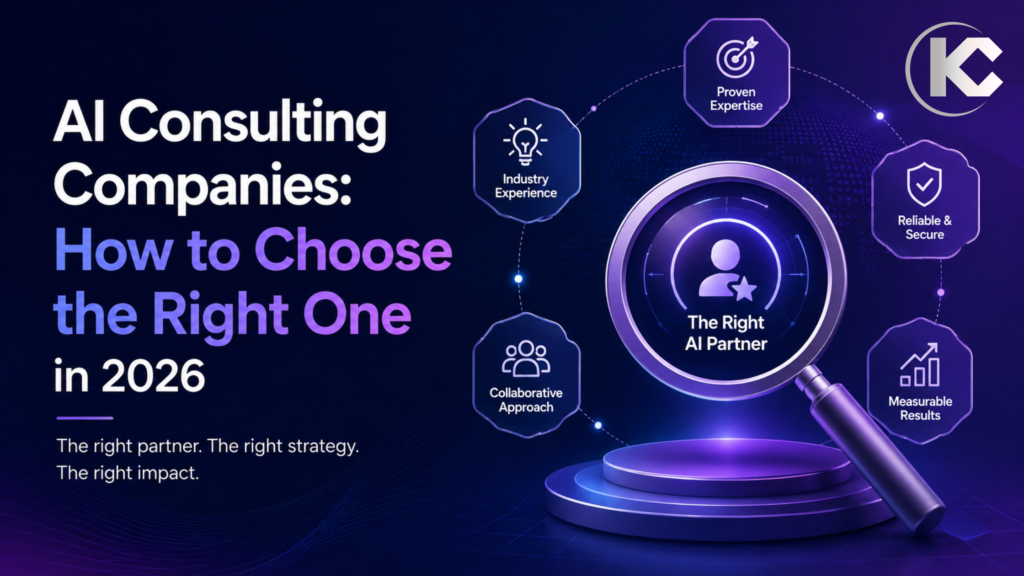
AI Consulting Companies: How to Choose the Right One in 2026
⏱ 5 min read
Choosing an AI consulting company is no longer a side decision, it is a budget-defining, risk-defining choice. The market is crowded with freelancers, boutique AI agencies, generalist system integrators, and Big Four firms, all claiming the same “AI transformation” language. Most of them cannot show a single production AI system they built end to end.
This guide gives CTOs, CIOs, VPs of Operations, and Innovation leaders a practical, evidence-based framework for evaluating enterprise AI consulting partners in 2026, including a scorecard, a comparison matrix, red flags to watch for, and the specific questions to ask before you sign anything.
Quick Answer
How do you choose the right AI consulting company? Evaluate vendors on five things: proven delivery evidence (not just case study slides), technical depth in your specific use case (agentic AI, RAG, automation, or custom models), a clear AI governance and security posture, transparent pricing tied to milestones, and a track record of long-term support after go-live. A specialized AI consulting partner who can show working systems will consistently outperform a generalist agency or a freelancer on a complex enterprise build.
70%+
Of enterprise AI pilots reportedly never reach production, most often due to weak governance and unclear ownership rather than the technology itself.
3-6 mo
Typical time-to-value when a specialized AI partner runs a scoped pilot before committing to full build-out.
1 in 3
Enterprise buyers who switch AI vendors mid-project cite poor communication and missed milestones as the top reason.
Why Choosing the Right AI Consulting Company Matters
AI projects fail differently than typical software projects. A late CRM rollout costs you a few weeks. A poorly built AI system can quietly produce wrong answers, leak sensitive data, or create compliance exposure long after launch, and the damage is not always visible until it is expensive.
Most failures trace back to the same handful of causes, and nearly all of them are decided at the vendor-selection stage, not during development.
Where AI Projects Actually Break Down
- Technology complexity: Teams pick a model or framework because it is trendy, not because it fits the use case, the data, or the budget.
- No governance: Nobody owns model risk, data lineage, or approval workflows, so the system drifts once it is live.
- Vendor lock-in: Proprietary pipelines with no documentation mean you cannot leave, even when the relationship sours.
- Security gaps: Prompt injection, data leakage, and unvetted third-party tools go unchecked because nobody tested for them.
- Unclear ROI: The system launches, but nobody defined what “working” means in business terms, so success is never measured.
- Scaling failure: A pilot that worked for ten users falls over at one thousand, because it was never architected to scale.
The right partner does not just write code. They close these gaps before they become expensive.
What Does an AI Consulting Company Actually Do?
A genuine AI consulting firm covers the full lifecycle, not just a proof of concept that never leaves the sandbox.
AI Strategy & Readiness
Assessing your data, systems, and processes to identify which AI use cases will actually move business metrics.
Architecture & Technology Selection
Choosing the right models, vector stores, and orchestration frameworks for your specific workload and budget.
PoC, MVP & Custom Development
Building AI agents, RAG systems, and automation pipelines that are tested against real business data, not demo data.
Integration & Deployment
Connecting the system to your CRM, ERP, or Salesforce org, and deploying it into production infrastructure.
Governance & Responsible AI
Setting up approval workflows, bias checks, and data handling policies that hold up to audit.
Optimization, Monitoring & Training
Watching performance and cost after go-live, and training your team so the system does not become a black box.
Signs You Need an AI Consulting Partner
No internal AI team
You have engineers but nobody with production LLM or agent experience.
Legacy systems everywhere
Your data lives in five disconnected systems and nobody has mapped it.
Manual, repetitive workflows
Teams spend hours a day on tasks that pattern-match well to automation.
Failed or stalled AI pilots
Something got built, nobody adopted it, and it quietly died.
Compliance concerns
You operate in a regulated space and need AI governance built in from day one.
Scaling issues
A prototype works for a demo, not for real transaction volume.
Ready to Move Beyond Stalled AI Pilots?
Stop wasting budget on prototypes that never reach production. Partner with an AI consulting team that builds secure, scalable, and business-focused systems from day one.
How to Evaluate AI Consulting Companies: A Practical Framework
Skip the sales deck. Evaluate on evidence you can verify in under an hour per vendor.

Enterprise AI Strategy and Architecture
Step 1: Frame the Problem Before You Talk to Anyone
Write a one-page brief covering the business goal, success metrics, scope boundaries, key integrations, and budget range. This is what you send every vendor, so every proposal answers the same question and you can compare them side by side.
Step 2: Shortlist by Verifiable Evidence
Ask each vendor for two to three case studies with measurable results, one reference you can actually call, and named team bios for people who will work on your project, not just the sales team. Verify with a short reference call and a look at how recent and specific their portfolio actually is.
Step 3: Test the AI-Specific Fundamentals
Step 4: Compare Proposals on Value, Not Hourly Rate
Demand a written statement of work with scope, deliverables, dated timeline, assumptions, and change policy. Weigh time-to-first-value, the PoC-to-MVP plan, and risk controls, not the hourly rate alone. A paid pilot of one to three weeks is the cheapest way to validate a working relationship before committing to full scope.
Step 5: Stress-Test Communication for a Week
Send a structured brief and expect a written recap within twenty-four hours. Hold one call and expect minutes with actions, owners, and dates, also within twenty-four hours. Insist on meeting the actual project manager and lead engineer, not only sales.
Evaluation Scorecard (Quick Reference)
- Industry experience relevant to your sector
- Technical depth: agentic AI, RAG, LLM orchestration, custom models
- Verifiable case studies and references (not just logos)
- Security and AI governance maturity
- Named team, not just sales
- Transparent, milestone-based pricing
- Support and SLA after go-live
- Communication speed and clarity
Freelancer vs Agency vs AI Consulting Company vs Big Four
Not every vendor type is built for the same job. Here is how they typically compare across what matters most for an enterprise AI build.
Freelancers work for narrow, low-risk tasks. Generalist agencies and system integrators bring process but often lack deep AI-specific expertise. Big Four firms bring credibility and slow-moving bureaucracy at a premium price. A specialized AI consulting partner sits in the sweet spot: enough process to be accountable, enough technical depth to actually ship, and enough focus to move fast.
Kizzy Consulting’s AI Consulting Services
AI Strategy & Readiness Assessment
A structured audit of your data, systems, and processes that produces a prioritized AI roadmap, not a slide deck of buzzwords.
AI Agent Development & Agentic AI
Custom AI agents that plan, use tools, and complete multi-step business tasks, built on production-grade orchestration.
RAG & Enterprise Knowledge Systems
Retrieval systems that ground answers in your actual documents, CRM records, and internal knowledge base.
Workflow Automation & LLM Consulting
Automating repetitive, rules-heavy workflows and choosing the right LLM for cost, latency, and accuracy tradeoffs.
AI Integration & Salesforce/Agentforce
Deep Salesforce expertise means our AI systems plug directly into the CRM and workflows your teams already use.
Responsible AI, Governance & Managed AI Services
Governance frameworks, monitoring, and ongoing optimization so your AI investment keeps paying off after launch.
See our full AI agent development services, learn more about agentic AI, or start with a formal AI readiness assessment.
Our AI Consulting Process
Discovery & Assessment
↓
Roadmap & Architecture
↓
PoC / MVP
↓
Development & Testing
↓
Deployment
↓
Optimization & Monitoring
↓
Ongoing Support
Technology Stack We Work With
Models & Orchestration
OpenAI, Anthropic Claude, Google Gemini, Llama, Mistral, LangChain, LangGraph, CrewAI, AutoGen, LlamaIndex, Model Context Protocol (MCP).
Data & Infrastructure
Pinecone, Weaviate, ChromaDB, Neo4j, Postgres, Redis, Docker, Kubernetes, Python, FastAPI, Azure AI, AWS, Google Cloud.
Business Systems & Integration
Salesforce, n8n, Slack, Microsoft 365, HubSpot, and REST APIs for connecting AI into the tools your teams already run.
Industries We Serve
Healthcare, Financial Services, Insurance, Retail, Manufacturing, Construction, Real Estate, Education, Government, Logistics, Telecom, Travel, and Nonprofits. AI strategy that works in one industry rarely transfers cleanly to another, which is why our engagements start with domain-specific discovery, not a templated playbook.
Why Choose Kizzy Consulting
Kizzy Consulting is an AI Claude Network Partner and OpenAI Statrup Member that builds business-first AI, not AI for its own sake. That combination matters because most enterprise AI use cases live inside the CRM, the support desk, or the sales pipeline, exactly where our AI expertise already sits.
- Business-first AI: Every engagement starts with a business metric, not a model choice.
- Dedicated engineering teams: Named engineers on your project, not a rotating bench.
- Transparent communication: Written recaps, clear timelines, and direct access to the people building your system.
- Responsible AI built in: Governance and security are part of the architecture, not an afterthought.
- Long-term partnership: We stay on after go-live to monitor, optimize, and support.
Need a Vendor That Actually Delivers?
Don’t settle for billable hours without outcomes. We price our AI builds on transparent milestones so you know exactly what you are getting and when.
Common Mistakes Companies Make When Hiring an AI Partner
- Buying AI technology before defining the business problem it should solve
- Ignoring governance until after something goes wrong
- Underestimating how much poor data quality will limit results
- Skipping a written roadmap and jumping straight to development
- Choosing a trendy technology instead of the one that fits the use case
- Signing contracts that create vendor dependency with no exit plan
- Launching without a monitoring or evaluation plan
- Never building an internal adoption plan, so the system goes unused
AI Consulting Best Practices
The engagements that succeed share a pattern: a written roadmap tied to business KPIs, governance defined before launch, human review on any high-stakes decision, answers grounded in verified knowledge rather than open generation, disciplined prompt and version management, real observability into cost and performance, ongoing evaluation against the original success metrics, and continuous optimization instead of a one-time delivery.
The Future of AI Consulting
Enterprise AI is moving from single chatbots toward multi-agent systems that plan, use tools, and coordinate across departments with minimal human handoff. As reasoning models improve and orchestration frameworks mature, the winning consulting partners will be the ones who treat AI governance, evaluation, and cost control as core engineering disciplines, not compliance paperwork bolted on at the end.
If you are also exploring retrieval-heavy architectures, our deep dive on agentic RAG architecture covers the technical side in detail.
AI Consulting Companies FAQs
1. What does an AI consulting company actually do?
It helps identify high-value AI use cases, designs the technical architecture, builds and tests a working system, integrates it with your existing tools, and supports it after launch.
2. How much does AI consulting cost in 2026?
Simple tools like a rule-based chatbot can run five thousand to fifty thousand dollars. Enterprise, LLM-powered systems with compliance needs often run four hundred thousand dollars or more, depending on scope and integration complexity.
3. How long does an AI consulting engagement take?
A scoped pilot typically runs one to three weeks. A full enterprise build, from discovery through deployment, generally takes three to six months.
4. What is the difference between an AI agency and an AI consulting company?
An agency often executes narrow tasks with less strategic input. A consulting company typically starts with strategy and governance, then builds toward a scalable, supported production system.
5. Should I hire a freelancer instead of an AI consulting firm?
A freelancer can work for narrow, low-risk tasks. For anything involving production data, integration, or compliance, a firm with named team members and governance processes carries much lower risk.
6. What questions should I ask before hiring an AI vendor?
Ask for case studies with measurable results, a callable reference, named team bios, their approach to prompt-injection defense, and how they handle data governance and IP transfer at contract end.
7. What are red flags when evaluating an AI consulting company?
Vague case studies with no measurable results, reluctance to name the actual engineers, no answer on data governance, no written statement of work, and pricing based on hours with no milestones.
8. What is AI governance and why does it matter?
AI governance is the set of policies and processes that control how a model is built, deployed, and monitored, including bias checks, data handling, and approval workflows. Without it, systems drift and create risk over time.
9. Can a small AI consulting company handle enterprise-scale projects?
Yes, if they can show relevant enterprise case studies, a real team behind the work, and infrastructure built for scale. Team size matters less than proven delivery evidence.
Conclusion: Choose Evidence Over Promises
The AI consulting market is full of confident pitches. What separates the partners worth hiring is simple: they can show working systems, they talk about governance before you ask, and they price around milestones instead of hours.
Run the evaluation framework above on every vendor you consider. It takes an afternoon and it will save you months.
Evaluating AI Consulting Partners?
Start with a free AI readiness assessment and get a scoped, milestone-based proposal, not a generic sales deck.
Talk to our AI Consulting team today.