Agentic AI vs Automation: What’s the Real Difference?
⏱ 3 min read
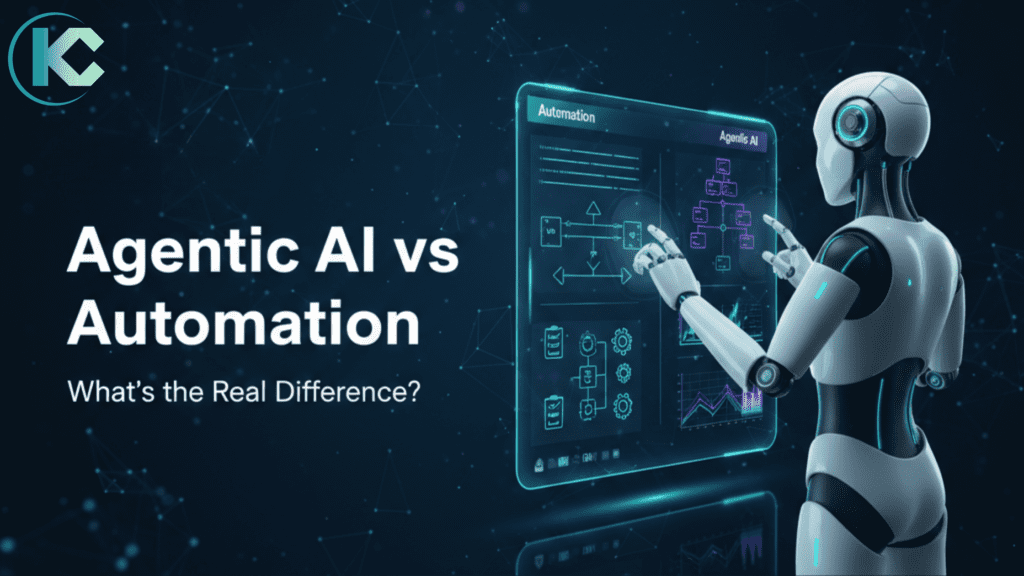
Quick Answer: Automation executes fixed, pre-written rules, it does exactly what it is told and stops when it hits something unfamiliar. Agentic AI is AI that can plan, decide, and act toward a goal with minimal human input – see our full definition of agentic AI for more. Here, we’re focused on how it compares to traditional automation.
In Salesforce terms: a standard Flow that assigns a lead to a rep is automation. An Agentforce agent that reads the lead’s history, scores intent, drafts a personalized reply, and only escalates to a human when it’s genuinely stuck-that’s agentic AI.
Machines are doing more work than ever – your coffee maker starts on schedule, chatbots answer routine questions, and workflows fire without anyone touching them. But “intelligent automation” and “autonomous agents” often get used as interchangeable buzzwords, and for a founder, CXO, or operations leader, that confusion has a real cost: it leads teams to automate a task that actually needed judgment, or to bolt an AI agent onto a problem that a simple rule would have solved for a fraction of the price.
Here is the distinction in plain terms – analyzing agentic AI vs automation – and where each one actually belongs in a Salesforce-driven operation.
What Is Automation?
Automation is technology that performs a task with a fixed set of rules. You define the “if this, then that.” It executes precisely, every time, and it does not deviate. If something happens outside its rules, it stops and waits for a human.
Everyday Examples of Automation
- An out-of-office auto-responder
- Assembly-line robots repeating the same weld
- A nightly scheduled file backup
- A Salesforce Flow that assigns a new lead to a rep based on territory
Think of automation as a highly obedient assistant. It will never miss a step you defined – but it also cannot handle a step you did not define.
What Is Agentic AI?
To truly understand automation vs AI agents, we must look at how they approach problems. Agentic AI is an AI system that understands a goal, reasons about how to reach it, plans a sequence of actions, and executes them – adjusting in real time as the situation changes. (For a deeper dive into the mechanics, see our full definition of agentic AI). It is not following a pre-written script. It is actively deciding what the next right action is.
Everyday Examples of Agentic AI
- An assistant that reads your inbox, notices you’re planning a trip, and starts comparing flights unprompted
- A self-driving car that hits a road closure and reroutes on its own
- An Agentforce service agent that diagnoses a multi-part customer issue and resolves it without a script
- A sales agent that notices a deal has gone quiet in a CRM and proactively drafts a re-engagement sequence
Automation = Calculator
Give it an input, it applies the formula, it returns the output. Every time, the same way.
Agentic AI = Analyst
Give it a goal, it gathers context, weighs options, and decides the best path forward.
Automation vs. Agentic AI: Side by Side
The easiest way to map automation vs AI agents is to look at their logic, inputs, and decision-making capabilities.
Agentic AI vs Automation in Practice
1. Customer Service & Support Tickets
A traditional automation routes a support ticket by scanning for keywords like “refund” or “billing” and assigning it to a queue. An agentic AI reads the full ticket, understands the customer’s actual issue and urgency, decides whether it can resolve it directly or needs to escalate, and takes that action – no predefined keyword list required.
2. Customer Service & Voice
Traditional IVR (Interactive Voice Response) automation forces users to “Press 1 for Sales, Press 2 for Support.” It’s rigid and frustrating. In contrast, AI voice agents use agentic AI to hold natural, two-way conversations, dynamically pulling data from your CRM to troubleshoot issues, book appointments, or qualify leads on the fly without a human agent.
3. Marketing Campaigns
In marketing, traditional automation triggers a 3-part email drip campaign based on a form fill. It sends Email 2 exactly three days after Email 1, regardless of context. Agentic AI evaluates how the user interacted with Email 1, checks their recent website activity, and autonomously decides whether to send a case study, offer a discount, or pause communication entirely.
Kizzy Framework
The Execution-Intelligence Stack
We build client systems on a simple split: automation owns execution, agentic AI owns intelligence. Flow, scheduled jobs, and integrations move data reliably and cheaply. Agentforce sits on top, deciding which lead matters, which case is urgent, and which customer needs a human right now. Neither layer replaces the other – the maturity of an operation is how cleanly the two are separated.
When to Use Which: The Decision Framework
Use traditional automation when: tasks are repetitive, rules are stable, and volume is high.
- The process repeats identically. Same task, same steps, every time.
- Rules are fully definable. If it can be written as “if this, then that,” automation is cheaper and faster.
Examples: invoice reminders, syncing records between systems, updating CRM status fields, rule-based lead routing.
Use agentic AI when: tasks require judgment, conditions change frequently, or multiple systems need coordinating.
- A decision has to be made. The system needs to weigh options, not just follow steps.
- Context matters. Past interactions, tone, or account history should shape the action.
Examples: Agentforce automation for proactive support resolution, intelligent CRM updates, behavior-based lead qualification.
Still unsure which technology fits your operational bottlenecks? Start by taking an AI readiness assessment to map your workflows against the right solutions.
The Smart Approach: Both, Layered
The real question isn’t automation or agentic AI – it’s how to layer them. Automation handles the structured, repetitive backbone: sending emails, syncing data, updating records, triggering reminders. Agentic AI sits above it, doing the thinking: understanding context, deciding priority, and choosing the next best action.
Automation can assign a lead. Agentic AI can decide which lead deserves priority, personalize the outreach, and carry the conversation forward without waiting for a human to prompt each step.
That’s the model we implement for clients moving from a rules-only Salesforce org to an Agentforce-driven one: automation for execution, AI workflow automation for intelligence, working as one system rather than two disconnected tools.
Frequently Asked Questions about Agentic AI vs Automation
1. Is agentic AI just a more advanced form of automation?
No. Automation executes fixed rules with no reasoning. Agentic AI reasons about a goal and decides its own steps to reach it, including steps nobody explicitly programmed. The difference is decision-making, not just sophistication.
2. Can automation and agentic AI work together in the same Salesforce org?
Yes, and this is how most mature Salesforce implementations are built. Flow and scheduled jobs handle structured execution, while Agentforce agents handle judgment-heavy decisions like lead prioritization, case triage, and personalized outreach.
3. What’s an example of agentic AI in Salesforce specifically?
An Agentforce agent that reviews a case, checks account history, drafts a resolution, and only escalates to a human agent when its confidence score falls below a set threshold is a working example of agentic AI inside Salesforce.
4. Is agentic AI more expensive to implement than automation?
Generally yes, and it should only be used where judgment is genuinely required. Applying agentic AI to a task that a simple Flow could handle adds cost without adding value, since the two tools solve different problems.
5. How do I know if my business needs automation or agentic AI?
If the task has a fixed set of rules and doesn’t change, automation is the right fit. If the task requires weighing context, adapting to new information, or working toward a goal rather than a step, agentic AI is the better fit.
Not Sure Where Automation Ends and Agentic AI Should Start?
We’ll map your current Salesforce workflows and show you exactly where a Flow is enough – and where an Agentforce agent earns its cost.