Agentforce Vibes 2.0: Salesforce AI Coding Revolution
⏱ 4 min read
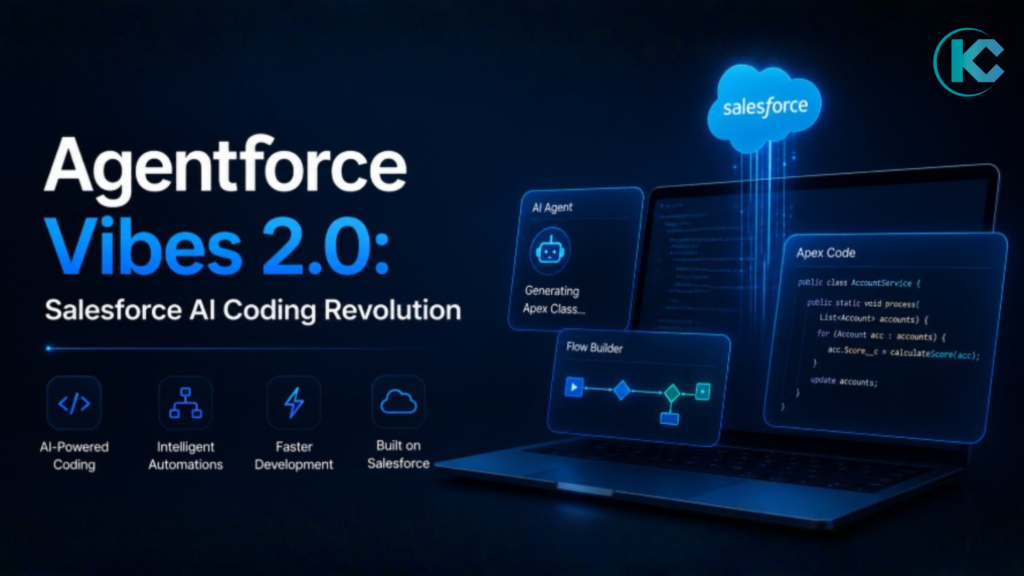
Agentforce Vibes 2.0: Salesforce unveiled one of its most impactful developer platform upgrades at TDX2026. Agentforce Vibes 2.0 transforms AI-assisted Salesforce development from generic code generation into a truly org-aware, enterprise-grade development experience. Whether you are exploring what is Agentforce Vibes 2.0, how Salesforce Multi-Framework works, or how AI coding agents integrate with Salesforce, this guide breaks down everything: org-aware AI development, multi-model support, native React app generation, GraphQL integration, Salesforce MCP servers, AI-powered DevOps workflows, and how Agentforce is reshaping enterprise Salesforce development.
40%
Faster Development Cycles with AI-assisted workflows
100%
Free Access in Developer Edition Orgs
3+
Supported AI Models Including GPT-5 & Claude
Real-Time
Org-Aware Code Generation & Previewing
Agentforce Vibes 2.0: What Changed and Why It Actually Matters
Salesforce introduced Agentforce Vibes 2.0 at TDX2026, and unlike many enterprise AI announcements, this one represents a meaningful shift in how Salesforce apps are actually built. The original Vibes release acted primarily as a browser-based AI coding assistant. Useful, yes – but still fundamentally limited by generic code generation.
Vibes 2.0 changes that entirely by making AI development deeply aware of your actual Salesforce org. Instead of generating generic snippets that require heavy manual adaptation, the platform now understands custom objects, field relationships, metadata structures, permissions, and existing architectural patterns directly from your org environment.
What makes Agentforce Vibes 2.0 different?
- AI-generated code is customized to your Salesforce org metadata
- Supports React apps, LWC components, Apex classes, and GraphQL queries
- Understands custom objects, relationships, and field structures automatically
- Includes multi-model AI support instead of locking users to one model
- Generates enterprise-ready apps with Salesforce-native security controls
- Provides cloud-hosted VS Code development environments directly inside Salesforce
From Generic AI Coding to Org-Aware Salesforce Development
Most AI coding tools generate code designed to work everywhere – which usually means it works perfectly nowhere. Enterprise Salesforce environments are highly structured, metadata-driven ecosystems with strict constraints around permissions, APIs, and governance. Generic AI tools often fail precisely because they lack org context.
Agentforce Vibes 2.0 addresses that problem directly. Developers and admins can describe requirements in natural language, and the platform generates code aligned to the specific structure of their Salesforce org. The generated outputs are not generic placeholders – they are functional applications built around the organization’s actual data model.
Traditional AI Coding Assistants
- Generic code generation with little platform awareness
- No understanding of Salesforce metadata structures
- Requires heavy manual adaptation after generation
- Limited understanding of org security constraints
- Minimal support for enterprise governance requirements
- Disconnected from live Salesforce environments
Agentforce Vibes 2.0
- Org-aware code generation using live metadata
- Understands custom objects and relationships automatically
- Builds React apps, LWCs, Apex, and GraphQL queries
- Respects Salesforce security and governance models
- Real-time previews and iterative app building
- Integrated directly into Salesforce Developer Edition orgs
Multi-Model AI Support: Why It Matters More Than People Think
One of the most important – and most overlooked – features in Agentforce Vibes 2.0 is its support for multiple AI models. Salesforce is not forcing developers into a single AI ecosystem. Instead, users can switch between models like Claude Sonnet, GPT-5, and Salesforce proprietary models depending on the task they are solving.
AI Model
Best For
Key Advantage
Claude Sonnet
Complex Apex logic & testing
Strong reasoning and structured code generation
GPT-5
UI generation & natural language translation
Excellent prompt interpretation and React generation
Salesforce Proprietary Models
Platform-native optimization
Deep Salesforce ecosystem awareness
This flexibility reflects a surprisingly mature approach to enterprise AI tooling. Different models excel at different tasks, and Salesforce appears to recognize that forcing every workflow through one model creates unnecessary limitations for developers.
Developer Edition Access: Why Free Changes Everything
Perhaps the most practical announcement is that Salesforce removed the cost barrier entirely for experimentation. Every Developer Edition org now includes access to:
- Agentforce Vibes IDE
- Multi-model AI support
- Salesforce Hosted MCP Servers
- Cloud-hosted VS Code environments
- React app generation workflows
- GraphQL and metadata tooling
- Zero additional licensing costs
For developers learning Salesforce, building proof-of-concepts, or experimenting with AI-powered development workflows, this dramatically lowers the barrier to entry. Teams can test ideas aggressively without worrying about additional platform costs.
Salesforce Multi-Framework: The Bigger Architectural Shift
While Agentforce Vibes 2.0 received the headline attention, the deeper platform innovation may actually be Salesforce Multi-Framework. This new architecture allows developers to build native Salesforce applications using React – without relying on fragile Visualforce workarounds or iframe-based integrations.
The generated applications inherit Salesforce-native authentication, permissions, governance controls, and security policies automatically. This effectively brings modern React development directly into the Salesforce ecosystem while maintaining enterprise-grade compliance standards.
What Multi-Framework enables:
- Native React apps running directly on Salesforce infrastructure
- Automatic authentication and governance inheritance
- GraphQL-powered data access using org metadata
- Type-safe access to Salesforce data structures
- Real-time previewing during development
- Automatic rate limit management via
@salesforce/sdk-data
What Agentforce Vibes 2.0 Means for Salesforce Admins
Salesforce is heavily promoting a future where admins can create applications using natural language prompts rather than traditional development workflows. While that vision has limitations for highly complex enterprise implementations, it becomes genuinely compelling for internal tools, dashboards, lightweight workflow apps, and administrative utilities.
Traditional Salesforce Development
- Admins gather requirements manually
- Developers translate business requests into code
- UI creation requires engineering involvement
- Long iteration cycles between teams
- Manual testing and deployment processes
Agentforce Vibes Workflow
- Admins describe requirements in plain language
- AI generates functional React applications
- Salesforce handles security automatically
- Rapid prototyping and live iteration
- Faster delivery of internal operational tools
Agentforce Vibes 2.0 Pricing Model
Salesforce has not positioned Agentforce Vibes 2.0 as a single packaged product. Instead, it sits inside a layered pricing architecture built around credits, usage, and per-user access.
This makes the model flexible – but also important to understand correctly before adoption.
This makes the model flexible – but also important to understand correctly before adoption.
ENTRY LAYER
Salesforce Foundations
$0
Designed for experimentation and early-stage development.
- Agent Builder + Prompt Builder included
- Starter Flex + Data Cloud credits
- Access to Agentforce Vibes IDE
- Developer Edition enabled usage
SCALE LAYER
Flex Credits Model
~$500
Pay-as-you-use model aligned with AI consumption.
- Customer & employee-facing agents
- Agentforce Voice capabilities
- Digital Wallet-based usage tracking
- Consumption-based scaling at enterprise level
PRODUCTIVITY LAYER
Flat Fee Access
$125
Per user / month for predictable AI development access.
- Multi-model AI (GPT, Claude, Salesforce models)
- Predictable monthly pricing
- Enterprise governance controls
- Ideal for dev teams & internal builders
Key Insight
The real shift here isn’t pricing – it’s abstraction. Salesforce is moving from product-based licensing to AI consumption + developer productivity economics, where cost aligns with agent usage and development velocity rather than static feature access.
The Real Limitations of Agentforce Vibes 2.0
Despite the excitement, Agentforce Vibes 2.0 is not a replacement for experienced Salesforce engineers. The platform dramatically accelerates scaffolding, repetitive coding tasks, UI generation, and metadata-aware development – but it still struggles with advanced architectural decisions and highly complex business logic.
- Complex multi-object automations still require human oversight
- Enterprise edge cases need experienced engineering judgment
- AI-generated architectures require validation before production rollout
- Performance optimization remains a human-led process
- Error handling and governance policies still need manual review
- Business context interpretation is still inconsistent for advanced workflows
The strongest use case today is acceleration – not replacement. Teams that understand Salesforce deeply will gain the most value because they can evaluate, refine, and guide AI-generated outputs effectively.
How Agentforce Vibes Fits Into Salesforce Headless 360
The announcements at TrailblazerDX 2026 revealed a much larger strategic direction beyond AI coding assistance. Salesforce is moving aggressively toward what many are calling Headless 360 – a platform architecture where nearly every Salesforce capability becomes accessible through APIs, MCP tools, CLI commands, and autonomous agents.
Agentforce Vibes 2.0 is the developer-facing layer of that transformation. It provides the interface through which developers and admins interact with the broader AI-native Salesforce ecosystem.
MCP Tools
AI agent connectivity & metadata access
Agentforce
AI orchestration & autonomous workflows
Multi-Framework
Native React development for Salesforce
Headless 360
API-first AI-native enterprise architecture
How to Get Started With Agentforce Vibes 2.0
- Create a Salesforce Developer Edition org to access Vibes 2.0 for free.
- Open the Agentforce Vibes IDE directly from Salesforce Setup.
- Start with a simple React app or internal dashboard project.
- Experiment with custom objects to see how org-aware generation works.
- Test multiple AI models depending on the type of work you are generating.
- Review generated code carefully before deploying to production environments.
The Verdict: A Legitimate Shift in Salesforce Development
Agentforce Vibes 2.0 feels less like a simple AI feature and more like the beginning of a fundamental platform transition. The combination of org-aware development, multi-model AI support, native React app generation, and deep integration with Salesforce governance systems makes this significantly more practical than earlier generations of enterprise AI tooling.
The biggest takeaway is not that AI will replace Salesforce developers – it will not. The real opportunity is that repetitive scaffolding, boilerplate coding, and low-value implementation work are increasingly becoming automated. That allows teams to focus more heavily on architecture, business logic, governance, and strategic decision-making.
- Org-aware AI coding dramatically improves Salesforce-specific development accuracy
- Multi-model support allows developers to use the best AI for each task
- Multi-Framework architecture modernizes React development inside Salesforce
- Developer Edition access removes cost barriers for experimentation and learning
- AI-assisted workflows accelerate development cycles by up to 40%
- Headless 360 integration positions Vibes 2.0 as part of Salesforce’s larger AI-native platform strategy
Ready to Modernize Your Salesforce Development Workflow?
Kizzy Consulting helps organizations adopt AI-powered Salesforce development using Agentforce, MCP tools, Headless 360 architecture, and modern React-based enterprise applications. Whether you are exploring AI-assisted coding, Salesforce modernization, or enterprise workflow automation, our team helps businesses implement scalable and governance-ready Salesforce ecosystems.
Explore how Agentforce Vibes 2.0 can accelerate your Salesforce transformation: