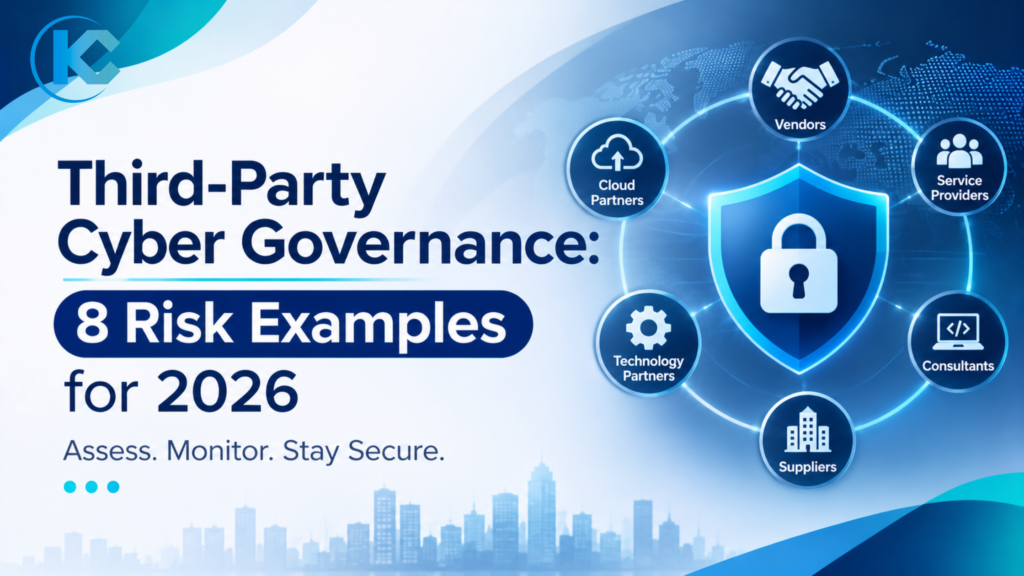
Third-Party Cyber Governance: 8 Risk Examples Every Security Team Must Know in 2026
⏱ 4 min read
Modern enterprises rely on dozens of external SaaS platforms, cloud vendors, API integrations, and managed service providers to run daily operations. While this connected ecosystem accelerates growth, it also introduces a hidden vulnerability: third-party cyber risk. Even when an organization secures its own perimeter, a single compromised vendor, over-permissioned integration, or unmonitored fourth-party sub-processor can expose sensitive customer and financial data. This guide explains what third-party cyber governance is, breaks down 8 critical third-party risk examples security teams must address in 2026, and provides a practical governance framework to reduce vendor-driven exposure.
TL;DR: Third-Party Cyber Governance at a Glance
- Third-party cyber risk is the exposure created when external vendors, suppliers, SaaS tools, or partners access your systems, APIs, or data.
- Point-in-time questionnaires are no longer enough. Annual vendor spreadsheets miss real-time configuration drift, newly disclosed vulnerabilities, and fourth-party dependencies.
- Key 2026 risk vectors include SaaS and OAuth token abuse, fourth-party supply chain cascades, shadow AI tools, MSP compromises, and over-permissioned CRM/ERP integrations.
- Effective cyber governance combines vendor tiering, least-privilege technical controls, continuous posture monitoring, contractual breach SLAs, and joint incident response planning.
- Shared accountability requires security, procurement, legal, and IT architecture teams to evaluate vendor risk across the entire lifecycle – from onboarding to offboarding.
01
Visibility
Map every vendor and API
02
Least Privilege
Restrict scopes and data
03
Continuous Governance
Monitor beyond onboarding
What Is Third-Party Cyber Governance?
Third-party cyber governance is the structured system of policies, technical controls, contractual obligations, and oversight processes an organization uses to manage cybersecurity risks introduced by external vendors, software providers, contractors, and business partners.
Unlike traditional vendor management – which focuses on pricing, delivery timelines, and service uptime – third-party cyber governance treats external connections as an extension of the enterprise attack surface. Every external platform connected to your CRM, ERP, identity provider, or cloud infrastructure inherits a degree of trust. Governance ensures that trust is verified, bounded, and continuously monitored.
Third-Party Risk vs. Fourth-Party Risk
- Third-Party Risk: Security exposure originating from a vendor you contract with directly (for example, your marketing automation platform, payroll provider, or managed IT partner).
- Fourth-Party Risk: Security exposure originating from your vendor’s own suppliers, cloud hosting providers, or sub-processors. You have no direct contract with fourth parties, yet a breach in their environment can directly impact your data.
Why Traditional Vendor Risk Management Falls Short
Many organizations still rely on annual security questionnaires and static compliance certificates during procurement. That approach creates a dangerous blind spot because vendor environments change daily.
| Dimension | Traditional Vendor Assessment | Modern Cyber Governance (2026) |
|---|---|---|
| Assessment Cadence | Annual or onboarding-only questionnaires | Continuous monitoring and event-driven reviews |
| Scope of Visibility | Direct third-party vendors only | Third-party vendors, APIs, and critical fourth-party sub-processors |
| Evidence Type | Self-attested spreadsheets and static PDFs | Technical telemetry, OAuth scope audits, and live security posture |
| Ownership | Siloed in procurement or compliance | Shared across security, IT architecture, legal, and business owners |
8 Third-Party Risk Examples Every 2026 Security Team Must Know
Attackers increasingly target the weakest link in an organization’s external ecosystem rather than attempting to breach hardened internal networks directly. Below are eight real-world third-party risk scenarios that security and IT leaders must account for in 2026.
1. Over-Permissioned SaaS and OAuth Integrations
Business teams frequently connect third-party apps to core platforms like Salesforce, Microsoft 365, or Google Workspace using broad OAuth scopes. If that third-party app is compromised, attackers inherit its API tokens and can exfiltrate customer records without triggering standard login alerts.
2. Fourth-Party Sub-Processor Cascades
A vetted SaaS vendor may rely on an external file-transfer service, analytics provider, or cloud infrastructure sub-processor. When that downstream fourth party suffers a breach or outage, hundreds of upstream organizations are exposed simultaneously – often without knowing they depended on it.
3. Shadow AI and Unvetted Generative AI Tools
Employees adopting unapproved AI assistants, browser extensions, or automation plugins may paste proprietary source code, customer PII, or financial forecasts into external models. Without governance, sensitive data can be logged, retained, or used for external model training.
4. Managed Service Provider (MSP) Compromises
MSPs and external IT support partners typically hold privileged administrative access across multiple client environments. A single compromised MSP remote monitoring tool or shared admin credential can give attackers lateral movement into dozens of customer networks at once.
5. Software Supply Chain and Open-Source Vulnerabilities
Commercial software and custom applications depend heavily on open-source libraries and third-party SDKs. Malicious package updates, hijacked maintainer accounts, or unpatched vulnerabilities in embedded components can introduce backdoors directly into production environments.
6. Orphaned Vendor Accounts and Stale Credentials
When a consulting engagement ends or a vendor contract expires, their VPN profiles, sandbox accounts, or API keys often remain active. Attackers routinely exploit these forgotten, unmonitored credentials to establish persistent access.
7. Compromised File Transfer and Data Exchange Tools
Organizations frequently exchange payroll files, customer lists, and compliance documents with partners through managed file transfer (MFT) platforms. Zero-day vulnerabilities in these external transfer tools have repeatedly enabled mass data theft across industries.
8. Vendor Business Email Compromise (BEC) and Invoice Fraud
When a trusted supplier’s email environment is compromised, attackers hijack legitimate email threads to send altered bank details, fraudulent invoices, or phishing links. Because the message originates from a real vendor domain, traditional email filters often fail to block it.
Key pattern: Notice that most of these incidents do not require breaking into your primary firewall. They exploit legitimate trust relationships – valid API tokens, active partner accounts, and approved software updates.
Enterprise Cybersecurity Services
Looking to Strengthen Your Enterprise Cybersecurity Posture?
Protect your cloud infrastructure, third-party integrations, and enterprise data with tailored security architecture, risk assessments, and governance frameworks built for modern threats.
How to Elevate Third-Party Cyber Governance: A 5-Step Framework
Closing the third-party risk gap requires moving from reactive compliance checks to an architecture-led governance model. Security, IT, and procurement teams can implement the following five-step framework.
1. Build a Complete Vendor and Integration Inventory
You cannot govern what you cannot see. Maintain a centralized register that tracks not just contracted vendors, but also connected SaaS apps, OAuth integrations, API keys, and critical fourth-party sub-processors. Assign a named internal business owner to every entry.
2. Tier Vendors by Business Criticality and Data Access
Not every supplier warrants the same level of scrutiny. Classify vendors into tiers based on the sensitivity of data they handle, their level of system integration, and the operational impact if they go offline.
3. Enforce Technical Least Privilege on Every Connection
Treat external integrations with the same rigor as internal users. Use dedicated integration accounts, restrict OAuth scopes to the minimum required permissions, enforce MFA and SSO for vendor portals, and segment network access where possible.
4. Embed Security Requirements into Contracts and SLAs
Ensure vendor agreements include clear breach notification timelines (for example, 24 to 72 hours), right-to-audit clauses, mandatory disclosure of critical sub-processors, and defined data deletion obligations upon contract termination.
5. Shift to Continuous Monitoring and Offboarding Discipline
Monitor high-tier vendors continuously for exposed credentials, unpatched external assets, and anomalous API activity. Establish a formal offboarding checklist so that API tokens, sandbox logins, and data-sharing pipelines are revoked the day a vendor relationship ends.
Vendor Risk Tiering Matrix
| Risk Tier | Vendor Profile | Required Governance Controls |
|---|---|---|
| Tier 1 (Critical) | Direct access to customer PII, financial systems, or core CRM/ERP infrastructure | Continuous monitoring, architecture review, strict OAuth scoping, fourth-party mapping, joint incident drills |
| Tier 2 (High) | Processes internal operational data or integrates with business applications | Annual security review, SOC 2 / ISO 27001 verification, dedicated integration user, contractual breach SLA |
| Tier 3 (Low) | No system integration and no access to confidential or customer data | Baseline onboarding review, standard contractual clauses, periodic inventory verification |
Applying Third-Party Governance to CRM and SaaS Ecosystems
For most B2B organizations, the CRM platform sits at the center of the third-party ecosystem. Marketing tools, CPQ extensions, e-signature apps, AI agents, and ERP connectors all read and write sensitive customer data continuously.
To reduce third-party exposure in platforms like Salesforce and connected enterprise apps, architecture teams should enforce four practical controls:
- Audit Connected Apps regularly: Review all installed packages and OAuth connected apps quarterly. Revoke unused tokens and restrict who can authorize new third-party applications.
- Eliminate shared admin credentials: Never allow an external vendor or integration to run under a System Administrator profile. Create dedicated integration users with minimal object and field permissions.
- Govern AI agent and MCP connections: As teams connect AI assistants to enterprise data, enforce strict permission boundaries so external models can only access approved records and fields.
- Monitor API consumption anomalies: Set up alerts for unusual bulk data exports, off-hours API spikes, or unexpected permission changes made by external integration accounts.
Related Read
Explore More Cybersecurity Insights from Kizzy Consulting
Dive deeper into enterprise security strategies, threat governance, and cloud protection best practices.
Conclusion: Make Third-Party Governance a Continuous Discipline
Third-party cyber risk is no longer an edge case – it is one of the primary ways modern enterprises experience data breaches and operational disruption. Because organizations cannot stop using external SaaS tools, cloud partners, and specialized integrations, the solution is disciplined, architecture-level governance.
Key Takeaways
- Map the full ecosystem: Track direct vendors, connected apps, OAuth tokens, and critical fourth-party sub-processors.
- Move past static checklists: Pair procurement reviews with continuous technical monitoring.
- Restrict integration blast radius: Enforce least privilege, dedicated integration accounts, and scoped API access.
- Prepare for vendor incidents: Define contractual breach SLAs and test how quickly your team can isolate a compromised partner.
- Enforce clean offboarding: Revoke credentials and data pipelines immediately when vendor engagements end.
Frequently Asked Questions About Third-Party Cyber Governance
1. What is third-party cyber risk?
Third-party cyber risk is the potential for data exposure, operational disruption, or regulatory non-compliance caused by external vendors, SaaS applications, contractors, or partners that have access to an organization’s systems, APIs, or data.
2. Why are annual vendor security questionnaires not enough in 2026?
Annual questionnaires only capture a self-reported snapshot at a single point in time. They cannot detect newly introduced software vulnerabilities, misconfigured cloud storage, OAuth token leaks, or fourth-party breaches that occur between review cycles.
3. What is the difference between third-party and fourth-party risk?
Third-party risk comes from vendors you contract with directly. Fourth-party risk comes from your vendors’ own suppliers, hosting providers, and sub-processors. Both can impact your organization if a downstream compromise exposes your shared data.
4. How can security teams reduce risk from third-party SaaS integrations?
Teams can reduce integration risk by maintaining an inventory of all connected apps, enforcing least-privilege OAuth scopes, using dedicated integration accounts instead of admin credentials, monitoring API activity for anomalies, and revoking access immediately during offboarding.
5. Who should own third-party cyber governance in an organization?
Effective governance is a shared responsibility. Security defines risk standards and technical controls, IT architecture reviews integrations, legal enforces contractual SLAs, procurement manages vendor onboarding, and business owners remain accountable for the tools their teams adopt.
Need Help Securing Your Enterprise and Third-Party Integrations?
Every connected app, API integration, and AI agent expands your enterprise attack surface. If your organization is auditing third-party integrations, tightening OAuth scopes, or building a scalable cyber governance framework, our team can help close gaps before they become incidents.
Talk to Kizzy Consulting about enterprise cybersecurity services, integration governance, and security architecture.