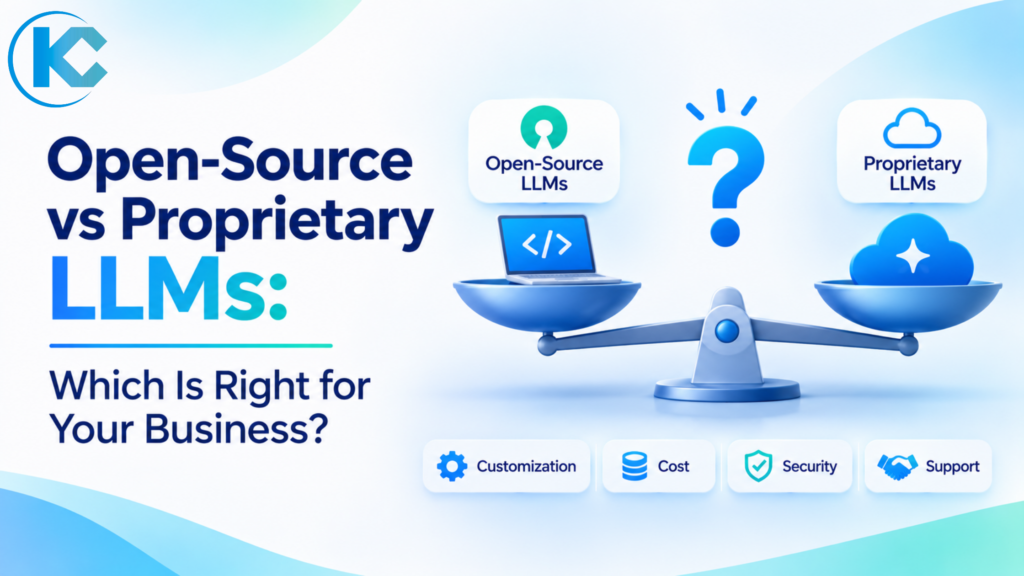
Open-Source vs Proprietary LLMs: Which Is Right for Your Business?
⏱ 3 min read
AI • LLMs • Enterprise AI
Open-source and proprietary large language models offer very different trade-offs in cost, control, customization, performance, security, and deployment. This guide explains the differences and helps you decide which LLM approach fits your AI strategy.
Executive Quick Answer
Open-source LLMs are usually the better choice when you need maximum customization, private deployment, model control, or flexibility over infrastructure. Proprietary LLMs are often better when speed to production, managed infrastructure, advanced capabilities, reliability, and vendor support matter most. For many enterprises, the strongest architecture is hybrid: use different models for different workloads rather than forcing every AI use case onto one model.
Key Takeaways
Open Source
More control, customization, deployment flexibility, and private hosting options.
Proprietary
Managed infrastructure, mature APIs, strong capabilities, and easier production adoption.
The Trade-Off
Control and flexibility versus convenience, managed operations, and provider support.
What Are Open-Source LLMs?
Open-source LLMs are language models whose model artifacts, code, weights, or other important components are made available under licenses that allow varying degrees of inspection, modification, or redistribution. The exact level of openness differs between models, so “open source” should not automatically be interpreted as meaning that the training data, architecture, and every component are publicly available.
Models such as Llama, Mistral, and Falcon have helped make customizable AI accessible to developers, researchers, and enterprises. Depending on the license and model, organizations can run these systems on their own infrastructure, fine-tune them, optimize inference, or integrate them into specialized workflows.
Typical Characteristics
- Greater control over deployment and infrastructure.
- More opportunities for customization and fine-tuning.
- Potential for private or on-premises deployment.
- Community-driven development and tooling.
- Infrastructure, security, and maintenance become more of the organization’s responsibility.
What Are Proprietary LLMs?
Proprietary LLMs are developed, owned, and controlled by a company or organization. Their underlying model weights, training processes, datasets, and internal architecture are generally not publicly available. Users typically access them through an API, hosted application, or commercial cloud service.
Examples include models offered through platforms from OpenAI, Anthropic, Google, Microsoft, and other commercial AI providers. These providers manage much of the underlying infrastructure, model updates, scaling, and operational reliability.
Typical Characteristics
- API-first access and managed infrastructure.
- Usage-based, subscription, or commercial pricing.
- Regular provider-managed model improvements.
- Enterprise support and platform integrations.
- Less control over model internals and hosting environment.
Open-Source vs Proprietary LLMs: Key Differences
The best LLM is not necessarily the one with the highest benchmark score. Enterprise teams should evaluate the complete operating model around the model.
| Factor | Open-Source LLMs | Proprietary LLMs |
|---|---|---|
| Cost | Model access may be inexpensive, but GPU, hosting, engineering, and operations add cost. | Usage-based or subscription pricing; infrastructure is generally managed by the provider. |
| Customization | High flexibility depending on model license and available tooling. | Customization is usually limited to provider-supported features. |
| Deployment | Cloud, private infrastructure, on-premises, or edge depending on the model. | Primarily provider-hosted, with some deployment options depending on vendor. |
| Performance | Rapidly improving, with many strong models for specialized workloads. | Often strong across general-purpose reasoning, multimodal, and production workloads. |
| Privacy | Private deployment can provide greater control over data. | Depends on provider policies, contract, deployment model, and data controls. |
| Maintenance | Your team manages infrastructure, updates, security, and model operations. | The provider manages most infrastructure and platform maintenance. |
Choosing an LLM is an architecture decision, not just a model decision.
Build the right foundation before scaling AI across your organization.
Benefits of Open-Source LLMs
Customization
Models can often be adapted to specialized domains, workflows, languages, or performance requirements.
Deployment Control
Organizations can choose where inference runs and how data moves through their infrastructure.
Flexibility
Teams can evaluate different models, inference stacks, hardware, and deployment strategies.
Private AI
Self-hosting can be valuable when data residency, isolation, or internal control is a priority.
Benefits of Proprietary LLMs
Faster Adoption
Managed APIs and mature SDKs allow teams to move from prototype to production quickly.
Managed Infrastructure
The provider handles much of the underlying scaling, availability, and infrastructure operations.
Advanced Capabilities
Leading providers often offer multimodal models, tool calling, embeddings, reasoning features, and integrated platforms.
Support
Enterprise plans may provide technical support, service commitments, security documentation, and operational tooling.
Challenges to Consider
Open-Source LLM Challenges
- GPU and infrastructure requirements.
- More engineering and MLOps responsibility.
- Security patching and model maintenance.
- Model quality can vary significantly.
- Licensing terms must be reviewed carefully.
Proprietary LLM Challenges
- Usage costs can increase with scale.
- Less visibility into model internals.
- Greater risk of vendor dependency.
- Provider policies can constrain customization.
- Data handling requires careful contractual and technical review.
When Should You Use Each Type?
Choose Open Source When…
- You need private or on-premises inference.
- Your application requires deep customization.
- You have strong ML/MLOps engineering capabilities.
- Predictable infrastructure economics matter at high volume.
- You want greater independence from a single model provider.
- You need specialized domain models or constrained inference environments.
Choose Proprietary When…
- You need to launch quickly.
- Your team does not want to operate model infrastructure.
- High-end reasoning or multimodal capabilities are important.
- You need mature APIs, tooling, and enterprise support.
- Your workload benefits from provider-managed scaling.
- You prefer paying for managed infrastructure rather than operating it.
Moving from AI experiments to governed production?
Explore practical approaches to AI integration, governance, data foundations, and enterprise AI operations.
Security, Privacy, and Compliance
Neither open-source nor proprietary automatically means “secure.” Security depends on the model, deployment architecture, data handling, access controls, monitoring, and governance around it.
Self-hosted open-source models can provide strong control over sensitive information, but the organization becomes responsible for infrastructure security, patching, access management, monitoring, and model operations. Proprietary providers may offer mature security controls and compliance programs, but organizations still need to understand where data is processed, how it is retained, which regions are supported, and what contractual protections apply.
Data Residency
Know where prompts, outputs, and logs are processed.
Know where prompts, outputs, and logs are processed.
Access Control
Restrict who can access models and sensitive workflows.
Restrict who can access models and sensitive workflows.
Data Protection
Mask or minimize sensitive information before inference.
Mask or minimize sensitive information before inference.
Evaluation
Test accuracy, bias, security, and failure modes continuously.
Test accuracy, bias, security, and failure modes continuously.
What About LLM Hallucinations?
Choosing an open-source or proprietary LLM does not eliminate hallucinations. Both types can generate incorrect, unsupported, or misleading information.
Production systems should therefore combine model selection with grounded retrieval, structured outputs, validation, human review where necessary, evaluation datasets, monitoring, and application-level guardrails.
For enterprise AI, model quality is only one part of reliability. The quality of the data, retrieval system, prompts, tools, workflow design, and evaluation process can have an equally important impact.
A Practical LLM Selection Framework
Before choosing a model, score your requirements across these dimensions:
| Question | If the answer is “high priority” |
|---|---|
| Do we need private deployment? | Evaluate self-hosted open-source models. |
| Do we need the fastest path to production? | Managed proprietary APIs may be attractive. |
| Do we require deep model customization? | Open-source options deserve closer evaluation. |
| Is operating GPU infrastructure undesirable? | Managed proprietary models can reduce operational burden. |
| Do we need multiple models? | Consider a multi-model architecture and centralized AI gateway. |
Best Practices for Enterprise LLM Adoption
- Start with the business problem. Select the model based on the workflow, not hype.
- Define measurable evaluation criteria. Test quality, latency, cost, safety, and reliability.
- Protect sensitive data. Apply appropriate access controls, masking, retention, and residency policies.
- Separate application logic from model providers. Avoid tightly coupling every workflow to one vendor.
- Monitor production behavior. Track cost, latency, failures, model usage, and quality.
- Plan for model changes. Models evolve quickly, so evaluation and migration should be repeatable.
- Use hybrid architectures when appropriate. Different workloads may justify different models.
Frequently Asked Questions
What is the difference between open-source and proprietary LLMs?
Open-source LLMs provide greater access and deployment flexibility, while proprietary LLMs are controlled and operated by their providers and typically accessed through commercial APIs or platforms.
Are open-source LLMs cheaper?
They can reduce model-access costs, but self-hosting introduces GPU, infrastructure, engineering, security, and maintenance expenses. Total cost of ownership matters more than the model license alone.
Are proprietary LLMs more accurate?
Not universally. Leading proprietary models can be highly capable, but strong open-source models can perform very well for particular tasks. Accuracy depends on the model, task, data, prompting, retrieval, and evaluation.
Which LLM is better for enterprise AI?
There is no universal answer. Enterprises should evaluate security, data residency, performance, customization, cost, latency, support, compliance, and operational requirements before selecting a model.
Can businesses use both open-source and proprietary LLMs?
Yes. A hybrid multi-model strategy can route different workloads to different models based on quality, cost, privacy, latency, and deployment requirements.
Do open-source LLMs solve privacy concerns?
Self-hosting can provide greater data control, but privacy still depends on infrastructure security, access controls, logging, retention, model supply chain, and overall governance.
Planning Your Enterprise LLM Strategy?
Whether you’re evaluating open-source models, proprietary APIs, or a hybrid architecture, Kizzy can help you assess the right approach and turn AI experimentation into a production-ready system.