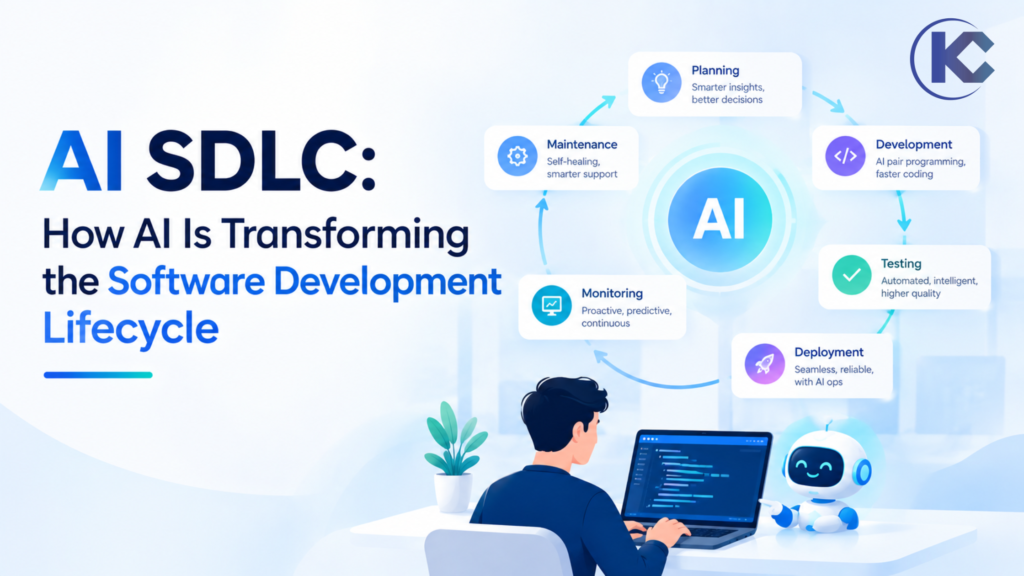
AI SDLC: How AI Is Transforming the Software Development Lifecycle
⏱ 6 min read
Contents
hide
Executive Quick Answer
AI SDLC refers to using artificial intelligence throughout the software development lifecycle to assist teams with planning, requirements analysis, architecture, coding, testing, deployment, monitoring, and maintenance. The next evolution is the Agentic SDLC, where AI agents can execute multi-step engineering tasks, use development tools, coordinate workflows, and continuously validate their work under defined human and governance controls.
What Is AI SDLC?
The AI Software Development Lifecycle (AI SDLC) is the integration of artificial intelligence into the traditional software development lifecycle to improve how software is planned, designed, developed, tested, deployed, and maintained.
AI can assist individual developers through coding copilots, but modern AI SDLC approaches increasingly extend beyond code generation. AI can analyze requirements, generate documentation, identify dependencies, create tests, review code, summarize incidents, detect anomalies, and support deployment and operational workflows.
The important distinction is that AI does not automatically eliminate the engineering lifecycle. Instead, it changes where humans spend their time. As AI coding and agentic systems become more capable, engineers increasingly need to focus on intent, architecture, verification, security, governance, and decisions that require business and technical context.
Traditional SDLC
Human-led planning, development, testing and operations with automation around defined engineering processes.
Human-led planning, development, testing and operations with automation around defined engineering processes.
AI-Assisted SDLC
AI copilots and tools assist humans with specific activities such as coding, documentation, testing and analysis.
AI copilots and tools assist humans with specific activities such as coding, documentation, testing and analysis.
Agentic SDLC
AI agents execute multi-step work across lifecycle stages while humans define intent, constraints, approvals and accountability.
AI agents execute multi-step work across lifecycle stages while humans define intent, constraints, approvals and accountability.
AI SDLC vs AI/ML Lifecycle: What Is the Difference?
The terms AI SDLC and AI/ML lifecycle are sometimes used interchangeably, but they describe different processes.
| Area | AI SDLC | AI/ML Lifecycle |
|---|---|---|
| Primary focus | Using AI throughout software engineering | Building and operating AI/ML models |
| Requirements | Software requirements and business objectives | Model objectives, data requirements and evaluation criteria |
| Development | Application and system development | Data preparation, model training and tuning |
| Testing | Code, security, integration and functional testing | Model performance, robustness, bias and data validation |
| Operations | Application monitoring, infrastructure and releases | Model monitoring, data drift, retraining and model governance |
An AI application may therefore have both an AI SDLC and an AI/ML lifecycle operating within it.
Why Traditional SDLC Is Changing
Traditional software development has evolved through major methodologies including Waterfall, iterative development, Agile and DevOps. Each approach improved how teams plan, build, test and operate software.
AI introduces another layer of change because software teams can now delegate portions of analysis, implementation, testing and operational work to AI systems. Recent AI-native SDLC discussions increasingly focus on changing the lifecycle itself rather than simply adding another coding assistant to an existing workflow.
The Shift in Software Engineering
Before
Human executes most implementation work.
Human executes most implementation work.
AI-Assisted
AI accelerates individual engineering tasks.
AI accelerates individual engineering tasks.
Agentic
Agents execute connected multi-step workflows.
Agents execute connected multi-step workflows.
Human Role
Intent, architecture, verification and governance.
Intent, architecture, verification and governance.
How AI Is Used in the Software Development Lifecycle
AI can support virtually every phase of the SDLC. The level of autonomy varies by organization, application risk, engineering maturity and governance requirements.
1. AI in SDLC Planning & Requirements
The planning phase establishes what the software needs to accomplish. AI can analyze business documents, meeting notes, support tickets, product requests and existing documentation to help teams identify requirements and create structured project artifacts.
- Summarize stakeholder discussions.
- Convert business requirements into user stories.
- Identify ambiguous or conflicting requirements.
- Generate acceptance criteria.
- Suggest project risks and dependencies.
- Create initial project plans and documentation.
2. AI in Requirements Analysis
AI can process large amounts of unstructured information and identify relationships that may be difficult to spot manually. This makes it useful for requirements analysis, documentation analysis and dependency discovery.
- Analyze emails, tickets and transcripts.
- Identify missing requirements.
- Detect inconsistencies between documents.
- Summarize legacy application behavior.
- Map requirements to technical components.
3. AI in Software Architecture & Design
During architecture and design, AI can help engineers explore alternatives and understand tradeoffs. AI tools can analyze repositories, dependencies and technical documentation to provide architecture recommendations.
- Generate architecture diagrams and documentation.
- Suggest application and integration patterns.
- Analyze dependencies between systems.
- Generate database schemas and API designs.
- Prototype user interfaces and workflows.
- Review designs against predefined engineering standards.
4. AI in Coding & Software Development
Coding is currently one of the most visible applications of AI in software engineering. AI coding assistants and coding agents can generate code, explain existing implementations, refactor modules, create documentation and work across repositories.
The emerging difference is between code completion and agentic coding. A copilot may suggest a function or code block, while an agent can potentially inspect a repository, modify multiple files, execute tools, run tests and iterate on the result.
- Generate code from natural-language specifications.
- Explain unfamiliar codebases.
- Refactor and modernize existing modules.
- Generate documentation and comments.
- Identify potential complexity and technical-debt issues.
- Create implementation plans before modifying code.
5. AI in Software Testing & Quality Assurance
AI can improve testing by analyzing code and requirements to identify potential failure points and generate test cases. Agentic workflows can go further by writing tests, executing them, analyzing failures and iterating on implementation.
- Generate unit and integration tests.
- Identify edge cases.
- Analyze test failures.
- Generate regression tests.
- Assist with visual regression testing.
- Identify potential security and quality issues.
6. AI in Deployment & DevOps
AI can assist DevOps teams by analyzing CI/CD pipelines, infrastructure configuration, deployment logs and operational signals. More advanced workflows can coordinate release activities while preserving approval and governance gates.
- Analyze CI/CD pipeline failures.
- Suggest deployment optimizations.
- Generate infrastructure configurations.
- Summarize release changes.
- Analyze deployment risks.
- Support rollback and incident workflows.
What Is Agentic SDLC?
Agentic SDLC is an emerging approach in which AI agents participate directly in software delivery rather than acting only as isolated assistants. Agents can reason over project context, use tools, execute multi-step tasks, validate outputs and hand work between lifecycle stages.
For example, an agentic workflow might receive a well-defined engineering requirement, inspect the repository, propose an implementation plan, modify code, run tests, analyze failures, update documentation and create a pull request for human review.
This represents a shift from AI-assisted development toward AI-orchestrated software engineering. Current industry discussions describe agentic SDLC as a lifecycle where agents can participate in planning, coding, testing, deployment and production operations while engineers increasingly focus on intent, architecture, review and governance.
The Agentic SDLC Operating Model
Human Intent
Define the outcome, constraints and acceptance criteria.
Define the outcome, constraints and acceptance criteria.
Agent Planning
Break the requirement into executable tasks.
Break the requirement into executable tasks.
Agent Execution
Use tools and repositories to implement the work.
Use tools and repositories to implement the work.
Verification
Run tests and evaluate the resulting changes.
Run tests and evaluate the resulting changes.
Human Approval
Review consequential changes before release.
Review consequential changes before release.
AI SDLC vs Agentic SDLC vs Traditional SDLC
| SDLC Stage | Traditional SDLC | AI-Assisted SDLC | Agentic SDLC |
|---|---|---|---|
| Planning | Manual requirements and planning | AI summarizes and drafts requirements | Agents coordinate requirements and downstream tasks |
| Architecture | Human-led architecture decisions | AI recommends patterns and alternatives | Agents validate designs against defined standards |
| Coding | Developers implement features | Copilots generate and explain code | Agents execute repository-level implementation tasks |
| Testing | Scheduled human and automated testing | AI generates tests and detects issues | Agents continuously execute and respond to verification results |
| Deployment | Manual release coordination and CI/CD | AI assists release analysis and optimization | Agents coordinate defined release workflows |
| Operations | Reactive monitoring and maintenance | AI detects anomalies and summarizes incidents | Agents can triage and execute bounded remediation workflows |
AI SDLC Architecture: The Enterprise AI Engineering Stack
An enterprise AI SDLC requires more than a coding model. AI systems need access to appropriate context, development tools, repositories, testing systems, deployment infrastructure and governance controls.
Context Layer
Repositories, architecture documentation, requirements, coding standards, APIs and enterprise knowledge.
Repositories, architecture documentation, requirements, coding standards, APIs and enterprise knowledge.
Model Layer
LLMs and specialized models that reason over engineering context and generate recommendations or actions.
LLMs and specialized models that reason over engineering context and generate recommendations or actions.
Agent Layer
Agents that plan tasks, call tools, modify code, execute tests and coordinate workflows.
Agents that plan tasks, call tools, modify code, execute tests and coordinate workflows.
Engineering Layer
Git, IDEs, CI/CD, issue tracking, testing, cloud infrastructure and deployment platforms.
Git, IDEs, CI/CD, issue tracking, testing, cloud infrastructure and deployment platforms.
Governance Layer
Identity, permissions, approvals, auditability, security policies and human oversight.
Identity, permissions, approvals, auditability, security policies and human oversight.
Observability Layer
Quality, reliability, cost, security, developer productivity and production outcomes.
Quality, reliability, cost, security, developer productivity and production outcomes.
AI/ML Development Lifecycle: Stages for Building AI Systems
When the software being built contains a machine-learning model, the development lifecycle introduces additional stages around data and model management. These stages complement the broader software SDLC.
1. Problem Definition
Define the business problem, stakeholders, constraints and success metrics.
2. Data Collection
Gather, clean, label and prepare data while addressing privacy and security requirements.
3. EDA
Analyze distributions, correlations, outliers and data-quality issues.
4. Model Development
Select algorithms, train models, tune parameters and track experiments.
5. Validation
Evaluate accuracy, robustness, bias, fairness and performance against defined criteria.
6. Deployment
Package models, integrate APIs or services and deploy them into production environments.
7. Monitoring
Track model performance, data drift, anomalies and production feedback.
8. Governance
Maintain model lineage, documentation, privacy, compliance, access controls and auditability.
Challenges of AI in the Software Development Lifecycle
AI can accelerate software development, but faster generation does not automatically mean better software. AI-generated output remains probabilistic, and the quality of the result depends heavily on context, specifications, validation and the engineering controls around the system.
Hallucinated Code
AI can generate functions, APIs or libraries that do not exist or misunderstand how an actual system behaves.
Security Risk
Unchecked generated code can introduce vulnerabilities, unsafe dependencies or insecure implementation patterns.
Context Gaps
AI may miss organizational architecture, undocumented dependencies, business rules or operational constraints.
Verification Bottleneck
When implementation becomes faster, review, testing and validation can become the new constraints.
Technical Debt
Rapidly generated code can increase complexity when teams optimize for short-term implementation without architectural discipline.
Governance
Enterprises need clear policies for data access, model usage, code provenance, approvals and agent permissions.
Human-in-the-loop matters:
The appropriate level of human review depends on risk. Critical architecture, security, compliance and production changes generally require stronger review and approval controls than low-risk development tasks.
The appropriate level of human review depends on risk. Critical architecture, security, compliance and production changes generally require stronger review and approval controls than low-risk development tasks.
Why AI Copilots Alone Are Not Enough for Enterprise Software Engineering
Coding copilots can significantly improve individual developer workflows, but enterprise software delivery involves much more than writing code.
Large engineering organizations also need architectural consistency, security controls, compliance, traceability, shared context, testing standards, deployment governance and measurable business outcomes.
Individual Productivity
AI helps one developer complete a task faster.
AI helps one developer complete a task faster.
Lifecycle Orchestration
Agents coordinate multiple activities across the engineering lifecycle.
Agents coordinate multiple activities across the engineering lifecycle.
Enterprise Context
AI operates against approved architecture, repositories, policies and business requirements.
AI operates against approved architecture, repositories, policies and business requirements.
Governed Execution
AI actions are constrained by permissions, verification gates and human approval.
AI actions are constrained by permissions, verification gates and human approval.
AI SDLC Best Practices for Enterprise Teams
1. Build Around Enterprise Context
Give AI access only to relevant and approved architecture, repositories, requirements, documentation and engineering standards.
2. Use Specification-Driven Development
Invest in precise requirements, acceptance criteria, constraints and definitions of done before delegating implementation to agents.
3. Integrate With Existing Tools
Connect AI workflows with Git, issue tracking, CI/CD, testing, observability and existing engineering platforms.
4. Keep Humans in Control
Define which actions agents can perform independently and which actions require human review or approval.
5. Measure Engineering Outcomes
Track cycle time, deployment frequency, defect rates, review time, reliability and business outcomes rather than code volume alone.
6. Design for Verification
Every autonomous workflow should have appropriate tests, validation checks, audit trails and rollback mechanisms.
AI SDLC Governance, Security & Human Oversight
Enterprise AI engineering requires governance to be part of the workflow rather than an after-the-fact review. Organizations should define what data AI systems can access, which repositories and environments agents can modify, which actions require approval, and how AI-generated changes are recorded.
Core AI SDLC Governance Controls
- Identity and role-based access controls
- Repository and environment permissions
- Code review and approval gates
- Security and dependency scanning
- Audit logs for agent actions
- Testing and release verification
- Data privacy and protection controls
- Rollback and incident-response mechanisms
How to Measure AI SDLC Success
Measuring AI adoption only through lines of code or developer activity can produce an incomplete picture. The objective should be improved software delivery and business outcomes.
| Metric | What It Indicates |
|---|---|
| Cycle Time | How quickly work moves from requirement to production. |
| Deployment Frequency | How frequently teams can safely release changes. |
| Defect Leakage | Whether faster development is maintaining or degrading software quality. |
| PR Review Time | Whether implementation speed is creating a review bottleneck. |
| Change Failure Rate | How often releases create production problems. |
| Business Outcome | Whether engineering improvements translate into measurable organizational value. |
How to Implement an AI SDLC: Enterprise Roadmap
PHASE 01
Assess
Identify repetitive engineering tasks, bottlenecks, risks and existing AI usage.
PHASE 02
Pilot
Start with bounded use cases such as documentation, code assistance, test generation or incident summarization.
PHASE 03
Integrate
Connect AI workflows to repositories, CI/CD, testing, issue management and enterprise context.
PHASE 04
Govern
Introduce permissions, approval gates, security controls, auditability and human oversight.
PHASE 05
Orchestrate
Connect agents across requirements, engineering, testing, deployment and operations.
PHASE 06
Optimize
Measure outcomes and continuously improve agent workflows, guardrails and engineering processes.
Build a More Intelligent Software Development Lifecycle
AI adoption is moving beyond isolated coding assistants. The opportunity is to connect AI, automation, engineering context and governance across the entire software lifecycle. Kizzy Consulting helps organizations design AI-powered workflows, AI agents and automation strategies that fit their existing technology environment.
Conclusion: From AI-Assisted SDLC to Agentic SDLC
AI is changing software development across more than just the coding phase. Requirements analysis, architecture, testing, deployment, monitoring and maintenance can all benefit from AI-assisted workflows.
The emerging Agentic SDLC takes this further by allowing AI agents to execute connected, multi-step engineering tasks. The fundamental shift is therefore not simply from human coding to AI coding. It is from fragmented AI assistance toward a more context-aware, governed and continuously verified engineering system.
For enterprises, the objective should not be maximum autonomy for its own sake. The more practical goal is to determine where AI can safely accelerate delivery, where human judgment remains essential, and how engineering organizations can measure whether AI actually improves software quality, delivery speed, reliability and business outcomes.
In this model, AI handles more of the repetitive execution while engineers increasingly focus on defining intent, designing systems, reviewing outcomes, managing risk and ensuring that the software solves the right problem.
Frequently Asked Questions About AI SDLC
What is AI SDLC?
AI SDLC is the use of artificial intelligence across the software development lifecycle to assist with requirements, planning, architecture, coding, testing, deployment, monitoring and maintenance.
What is the difference between AI SDLC and Agentic SDLC?
AI SDLC describes the broader use of AI across software development. Agentic SDLC specifically emphasizes AI agents that can plan and execute multi-step tasks, use tools, coordinate workflows and operate with defined levels of autonomy and human oversight.
How is AI used in the software development lifecycle?
AI can assist with requirements analysis, architecture, code generation, refactoring, documentation, test generation, code review, deployment analysis, monitoring, incident management and maintenance.
Why is monitoring important in the AI development lifecycle?
Monitoring is important because AI-enabled systems can change behavior based on data, models, prompts, dependencies and changing production conditions. Monitoring helps teams identify quality, reliability, security and performance issues after deployment.
How is AI SDLC different from MLOps?
AI SDLC focuses on applying AI across software engineering, while MLOps focuses specifically on operationalizing machine-learning systems, including data pipelines, model deployment, monitoring, versioning and retraining.
Why are coding copilots not enough for enterprise software engineering?
Coding copilots primarily improve individual development tasks. Enterprise software engineering also requires architecture, security, testing, governance, shared context, deployment controls and coordination across teams and systems.
What are the challenges of AI in the SDLC?
Key challenges include inaccurate or hallucinated code, security vulnerabilities, insufficient context, technical debt, verification bottlenecks, data privacy, governance and the need for appropriate human oversight.
Ready to Modernize Your Software Development Lifecycle?
Kizzy Consulting can help you identify practical AI and agentic automation opportunities across software engineering, establish governance, and build AI-powered workflows around your existing technology environment.