Salesforce AIforce: Architecture, Features, Pricing & Guide 2026
⏱ 4 min read
At Dreamforce 2026, Salesforce unveiled AIforce, a live interface layer that carries the company’s data, workflows, business logic, and governance into whatever AI tool a business already uses, including Claude, Slack, and Salesforce’s own Lightning interface. This guide explains what AIforce actually is, how it’s architected, what it costs, and what it means for enterprises already running Salesforce and Agentforce.
Executive Quick Answer
What is Salesforce AIforce?
AIforce is Salesforce’s new “live interface layer” that lets Salesforce data, workflows, permissions, and business logic surface inside any AI interface rather than only inside Salesforce’s own screens. It launches with three surfaces: Claudeforce (Salesforce inside Claude), Slackforce (Salesforce inside Slack), and Agentforce Coworker (an AI teammate inside Lightning). It runs on existing permissions with Zero Data Retention, and is built on top of Salesforce’s Headless Toolkit and AgentExchange ecosystem.
In short: AIforce doesn’t replace Agentforce or Salesforce’s platform – it changes where and how people and agents reach it.
3 Surfaces
Claudeforce, Slackforce, and Agentforce Coworker launch together, with more surfaces promised
37 Skills
Prebuilt sales skills shipped with Salesforce in Claude at launch
100K Users
Activated Agentforce Coworker within its first 35 days
$0 Add-On
No standalone AIforce price has been published so far
Why Salesforce Built AIforce
The development of AIforce reflects a broader shift in enterprise software: work is increasingly happening through conversational AI, agents, APIs, and connected digital environments rather than exclusively through traditional application screens.
Salesforce has spent years building a platform around structured data, business processes, permissions, workflows, automation, and customer information. As AI becomes a more common way to interact with that information, the traditional CRM interface can become only one of several possible entry points.
AIforce addresses that shift by extending Salesforce capabilities into the environments where people and AI agents already work. Instead of requiring every interaction to begin inside Salesforce, the underlying data, business logic, security controls, and workflows can be surfaced through interfaces such as Claude, Slack, and Lightning.
The broader idea is simple: the Salesforce platform remains the governed system of record, while the interface can adapt to the user’s workflow.
This also reflects the growing role of AI agents in enterprise operations. As agents become capable of reading records, reasoning across business context, and taking actions, they need access to the same governed systems and business rules that humans rely on.
The shift is from “open Salesforce to get the work done” toward “bring Salesforce intelligence into the place where the work is already happening.”
What Is AIforce, Exactly?

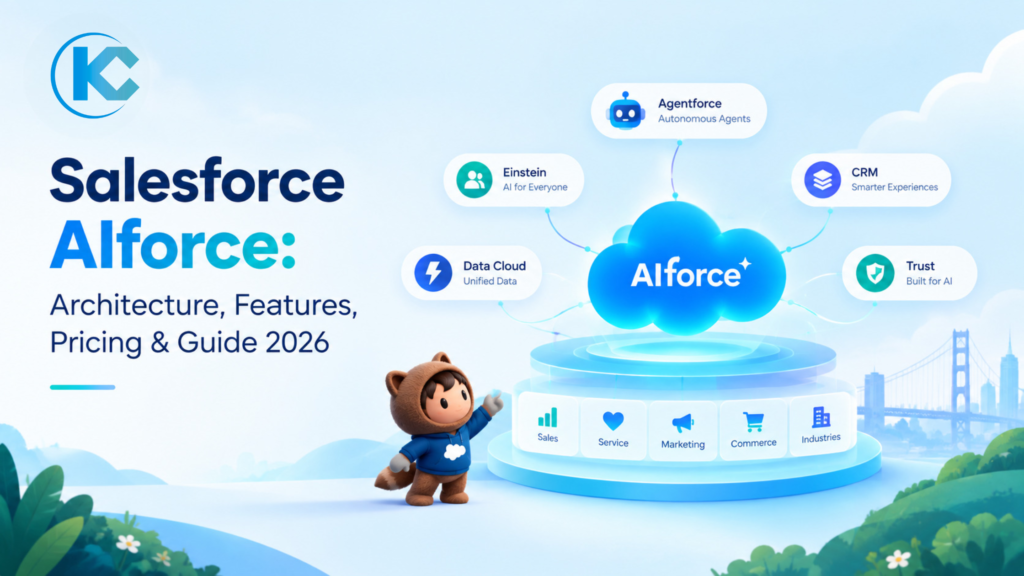
Official Salesforce AIforce image from Dreamforce 2026.
AIforce is a live interface layer that exposes Salesforce’s data, workflows, business logic, semantics, permissions, security, and governance to any AI interface a business already uses – instead of requiring a dedicated Salesforce screen.
In practical terms, that means an employee who has never opened a Salesforce dashboard can ask a question, update a record, or trigger a workflow from inside Claude or Slack, grounded in real Salesforce data and real business rules.
Agents built on top of AIforce can read across hundreds of records at once, reason over connected systems, and act with a fuller view of the business than a single screen would ever show a person.
AIforce also lets users compose a custom, live interface simply by describing what they need – instead of navigating a fixed system of tabs, layouts, and page fields.
That’s the distinction worth holding onto: Agentforce is the digital workforce of agents; AI agent development and automation is how organizations build and connect intelligent agents; and AIforce is the interface layer that decides where all of that shows up for a human being.
AIforce Architecture: Where It Sits in Salesforce’s Stack
Salesforce describes AIforce as the newest layer in its Agentic Enterprise architecture. Each layer beneath it does a different job:
| Layer | What It Provides |
|---|---|
Data 360 |
Unified context from harmonized and federated data, metadata, and memory |
| Customer 360 | Application and semantic intelligence – business logic, processes, permissions, and actions across sales, service, marketing, and commerce |
Agentforce |
The digital workforce of ready-to-deploy and custom-built agents |
| AIforce | Carries that entire foundation into any AI interface people and agents already use |
AIforce itself runs on the Headless Toolkit – the open architecture Salesforce introduced earlier in 2026 that exposes the platform through MCP servers, APIs, plug-ins, skills, and developer tools.
For a deeper explanation of this architecture, see Kizzy Consulting’s guide to Salesforce Headless 360.
The Headless Toolkit also powers the AgentExchange, a partner ecosystem where companies can build interfaces, agents, applications, integrations, workflows, and actions on Salesforce’s architecture.
Headless Toolkit (MCPs, APIs, plug-ins, skills) → AgentExchange → AIforce → Claudeforce / Slackforce / Agentforce Coworker
Planning Your Salesforce AI Architecture?
Whether you’re exploring AIforce, Agentforce, Headless 360, or AI integrations, the right architecture depends on your existing Salesforce data, workflows, permissions, and automation.
AIforce Features: The Three Launch Surfaces
AIforce ships with three products at launch, each targeting a different place where enterprise teams already spend their day.
1. Claudeforce – Salesforce Inside Claude
Claudeforce
extends the existing partnership between Salesforce and Anthropic.
Its core component, Salesforce in Claude, packages Salesforce intelligence into a prebuilt MCP server directly inside Claude – removing the manual setup, authentication, and custom skill-mapping that this kind of integration usually requires.
- Ships with 37 prebuilt sales skills covering prospecting through pipeline hygiene
- Tableau analytics plus service, marketing, commerce, and industries skills are planned next
- A Salesforce Development plug-in for Claude Code adds more than 40 skills, a GitHub skills library, and dynamically loading sub-plug-ins for builders
- Salesforce in Claude has been piloted by enterprise organizations before opening to customers in beta
2. Slackforce – Salesforce Inside Slack
Slackforce brings Salesforce context into Slack conversations, powered by a combination of Slackbot and a new capability called Slack Surfaces.
- Slackforce Surfaces lets a team pull live Salesforce and Slack data into one interactive view they can filter, comment on, and act on together
- Slackbot can reason across Slack conversations and Salesforce records to identify account activity, reassign owners, and draft follow-ups
- Slack CRM connects Slack conversations and updates to Salesforce, allowing users to create accounts, log notes, and update records without leaving the conversation
- Slack Code turns AI-assisted coding into a collaborative activity inside Slack
3. Agentforce Coworker – An AI Teammate Inside Lightning
Agentforce Coworker is aimed at organizations still working primarily in Salesforce’s Lightning interface that want an agentic layer without leaving it.
- Runs within existing permissions and business rules
- Calls the specialized Agentforce agents an organization has already built and deployed
- Can be activated without a migration or new permissions model
- 100,000 users activated Coworker within its first 35 days
Salesforce says more AIforce surfaces are coming, although additional platforms and timelines have not all been specified.

Official Salesforce Dreamforce event image.
Security, Permissions, and Zero Data Retention
For enterprises, the governance model matters as much as the feature list.
Salesforce’s stated design principles for AIforce are:
Permission-Bound
Every request runs on the requester’s existing permissions, and actions route back through Salesforce.
Zero Data Retention
Business data is used to answer the request at hand and is not retained by the model provider, according to Salesforce.
No New Setup
Salesforce describes AIforce as requiring no new permissions model, migration, or custom integration work.
Composable
Teams can build with MCPs, APIs, plug-ins, and skills on top of the same governed architecture.
These are Salesforce’s own stated design principles rather than independently audited guarantees, so enterprises evaluating AIforce should still run it through the same AI governance review they’d apply to any new agentic surface touching production CRM data.
Not Sure How AIforce Fits Your Salesforce Org?
Kizzy Consulting, a Salesforce Ridge Partner, can assess your current Agentforce footprint, permissions model, and integration layer to identify where Claudeforce, Slackforce, or Agentforce Coworker may fit within your existing architecture.
AIforce Pricing: What’s Confirmed So Far
Salesforce’s current announcement does not provide a standalone AIforce price list. Salesforce also notes that pricing and packaging are subject to change and that availability can vary by region and customer agreement.
What can be said with more confidence is that AIforce is built on top of Salesforce’s existing platform, Agentforce, Data 360, Headless Toolkit, and related consumption models.
| Component | What We Know |
|---|---|
| Salesforce Hosted MCP | Forms part of the Salesforce-in-Claude architecture used by Claudeforce |
| Agentforce actions | Can involve Salesforce’s existing Agentforce consumption and credit model where applicable |
| Data 360 activity | Data and query usage should be evaluated according to the applicable Salesforce products and agreements |
| AIforce surfaces | Specific pricing and packaging should be confirmed with Salesforce as availability and commercial terms evolve |
The practical takeaway is that enterprises should avoid treating AIforce as a simple standalone software add-on with one universal price. The actual cost can depend on the Salesforce products already deployed, Agentforce usage, Data 360 activity, AI interactions, integrations, and customer-specific commercial agreements.
Before budgeting, confirm the current pricing, packaging, regional availability, and consumption requirements directly with Salesforce.
AIforce: What Enterprises Should Evaluate
AIforce represents a significant architectural shift because it moves the focus away from a single CRM interface and toward Salesforce capabilities being available across multiple AI and productivity environments.
However, organizations should evaluate the practical implications before adding another AI layer to their architecture.
Data Readiness
AIforce can only be as useful as the Salesforce data and connected business context available to it.
Permission Design
Existing permissions and security models become increasingly important when AI can access and act on CRM data.
Agent Architecture
Organizations should understand how AIforce interacts with their existing Agentforce agents, workflows, and automation.
Governance
New AI interfaces should be reviewed for security, data access, monitoring, compliance, and operational controls.
Want to Explore AIforce for Your Salesforce Org?
AIforce sits at the intersection of Salesforce data, Agentforce, AI interfaces, integrations, and governance. Before adopting another AI layer, it’s worth understanding how it fits into your existing architecture.
Frequently Asked Questions About Salesforce AIforce
1. What is Salesforce AIforce?
Salesforce AIforce is an interface layer designed to bring Salesforce data, workflows, permissions, business logic, and agents into AI interfaces such as Claude and Slack, as well as Salesforce’s Lightning environment. It is intended to let users interact with Salesforce capabilities without relying exclusively on traditional Salesforce screens.
2. Is AIforce replacing Agentforce?
No. AIforce and Agentforce serve different roles. Agentforce provides AI agents that can perform tasks and work with business data, while AIforce is positioned as the interface layer through which people and agents can access Salesforce capabilities across different environments.
3. What are the three AIforce surfaces?
The initial AIforce surfaces are Claudeforce, which brings Salesforce into Claude; Slackforce, which brings Salesforce context into Slack; and Agentforce Coworker, which provides an AI teammate within Salesforce Lightning.
4. How does AIforce relate to Salesforce Headless 360?
AIforce is built on the architecture Salesforce has developed through its Headless Toolkit and Headless 360 approach. That foundation exposes Salesforce capabilities through technologies such as APIs, MCP servers, plug-ins, and skills, while AIforce packages those capabilities into interfaces designed for users and AI agents.
5. How much does Salesforce AIforce cost?
Salesforce has not published a standalone AIforce price list for the complete offering. Costs can depend on the Salesforce products, Agentforce usage, Data 360 activity, consumption models, and customer-specific agreements involved in an organization’s implementation. Enterprises should confirm current pricing and availability with Salesforce before budgeting.
6. Is Salesforce AIforce secure for enterprise data?
Salesforce says AIforce operates using existing permissions, business rules, security controls, and governance, with Zero Data Retention as a stated design principle. Organizations should still evaluate the specific AIforce configuration, data flows, integrations, permissions, and governance requirements before using it with production data.