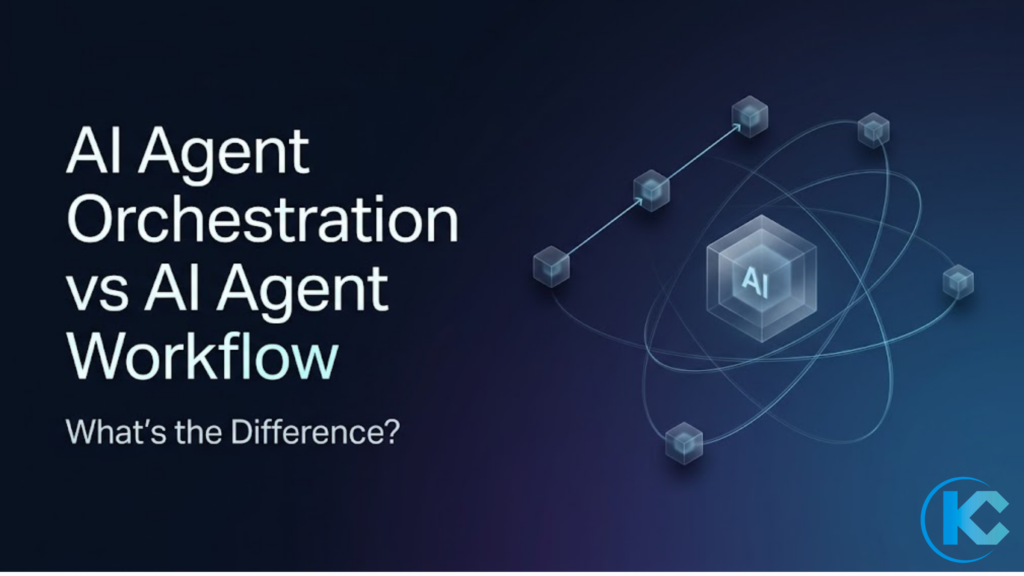
AI Agent Orchestration vs AI Agent Workflow: What’s the Difference?
⏱ 4 min read
AI agents are becoming more capable, but capability alone does not make an enterprise AI system reliable. As businesses move from individual AI agents to multi-agent systems and autonomous workflows, one question is becoming increasingly important: should you build an AI agent, an AI agent workflow, or an orchestration layer that coordinates multiple agents?
This is a decision guide, not a general orchestration primer: it assumes you already know what AI orchestration is, and focuses on which of the three architectures – agent, workflow, or orchestration – fits a given business process.
By Sanjeet Mahajan – CEO/Founder of Kizzy Consulting
Executive Quick Answer
Should I build an AI agent, an AI agent workflow, or an orchestration layer?
Use a single AI agent for a self-contained task with no strict process to follow. Use an AI agent workflow when the business process has defined stages and the agent makes decisions inside those stages. Use AI agent orchestration when multiple agents, systems, or people need to coordinate on one objective. Most production enterprise use cases end up combining all three at different points in the process.
Agent
Reasons and acts toward a goal.
Workflow
Structures how work moves from step to step.
Orchestration
Coordinates agents, workflows, systems, and humans.
Agent-Level Orchestration vs. Enterprise AI Orchestration
“AI orchestration” and “AI agent orchestration” get used interchangeably, but they sit at different altitudes. Our guide, What Is AI Orchestration?, covers the full stack – coordinating AI models, data pipelines, compute, and MLOps across the enterprise.
This guide sits one level down, inside the “agents and automation” layer of that stack. It answers a narrower, more practical question: for a given business process, do you need one agent, an agent inside a fixed workflow, or a layer coordinating several agents at once? That is an architecture decision, not a definitions question – which is why the rest of this guide is built around a comparison and a decision framework rather than a component breakdown.
What is an AI Agent Workflow?
An AI agent workflow is a structured business process that uses one or more AI agents as part of its execution. The workflow defines the major stages, while agents provide intelligence and decision-making where needed.
For example, imagine an enterprise customer service process:
- Receive the customer request.
- Identify the customer’s intent.
- Retrieve account and knowledge data.
- Ask an AI agent to determine the appropriate response.
- Check whether the action requires approval.
- Update Salesforce.
- Escalate unusual cases to a human.
The agent can make intelligent decisions, but the workflow keeps the overall process controlled. This makes agentic workflows particularly useful for enterprise AI automation where reliability, traceability, and governance matter.
AI Agent Orchestration vs AI Agent Workflow: The Key Difference
| Area | AI Agent | AI Agent Workflow | AI Agent Orchestration |
|---|---|---|---|
| Main role | Reason and act | Execute a structured process | Coordinate the entire system |
| Control | Lower | Medium to high | High |
| Best for | Dynamic tasks | Repeatable business processes | Complex enterprise automation |
| Observability | Often limited | Step-level visibility | End-to-end visibility |
| Governance | Must be added | Can be built into steps | Centralized controls |
| Enterprise scale | Limited alone | Strong | Strongest for complex systems |
Inside a Multi-Agent Orchestration Layer
Once a process needs more than one agent, the orchestration layer has to manage the handoffs between them – not just the infrastructure underneath. The pieces that matter most at this level:
- Role definition: each agent is scoped to one capability – research, extraction, pricing, CRM updates – so no single agent owns the whole process.
- Handoff logic: the orchestrator decides which agent acts next and what context passes forward when it does.
- Shared task state: agents work from the same case, customer, or record rather than partial or stale copies of it.
- Escalation path: defined points where control moves from agent, to workflow rule, to human reviewer.
- Per-agent guardrails: permissions and validation scoped to what each individual agent is allowed to touch, not just system-wide rules.
- Cross-agent observability: visibility into the full decision sequence across agents, not just what any one agent did.
This is deliberately narrower than a full orchestration stack – it’s the layer specific to coordinating agents with each other, sitting on top of the integration, compute, and governance layers our AI orchestration guide covers in depth.
Not Sure Where AI Agents Fit in Your Business?
Kizzy Consulting can assess your workflows, data, systems, and AI readiness to identify practical opportunities for agentic automation.
When Should You Use an AI Agent?
A standalone AI agent works well when the task is relatively self-contained and requires flexible reasoning. Examples include research, information retrieval, drafting, classification, scheduling, or answering questions from a controlled knowledge base.
For example, Kizzy Consulting’s AI agents include document analysis and knowledge-based capabilities designed to turn unstructured enterprise information into useful outputs.
An AI agent becomes less suitable when it must coordinate many systems, follow strict business rules, handle sensitive actions, or provide detailed auditability. That is where an agent workflow or orchestration architecture becomes more useful.
When Should You Use an AI Agent Workflow?
Use an AI agent workflow when the business process has recognizable stages but some decisions require AI.
Consider an invoice workflow. The process might be:
- Receive invoice.
- Extract information using AI.
- Validate the supplier.
- Check business rules.
- Identify exceptions.
- Request human approval when required.
- Send the approved information to the accounting system.
The AI can make decisions inside the process, but the overall workflow remains controlled. This is often the right balance between AI autonomy and enterprise reliability.
When Should You Use AI Agent Orchestration?
AI agent orchestration becomes important when the process involves multiple agents, multiple systems, long-running tasks, or high-value decisions.
For example, an enterprise sales process could involve a research agent, lead qualification agent, pricing agent, proposal agent, CRM agent, and human sales representative. An orchestration layer can coordinate these components instead of putting all responsibilities inside one large AI agent.
This is especially relevant for Agentforce implementations, where AI agents can interact with CRM data, business processes, customer information, and enterprise workflows.
Enterprise Multi-Agent Handoff Patterns
| Use Case | Agents Involved | Where the Handoff Happens |
|---|---|---|
| Customer Service | Intent, knowledge, case agents | Intent agent routes to the knowledge agent, then to a human on escalation |
| Document Processing | Extraction, validation, risk agents | Extraction hands structured data to validation, then to risk scoring before it reaches a business system |
| Sales Automation | Research, qualification, CRM agents | Research agent enriches the lead, qualification agent scores it, CRM agent writes the result back |
| IT Operations | Monitoring, diagnosis, remediation agents | Diagnosis agent hands a proposed fix to remediation, gated by an approval checkpoint |
| Healthcare | Knowledge, documentation, triage agents | Triage agent’s output is reviewed by documentation and knowledge agents before reaching a clinician |
Governance at the Agent-Decision Level
The more autonomy an AI system receives, the more important governance becomes. An agent that only generates a draft has limited operational risk. An agent that can modify CRM records, approve transactions, or call external APIs needs much stronger controls – specifically, controls scoped to what that individual agent is allowed to decide and act on, not just system-wide policy.
For the full enterprise AI governance framework – access control, monitoring, auditability, and compliance – see Kizzy Consulting’s AI governance trends guide.
How Kizzy Consulting Approaches AI Agent Architecture
At Kizzy Consulting, we do not start by asking which AI agent should be built. We start by understanding the business workflow, data, systems, decisions, and measurable outcome.
Our AI integration and implementation approach connects custom AI agents with enterprise APIs, Salesforce, ERP systems, knowledge bases, data platforms, and existing business processes.
The architecture can include a single AI agent, an agentic workflow, or a multi-agent orchestration layer depending on the complexity of the use case. The objective is not maximum autonomy. The objective is reliable automation that creates measurable business value.
A Simple Framework for Choosing the Right Architecture
- Use an AI agent when one autonomous capability can solve the problem.
- Use an AI agent workflow when the process has defined stages but needs AI-powered decisions inside those stages.
- Use AI agent orchestration when several agents, systems, workflows, or humans need to coordinate.
- Add human-in-the-loop controls when actions are sensitive, high-risk, or difficult to reverse.
- Add observability and governance whenever the system moves into production or handles business-critical data.
The goal is to create the right level of autonomy for the business, not simply the highest level of autonomy possible.
Frequently Asked Questions about AI Agent Orchestration and AI Agent Workflow :
Is AI agent orchestration the same as an AI agent workflow?
No. An AI agent workflow is a structured process that uses AI agents. AI agent orchestration is the broader coordination layer that can manage multiple agents, workflows, APIs, enterprise systems, human approvals, state, monitoring, and governance.
Which is better for enterprise AI: agents or workflows?
Most enterprise use cases benefit from combining both. Agents provide reasoning and adaptability, while workflows provide structure, reliability, and control.
What is multi-agent orchestration?
Multi-agent orchestration coordinates several specialized AI agents so they can work together toward a larger business goal. The orchestration layer manages communication, execution order, data sharing, permissions, failures, and outcomes.
Why do enterprises need AI agent orchestration?
Enterprise AI agents often need to interact with CRM, ERP, databases, APIs, employees, and other AI systems. Orchestration provides the control, visibility, security, and reliability required to coordinate these interactions at scale.
Can Agentforce use workflows and AI agents together?
Yes. Enterprise Salesforce environments can combine AI agents with business workflows, CRM data, integrations, approvals, and automation. The right architecture depends on the process, data, governance requirements, and level of autonomy required.
How does this compare to AI orchestration in general?
AI agent orchestration is one part of the wider AI orchestration discipline. AI orchestration also covers coordinating AI models, data pipelines, compute, and MLOps across the enterprise. See our complete guide, What Is AI Orchestration?, for the full picture.