Top AI Trends for 2026
⏱ 5 min read
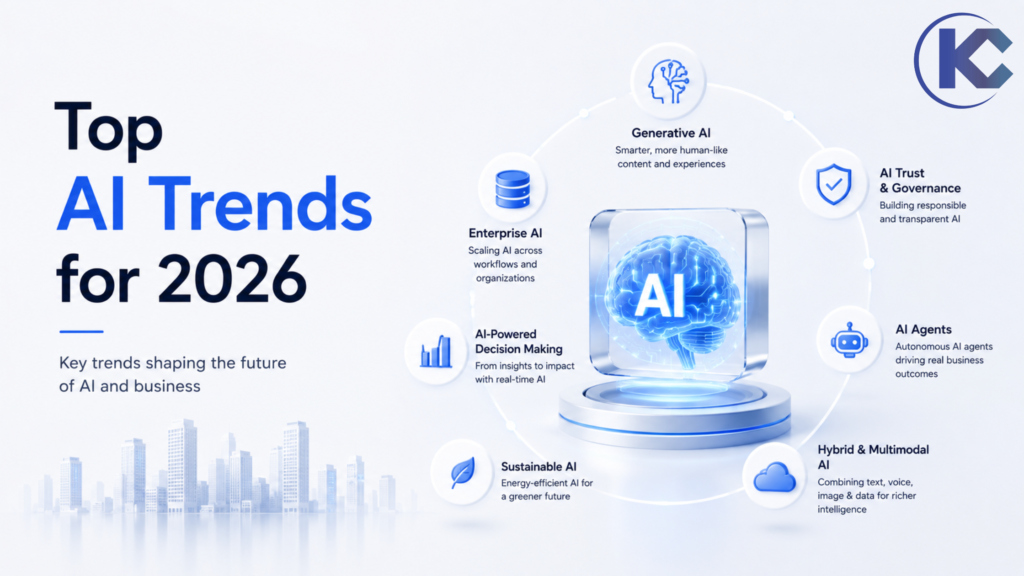
Artificial Intelligence is entering a new phase. The conversation is moving beyond Generative AI, chatbots, and content creation toward AI systems that can understand business context, reason over information, interact with software, automate workflows, and take action.
In 2026, businesses are increasingly evaluating AI based on what it can accomplish rather than simply what it can generate. This shift is accelerating the adoption of Agentic AI, AI agents, enterprise AI, AI workflow automation, multimodal AI, Retrieval-Augmented Generation (RAG), AIaaS, AI-native software, and intelligent business automation.
For organizations, the opportunity is no longer limited to adding an AI chatbot to a website. The bigger opportunity is embedding intelligent systems directly into customer journeys, internal operations, decision-making, knowledge management, software development, and enterprise workflows.
By Sanjeet Mahajan – CEO and Founder of
Kizzy Consulting
Quick Answer
What are the biggest AI trends in 2026?
The biggest AI trends in 2026 include Agentic AI, multi-agent systems, AI workflow automation, multimodal AI, AI voice agents, enterprise RAG, AI-native software development, efficient AI infrastructure, edge AI, AI search, SEO, AEO, GEO, AI governance, AI security, and industry-specific AI solutions. The central shift is from AI that generates information to AI systems that can reason, interact with business systems, and execute defined tasks.
What Does the Latest AI Data Tell Us About 2026?
The shift toward agentic AI and AI-powered search is supported by recent industry research and platform data. These numbers provide useful context for understanding why AI agents, AI search, and AI-ready content strategies are becoming important business priorities.
62%
of McKinsey survey respondents said their organizations were at least experimenting with AI agents.
McKinsey, State of AI 2025
23%
reported scaling an agentic AI system somewhere in their enterprise.
McKinsey, State of AI 2025
1.5B+
monthly users were reported for Google AI Overviews in 2025.
Google, May 2025
10%+
increase in Google usage for query types showing AI Overviews in the U.S. and India, according to Google.
Google, May 2025
Sources:
McKinsey – The State of AI 2025;
Google – AI in Search: Going Beyond Information to Intelligence.
What Are the Latest AI Trends to Watch in 2026?
Generative AI remains an important part of the artificial intelligence landscape, but it is increasingly becoming one layer of a much larger enterprise AI ecosystem. In 2026, organizations are looking at AI as infrastructure for automation, knowledge management, customer engagement, software development, analytics, and business operations.
The following AI trends are expected to have a major impact on how businesses build, deploy, govern, search, and scale artificial intelligence.
Agentic AI
AI agents that reason, use tools, make decisions, and execute multi-step business workflows.
Multimodal AI
AI systems capable of understanding text, images, audio, video, documents, and other data formats.
Enterprise RAG
AI systems connected to trusted organizational data, documents, knowledge bases, and applications.
AI Search
Search experiences shaped by AI Overviews, AI Mode, conversational queries, and answer-focused discovery.
AI Security
Protecting AI systems against deepfakes, prompt attacks, data leakage, fraud, and emerging AI-powered threats.
1. What Is Agentic AI and How Is It Different From Generative AI?
One of the most important AI trends in 2026 is the growth of Agentic AI. Traditional Generative AI responds to prompts by generating text, code, images, or other content. AI agents are designed to go further by pursuing defined goals and executing tasks.
Recent McKinsey research shows that 62% of respondents said their organizations were at least experimenting with AI agents, while 23% reported scaling an agentic AI system somewhere in their enterprise. The same research indicates that most organizations are still early in scaling AI across the enterprise. McKinsey’s State of AI 2025 research provides the underlying survey data.
An AI agent can combine a large language model with tools, memory, business rules, APIs, enterprise data, and workflow automation. Depending on its permissions and architecture, it can interpret an objective, determine the next step, retrieve information, interact with applications, and complete actions. Businesses exploring this shift can learn more about custom AI agent development and how intelligent AI systems are designed for real-world workflows.
Goal → Reasoning → Tools → Data → Decision → Action → Outcome
This represents the fundamental shift from AI-generated responses toward AI-powered execution.
How Are AI Agents Different From Generative AI?
| Capability | Generative AI | AI Agents |
|---|---|---|
| Primary purpose | Generate content and responses | Complete tasks and workflows |
| Interaction | Prompt-based | Goal and workflow-based |
| Decision-making | Provides generated outputs | Can reason through defined tasks |
| Tool usage | Usually application-dependent | Can interact with tools, APIs, databases, and applications |
| Automation | Supports human productivity | Can execute multi-step processes |
2. Why Are Multi-Agent Systems and AI Workflow Automation Growing?
As AI agents become more capable, organizations are moving toward multi-agent systems where specialized agents collaborate on different parts of a business process.
Instead of asking a single AI agent to handle everything, businesses can create specialized agents for individual responsibilities. For example:
Lead Agent → Qualification Agent → Knowledge Agent → Scheduling Agent
This approach combines AI agents + APIs + enterprise data + business rules + workflow automation to create intelligent processes that can determine what should happen next based on context. Kizzy Consulting also develops AI content workflows that use specialized AI components for ideation, writing, review, and publishing.
Ready to Make AI Work for Your Business?
Transform AI from an experiment into a real business advantage with AI strategy, custom AI agents, enterprise RAG, intelligent automation, AI voice solutions, and seamless integrations built for your goals.
3. What Is Multimodal AI and Why Does It Matter?
AI is becoming increasingly multimodal. Instead of working with text alone, modern AI models can process combinations of text, images, audio, video, documents, tables, and other structured or unstructured data.
This creates opportunities for enterprise AI applications such as intelligent document processing, AI-powered computer vision, visual search, document analysis, customer support, healthcare imaging, manufacturing quality inspection, and multimodal knowledge assistants. For document-heavy workflows, an AI document analysis system can read, extract, validate, and process information from business documents.
Documents
Extract and reason over contracts, reports, PDFs, invoices, and business documents.
Voice
Understand natural conversations and connect voice interactions with business workflows.
Vision
Analyze images, video, products, environments, and visual information.
4. How Are AI Voice Agents Changing Conversational AI?
AI voice technology is also moving beyond traditional IVR systems. Instead of forcing customers to navigate rigid menus such as “Press 1 for Sales” or “Press 2 for Support,” AI voice agents can understand natural language conversations.
A business AI voice agent can potentially identify intent, answer questions, qualify leads, retrieve customer information, schedule appointments, update business records, route calls, and trigger follow-up workflows. See how this works in practice in Kizzy Consulting’s AI voice agent real estate case study.
AI Voice Workflow
Call → Intent Detection → Conversation → Qualification → Data Update → Action
5. Why Are Enterprise RAG and AI Knowledge Bases Becoming Important?
Enterprise organizations have valuable information spread across documents, knowledge bases, databases, intranets, and business applications. A general-purpose AI model does not automatically have access to this private organizational knowledge.
Retrieval-Augmented Generation (RAG) helps connect AI systems with trusted business information. Instead of relying only on a model’s existing knowledge, a RAG architecture retrieves relevant information from an organization’s data sources before generating a response. For a deeper look at this architecture, explore Kizzy Consulting’s AI Knowledge Base Agent powered by RAG.
Business Data → Retrieval → Context → LLM → Grounded Response → Business Action
6. Why Are Smaller AI Models, Efficient Infrastructure, and Edge AI Growing?
As AI adoption increases, organizations must also consider the infrastructure required to train, deploy, and operate AI applications at scale. Cost, latency, compute requirements, privacy, and energy consumption are becoming important parts of enterprise AI strategy.
Businesses are increasingly exploring approaches such as smaller language models, model optimization, quantization, specialized AI hardware, efficient inference, cloud-native AI infrastructure, and Edge AI.
- Smaller AI models: Useful when organizations need lower latency and lower infrastructure costs.
- Model optimization: Techniques such as quantization can reduce computational requirements.
- Edge AI: Processes information closer to where it is generated when latency, privacy, or connectivity are important.
- AI infrastructure modernization: Helps organizations scale production AI applications more reliably.
7. How Is Spatial Computing Combining AI With the Physical World?
Spatial computing combines AI, computer vision, sensors, 3D environments, and extended reality to create more immersive interactions between digital systems and the physical world.
While spatial computing has applications in entertainment and gaming, enterprise use cases are also emerging across healthcare, manufacturing, training, retail, architecture, product visualization, remote collaboration, and education.
AI That Delivers Real Business Impact
Turn AI potential into measurable business outcomes with practical AI strategy, custom AI agents, enterprise RAG, intelligent automation, AI voice solutions, and seamless integrations built around your business needs.
8. How Are AI Search, SEO, AEO, and GEO Changing Search in 2026?
One of the biggest AI trends in 2026 is the transformation of search itself. Search is moving from a model where users primarily enter short keyword queries toward experiences where users can ask longer, more complex, conversational, and multimodal questions.
Google reported in 2025 that AI Overviews had reached more than 1.5 billion monthly users across more than 200 countries and territories. Google also reported that in the U.S. and India, AI Overviews were driving a 10%+ increase in usage for the types of queries where they appear. These developments show why businesses need to think beyond traditional rankings and consider how their content can be discovered, understood, cited, and surfaced by AI-powered search experiences.
Google’s own Search updates also describe users asking longer and more complex questions through AI-powered experiences. This creates a growing need for content that directly answers questions, demonstrates expertise, provides original information, uses clear structure, and gives search systems enough context to understand individual entities and topics.
SEO
Optimizes content, technical structure, relevance, and authority for search engine visibility.
AEO
Answer Engine Optimization focuses on structuring content so direct answers can be identified and surfaced by answer-focused search experiences.
GEO
Generative Engine Optimization focuses on making brand and informational content easier for generative AI systems to understand, retrieve, summarize, and potentially cite.
What does this mean for businesses?
Businesses should create content around real customer questions, provide original data and first-hand insights, use descriptive headings, clearly define entities and concepts, support claims with trustworthy sources, maintain strong internal linking, and make important information easy for both people and AI systems to understand.
Sources:
Google – AI in Search: Going Beyond Information to Intelligence;
Google I/O 2025 – AI Mode in Search.
9. Why Are AI Security, Synthetic Media, and Digital Trust Becoming More Important?
As organizations deploy more AI systems, security and trust are becoming equally important. Generative AI can increase productivity, but the same capabilities can also be used to create sophisticated phishing attacks, synthetic identities, deepfakes, misinformation, and automated cyber threats.
This is increasing demand for AI security, identity verification, content authenticity, threat detection, AI governance, model monitoring, data protection, and responsible AI practices.
Why AI security matters
Organizations need to secure not only their traditional applications and data but also their AI models, prompts, agents, integrations, knowledge bases, APIs, and automated workflows.
10. Why Is AI Governance Essential for Businesses in 2026?
As AI moves from experimentation into production, organizations need clear frameworks for how AI systems are designed, deployed, monitored, and governed.
- Data privacy: Protecting sensitive customer and business information.
- AI security: Controlling access to models, tools, APIs, and knowledge sources.
- Human oversight: Defining where human approval is required.
- AI monitoring: Tracking model performance, reliability, and unexpected behavior.
- Compliance: Aligning AI deployments with applicable regulatory and industry requirements.
- Responsible AI: Addressing issues such as bias, transparency, explainability, and accountability.
11. Why Is Industry-Specific and Vertical AI Growing?
Another important AI trend is the movement from generic AI tools toward industry-specific AI solutions. Businesses increasingly need AI systems that understand their terminology, workflows, regulations, customer journeys, operational data, and domain-specific requirements.
Real Estate AI
Lead qualification, property search, AI voice agents, CRM automation, and document intelligence.
Healthcare AI
Knowledge assistants, document analysis, clinical workflows, and intelligent automation.
Financial Services AI
Risk analysis, document processing, customer support, fraud detection, and workflow automation.
Enterprise AI
AI agents, RAG systems, workflow automation, analytics, and AI-powered decision support.
How Should Businesses Respond to These AI Trends?
Businesses do not need to adopt every emerging AI technology. The better approach is to identify business problems where AI can produce measurable improvements in productivity, customer experience, operational efficiency, revenue, or decision-making.
- Assess AI Readiness:
Evaluate your existing data, technology stack, workflows, infrastructure, security, skills, and business objectives. Kizzy Consulting’s AI Readiness Agent is designed to assess data maturity, infrastructure, skills, and governance before an AI initiative begins. - Identify High-Value AI Use Cases:
Look for repetitive workflows, large data volumes, customer interaction bottlenecks, knowledge-intensive tasks, and complex decision-support processes. - Select the Right AI Architecture:
Determine whether the business problem requires Generative AI, RAG, an AI agent, multi-agent architecture, AI voice, computer vision, or workflow automation. - Build a Focused Proof of Concept:
Start with one measurable business use case rather than attempting an organization-wide AI transformation immediately. - Integrate AI With Existing Systems:
Connect AI applications with CRMs, ERPs, databases, communication platforms, internal applications, APIs, and enterprise knowledge bases. - Establish AI Governance:
Define security, privacy, access control, human oversight, monitoring, compliance, and responsible AI requirements. - Measure Business Outcomes:
Track metrics such as response time, operational cost, conversion rate, productivity, customer satisfaction, and workflow completion. - Scale What Works:
Once an AI use case demonstrates measurable value, expand it across additional workflows, teams, and business functions.
Ready to Turn AI Trends Into Business Results?
Move beyond AI experimentation with practical AI strategy, AI agent development, enterprise RAG, AI automation, AI voice agents, and AI integration designed around your business goals.
Frequently Asked Questions About AI Trends in 2026
What are the biggest AI trends in 2026?
Major AI trends in 2026 include Agentic AI, AI agents, multi-agent systems, AI workflow automation, multimodal AI, AI voice agents, enterprise RAG, AI-native software development, efficient AI infrastructure, Edge AI, AI search, SEO, AEO, GEO, AI governance, AI security, and industry-specific AI solutions.
What is Agentic AI?
Agentic AI refers to AI systems that can pursue defined goals by reasoning through tasks, using tools, retrieving information, interacting with software, making decisions within defined boundaries, and executing multi-step workflows. Learn more about AI agent development.
How is Agentic AI different from Generative AI?
Generative AI primarily creates content or responses based on instructions. Agentic AI combines AI models with tools, data, APIs, memory, business rules, and workflows to perform actions and complete defined tasks.
Why is AI governance important for businesses?
AI governance helps organizations manage risks related to data privacy, security, compliance, bias, hallucinations, access control, model performance, AI transparency, and human oversight as AI systems move into production.
AI CONSULTING & IMPLEMENTATION
The Next Phase of AI Is About Action
The next phase of artificial intelligence will not be defined only by bigger models or better content generation. It will be defined by how effectively organizations can connect AI with their data, applications, people, search presence, and business workflows.