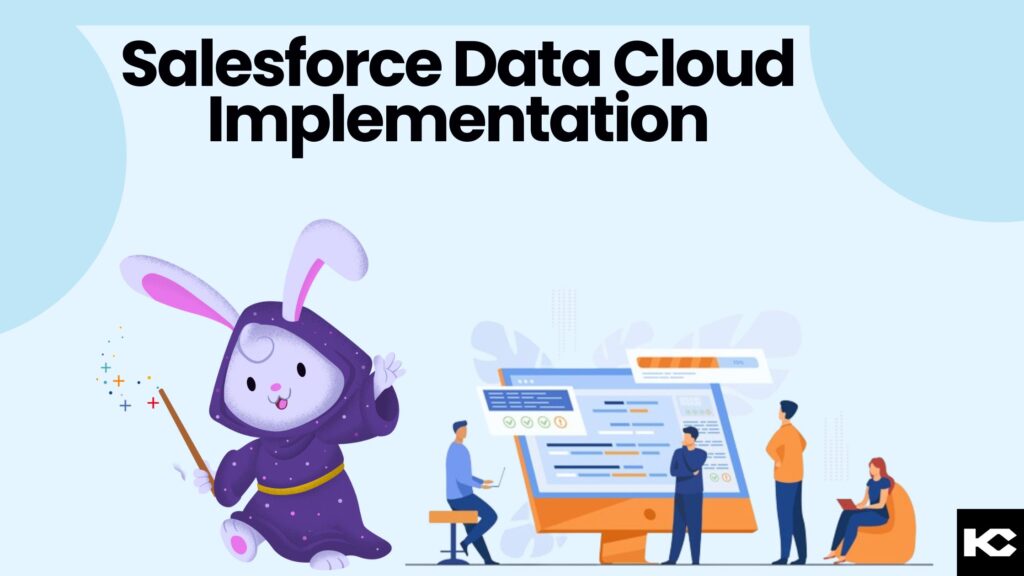
Salesforce Data Cloud Implementation: Complete Guide to Data 360
⏱ 5 min read
SALESFORCE DATA CLOUD / DATA 360
Learn how Salesforce Data Cloud, now called Data 360, connects, transforms, unifies, analyzes, and activates data to create a stronger foundation for CRM, AI, personalization, and business decision-making.
Contents
hide
Quick Answer
Salesforce Data Cloud implementation is the process of connecting an organization’s data sources to Salesforce Data 360, transforming and mapping that data into a common model, unifying customer or account identities, generating actionable insights, and activating the resulting data across business processes and channels. Salesforce renamed Data Cloud to Data 360 on October 14, 2025, while retaining the underlying functionality.
Introduction
Businesses increasingly operate across multiple data environments. Customer information may exist in Salesforce CRM, marketing platforms, commerce systems, websites, mobile applications, data warehouses, service platforms, and external databases.
The challenge is no longer simply collecting more data. Organizations need to connect the right data, understand it in context, resolve fragmented identities, generate useful insights, and make those insights available where teams and AI systems can act on them.
Salesforce Data Cloud, now branded as Salesforce Data 360, is designed to provide this connected data foundation. Salesforce describes Data 360 as a platform that can ingest or connect structured and unstructured data, transform and harmonize it, unify profiles through identity resolution, generate insights, support AI, and activate data across channels.
This guide explains the major components of a Salesforce Data Cloud implementation, the implementation process, benefits, use cases, governance considerations, and best practices for building a scalable data foundation.
What Is Salesforce Data Cloud?
Salesforce Data Cloud was introduced as Salesforce’s platform for bringing data from different sources together and making that data useful across the Salesforce ecosystem. Since October 2025, Salesforce has referred to the platform as Data 360. Existing references to Data Cloud may still appear in Salesforce documentation during the transition.
Data 360 can ingest data from Salesforce and external sources, access external data through zero-copy connections, transform and map information into a standard data model, unify identities, calculate metrics, segment audiences, and activate data for downstream use cases.
Connect Data
Bring together Salesforce, external, structured, and unstructured data.
Unify Data
Resolve identities across different systems to create unified profiles.
Generate Insights
Calculate metrics and uncover patterns from connected information.
Activate Data
Put data and insights into action across Salesforce and external destinations.

Salesforce Data Cloud Implementation Architecture
A successful Data 360 implementation typically follows a connected data lifecycle rather than treating integration, analytics, and activation as separate projects.
1. Data Sources
Salesforce CRM, marketing systems, commerce platforms, websites, mobile applications, data warehouses, files, and external systems.
2. Data Ingestion & Connection
Ingest data into Data 360 or connect to supported external data sources through zero-copy capabilities.
3. Transformation & Modeling
Transform, harmonize, and map information to Data 360’s data model so information from different systems can be interpreted consistently.
4. Identity Resolution
Apply matching and reconciliation rules to connect records representing the same individual or account.
5. Insights & Analytics
Build calculated insights, segments, analytics, and AI-driven use cases from unified data.
6. Activation
Deliver data and insights to Salesforce applications, marketing platforms, external destinations, and automated workflows.
Key Components of Salesforce Data Cloud Implementation
1. Data Integration and Ingestion
Data integration is the starting point for most Data 360 implementations. Organizations can connect Salesforce data sources and external systems, ingest structured or unstructured information, or use zero-copy approaches for supported external platforms.
Salesforce documentation identifies connectors and integration approaches for sources including Salesforce CRM, Amazon S3, Google Cloud storage, Snowflake, Databricks, BigQuery, MuleSoft, web and mobile sources, and other environments.
2. Data Transformation and Modeling
Data from different systems rarely follows the same structure. Transformation helps standardize information before it is used for analytics, segmentation, identity resolution, or activation.
Data 360 supports data transformation and mapping into its standard data model so information from different sources can be interpreted consistently.
3. Identity Resolution
Customer and account information may appear differently across systems. Identity resolution uses matching and reconciliation rules to connect records from different sources into unified profiles.
Salesforce notes that identity resolution creates unified profiles but is not itself a master data management system or a mechanism for creating golden records.
4. Calculated Insights and Analytics
Once data has been connected and unified, organizations can calculate business metrics and insights from the available data. These can support use cases such as customer value, product engagement, service activity, purchase behavior, and other business KPIs.
Salesforce describes Calculated Insights as a way to create metrics from batch or streaming data and use those insights for segmentation and analysis.
5. Segmentation and Activation
Connected data becomes more valuable when organizations can use it to create audiences and trigger business actions.
Data 360 supports segmentation and activation to destinations such as Marketing Cloud Engagement and other supported platforms. It also provides data actions that can respond to data changes and trigger downstream processes.
6. AI and Agentforce Data Foundation
Data 360 can provide connected data and context for AI-powered experiences. Salesforce describes Data 360 as a foundation for grounding Agentforce and other AI use cases with enterprise data.
This makes data quality, governance, identity resolution, and access controls especially important when Data 360 is used as part of an AI strategy.
Explore Salesforce Data Cloud & Data 360
Understand the capabilities of Salesforce Data Cloud and how Data 360 can support connected customer data, analytics, personalization, and AI.
Salesforce Data Cloud Implementation Process
A structured implementation reduces unnecessary complexity and helps teams connect technical architecture with measurable business outcomes.
Phase 1: Define Business Objectives
Start by identifying the business problems Data 360 needs to solve. Examples include customer 360, personalization, marketing segmentation, service intelligence, revenue analytics, AI grounding, or cross-cloud reporting.
Phase 2: Audit Data Sources
Document where important data lives, who owns it, how frequently it changes, its quality, and how it currently moves between systems.
Phase 3: Design the Data Architecture
Determine which information should be ingested, connected through zero copy, transformed, modeled, unified, calculated, segmented, or activated.
Phase 4: Connect and Transform Data
Configure data streams or external connections, transform source information, and map it to the appropriate data model objects.
Phase 5: Configure Identity Resolution
Establish matching and reconciliation rules appropriate to the business use case and validate the resulting unified profiles.
Phase 6: Build Insights and Segments
Create calculated insights, segments, dashboards, analytics, and other data products required by business teams.
Phase 7: Activate and Operationalize
Send appropriate data to marketing, sales, service, commerce, AI, or external activation destinations and connect insights to business workflows.
Phase 8: Monitor and Optimize
Continuously monitor data quality, ingestion, identity resolution, usage, performance, governance, and business outcomes.
Data Management, Quality and Governance
A Data 360 implementation is only as effective as the data strategy behind it. Connecting poor-quality information at scale can make downstream analytics and AI less reliable rather than solving the underlying problem.
Data Ownership
Assign clear ownership for critical datasets and business definitions.
Data Quality
Establish rules for completeness, accuracy, consistency, duplication, and freshness.
Access Control
Define who can access, modify, analyze, or activate sensitive information.
Governance
Document policies for privacy, retention, compliance, data usage, and change management.
Benefits of Salesforce Data Cloud Implementation
Unified Customer View
Connect information from multiple sources to create more comprehensive customer and account profiles.
Personalized Experiences
Use connected data and segmentation to support more relevant customer interactions.
Better Decision-Making
Generate metrics and insights from connected data instead of relying on fragmented information.
Stronger AI Foundation
Provide AI applications and Agentforce with relevant enterprise data and context.
Operational Efficiency
Reduce manual movement of data between disconnected systems and automate downstream actions.
Scalable Data Architecture
Build a connected foundation that can support additional data sources and business use cases over time.
Salesforce Data Cloud Use Cases
E-Commerce Personalization
Combine purchase, browsing, engagement, and customer information to create more relevant product and marketing experiences.
Financial Services
Connect customer and account information across lines of business to support service, analytics, personalization, and risk-related workflows.
Healthcare Data
Create connected data experiences across appropriate systems while applying the privacy, security, and governance requirements of the organization.
Marketing Segmentation
Build audiences from connected customer information and activate segments in supported marketing destinations.
Sales Intelligence
Give sales teams more context by bringing relevant customer activity and calculated insights into CRM experiences.
AI and Agentforce
Connect trusted enterprise data to AI experiences so agents can work with relevant organizational context.
Building a Data Foundation for AI?
Data quality, governance, integration, and unified data are essential when preparing enterprise information for AI and Agentforce.
Salesforce Data Cloud Implementation Best Practices
Start With Business Outcomes
Define the business problem before determining which data to connect. This prevents unnecessary data ingestion and keeps the implementation focused.
Prioritize Data Quality
Clean, standardized, governed data is critical for reliable identity resolution, segmentation, analytics, and AI use cases.
Design Identity Resolution Carefully
Matching and reconciliation rules directly influence the quality of unified profiles, so they should be designed and tested around specific business requirements.
Use Zero Copy Where Appropriate
Evaluate whether data should be ingested or accessed through zero-copy connections based on architecture, governance, performance, and business requirements.
Test Before Production
Use appropriate development and sandbox environments to validate data ingestion, transformations, identity resolution, calculations, and activation workflows before production use.
Monitor Continuously
Data environments change over time. Monitor data quality, source changes, ingestion, unified profiles, usage, and business outcomes after launch.
“`
Security, Privacy and Data Governance
Data 360 implementations often involve sensitive customer information, making security and governance central to the architecture.
- Define appropriate user permissions and access controls.
- Identify sensitive data and establish handling requirements.
- Document data ownership and governance responsibilities.
- Define retention and deletion policies where applicable.
- Review integration authentication and authorization.
- Establish monitoring and operational procedures.
- Document how data will be used for analytics, personalization, automation, and AI.
Salesforce’s current Data 360 guidance recommends defining a data strategy, analyzing existing data sources, identifying users and permissions, and establishing goals before implementation.
Need Help With Salesforce Data Cloud Implementation?
From data architecture and integration to identity resolution, analytics, activation, and AI readiness, build a Data 360 foundation aligned with your business goals.
Frequently Asked Questions About Salesforce Data Cloud Implementation
“`
Is Salesforce Data Cloud now called Data 360?
Yes. Salesforce rebranded Data Cloud as Data 360 on October 14, 2025. Salesforce notes that the functionality and content remain unchanged, although documentation may still contain references to Data Cloud during the transition.
What does Salesforce Data Cloud implementation involve?
A typical implementation involves defining business objectives, connecting data sources, transforming and mapping data, configuring identity resolution, creating calculated insights and segments, activating data, establishing governance, testing the solution, and continuously monitoring the environment.
Can Salesforce Data Cloud connect to external data warehouses?
Yes. Salesforce documentation describes zero-copy connections to supported external platforms including Snowflake, Databricks, and Google BigQuery, alongside other ingestion and connector options.
What is identity resolution in Salesforce Data Cloud?
Identity resolution uses matching and reconciliation rules to connect records from different data sources and create unified profiles for people or accounts. Salesforce notes that these unified profiles are not the same as golden records in a master data management system.
Can Salesforce Data Cloud support AI and Agentforce?
Yes. Salesforce positions Data 360 as a data foundation for AI use cases, including grounding Agentforce with enterprise data and context.
What are calculated insights in Salesforce Data Cloud?
Calculated Insights are metrics generated from Data 360 data. They can be used to calculate business measures and support segmentation, analytics, and other downstream use cases. Salesforce supports both batch and streaming insight scenarios.
How long does a Salesforce Data Cloud implementation take?
There is no standard timeline for every organization. The duration depends on the number of data sources, data quality, integration architecture, identity resolution requirements, business use cases, governance requirements, testing scope, and the number of Salesforce clouds or external platforms involved.
Conclusion
Salesforce Data Cloud, now known as Salesforce Data 360, provides organizations with a framework for connecting data across systems and turning that information into actionable business context.
The most effective implementations go beyond simply moving data into Salesforce. They establish a clear data architecture, transform and harmonize information, resolve identities, create meaningful insights, activate data where it matters, and put governance around the entire lifecycle.
As organizations increasingly combine CRM, analytics, automation, and AI, Data 360 can serve as an important data foundation for connected customer experiences and AI-powered business processes.
Ready to Build a Connected Data Foundation?
Kizzy Consulting helps organizations plan and implement Salesforce data, integration, automation, and AI foundations aligned with their business requirements.
Email: [email protected]