Top Real Estate CRM Trends for 2026: AI, Automation & Salesforce
⏱ 5 min read
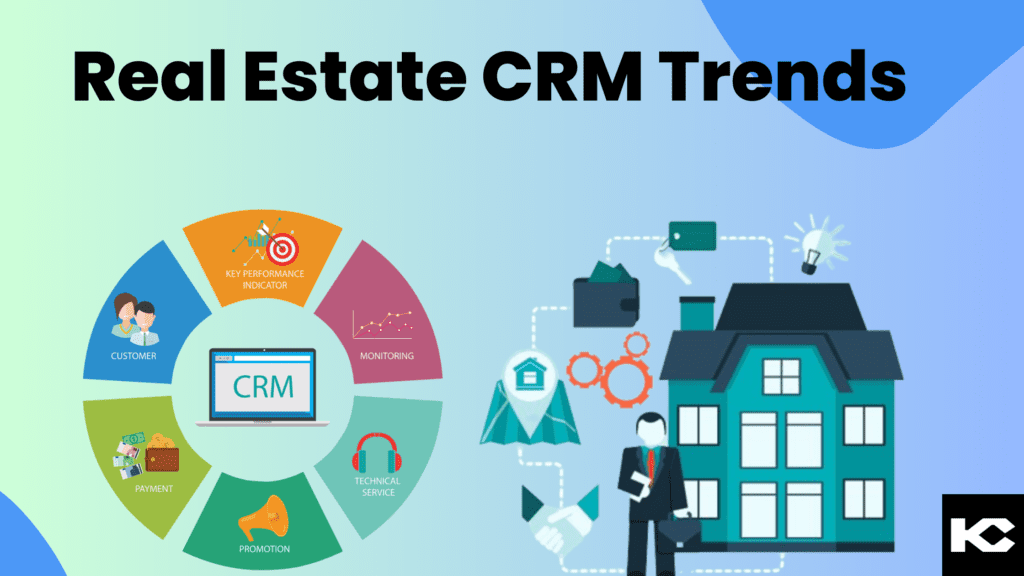
Real estate CRM trends in 2026 center on one shift – AI is no longer an add-on, it is the default layer. Real estate CRM software now handles lead scoring, follow-up, and even property showings autonomously, not just contact storage. Legacy CRMs that only log names and phone numbers are falling behind agents using AI agents to qualify leads and respond in minutes instead of hours. In this guide, you will learn the real estate CRM trends shaping 2026, why Salesforce is the strongest CRM platform for the industry, and how to evaluate your next CRM investment.
What is a real estate CRM?
A real estate CRM is a platform that centralizes client data, property listings, leads, and transaction history for agents, brokers, and property managers. Modern real estate CRMs go beyond contact storage – AI-enabled platforms score leads by likelihood to transact, automate follow-up, sync directly with MLS feeds, and increasingly deploy autonomous AI agents to qualify buyers and book showings without a human touching every step.
Real estate agents, investors, homeowners, lenders, and property managers are all working faster than the industry’s tools were originally built for. AI adoption among real estate agents reached 82% in a February 2026 Realtors Property Resource survey, up from 68% in the National Association of Realtors’ 2025 Technology Survey – a jump that means CRM choice is no longer a back-office decision, it is a competitive one.
Legacy Real Estate CRM
- ✗ Contact storage with manual data entry
- ✗ No lead scoring, every lead treated equally
- ✗ Static follow-up templates on a fixed schedule
- ✗ Manual MLS and portal syncing
- ✗ Desktop-first, limited mobile functionality
AI-Powered Real Estate CRM
- ✓ AI-driven lead scoring by transaction likelihood
- ✓ Autonomous follow-up within minutes of a new lead
- ✓ Voice agents that answer missed calls 24/7
- ✓ Live MLS and portal integration
- ✓ Full mobile access in the field
Real Estate CRM Trends Shaping 2026
AI Lead Scoring and Predictive Analytics
AI-driven scoring analyzes listing views, return visits, and time spent on valuation pages to rank a lead database by likelihood to transact. Real estate CRMs using AI follow-up have shown conversion lifts of up to 40 percent and response time cuts of roughly 60 percent, per a 2025 review of AI chatbot adoption in real estate CRM systems.
AI Voice Agents for Lead Qualification
Voice agents like AgentCalling.ai answer missed calls, qualify buyer or seller intent, and book showings around the clock – closing the speed-to-lead gap that costs agents the most deals.
Mobile-First CRM Access
Agents work from open houses and showings, not a desk. Full mobile access to listings, client data, and lead activity is now baseline, not a premium feature.
MLS and Portal Integration
Direct CRM integration with MLS feeds and listing portals removes manual re-entry and keeps client-facing listing data accurate in real time.
Speed-to-Lead Automation
Speed-to-lead is the single biggest conversion lever in residential real estate. A CRM that responds in minutes converts meaningfully better than one that responds in hours.
Data Security and Compliance
Client financial and personal data sits inside every real estate CRM record. Strong encryption and compliance controls are non-negotiable, not optional line items.
Remote and Hybrid Collaboration
Virtual tours, e-signature workflows, and remote transaction management are now standard CRM functionality, not a pandemic-era add-on.
Legacy Real Estate CRM vs AI-Enabled Real Estate CRM
| Legacy Real Estate CRM | AI-Enabled Real Estate CRM |
|---|---|
| Manual lead entry | Automated capture and scoring |
| Fixed follow-up schedule | Instant, behavior-triggered follow-up |
| No call coverage after hours | 24/7 AI voice agent coverage |
| Manual MLS updates | Live MLS and portal sync |
| Reactive reporting | Predictive analytics and forecasting |
Why Salesforce Stands Out as the Ideal Real Estate CRM
Deep Customization
Configure the platform around client relationships, listings, and campaigns exactly as your workflow requires, not a fixed template.
Centralized Data Management
One platform holds client data, property details, leads, and interaction history for a unified view of the customer and property lifecycle.
Real Estate-Specific Integrations
Connects to property valuation tools, mortgage calculators, and MLS feeds – well past generic contact management.
Mobile Accessibility
Full client and property data access in the field, enabling faster response and fewer missed follow-ups.
Analytics and Reporting
Built-in analytics surface sales performance, buyer behavior, and marketing ROI – decisions backed by data, not guesswork.
Scalability
Scales from a single agent to a multi-office brokerage without a platform migration.
Community and Support
The Salesforce partner ecosystem gives real estate businesses access to training, resources, and implementation expertise.
Agentforce AI Capability
Salesforce’s Agentforce platform brings autonomous AI agents into real estate workflows directly – qualifying leads and scheduling showings without a human in the loop at every step.
Check out our Customer Success Story on the Real Estate Industry for a real-world Salesforce real estate implementation.
Real Estate CRM Market Data and Statistics
Data on AI adoption inside real estate CRM workflows, sourced from the National Association of Realtors and Realtors Property Resource surveys:
82%
Of agents now use AI tools, per RPR’s February 2026 survey
40%
Lead conversion lift from AI-driven CRM follow-up
60%
Reduction in response time with AI chatbot follow-up
97%
Of brokerage leaders report agents actively using AI, per Delta Media’s January 2026 survey
Case Evidence
AI Voice Agent for Real Estate Lead Qualification – an AI voice agent answers every inbound call, captures buyer or seller requirements, qualifies leads against set criteria, schedules property viewings, and syncs lead details with the CRM instantly. Teams respond faster, reduce missed opportunities, and spend time on high-intent leads instead of repetitive inquiries.
Expert Perspective
“Real estate is a speed business before it is anything else. The teams winning in 2026 are not the ones with the most listings, they are the ones whose Agentforce or CRM setup responds to a new lead in minutes instead of hours. That gap is the whole game.”
– Sanjeet Mahajan, Founder & CEO, Kizzy Consulting
Common Real Estate CRM Challenges – and How to Solve Them
| Challenge | How to Solve It |
|---|---|
| Slow lead response | Deploy an AI voice or chat agent for instant first response, 24/7. |
| Fragmented listing data | Integrate the CRM directly with MLS and portal feeds instead of manual entry. |
| Agent adoption resistance | Start with one high-friction workflow, prove time savings, then expand. |
| Data security concerns | Choose a CRM with encryption at rest and in transit and role-based access controls. |
| Disconnected mobile experience | Confirm full feature parity on mobile before signing, not a stripped-down app. |
How to Choose a Real Estate CRM
- AI and automation depth – does it score and follow up on leads, or just store contacts.
- MLS and portal integration – can listings sync without manual entry.
- Mobile functionality – full feature access in the field, not a limited app.
- Scalability – will it hold up at 10x current transaction volume.
- Implementation support – is there a certified partner behind the platform.
- Voice agent capability – can it answer and qualify calls outside business hours.
Frequently Asked Questions About Real Estate CRM Trends
What are the biggest real estate CRM trends in 2026?
AI lead scoring, autonomous voice agents for follow-up and qualification, mobile-first access, MLS and portal integration, and speed-to-lead automation are driving real estate CRM adoption in 2026.
Why is Salesforce considered the best CRM for real estate?
Salesforce combines deep customization, centralized data management, real estate-specific integrations, and Agentforce AI capability – a CRM that scales from a single agent to a full brokerage.
How much does AI improve real estate lead conversion?
Real estate CRMs using AI-driven lead follow-up have shown conversion lifts of up to 40 percent and response time reductions of roughly 60 percent, per a 2025 review of AI chatbot adoption in real estate CRM systems.
Do small real estate teams need an AI-enabled CRM?
Yes – speed-to-lead is the biggest conversion factor regardless of team size, and AI-enabled follow-up closes that gap for solo agents the same way it does for large brokerages.
Can AI voice agents replace a real estate call center?
For lead qualification and after-hours coverage, yes. Complex negotiations and relationship-driven conversations still need a human agent – AI voice agents handle the volume, not the closing.
Does Agentforce integrate with real estate MLS systems?
Salesforce and Agentforce connect to MLS and listing portal data through standard integrations, letting AI agents reference live listing details when qualifying leads or answering inquiries.
Key Takeaways
- AI is now the default layer in real estate CRM, not an optional add-on.
- AI-driven lead scoring and follow-up lift conversion by up to 40 percent.
- Voice agents close the after-hours response gap that costs agents deals.
- Salesforce leads the category on customization, integration, and Agentforce AI capability.
- Mobile access and MLS integration are baseline requirements, not differentiators, in 2026.
Conclusion
Real estate CRM trends in 2026 all point the same direction – speed and AI capability decide which agents and brokerages win the lead. A CRM that only stores contacts is no longer competitive. Salesforce, paired with Agentforce and AI voice agents, gives real estate businesses the scoring, follow-up, and after-hours coverage that legacy CRMs cannot match.
Ready to Modernize Your Real Estate CRM?
Kizzy Consulting is a Salesforce Ridge Partner delivering real estate CRM implementation, Agentforce deployment, and AI voice agent integration for agents, brokerages, and property managers across the US, Europe, and Australia.
Contact our team today to modernize your real estate CRM.