Koa Explained: Salesforce’s First CRM Reasoning Model (2026)
⏱ 4 min read
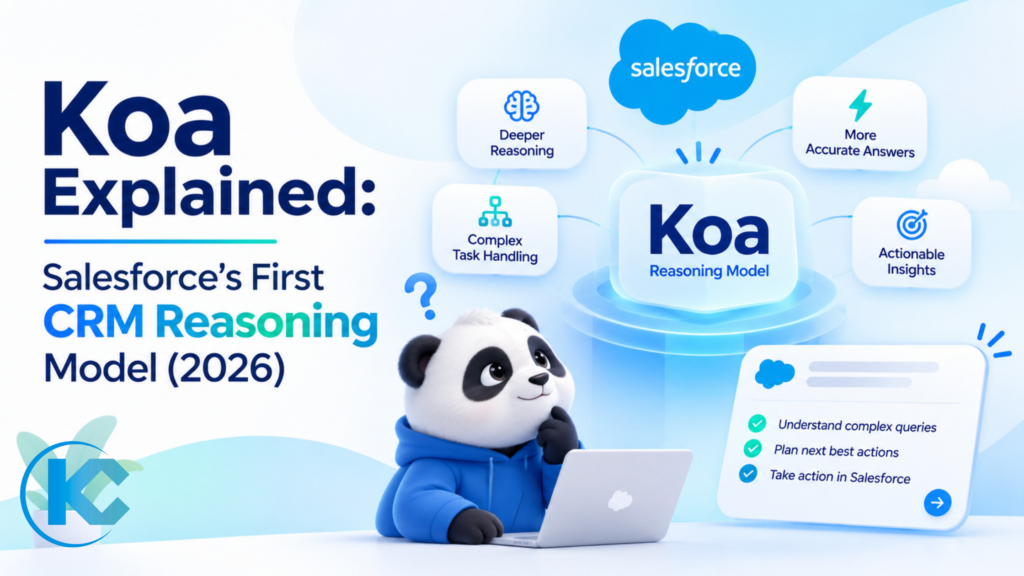
Koa is Salesforce’s first CRM-specific reasoning model, built with NVIDIA on Nemotron 3 Super and announced at Dreamforce 2026. Rather than just generating a good response, Koa is trained to reason through multi-step CRM work, such as reviewing an opportunity, checking recent activity, and deciding what should happen next, using enterprise scenarios modeled on nearly 27 years of Salesforce CRM data.
Koa: Quick Answer
Koa is Salesforce’s first CRM reasoning model, built with NVIDIA on Nemotron 3 Super and announced at Dreamforce 2026. It is post-trained on synthetic business scenarios reflecting 27 years of Salesforce CRM intelligence, so it can reason through multi-step work like qualifying an opportunity or routing a case, instead of just generating a response. On Salesforce’s CRM benchmark, Koa reportedly matches or exceeds leading model performance on CRM actions with three times fewer errors. It is currently in pilot with select customers, with general availability expected in U.S. regions in Winter 2026.
Wondering If Koa Fits Your Agentforce Setup?
Kizzy Consulting helps sales and RevOps teams evaluate new Agentforce model options like Koa and plan a pilot without disrupting agents already in production.
1. What Is Koa, Exactly?
Koa is Salesforce’s first CRM-specific reasoning model, built for Agentforce in deep technical collaboration with NVIDIA. It was unveiled on stage at Dreamforce 2026, with Marc Benioff and NVIDIA CEO Jensen Huang discussing the partnership directly.
Salesforce built Koa by post-training NVIDIA’s open Nemotron 3 Super model using a proprietary synthetic dataset modeled on enterprise knowledge from nearly three decades of CRM deployments. In Marc Benioff’s words, the goal was to put Salesforce’s accumulated business knowledge directly inside the model itself, rather than leaving it locked inside dashboards and workflows.
Koa at a Glance
- Announced September 15, 2026 at Dreamforce, alongside AIforce.
- Built by post-training NVIDIA Nemotron 3 Super for CRM-specific reasoning.
- Trained on synthetic scenarios modeled on 27 years of Salesforce CRM intelligence.
- Covers scenarios across more than 14 industries.
- Matches or exceeds leading model performance on CRM actions with 3x fewer errors, per Salesforce’s CRM benchmark.
- In pilot with customers including UChicago Medicine and Baxter Credit Union.
2. How Koa Differs From a General-Purpose Model
A general-purpose AI model is built to produce a helpful response to a prompt. Ask it a question, and it answers well. That is not quite the same problem as CRM work.
Consider a sales manager asking an Agentforce agent to “review this opportunity, check the latest customer activity, identify the next best action, and schedule a follow-up for next week.” Completing that request is not one step. It involves retrieving the opportunity, reviewing recent emails and activity, understanding the deal stage and business context, deciding the right next action, and then updating the record or scheduling the follow-up.
Koa is built specifically for that kind of multi-step reasoning, choosing the right tool at each stage and staying on track as the workflow progresses, rather than treating each action as an isolated response.
General-Purpose Model vs Koa
- General-purpose model: Optimized for a strong single response to a prompt.
- Koa: Optimized to reason through multi-step CRM tasks and choose the correct tool at each step.
- General-purpose model: Broad knowledge across many domains.
- Koa: Trained specifically on enterprise CRM scenarios across 14-plus industries.
- General-purpose model: Not evaluated against CRM-specific action benchmarks.
- Koa: Benchmarked directly against CRM actions like updating opportunities, routing cases, and scheduling follow-ups.
Koa is one of several major announcements from this year’s event. For the full picture, see Kizzy Consulting’s Dreamforce 2026 Highlights: Top Announcements You Need to Know, and for the interface layer Koa sits alongside, read our Salesforce AIforce: Architecture, Features, Pricing & Guide 2026.
3. How Koa Was Trained
Salesforce and NVIDIA built Koa in two main stages. First, supervised fine-tuning gave the model examples of how CRM tasks should be handled correctly. Second, reinforcement learning using Group Relative Policy Optimization, run with NVIDIA’s NeMo tools, refined how Koa completes tasks correctly rather than simply producing a plausible-sounding response.
Notably, training relied on synthetic business scenarios modeled on how enterprises operate, not on real customer data. This is a meaningful detail for any organization asking whether adopting Koa means exposing their own CRM data to model training.
Koa’s Training Approach
- Base model: NVIDIA Nemotron 3 Super, an open-weight model.
- Stage 1: Supervised fine-tuning on synthetic CRM task examples.
- Stage 2: Reinforcement learning via Group Relative Policy Optimization (GRPO).
- Training data: Synthetic enterprise scenarios, not real customer records.
- Scope: Scenarios modeled across more than 14 industries.
- Hosting: Salesforce controls the model weights and performs post-training and inference within its own trust boundary.
4. What Koa Means for Your Sales Team
This is the part that matters most for revenue teams. Koa is not a chatbot feature bolted onto Sales Cloud. It is a reasoning engine aimed directly at the kind of multi-step review work that eats up a rep’s or a manager’s day.
Picture the pipeline review a sales manager runs every week: open each stalled opportunity, scan recent emails and call notes, judge whether the deal is actually progressing, decide on a next step, and either nudge the rep or update the record directly. Koa is designed to run that exact sequence as one reasoning pass, then hand a rep a recommended action instead of a raw list of records to dig through.
Practical Impact for Sales Teams
- Faster opportunity reviews: An agent powered by Koa can check an opportunity, review activity history, and surface a recommended next action in one pass.
- Fewer manual errors: Salesforce reports 3x fewer errors on CRM benchmark actions compared to leading general-purpose models.
- Less busywork: Scheduling follow-ups, updating stages, and routing records can happen as part of the agent’s reasoning, not a separate manual step.
- More consistent judgment calls: Because Koa is trained on structured CRM scenarios, its recommendations are grounded in how deals typically move through a pipeline.
- A model choice, not a mandate: Sales leaders can pilot Koa for specific agents without ripping out existing Agentforce configurations built on other models.
The caveat worth repeating to any sales leader excited by this: Koa is still in pilot. Rolling it into daily workflows today means joining a pilot program rather than flipping a switch in Setup.
5. Koa vs Claude, Gemini, and Other Agentforce Model Options
It’s worth being direct about what Koa is not: it is not a replacement for the other model providers available inside Agentforce. Salesforce’s model-selection options currently include the Salesforce Default model, AWS-hosted Claude, and Google Gemini, and Koa joins that lineup as an additional, CRM-specialized option rather than the only choice.
The practical decision for most teams will not be “which model is best overall,” but “which model fits this specific agent’s job.” A customer-facing conversational agent may still lean on a general-purpose model’s broader reasoning and language range. A backend sales-ops agent handling opportunity triage, case routing, or pipeline hygiene is exactly the kind of narrow, structured, repeatable task Koa was built for.
Where Koa Fits Best
- Opportunity review and next-best-action recommendations.
- Case routing and service triage workflows.
- Pipeline hygiene and stalled-deal identification.
- Follow-up scheduling tied to CRM activity history.
- Multi-step backend agent tasks, more than open-ended customer conversations.
6. Availability: When Can You Actually Use Koa?
As of the Dreamforce 2026 announcement, Koa is not generally available. It is in pilot with select Agentforce customers, including UChicago Medicine and Baxter Credit Union, with general availability expected in U.S. regions in Winter 2026.
Once broadly available, Koa can be selected at the agent or sub-agent level inside Agentforce Builder, set as an organization-wide model provider, or accessed as a managed LLM through the Data Cloud generative models catalog.
Rollout Snapshot
- Announced: September 15, 2026, at Dreamforce.
- Current status: Pilot with select customers.
- Pilot customers named: UChicago Medicine, Baxter Credit Union.
- Expected GA: Winter 2026, U.S. regions.
- Where it lives: Agentforce Builder (agent or sub-agent level), org-wide model provider, or Data Cloud generative models catalog.
Want to See Where Koa Fits Your Agentforce Roadmap?
Kizzy Consulting helps sales and RevOps teams map new Agentforce capabilities like Koa against real pipeline and service workflows, before committing to a pilot.
Frequently Asked Questions About Salesforce Koa
What is Salesforce Koa?
Koa is Salesforce’s first CRM-specific reasoning model for Agentforce, built with NVIDIA on Nemotron 3 Super and announced at Dreamforce 2026. It is post-trained on synthetic enterprise scenarios modeled on nearly 27 years of Salesforce CRM deployments, so it can reason through multi-step CRM work like qualifying opportunities, routing cases, and scheduling follow-ups.
How is Koa different from a general-purpose AI model?
A general-purpose model is optimized to produce a good response to a prompt. Koa is optimized to decide what should happen next in a CRM workflow: which record to check, which tool to call, and what action to take, across multiple steps in a single task rather than one isolated response.
How was Koa trained?
Salesforce post-trained NVIDIA’s open Nemotron 3 Super model using supervised fine-tuning and Group Relative Policy Optimization reinforcement learning with NVIDIA’s NeMo tools. Training used synthetic business scenarios across more than 14 industries rather than real customer data.
Does Koa use customer data for training?
Get Ahead of Koa Before It’s General Availability
Koa is still in pilot, which means there is time to plan before it lands in every Agentforce org. Kizzy Consulting can help you map your sales and service workflows against what Koa is actually built to do, so you are ready to pilot it the moment it fits.
If you are evaluating Agentforce model selection, sales AI automation, or Agentforce implementation, Kizzy Consulting can help.
Email: [email protected]