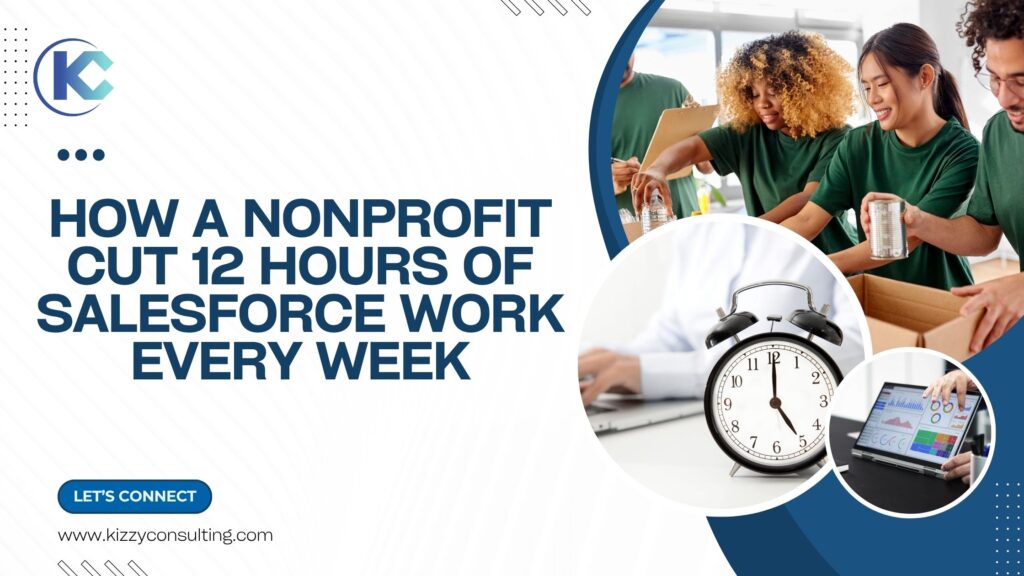
How a Nonprofit Cut 12 Hours of Salesforce Work Every Week
⏱ 2 min read
Salesforce Optimization
Thinking About Streamlining Your Nonprofit Salesforce Org?
Let’s talk through what’s possible, even with the setup you already have.
The Situation: Scaling Nonprofit Donor Management
Nonprofits often face the challenge of doing more with less, limited staff, tight budgets, and increasing demands. One of our clients, a mid-sized nonprofit in education and community development, was no exception.
Managing Growing CRM Demands:
- Over 20,000 donor records
- A growing list of grant programs and outreach campaigns
Their Salesforce system had become difficult to maintain, creating more work than it solved. Each new campaign added more complexity and stress to the team’s already full plate.
Key Salesforce CRM Issues Included:
- Spending 12+ hours a week on manual data cleanup
- Constantly updating donor statuses by hand
- Manually assembling reports for leadership
The Challenge: Data Clutter and Manual CRM Workflows
While they had Salesforce in place, it wasn’t optimized for scale or accuracy. The biggest issues included:
Duplicate and outdated donor records making segmentation nearly impossible
Manual data entry for campaign updates and donation statuses
Inconsistent grant tracking, leading to reporting delays
No clear data ownership, which led to a growing backlog of unresolved issues
The impact? Wasted staff time, missed donor touchpoints, and reduced confidence in their data. Leadership couldn’t get reliable reports without hours of cleanup.
Our Approach: Fast Salesforce Optimization & Native Automation
We started with a two-week discovery and audit, mapping out data pain points and current workflows. From there, we designed a lightweight cleanup and automation sprint using only Salesforce’s native tools, no third-party apps, no reimplementation.
STEP 01
Automated duplicate detection and merging using Matching Rules and Duplicate Jobs.
STEP 02
Scheduled batch jobs to clean outdated records and standardize fields (e.g., donor type, grant stage).
STEP 03
Process Builder and Flow to automate updates on donor and grant statuses based on defined triggers.
STEP 04
Custom reports and dashboards highlighting stale data, missing values, and overdue actions.
We also trained their team on basic data hygiene best practices, so improvements would stick.
The Outcome: Successful Data Cleanup & Enhanced Donor Focus
In just a few weeks, the team reclaimed over 12 hours of manual effort each week. More importantly, the system started working for them, not against them.
- Donor records were 98% clean and deduplicated
- Grant workflows became automatic and consistent
- Reporting became self-service for leadership
- No additional headcount or tools required
Why Salesforce CRM Optimization Matters for Nonprofits
For nonprofits, time is a limited resource, and every hour saved on operations is an hour that can go toward mission-driven work. With just a focused cleanup and the right automation, this team turned Salesforce from a chore into a strategic asset.
Frequently Asked Questions: Salesforce CRM Optimization
Do we need to purchase third-party apps for this cleanup?
No. Our approach to Salesforce optimization uses only native tools—like Matching Rules, Duplicate Jobs, and Flow—meaning no extra software costs or full reimplementations are required.
How long does a typical nonprofit Salesforce optimization take?
We start with a fast, two-week discovery and audit to map out data pain points. This is followed by a lightweight automation sprint, allowing your team to see results in just a few weeks.
How do we ensure our data stays clean moving forward?
In addition to setting up automated batch jobs to continually standardize fields, we provide your team with hands-on training on basic data hygiene best practices so the improvements stick.
Will this help our leadership team with grant tracking and reporting?
Yes. By fixing inconsistent tracking and standardizing your data, reporting transitions from a manual, time-consuming chore into a reliable, real-time, self-service process for leadership.
What happens to thousands of duplicate donor records?
We implement automated duplicate detection and merging. For our featured client, over 20,000 donor records were seamlessly processed, resulting in a database that was 98% clean and deduplicated.
Ready for Your Own Salesforce Optimization?
Let’s talk through what’s possible, even with the setup you already have.