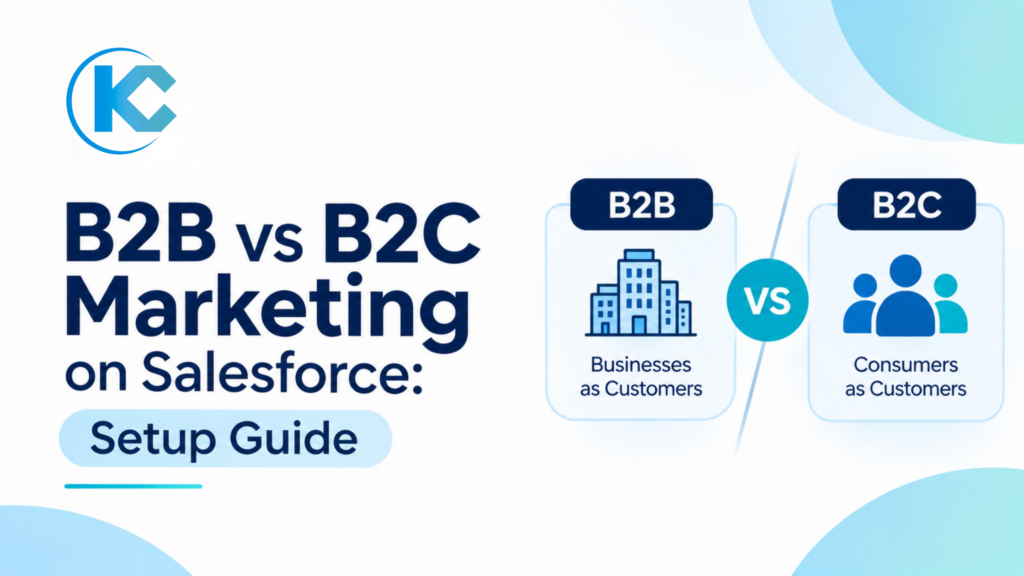
B2B vs B2C Marketing on Salesforce: How to Run Both Without Doubling Your Team
⏱ 3 min read
Salesforce • Marketing Cloud • AI Agents
Run B2B and B2C marketing on Salesforce without doubling your team.
B2B buyers research for weeks and need proof. B2C buyers decide in one sitting and respond to urgency. One playbook cannot serve both, but one Salesforce stack can. Kizzy sets up the CRM, marketing automation, data and AI agents behind each model, so a lean team can run both from a single source of truth. Details reflect public information as of November 25, 2026.
50+
AI agents built
120+
Projects delivered
98%
Client satisfaction
Salesforce
Ridge Partner
B2B vs B2C marketing on Salesforce:
B2B marketing is a longer, multi-stakeholder, pipeline-driven journey, so it runs on B2B marketing automation tied closely to your sales process. B2C marketing is shorter and behavior-driven, so it runs on cross-channel journeys fed by unified customer data. In Salesforce’s product line, Account Engagement (formerly Pardot) is positioned for B2B, Marketing Cloud Engagement (formerly ExactTarget) for B2C, and Marketing Cloud Next for both.
What both models need is the same: one clean CRM as the source of truth, separate journeys, content and metrics for each audience, and AI that takes over the busywork while people own strategy.
B2B vs B2C Marketing: The Differences That Change Your Setup
These differences are not just theory. Each one decides how you configure journeys, content, data and reporting in Salesforce.
| Factor | B2B | B2C | What it means in Salesforce |
|---|---|---|---|
| Buying journey | Weeks of research, several stakeholders, proof required | Short, often one sitting, a personal decision | B2B tracks leads, contacts and opportunities. B2C relies on unified customer profiles and behavior data |
| Messaging | Logic, ROI, risk reduction | Emotion, personal benefit, urgency | Separate content tracks and templates for each audience |
| Proof | Case studies, comparison guides, detailed FAQs | Social proof, short video, limited-time offers | Content libraries and offers tied to audience segments |
| Channels | Email, LinkedIn, SEO, webinars | Social, mobile, email and SMS, e-commerce | One or two channels per audience, all connected to the CRM |
| Personalization | Industry, role and past interactions | Browsing and purchase history | B2B uses account and contact fields. B2C uses order and engagement data |
| Key metrics | Pipeline velocity, deal size, stage progression | Conversion rate, cart abandonment, average order value | Separate dashboards for each audience |
| Relationship | Trust and long-term partnership | Loyalty and repeat purchase | Account management for B2B, loyalty and retention journeys for B2C |
Differences summarized from Salesforce’s guidance for small teams and IMD Business School.
Which Salesforce Marketing Tools Fit Which Model
Salesforce’s marketing line has changed names and structure, which makes the choice confusing. Here is how the pieces fit.
Best for B2B
Account Engagement
Formerly Pardot. B2B marketing automation for longer buying cycles, built to nurture leads and hand them to sales.
Best for B2C
Marketing Cloud Engagement
Formerly ExactTarget. Email, SMS, push and cross-channel journeys, with Journey Builder, Content Builder and Automation Studio.
B2B and B2C
Marketing Cloud Next
Built natively on the Salesforce Platform, with AI through Agentforce and Flow behind its journeys. Existing Journey Builder journeys can be used within Flow, and Salesforce says current customers can adopt its capabilities without switching platforms.
The data layer
Data 360
Formerly Data Cloud. Unifies customer signals from across your systems, and Marketing Cloud Next is built on it.
Kizzy’s view: do not pick a tool first. Pick the audience, the journey and the data you need, then choose the lightest product that supports them. A B2B-only team and a retail brand need very different setups, and teams that sell to both usually need shared data with separate journeys. See how this plays out in our guides to Marketing Cloud for retail and Marketing Cloud for real estate.
How to Run Both Models With One Lean Team
Teams that sell to businesses and consumers do not need two stacks. They need shared data and separate playbooks.
1
Build different journeys and content tracks for each audience, but keep every lead, customer and interaction in one system.
2
Make the CRM the source of truth
Route leads, orders and notes into Salesforce so marketing, sales and service work from the same record. Salesforce integration services connect your forms, e-commerce and other tools.
3
Give B2B buyers something to forward
B2B buyers answer to managers and budgets. Case studies, comparison sheets and short summaries help your champion make the internal case.
4
Personalize with the data you have
Use industry, role and past interactions for B2B, and browsing and purchase history for B2C. You do not need a large data team to start.
5
Measure each audience on its own
Report pipeline velocity and deal size for B2B, and conversion and order value for B2C. Blended averages hide what is working.
6
Let AI do the busywork, not the strategy
Use agents for research, follow-up drafts and content variations. Keep your value proposition, segmentation and brand voice in human hands. See our AI content writing agent.
How Kizzy Helps You Set This Up
Strategy and consulting
Decide which audiences, journeys and tools to prioritize before you build anything.
Implementation
Set up Marketing Cloud, Account Engagement and your CRM data model, tested and documented.
Integration and data
Connect web forms, e-commerce and other systems so every touchpoint lands in Salesforce.
AI agents and Agentforce
Add agents that draft content, follow up on leads and take routine work off your team.
Quickstart for small teams
A fast, scoped way to get Salesforce running when you do not need a full programme.
Not sure what you need?
Tell us how you sell and we will point you to the right starting point.
B2B vs B2C Marketing on Salesforce: FAQs
What is the main difference between B2B and B2C marketing?
B2B marketing targets businesses with longer, multi-stakeholder buying cycles and logic- and ROI-based messaging. B2C marketing targets individuals with shorter cycles and emotion-, benefit- and urgency-based messaging. That changes the content, channels, personalization and metrics you need.
Which Salesforce product is for B2B marketing and which is for B2C?
Salesforce positions Account Engagement, formerly Pardot, for B2B marketing automation and Marketing Cloud Engagement, formerly ExactTarget, for B2C. Marketing Cloud Next is positioned for both. Product names and packaging change, so confirm current options before you buy.
Can one small team run both B2B and B2C marketing?
Yes, if they share one CRM as the source of truth and keep journeys, content and metrics separate for each audience. Shared data and automation let a lean team cover both without duplicating work.
Do we need Data 360 for marketing?
Not every team does. It matters most when you need to unify customer data from several systems to personalize at scale. Start with the data and journeys you need, and add Data 360 when the use case justifies it.
Where do AI agents help marketing teams?
With research, follow-up drafts, content variations and routine confirmations. B2B teams often use them to speed up research-heavy nurture work, and B2C teams to produce more personalized variations. People should still own strategy, segmentation and brand voice.
How do we get started with Kizzy?
Book a 30-minute strategy call or send the form below. We review how you sell and what you already run, then recommend the marketing tools, data model and automation to build first.
Talk to a Salesforce Marketing Expert
Tell us who you sell to and what you run today. We will recommend the right Salesforce marketing setup for your B2B, B2C or mixed audience. No obligation, and we work with teams in the USA and Australia.
1. Send the form2. We review your setup3. You get a clear recommendation
Prefer to book directly? Book a 30-minute strategy call or contact us.