Why AI Governance Matters in 2026: 10 Trends Enterprises Need to Know
⏱ 4 min read
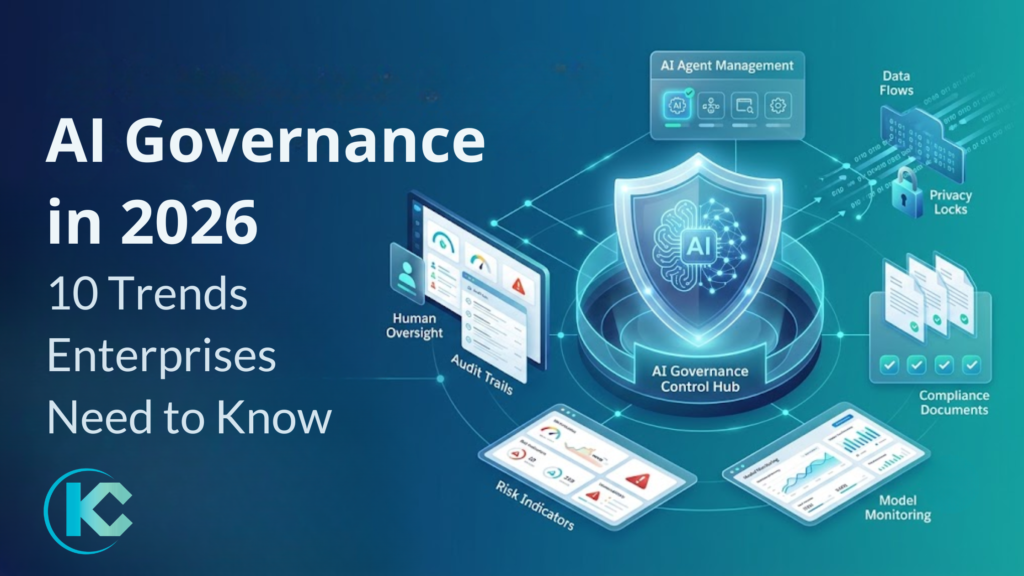
AI governance is becoming one of the most important parts of enterprise AI adoption in 2026. Organizations are moving from AI experiments to production systems, AI agents, automated workflows, and customer-facing applications. That shift creates a new challenge: companies must move quickly while still protecting data, controlling AI risk, meeting regulatory requirements, and keeping humans accountable.
Modern AI governance is no longer just a policy document written by legal or compliance teams. It now covers AI security, data governance, model risk, agentic AI oversight, shadow AI, AI compliance, human oversight, vendor risk, monitoring, auditability, and responsible AI. This guide explains the most important AI governance trends for 2026 and what enterprises should do to prepare.
By Sanjeet Mahajan – CEO/Founder of Kizzy Consulting
Executive Quick Answer
What are the biggest AI governance trends in 2026?
The biggest AI governance trends in 2026 include Agentic AI governance, real-time AI monitoring, shadow AI discovery, stronger AI compliance, human oversight, AI vendor risk management, AI lifecycle governance, AI security, automated audit trails, and governance frameworks such as ISO/IEC 42001 and NIST AI RMF. The biggest change is that governance is moving from static policies to continuous controls that operate throughout the AI lifecycle.
2026
AI governance is shifting from policy documents to continuous operational controls.
10
Major AI governance trends enterprises should monitor this year.
24/7
The direction of AI monitoring as agents and automated workflows operate continuously.
What Is AI Governance?
AI governance is the framework an organization uses to make sure artificial intelligence is developed, deployed, monitored, and used safely and responsibly. It defines who owns an AI system, what data it can access, what decisions it can make, when humans must intervene, how risks are monitored, and how compliance is demonstrated.
Traditional software governance often focuses on access, security, change management, and uptime. Enterprise AI governance adds another layer because AI systems can generate unpredictable outputs, learn from changing data, interact with users, and increasingly take actions through tools and APIs.
For enterprises, an effective AI governance framework should cover strategy, data, security, privacy, model risk, responsible AI, compliance, human oversight, monitoring, documentation, and continuous improvement.
10 AI Governance Trends Shaping Enterprise AI in 2026
AI governance is changing quickly because enterprise AI itself is changing. The following trends are becoming especially important for CIOs, CISOs, CTOs, compliance leaders, Salesforce teams, data leaders, and business executives.
1. Agentic AI Governance Is Becoming a Priority
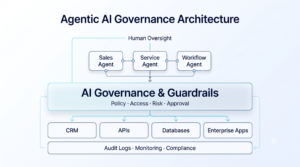
The biggest change in AI governance is the rise of Agentic AI. Traditional AI may generate an answer. AI agents can plan tasks, call APIs, retrieve information, update systems, communicate with users, and complete multi-step workflows.
That creates a much larger governance surface. Enterprises must define what an AI agent is allowed to do, what data it can access, which systems it can modify, when human approval is required, and how every important action is recorded.
- Maintain an inventory of production AI agents.
- Use least-privilege permissions for agent identities.
- Define human approval thresholds for high-risk actions.
- Log agent decisions, tool calls, and system changes.
- Provide rollback and emergency shutdown controls.
2. AI Governance Is Moving From Policies to Real-Time Controls
One of the biggest weaknesses of traditional AI policies is that a document does not stop risky behavior. Modern AI governance software and governance programs are moving toward real-time monitoring, access controls, automated alerts, and policy enforcement.
This means organizations can monitor AI usage, data access, model performance, agent actions, and policy violations while systems are running instead of discovering problems months later during an audit.
3. Shadow AI Is Becoming an Enterprise Governance Problem
Employees are using generative AI tools for research, writing, coding, analysis, sales, customer support, and productivity. The problem is that IT teams may not know which tools are being used or what company information is being entered into them.
This is known as shadow AI. It can expose sensitive customer information, intellectual property, credentials, financial data, or confidential business documents.
The answer is not simply banning AI. Enterprises need approved AI tools, clear acceptable-use policies, employee training, data controls, and continuous visibility into AI usage.
4. AI Compliance Is Moving From Preparation to Enforcement
AI regulation is becoming more important as governments introduce rules covering transparency, risk management, privacy, accountability, and high-risk AI systems. Enterprises operating across countries must increasingly understand how different regulations affect their AI systems.
Organizations should map AI systems to applicable requirements instead of waiting for a compliance review after deployment. Frameworks such as the NIST AI Risk Management Framework (AI RMF) and ISO/IEC 42001 can provide structure for building an enterprise AI management program.
5. AI Vendor Risk Management Is Becoming Essential
Enterprise AI does not come only from internally developed models. AI capabilities are increasingly embedded inside CRM, collaboration, analytics, HR, finance, marketing, and productivity platforms.
This creates a new AI vendor risk. A company may approve a SaaS platform and later discover that a new AI feature processes business information or sends data to an external model provider.
- Review how vendors use enterprise data for AI.
- Understand model providers and subprocessors.
- Check data residency and retention policies.
- Review AI security and privacy controls.
- Reassess vendors when major AI features change.
6. Human Oversight Is Evolving Into Human-on-the-Loop AI
Human oversight remains critical, but the model is changing. Humans cannot manually approve every AI decision when hundreds or thousands of AI actions happen every day.
Enterprises are therefore moving toward risk-based human oversight. Low-risk actions can be automated, while sensitive decisions require human approval. For example, an AI agent may summarize a customer case automatically but require approval before issuing a large refund, changing a contract, or modifying a critical financial record.
7. AI Governance and Cybersecurity Are Converging
AI governance can no longer operate separately from cybersecurity. AI systems introduce risks involving prompt injection, data leakage, unauthorized access, insecure integrations, model manipulation, and excessive agent permissions.
A strong AI security framework should therefore include identity management, encryption, access controls, secure APIs, data loss prevention, monitoring, vulnerability testing, and incident response.
8. AI Lifecycle Governance Is Replacing One-Time AI Reviews
AI governance must continue after deployment. Models change, prompts change, business processes change, data changes, and vendors release new versions.
This makes AI lifecycle management a major governance trend. Enterprises need regular testing, model evaluation, data quality checks, performance monitoring, prompt version control, incident tracking, and periodic risk reassessment.
9. AI Governance Is Becoming a Board-Level Business Issue
AI governance was once viewed mainly as an IT, legal, or compliance responsibility. That is changing. AI now affects revenue, customer experience, workforce productivity, operational decisions, and enterprise risk.
Executives increasingly need visibility into where AI is being used, what value it produces, what risks it creates, and who owns each system. This makes AI governance strategy part of enterprise transformation rather than a technical side project.
10. AI Governance Is Becoming Part of AI Readiness
Organizations are learning that governance should be evaluated before AI deployment, not after a problem appears. Data readiness, technology readiness, process readiness, organizational readiness, and governance readiness all affect whether an AI initiative can scale.
Is Your Enterprise AI-Ready?
Before deploying AI agents or scaling generative AI, identify gaps in data, infrastructure, security, governance, processes, and team readiness.
What Should an Enterprise AI Governance Framework Include?
A practical enterprise AI governance framework does not need to be complicated. It needs clear ownership, measurable controls, and continuous monitoring.
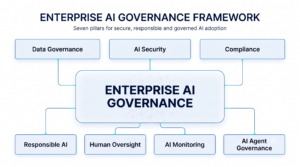
| Governance Area | What to Govern | Example Control |
|---|---|---|
| AI Inventory | Models, agents, tools and use cases | Central AI system registry |
| Data Governance | Data quality, access and privacy | RBAC and data classification |
| AI Security | Threats, permissions and integrations | Least-privilege access |
| Responsible AI | Bias, fairness and transparency | Responsible AI assessments |
| Agent Governance | Actions, permissions and escalation | Human approval for high-risk actions |
| Monitoring | Accuracy, cost, usage and incidents | Continuous AI telemetry |
| Compliance | Regulatory and audit requirements | Automated audit evidence |
AI Governance Starts With Data Governance
AI systems are only as trustworthy as the data and permissions behind them. Poor data quality, outdated information, duplicate records, missing context, and uncontrolled access can create unreliable AI outputs.
This is especially important for enterprise AI agents and RAG systems. A knowledge agent needs accurate documents, controlled access, reliable retrieval, and clear source attribution. A CRM agent needs clean customer data and carefully defined permissions.
Kizzy Consulting’s Data Foundation for AI approach focuses on data discovery, data audits, unified architecture, data quality, metadata, governance, and AI-ready data pipelines.
How to Build an AI Governance Strategy in 2026
Enterprises do not need to solve every governance problem on day one. A practical roadmap can start small and become stronger as AI adoption grows.
- Step 1, Inventory:
Identify every AI model, AI application, AI agent, vendor AI feature, and shadow AI tool being used. - Step 2, Classify Risk:
Group AI systems according to data sensitivity, business impact, autonomy, and regulatory exposure. - Step 3, Define Ownership:
Give every production AI system a clear business and technical owner. - Step 4, Secure Access:
Apply least-privilege permissions, identity controls, data protection, and secure integration practices. - Step 5, Add Human Oversight:
Define which actions can happen automatically and which require human approval. - Step 6, Monitor Continuously:
Track accuracy, usage, cost, incidents, data quality, model performance, and agent actions. - Step 7, Maintain Evidence:
Keep documentation, approvals, evaluations, incidents, changes, and audit records throughout the AI lifecycle.
Planning AI Agents or Agentforce?
Make governance part of the implementation from day one. Kizzy Consulting can help you evaluate AI readiness, data quality, security, workflows, agent permissions, human oversight, and production readiness.
Responsible AI Is Becoming a Competitive Advantage
Responsible AI is not simply about avoiding problems. Strong governance can make employees and customers more comfortable using AI. When users know how an AI system works, what data it uses, when humans review decisions, and who is accountable, trust improves. This makes responsible AI, AI transparency, AI accountability, AI explainability, AI ethics, and AI trust important parts of enterprise AI strategy.
How Kizzy Consulting Helps With Enterprise AI Governance
At Kizzy Consulting, we treat AI governance as part of the full AI implementation lifecycle, not as a final compliance step. Our approach connects AI strategy, data readiness, security, governance, workflow automation, AI agents, Salesforce, Agentforce, Data Cloud, integrations, monitoring, and ongoing optimization.
Our AI Integration & Implementation Services include technical debt and architecture review, data readiness, governance and security frameworks, use-case mapping, and phased enterprise AI implementation.
Frequently Asked Questions
What are the top AI governance trends in 2026?
The major AI governance trends include Agentic AI governance, shadow AI discovery, real-time monitoring, AI compliance, AI security, human oversight, vendor risk management, AI lifecycle governance, responsible AI, and automated audit evidence.
Why is AI governance important for enterprises?
AI governance helps enterprises manage AI risks while enabling responsible adoption. It provides controls for data privacy, security, compliance, accountability, model performance, human oversight, and AI agent actions.
What is shadow AI?
Shadow AI refers to AI tools used by employees without formal approval or visibility from IT and security teams. It can create risks involving confidential data, privacy, security, compliance, and uncontrolled AI spending.
How does AI governance work with Salesforce Agentforce?
Agentforce governance should define agent ownership, data access, permissions, human escalation, action limits, testing, monitoring, prompt and instruction management, and auditability before agents are deployed into production.
What is the difference between AI governance and AI compliance?
AI compliance focuses on meeting applicable laws, regulations, and standards. AI governance is broader and includes compliance along with security, data governance, accountability, risk management, monitoring, human oversight, and responsible AI practices.