QuickBooks and Salesforce Integration: Options, Sync Methods and Setup
⏱ 10 min read
Yes, QuickBooks and Salesforce can be connected, but the right integration depends on which QuickBooks edition you use, what information needs to move, and whether the sync must work one way or both ways. Common options include a Salesforce AppExchange connector, an integration platform such as an iPaaS, or a custom integration using the QuickBooks Online API. Intuit also documents a separate one-way connection that brings selected Salesforce CRM data into QuickBooks Online Advanced and Intuit Enterprise Suite. This guide compares the options, explains QuickBooks Online vs. Desktop requirements, maps the records businesses commonly sync, and shows how to plan a secure integration that handles invoices, payments and errors reliably.
Contents
hide
Does QuickBooks Integrate with Salesforce?
Yes. Salesforce can connect with QuickBooks through third-party AppExchange applications, middleware or iPaaS platforms, and custom API integrations. These approaches can support workflows such as customer synchronization, invoice creation, and payment-status visibility, depending on the product and integration design.
There is also an Intuit-documented CRM connection for QuickBooks Online Advanced and Intuit Enterprise Suite. This brings selected CRM information from Salesforce into QuickBooks. It is a one-way CRM-to-accounting data flow, not a complete two-way integration for synchronizing invoices, payments and financial updates between both systems. The distinction matters when choosing an integration.
QuickBooks Salesforce Integration at a Glance
Customer and CRM Data
Coordinate customer, contact, opportunity and product information where the selected integration supports it.
Invoice Workflows
Create or update accounting transactions from approved Salesforce business events when configured.
Payment Visibility
Display relevant invoice balances and payment information for Salesforce sales and account teams.
When QuickBooks and Salesforce work together, sales, finance and operations teams can work with more consistent customer and transaction information. The integration should be designed around the business process rather than simply copying every field between systems.
QuickBooks and Salesforce Integration Options Compared
There are four routes worth evaluating: a third-party AppExchange connector, middleware or iPaaS, a custom API integration, and Intuit’s documented CRM-to-QuickBooks connection. They do not provide identical functionality. Compare them against your required QuickBooks edition, data objects, sync direction, frequency, security and ongoing maintenance.
| Approach | Best Fit | Data Flow | Setup Effort | Maintenance |
|---|---|---|---|---|
| AppExchange connector | Standard workflows already supported by the selected connector. | One-way or two-way, depending on the product and configuration. | Low to medium | Vendor maintains the product; the Salesforce admin manages configuration, access and operational checks. |
| Middleware / iPaaS | Multiple applications, complex mapping, orchestration and centralized monitoring. | One-way or bidirectional, based on the designed flows. | Medium to high | The integration team or implementation partner maintains flows, credentials and monitoring. |
| Custom API integration | Specialized business logic, custom mapping and control over integration behavior. | One-way or bidirectional, based on the architecture. | Medium to high | The development or managed services team maintains code, authentication, tests and error handling. |
| Intuit CRM connection | Bringing selected CRM information into supported QuickBooks Online Advanced and Intuit Enterprise Suite environments. | One-way from CRM into QuickBooks for the documented connection. | Depends on product availability and configuration. | Follow Intuit’s supported setup and product limitations. |
How should you choose?
Start with a connector if your required objects and workflows are already supported. Consider middleware when several systems or complex transformations are involved. Choose custom API development when you need specific business rules or control over the end-to-end workflow. Consider Intuit’s CRM connection when its supported one-way data flow matches your requirements.
For a more technical walkthrough, see Kizzy Consulting’s QuickBooks and Salesforce REST API integration guide.
What Does Intuit’s QuickBooks CRM Connection Actually Do?
Intuit documents a CRM connection for QuickBooks Online Advanced and Intuit Enterprise Suite that includes Salesforce as a supported CRM data source. The documented direction is from the CRM into QuickBooks. It is designed to bring selected sales information into the accounting environment, rather than provide a complete two-way accounting synchronization.
CRM information covered by the documented connection
- Contacts and accounts
- Deals or opportunities
- Products
- Hourly refresh, as described in Intuit’s documentation
Important distinction: this connection should not be described as a full two-way Salesforce-QuickBooks integration. The documented CRM flow brings selected Salesforce data into QuickBooks. If your business also needs to create invoices from Salesforce, return invoice status to Salesforce, synchronize payment information, or apply custom financial rules, evaluate a separate connector, iPaaS workflow or custom integration.
Product availability, supported editions and features can change. Check the latest Intuit CRM connection documentation before selecting this route.
Is There a Salesforce QuickBooks Connector on AppExchange?
Yes. Salesforce AppExchange lists third-party applications that connect Salesforce with QuickBooks Online. For example, the Salesforce to QuickBooks Online Connector by Aonflow describes support for synchronizing customer and sales data, transactions, product details and invoice workflows.
That listing is one example, not a recommendation or proof that every required feature is supported. Connector capabilities vary by vendor, edition and plan. Review the current product documentation and confirm the required functionality with the vendor before purchase.
What Should You Check Before Choosing a Connector?
- QuickBooks edition: Does it support your exact QuickBooks Online or Desktop edition and deployment?
- Salesforce compatibility: Does it support your Salesforce products, objects, custom fields and security configuration?
- Sync direction: Does it support one-way or two-way synchronization for each required object?
- Object coverage: Can it handle customers, contacts, products, invoices, payments, credit memos and other required records?
- Sync frequency: Is synchronization real-time, event-driven, scheduled or manually triggered?
- Duplicate prevention: Does it match records using external IDs or another reliable mechanism?
- Error recovery: Does it provide retries, error visibility, alerts and reconciliation tools?
- Security: How are credentials stored, permissions managed and sensitive financial data protected?
- Commercial terms: What are the licensing model, implementation costs, support arrangements and renewal terms?
- Vendor support: Is the product actively maintained, and does the vendor document supported versions and release changes?
Connector Comparison: What to Verify
The table below is a vendor-neutral evaluation framework. It does not assume that a named connector supports a particular object, QuickBooks edition or sync direction. Fill in the details from current vendor documentation and a product demonstration before making a decision.
| Evaluation criterion | Questions to ask the vendor | Evidence to request |
|---|---|---|
| Edition support | Which QuickBooks editions and Salesforce configurations are supported? | Current compatibility matrix and setup documentation. |
| Sync direction | Can each object sync one way or both ways? | Object-level direction and conflict-handling documentation. |
| Object coverage | Which customers, products, invoices, payments and accounting records are supported? | Supported object and field mapping list. |
| Sync frequency | How quickly are changes transferred, and can schedules be configured? | Documented refresh intervals and event-processing behavior. |
| Reliability | How are failed transactions, retries and duplicate submissions handled? | Error logs, retry policy and reconciliation examples. |
| Security and support | How are credentials, permissions, data access and product support managed? | Security documentation, support terms and release history. |
For broader integration planning, see Best Practices for Salesforce Integration.
QuickBooks Online vs. QuickBooks Desktop Integration
The QuickBooks edition matters because the available integration architecture is different. Confirm the exact edition, version, hosting arrangement and supported connector before choosing an implementation.
QuickBooks Online
QuickBooks Online provides cloud-based accounting APIs. A custom integration can use the Intuit Developer Portal, OAuth 2.0 authorization, the QuickBooks Online Accounting API, and Salesforce Named Credentials with Apex callouts or middleware.
This approach can support cloud workflows such as customer synchronization, invoice creation and retrieving payment information, subject to the supported API operations and integration design.
QuickBooks Desktop
QuickBooks Desktop does not use the same cloud REST API integration model as QuickBooks Online. Desktop integrations commonly use the QuickBooks Desktop SDK and qbXML, with the QuickBooks Web Connector acting as a bridge between a web service and the local QuickBooks installation.
Middleware or a supported third-party connector may also be an option, depending on the product, Desktop version and deployment requirements.
What Should You Verify for QuickBooks Desktop?
- The exact QuickBooks Desktop edition and version.
- Whether the installation is local, hosted or accessed through a remote environment.
- Whether the connector uses the Desktop SDK, qbXML and Web Connector.
- Which objects and transactions the selected connector supports.
- Whether the required synchronization direction and schedule are supported.
- Who is responsible for maintaining the local service, credentials and connection.
For technical details, see Intuit’s documentation for the QuickBooks Web Connector.
Implementation note: confirm Desktop support before making a delivery commitment.
The Web Connector and SDK are documented QuickBooks Desktop integration routes. However, the specific route for a customer, supported Desktop version, hosting arrangement and synchronization schedule must be confirmed during technical discovery. Do not assume every third-party connector supports every Desktop setup.
What Data Should Sync Between Salesforce and QuickBooks?
Before building an integration, define the system of record for each type of information. Without clear ownership, two-way synchronization can overwrite valid changes, create duplicates or produce mismatched financial records.
| Business Data | Salesforce Record | QuickBooks Record | Ownership to Define |
|---|---|---|---|
| Customer or company | Account | Customer | Choose a master system or define field-level ownership. |
| Individual contact | Contact | Customer contact details, where supported by the selected integration. | Define which system owns contact details and matching rules. |
| Sales deal | Opportunity | May contribute to an invoice after approval or a defined sales event. | Salesforce usually owns the opportunity lifecycle. |
| Order or fulfillment request | Order, where used | May map to an invoice or sales transaction, depending on the workflow. | Define ownership based on the order-to-cash process. |
| Products and prices | Product and Price Book records | Products or service items | Select one authoritative catalog or define ownership for each field. |
| Invoice | Invoice object or custom invoice record, if configured | Invoice | QuickBooks commonly owns the accounting invoice and financial state. |
| Payment and balance | Mapped status field or related payment record | Payment and invoice balance information | QuickBooks commonly owns payment status; Salesforce receives the relevant update. |
| Credit memo or refund | Related financial adjustment record, if configured | Credit memo, refund or related accounting transaction | Finance should control the accounting adjustment and its reconciliation. |
Important: these are example mappings, not automatic one-to-one relationships. A Salesforce Opportunity is not itself a QuickBooks invoice. The integration must define when an invoice is created, how products, tax, currency, terms and customer details are mapped, and how the two systems link related records.
For each mapped record, store the external system’s identifier in a suitable Salesforce field or mapping structure. Use that identifier to match records during subsequent updates and reduce duplicate creation.
One-Way vs. Two-Way QuickBooks Salesforce Sync: How to Choose
One-way synchronization transfers data in a defined direction. Two-way synchronization allows selected records or fields to move between both systems. Two-way does not mean every field should be freely editable in both applications. Financial data needs clear ownership and conflict rules.
One-Way Sync
A record moves from one designated system to another. For example, an approved Salesforce order may create a QuickBooks invoice, while QuickBooks remains the system that owns the invoice’s financial status.
Two-Way Sync
Selected records or fields can be updated in both systems. For example, customer details may be synchronized in both directions while QuickBooks remains authoritative for invoice balances and payment status.
Decisions to Make Before Enabling Two-Way Sync
- Which system owns each object and each important field?
- What happens when the same field changes in both systems?
- How are records matched when names, email addresses or company details are similar?
- How are duplicates detected and prevented?
- Which updates should trigger an immediate sync, and which can use a scheduled process?
- How are failed transactions retried without creating duplicate invoices or payments?
- How are financial adjustments reconciled after a transaction has been changed or reversed?
Practical rule:
Use two-way sync only where both systems genuinely need to update the same information. For accounting records, define one authoritative system and send controlled updates to the other application.
Accounting Scenarios Your Integration Should Handle
A successful test that creates one customer or invoice is not enough to validate a production integration. Real accounting workflows include adjustments, partial transactions and exceptions. Include these scenarios in the integration design and acceptance tests.
| Scenario | What the integration needs to do | What to validate |
|---|---|---|
| Partial payment | Update the relevant invoice balance and payment status in Salesforce when supported. | The outstanding balance must not be mistaken for a fully paid invoice. |
| Credit memo | Represent the accounting adjustment and its relationship to the original transaction. | The adjustment must not create an unrelated or duplicate invoice. |
| Refund | Transfer the relevant refund status or reference where the integration supports it. | The refund should remain linked to the correct customer and transaction. |
| Tax and discounts | Map the appropriate tax codes, rates, discounts and line-level values. | Invoice totals should reconcile with the accounting system. |
| Multi-currency | Map transaction currency and relevant exchange-rate information according to the accounting setup. | Currency, conversion and rounding behavior should be consistent. |
| Duplicate customer | Match records using external identifiers and agreed business rules. | Repeated requests should update the existing record where appropriate. |
| Overdue invoice | Make relevant invoice status and aging information available to authorized Salesforce users. | The displayed status should reflect the latest successful synchronization. |
The exact handling of these scenarios depends on the selected connector, QuickBooks edition, API capabilities and accounting configuration. Confirm support before treating any scenario as included in a standard connector.
What Is QuickBooks?
QuickBooks, developed by Intuit, is accounting software used by businesses to manage financial operations. Depending on the product and subscription, it can support invoicing, expense tracking, bank reconciliation, tax-related workflows, inventory functions and financial reporting.
- Customer invoicing and billing
- Expense tracking and reconciliation
- Financial reports and transaction records
- Customer and product or service information
- Cloud access in QuickBooks Online or locally managed workflows in supported Desktop editions
Benefits of QuickBooks Salesforce Integration
Automated Workflows
Trigger supported invoice and financial workflows from Salesforce events after the appropriate validation or approval.
Less Duplicate Entry
Reduce repetitive data entry by transferring approved information through a defined integration flow.
Better Financial Visibility
Show relevant invoice and payment information in Salesforce to help teams follow up with customers.
More Consistent Data
Use validation, external IDs and reconciliation to reduce duplicate records and mismatched values.
QuickBooks Salesforce Integration Use Cases
Convert an Approved Opportunity into an Invoice
Create a QuickBooks invoice after a Salesforce Opportunity or Order reaches a defined approval or fulfillment stage.
Customer Synchronization
Match and synchronize customer details using external IDs and defined field ownership.
Invoice and Payment Visibility
Display relevant invoice balances, payment status and overdue information in Salesforce.
Revenue Reporting
Combine CRM and financial information for more complete business reporting and customer follow-up.
Integration Architecture, Security and Error Handling
A production-ready QuickBooks Salesforce integration needs more than a successful API call. It should protect credentials, validate financial data, recover from transient failures and give administrators a way to investigate synchronization issues.
Authentication and Access
- Use OAuth 2.0 for supported QuickBooks Online API access.
- Use Salesforce Named Credentials and the supported external authentication configuration.
- Never hard-code client secrets, access tokens or refresh tokens in Apex.
- Grant integration users only the permissions they need.
Error Handling and Reliability
- Validate required fields before sending data.
- Handle API limits, expired credentials and temporary service errors.
- Use controlled retry logic with backoff for transient failures.
- Prevent duplicate invoices when a request is retried.
- Use an error queue or equivalent mechanism for transactions that need manual review.
Monitoring and Reconciliation
- Log integration status, timestamps, external IDs and actionable error details.
- Alert the responsible team when critical syncs fail.
- Track pending, successful and failed transactions.
- Reconcile invoice totals and payment status against the accounting source.
- Restrict access to logs containing customer or financial information.
For larger integration environments, Salesforce Integration Services from Kizzy Consulting can help define API architecture, middleware flows, secure authentication, monitoring and error recovery across connected business applications.
Where Salesforce Revenue Cloud Fits
For businesses with a more advanced quote-to-cash process, Salesforce Revenue Cloud can help manage product configuration, pricing, quotes, contracts, orders and supported billing workflows. QuickBooks may continue to serve as the accounting system for invoicing, payments and financial records.
An integration can transfer approved commercial information from Salesforce into QuickBooks when an order or other business event meets the agreed criteria, then return relevant invoice and payment status to Salesforce. The exact handoff depends on the systems, Revenue Cloud capabilities in use and accounting workflow. Read Kizzy’s Salesforce Revenue Cloud Implementation Guide for more on the revenue lifecycle and implementation planning.
QuickBooks Salesforce Integration Implementation Plan and Testing Checklist
Before configuring APIs or installing a connector, document the business process and define what a successful integration must do. A short discovery and testing plan helps prevent data ownership conflicts and accounting errors after launch.
1. Discovery and Data Ownership
- Confirm the QuickBooks edition, version and hosting arrangement.
- Identify the Salesforce objects and business processes involved.
- Define the system of record for customers, products, invoices and payments.
- Document the required sync direction and frequency for each object.
- Identify tax, currency, approval and accounting requirements.
2. Sandbox Configuration and Mapping
- Configure the connector, middleware or API authentication in a non-production environment.
- Map Salesforce fields to the corresponding QuickBooks records.
- Define external IDs and duplicate-matching rules.
- Configure validation, error logging and retry behavior.
- Restrict access to the integration user and required records.
3. Test the Main Business Scenarios
| Test | Acceptance check |
|---|---|
| New customer | The customer is created or matched correctly without an unintended duplicate. |
| Approved invoice | The invoice is created with the correct customer, line items, totals and external ID. |
| Partial payment | The remaining balance and payment status are represented correctly. |
| Credit memo or refund | The adjustment is linked to the correct accounting transaction. |
| Expired credentials | The failure is logged and the supported reauthorization process can restore the connection. |
| Repeated request | A retry does not create a second invoice or duplicate transaction. |
| API or service failure | The failed transaction is visible, recoverable and routed to the right owner. |
4. Cutover and Ongoing Monitoring
- Complete user acceptance testing and obtain finance-team approval.
- Confirm production credentials and permissions.
- Define the cutover sequence and any initial data migration.
- Monitor the first production transactions and reconcile accounting totals.
- Document support ownership, escalation paths and maintenance responsibilities.
QuickBooks Online API Integration with Salesforce: Step-by-Step
This example describes a custom QuickBooks Online integration. The exact Salesforce authentication screens and available settings may vary with the Salesforce release and authentication configuration.
Step 1: Create a QuickBooks Developer Account
Create or access your developer account in the Intuit Developer Portal. Review the QuickBooks Online Accounting API documentation for the entities and operations required by your integration.
Step 2: Create an App in the Intuit Developer Portal
Create an application and configure its required API access and OAuth settings.
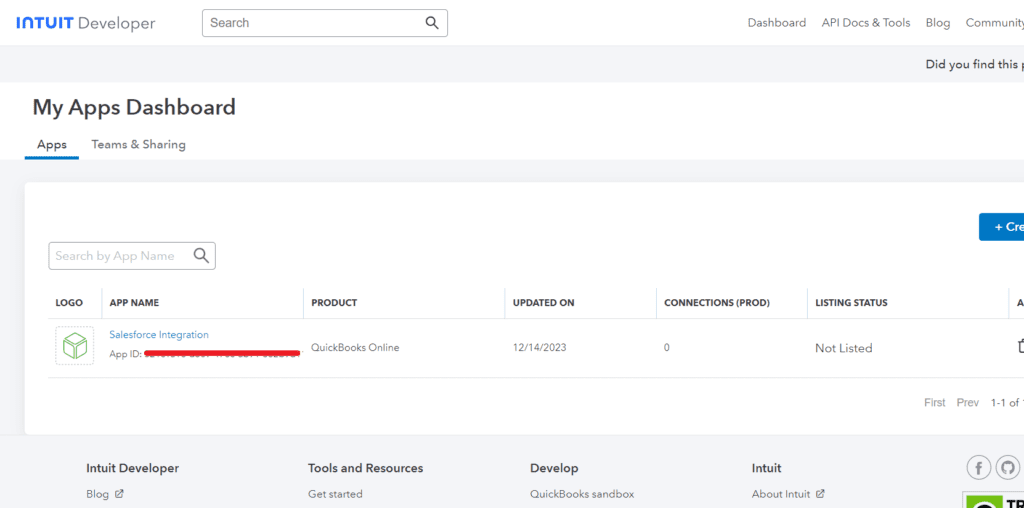
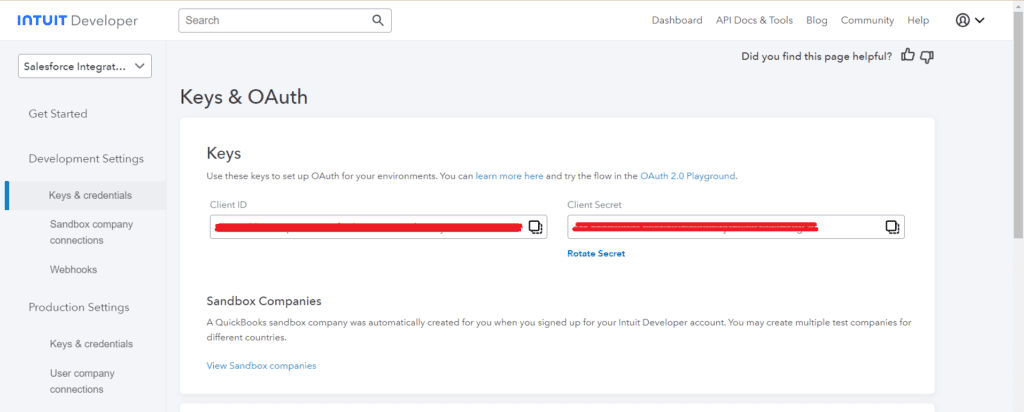
Step 3: Obtain the Client ID and Client Secret
Use the credentials provided for your application when configuring the supported authentication flow. Keep the client secret private and do not place it in public code or client-side scripts.
Step 4: Configure Salesforce Authentication
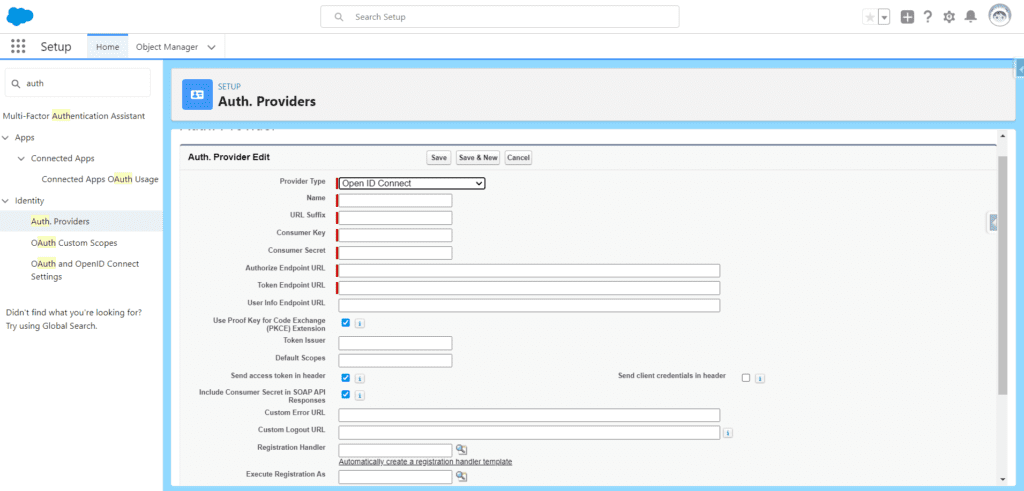
In Salesforce Setup, configure the supported external authentication mechanism for QuickBooks Online. Depending on the org and authentication model, this can involve an Auth Provider, External Credentials and a Named Credential.
Step 5: Configure the OAuth Credentials
Enter the application credentials in the appropriate secure configuration. Set the authorization and token endpoints, scopes and other required parameters according to the current Intuit documentation and the selected OAuth flow.
Step 6: Configure the Redirect URI
Use the callback or redirect URI required by the Salesforce authentication configuration. Register the matching URI in your Intuit application. The URI configured on both sides must match the supported OAuth setup.
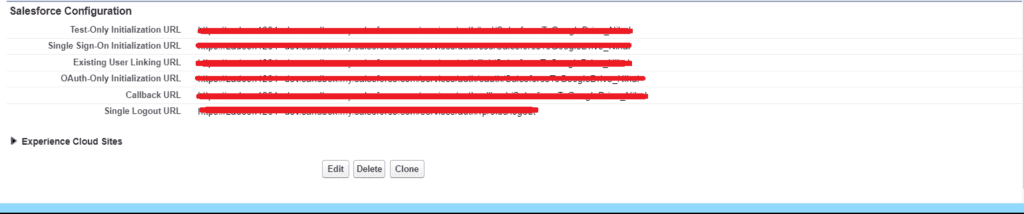
Step 7: Register and Test the Redirect URI
Save the matching redirect URI in the Intuit application and test the authorization flow in a sandbox environment before using production credentials.

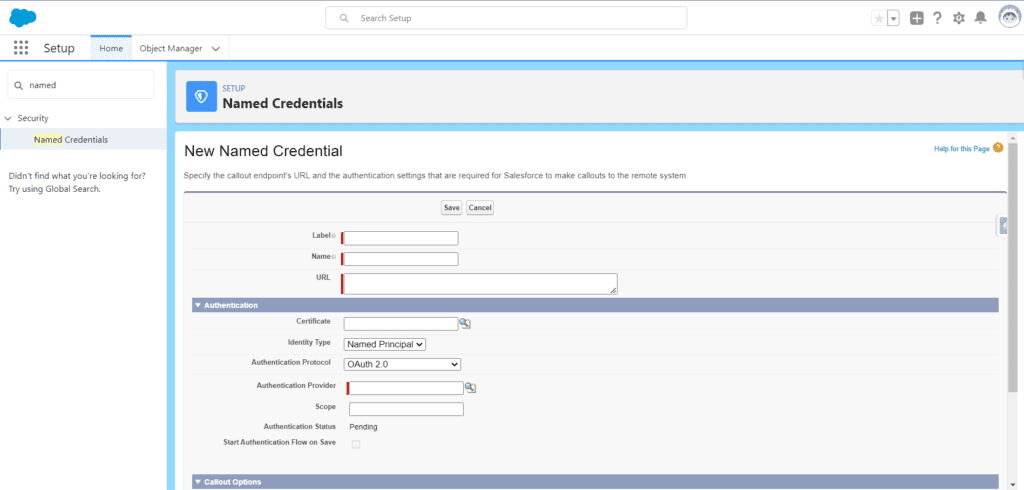
Step 8: Create a Salesforce Named Credential
In Salesforce Setup, create a Named Credential for the QuickBooks API endpoint and associate it with the appropriate external authentication configuration.
- Use the correct QuickBooks Online API base URL for the environment.
- Configure the required authentication and principal settings.
- Grant access to the integration user or execution context as appropriate.
- Use the Named Credential from Apex instead of embedding tokens in code.
Step 9: Verify Authentication and Configure Company Information
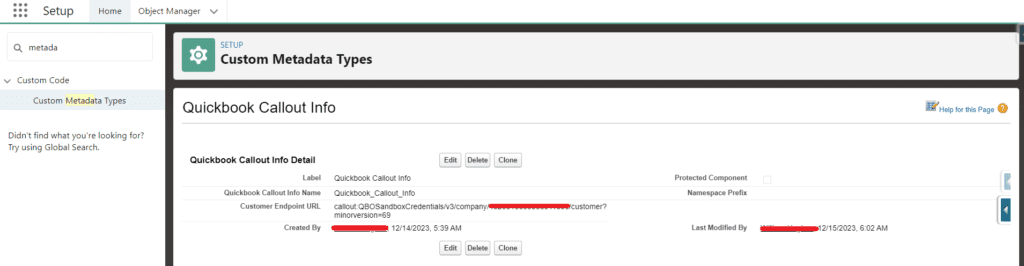
Complete the OAuth authorization process and confirm that the connection can make an authenticated API request. Store non-secret integration configuration in an appropriate configuration mechanism. For QuickBooks Online, the company identifier is commonly referred to as the realm ID; use the correct value for the authorized company and environment.
Step 10: Create the Apex Integration
Use Apex HTTP callouts to send authenticated requests to supported QuickBooks Online API endpoints. For example, a customer creation request uses the customer endpoint, while invoice creation uses the invoice endpoint. The request body must follow the schema required by the selected API operation.
- Endpoint pattern:
callout:QB_NAMED_CRED/v3/company/{realmId}/customeror the appropriate invoice endpoint. - Method: POST for creating supported records.
- Content type: application/json.
- Response handling: Validate HTTP status and parse the returned record identifier or error details.
Check the current QuickBooks Online API documentation for required fields, supported operations, version parameters and endpoint requirements before deploying.
Apex Integration Code Example
The following illustrative example sends a customer-creation request through a Salesforce Named Credential. Replace the example values with validated data and add production-grade validation, logging, duplicate prevention and error handling before using a similar pattern in a live org.
public class QuickBooksCustomerService {

    public static void createCustomer(String realmId) {
        HttpRequest req = new HttpRequest();

        req.setEndpoint(
            'callout:QB_NAMED_CRED/v3/company/' +
            EncodingUtil.urlEncode(realmId, 'UTF-8') +
            '/customer'
        );

        req.setMethod('POST');
        req.setHeader('Content-Type', 'application/json');
        req.setHeader('Accept', 'application/json');

        Map<String, Object> customer = new Map<String, Object>{
            'DisplayName' => 'Example Customer'
        };

        req.setBody(JSON.serialize(customer));

        Http http = new Http();
        HttpResponse res = http.send(req);

        Integer statusCode = res.getStatusCode();

        if (statusCode >= 200 && statusCode < 300) {
            System.debug('QuickBooks customer request succeeded.');
            // Parse the response and save the returned QuickBooks ID.
        } else {
            // Log a sanitized error and route it for investigation.
            System.debug(
                'QuickBooks request failed. HTTP status: ' +
                statusCode
            );
        }
    }
}
This is a starting example, not a complete production integration. Confirm the API payload, OAuth configuration, Named Credential setup and error-handling requirements for your environment. Avoid logging customer data, secrets or access tokens.
Postman Testing Flow
1. Configure OAuth 2.0
Follow Intuit’s current OAuth authorization flow to obtain an access token. Use a sandbox company for development and testing.
2. Configure the Postman Environment
Set up environment variables for the base URL, realm ID and authorization values needed by your test requests. Use Postman’s supported secret or sensitive-variable features for credentials.
- baseUrl: QuickBooks API base URL for the selected environment.
- realmId: QuickBooks Online company identifier.
- accessToken: OAuth access token.
- clientId and clientSecret: Application credentials, handled securely.
- refreshToken: Refresh token, if required by your configured flow.
3. Obtain an Access Token
Complete the required authorization process and request a token according to Intuit’s OAuth documentation. Do not assume that a token from one company or environment will authorize requests to another.
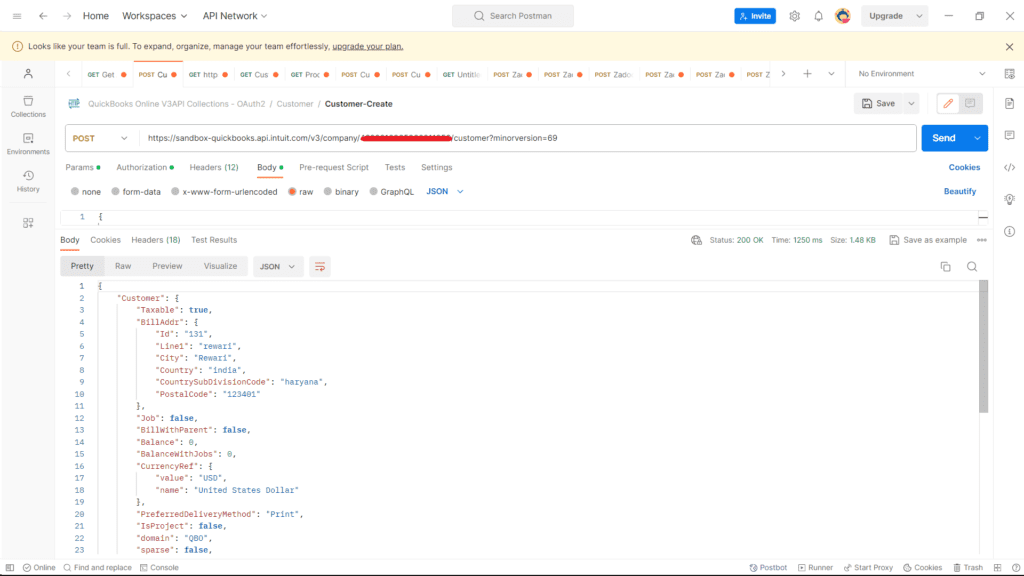
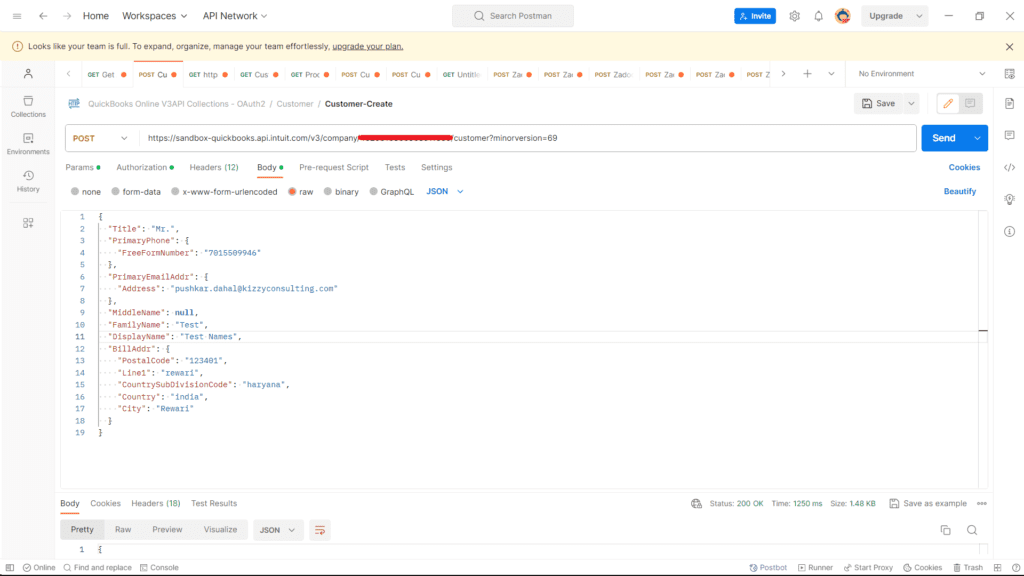
4. Test a Customer or Invoice Request
Send a request to the appropriate API endpoint with a valid JSON payload and the required authorization headers. Use the customer endpoint for a customer test and the invoice endpoint for an invoice test.
5. Validate the Response
Check the HTTP status, response body, returned record identifier and the resulting record in the QuickBooks sandbox. Test invalid input, expired credentials, duplicate submissions and recoverable API errors as well.
QuickBooks Salesforce Integration FAQs
1. Does Salesforce integrate with QuickBooks?
Yes. Salesforce can connect with QuickBooks through a third-party AppExchange connector, middleware or an iPaaS platform, or a custom API integration. Intuit also documents a one-way CRM connection that brings selected Salesforce data into QuickBooks Online Advanced and Intuit Enterprise Suite. The right option depends on your QuickBooks edition, required data, sync direction and workflow complexity.
2. Is there a native QuickBooks Salesforce integration?
Intuit documents a CRM connection for QuickBooks Online Advanced and Intuit Enterprise Suite that includes Salesforce as a supported CRM source. The documented flow brings selected CRM information into QuickBooks. It should not be confused with a full two-way accounting integration that synchronizes invoices, payments and financial updates back into Salesforce. Check Intuit’s current documentation for availability and supported features.
3. How do I integrate QuickBooks Online with Salesforce?
Choose a connector, middleware platform or custom API approach. For a custom integration, create an app in the Intuit Developer Portal, configure OAuth 2.0, set up Salesforce’s supported authentication configuration and Named Credential, and use Apex or middleware to call the QuickBooks Online Accounting API. Map the required records, test in a sandbox, and implement error handling and reconciliation before going live.
4. Can Salesforce integrate with QuickBooks Desktop?
Yes, but the approach differs from QuickBooks Online. QuickBooks Desktop integrations commonly use the QuickBooks Desktop SDK and qbXML, with the QuickBooks Web Connector enabling a web service to communicate with a local QuickBooks installation. Confirm compatibility with the specific Desktop edition, version, hosting arrangement and connector before selecting an implementation route.
5. Is there a Salesforce QuickBooks connector on AppExchange?
Yes. Salesforce AppExchange lists third-party integrations for QuickBooks, including connectors for QuickBooks Online. Review the Salesforce to QuickBooks Online Connector listing as one example. Compare supported editions, object coverage, sync direction, refresh behavior, security, pricing and support before choosing a product.
6. What is the best way to integrate Salesforce and QuickBooks?
A prebuilt connector is often a practical starting point for standard workflows. Middleware is useful for multi-system processes and complex orchestration. Custom API development provides greater control over business rules and data mapping but requires ongoing technical maintenance. Intuit’s CRM connection may suit businesses that need its documented one-way CRM-to-QuickBooks flow. Choose based on functionality, security, cost, reliability and long-term support.
7. Can Salesforce create QuickBooks invoices automatically?
Yes. A connector, middleware workflow or custom integration can create a QuickBooks invoice when a defined Salesforce event occurs, such as an approved order or an Opportunity reaching a specified stage. The implementation should validate required fields, map products and prices, prevent duplicate invoices, record the QuickBooks invoice ID and handle failed requests safely.
Need a Broader Salesforce Integration Strategy?
QuickBooks is often one part of a wider business technology ecosystem. Kizzy Consulting helps businesses connect Salesforce with accounting platforms, ERP systems, APIs, data platforms and other enterprise applications.
Explore Salesforce Integration Services to learn how secure integrations can streamline your technology stack.
Conclusion
QuickBooks and Salesforce can be connected through AppExchange connectors, middleware or iPaaS platforms, and custom API integrations. Intuit also documents a one-way CRM connection for supported QuickBooks Online Advanced and Intuit Enterprise Suite environments. These options serve different needs, so it is important to distinguish a selected CRM data connection from a full two-way accounting integration.
Before choosing an approach, identify whether you use QuickBooks Online or Desktop, define which system owns each data field, and plan authentication, error handling, monitoring and reconciliation. Test real accounting scenarios such as partial payments, credit memos, refunds and duplicate submissions. A well-designed integration should support the actual business process and remain maintainable as requirements evolve.
Need Help with QuickBooks Salesforce Integration?
Kizzy Consulting helps businesses plan and build Salesforce integrations that connect CRM data with financial systems and business applications. From API architecture and OAuth 2.0 to Apex development, integration monitoring and ongoing optimization, our team can help align the solution with your workflows.
Kizzy Consulting supports businesses with Salesforce implementation, integration, consulting and managed services. To discuss your Salesforce and QuickBooks requirements, contact our Salesforce experts or email [email protected].