Stripe ACH Payments with Salesforce: Benefits, Security & Integration (2026)
⏱ 3 min read
STRIPE · ACH PAYMENTS · SALESFORCE
Learn how Stripe ACH payments work, their benefits and security considerations, and how ACH payment processing can be integrated with Salesforce using ChargeEasy.
Stripe has transformed how businesses accept and manage online payments. When Stripe is combined with a Salesforce application such as
ChargeEasy,
businesses can bring payment workflows closer to their CRM and simplify payment processing.
This guide explains Stripe ACH payments, how ACH transactions work, the benefits and challenges of ACH payment processing, security considerations, and how ACH can work alongside other payment methods in Salesforce.
Contents
hide
Executive Quick Answer
Stripe ACH payments allow businesses to accept payments directly from a customer’s bank account through the ACH network. Compared with card payments, ACH can offer different processing economics and is particularly useful for recurring, invoice-based, and larger-value transactions. When integrated with Salesforce through a solution such as ChargeEasy, businesses can manage payment options and payment workflows directly within the CRM.
How Do Stripe ACH Payments Work?
ACH payments are electronic bank-to-bank payments processed through the Automated Clearing House network in the United States. Instead of using a credit or debit card, a customer authorizes a business to debit funds from their bank account.
01
Customer Authorizes Payment
The customer provides authorization for the business to collect payment from their bank account.
02
Payment Is Submitted
The ACH transaction is submitted for processing through the relevant banking network.
03
Banks Process the Transaction
The payment moves through the ACH network between the customer’s financial institution and the receiving institution.
04
Payment Status Is Updated
The transaction eventually reaches a successful, failed, or otherwise applicable payment status.
Benefits of Using ACH Payments in Stripe
ACH payments can provide an alternative to card-based transactions and can be particularly useful for businesses managing recurring payments, invoices, subscriptions, and other bank-account-based payment workflows.
Cost Efficiency
ACH transactions can have different processing costs from card payments, making them an option worth evaluating for businesses looking to manage payment-processing expenses.
Bank Account Payments
Customers can pay directly from their bank accounts instead of relying exclusively on credit or debit cards.
Recurring Payment Support
ACH can be useful for recurring business models such as subscriptions, memberships, and regular invoices.
Customer Flexibility
Offering both ACH and card payments gives customers more flexibility when selecting how they want to pay.
Using Stripe ACH Payments with Salesforce
Integrating payment processing with Salesforce can reduce the need for users to switch between multiple systems. With a Salesforce payment application such as
ChargeEasy,
businesses can bring Stripe payment functionality into their Salesforce workflows.
In the demonstrated Salesforce workflow, the account record provides an option to select a payment method, including card or ACH. Once ACH is selected, the user can proceed with the ACH payment process.

Salesforce provides the option to select the applicable payment method from the account workflow.
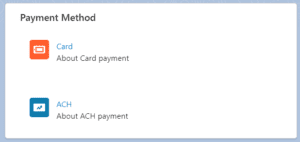
After selecting ACH as the payment method, the payment workflow can proceed from Salesforce.
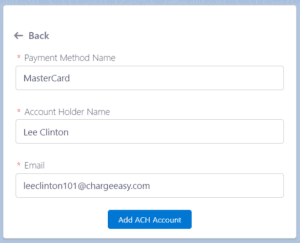
The payment workflow demonstrates how ACH processing can be incorporated into the Salesforce experience.
Best Practices for Stripe ACH Payments
Businesses adopting ACH payment processing should consider customer education, payment monitoring, automation, notifications, and appropriate fraud-prevention controls.
Promote ACH Payments
Explain the benefits, payment process, timing, and requirements so customers understand when ACH may be appropriate.
Automate Recurring Payments
For recurring billing models, use appropriate Stripe payment capabilities to reduce manual payment collection and follow-up.
Monitor Payment Events
Track payment statuses and relevant transaction events so teams can respond to successful or failed payments promptly.
Use Payment Reminders
Appropriate reminders can help reduce missed payments and support healthier accounts receivable workflows.
Monitor for Fraud
Use appropriate Stripe controls, transaction monitoring, and internal processes to identify suspicious payment activity.
Tips for Maximizing ACH Payment Efficiency in Stripe
1
Maintain Accurate Customer Records
Keep customer and payment-related information accurate and appropriately protected to reduce processing errors.
2
Keep Contact Information Updated
Accurate contact information makes it easier to resolve failed payments, authorization issues, or other transaction-related questions.
3
Invest in Customer Support
Clear support processes help customers understand payment issues and improve the overall payment experience.
Common Challenges When Implementing ACH Payments
ACH payments can introduce operational and technical considerations that businesses should address before and during implementation.
Customer Adoption
Customers unfamiliar with ACH may need clear education about the authorization and payment process.
Payment Failures
Insufficient funds, incorrect information, or other processing issues can result in failed transactions that require follow-up.
Regulatory Requirements
Businesses need processes appropriate to the regulatory and network requirements applicable to their ACH payment operations.
Integration Complexity
Connecting payment processing with CRM, billing, ERP, or other systems requires appropriate architecture, APIs, data flows, and testing.
Security Considerations for Stripe ACH Payments
Payment integrations need strong security controls because they can involve sensitive financial and customer information. Security responsibilities should be considered across the payment provider, Salesforce environment, integrations, users, and connected systems.
Data Protection
Use appropriate encryption, access controls, secure integrations, and data-handling practices to protect sensitive information.
Compliance
Understand the compliance responsibilities applicable to your business, payment methods, geography, and system architecture.
Strong Authentication
Protect administrative and user access with strong authentication and appropriate identity and access-management controls.
Security Reviews
Regularly review integrations, permissions, connected applications, and security controls to identify potential weaknesses.
Integrating ACH With Other Payment Methods
ACH does not necessarily need to replace other payment methods. Offering multiple payment options can allow businesses to accommodate different customer preferences and transaction requirements.
A Salesforce payment workflow can support different payment methods depending on the business’s requirements and payment architecture. Stripe APIs and developer tools can be used to build or connect payment workflows to existing systems.
STRIPE + SALESFORCE
Want to Bring Stripe Payments Into Salesforce?
Explore ChargeEasy, a Salesforce payment solution designed to connect Stripe payment processing with Salesforce workflows.
Conclusion
Stripe ACH payments provide businesses with an alternative way to collect payments directly from customer bank accounts. They can be particularly useful for recurring billing, invoices, subscriptions, and other payment scenarios where bank-account payments are appropriate.
When ACH payment processing is connected with Salesforce, businesses can bring payment workflows closer to their customer and account data. Solutions such as
ChargeEasy
can help connect Stripe payment capabilities with Salesforce and create a more integrated payment experience.
Frequently Asked Questions About Stripe ACH Payments
What are Stripe ACH payments?
Stripe ACH payments allow eligible businesses to accept payments from customers through bank-account-based ACH transactions instead of relying only on card payments.
What are the benefits of ACH payments in Stripe?
ACH can provide an alternative payment method, potentially lower processing costs depending on the transaction, support for bank-account payments, and useful options for recurring or invoice-based payment models.
Can Stripe ACH payments be integrated with Salesforce?
Yes. Stripe payment capabilities can be connected to Salesforce through integrations, APIs, and Salesforce payment applications. ChargeEasy is one example of a Salesforce payment solution designed to connect Stripe with Salesforce workflows.
Can Salesforce support both ACH and card payments?
A Salesforce payment solution can be designed to support multiple payment methods, depending on the specific integration and business requirements. The demonstrated ChargeEasy workflow includes both card and ACH payment options.
Are Stripe ACH payments secure?
Payment security depends on the payment provider, integration architecture, account configuration, access controls, data handling, and the business’s own security practices. Businesses should evaluate the applicable security and compliance requirements for their implementation.
What challenges should businesses consider when implementing ACH payments?
Common considerations include customer adoption, failed transactions, regulatory requirements, payment-status handling, data security, and integration complexity.
Is ACH suitable for recurring payments?
ACH can be useful for recurring payment scenarios such as subscriptions and regular invoices, provided the payment setup, authorization process, and applicable Stripe capabilities support the business’s requirements.
Need Help With Stripe and Salesforce Payment Integration?
Talk to Kizzy Consulting about Salesforce payment integrations, Stripe workflows, and solutions for connecting payments with your CRM.