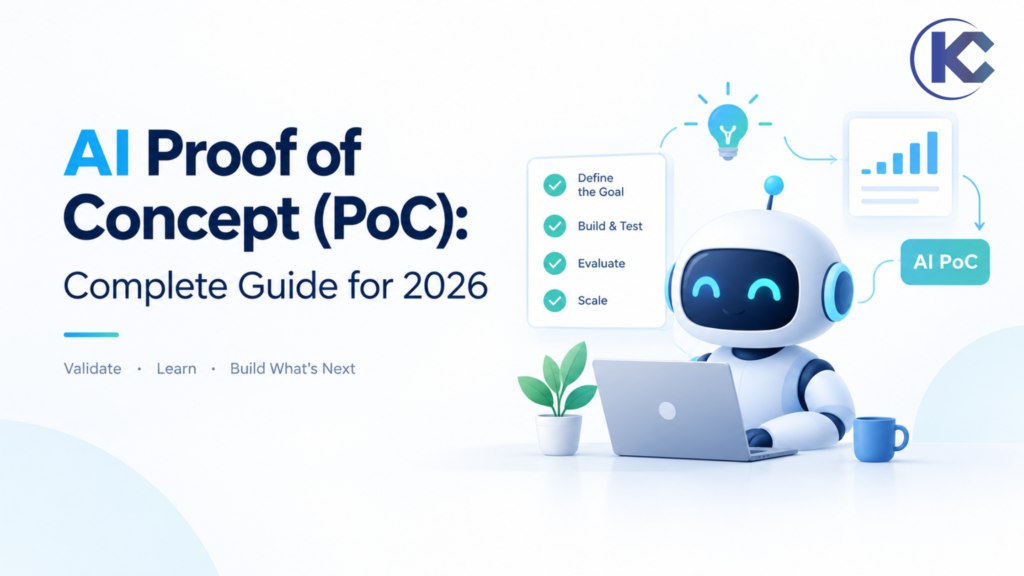
AI Proof of Concept (PoC): Complete Guide to Building, Testing & Scaling AI in 2026
⏱ 4 min read
AI Strategy • AI Development • AI Implementation
Learn how to build an AI Proof of Concept that validates technical feasibility, business value, data readiness, model performance, security, scalability, and production potential before committing to full-scale AI development.
An AI Proof of Concept (PoC) is a time-bound experiment that tests whether an AI solution can solve a specific business problem within acceptable limits for accuracy, cost, security, and reliability.
It helps organizations validate AI use cases, from Generative AI and machine learning to AI automation and agentic AI, before investing in full-scale implementation. A successful PoC provides evidence to decide whether to proceed, refine, or stop the project.
Contents
hide
AI Proof of Concept: Executive Quick Answer
An AI PoC validates whether an AI solution is technically feasible and capable of producing measurable business value before full-scale development. The process typically includes problem definition, AI use case selection, data preparation, model selection, AI experimentation, evaluation, security assessment, stakeholder validation, and a go/no-go decision.
Validate Feasibility
Determine whether the proposed AI approach can actually work.
Measure Business Value
Connect AI performance to measurable operational or financial outcomes.
Reduce AI Risk
Identify data, integration, security, compliance, and model limitations early.
Prepare for Scale
Create a practical path from AI experimentation to production deployment.
What Is an AI Proof of Concept (PoC)?
An AI Proof of Concept is a focused, experimental project used to test whether a proposed artificial intelligence solution can address a specific business problem before full-scale implementation.
Unlike a complete AI product, an AI PoC has a narrow scope and a defined timeline. Its purpose is not to build everything. Its purpose is to generate enough reliable evidence to answer critical questions:
Can AI Solve the Problem?
Test whether the selected AI model or architecture can achieve the required technical performance.
Does AI Create Business Value?
Measure potential improvements in cost, speed, revenue, productivity, quality, or customer experience.
Is the Data Ready?
Assess data quality, completeness, accessibility, privacy, labeling, and representativeness.
Can It Scale?
Determine whether the AI PoC can evolve into a secure, maintainable, production-ready AI system.
AI Proof of Concept vs. Proof of Value
AI Proof of Concept and Proof of Value (PoV) answer different questions. A PoC primarily asks, “Can this AI solution work?” A PoV goes further by asking, “Does this solution create enough measurable value to justify investment?”
AI PoC
Tests technical feasibility, model performance, data suitability, architecture, and initial operational viability.
AI Proof of Value
Tests measurable financial and operational impact such as ROI, cost savings, productivity gains, revenue impact, or risk reduction.
Why Does an AI Proof of Concept Matter?
AI development involves uncertainty. Even when a model performs well in a controlled environment, production deployment can expose data quality problems, integration limitations, security concerns, latency issues, adoption barriers, or unexpected model behavior.
Reduce AI Investment Risk
Test assumptions before committing to large development and infrastructure budgets.
Validate AI ROI
Connect technical performance with measurable business outcomes.
Identify Technical Risks
Expose model, data, infrastructure, security, and integration challenges early.
Build Stakeholder Confidence
Give leadership tangible evidence before approving broader AI implementation.
From AI Idea to Working PoC
Need a Dedicated Team to Build Your AI PoC?
An AI Pod brings together the technical expertise needed to scope, build, test, evaluate, and move a focused AI use case toward production.
How to Build a Generative AI Proof of Concept
A Generative AI PoC requires a different evaluation approach from traditional machine learning. Instead of asking whether a prediction is simply correct or incorrect, teams must assess the quality, factuality, relevance, consistency, safety, latency, cost, and usefulness of generated outputs.
Foundation Model Layer
Select an appropriate hosted or open model based on reasoning, context length, cost, latency, privacy, and business requirements.
AI Orchestration Layer
Connect models with prompts, retrieval pipelines, APIs, business rules, tools, and enterprise data.
RAG & Knowledge Layer
Ground LLM responses in trusted enterprise information through retrieval-augmented generation and knowledge retrieval.
AI Evaluation Layer
Evaluate factuality, relevance, hallucinations, consistency, safety, latency, cost, and user acceptance.
AI Proof of Concept Checklist
Business Problem
Define one specific business problem and quantify its current cost, delay, error rate, or missed opportunity.
Data Readiness
Confirm data access, quality, completeness, privacy, labeling, and representative coverage.
Success Metrics
Define technical, business, operational, adoption, and financial KPIs before development begins.
Governance
Establish ownership, security requirements, compliance controls, evaluation processes, and decision rights.
Before You Build
Is Your Organization Ready for AI?
Assess your data, technology, processes, governance, use cases, and organizational readiness before investing in an AI initiative.
How to Build an AI Proof of Concept: 9-Step AI PoC Roadmap
Step 1: Define the AI Business Problem and Objectives
Start with a measurable business problem rather than a technology-first objective. Instead of saying “we want to use AI to improve efficiency,” define the specific process, baseline, desired outcome, constraints, and timeframe.
Strong AI PoC objectives connect technical performance to business outcomes such as processing time, accuracy, revenue, cost reduction, customer satisfaction, or operational capacity.
Step 2: Select the Right AI Use Case
Choose a use case that is meaningful enough to demonstrate business value but narrow enough to validate within the PoC timeline.
Consider data availability, business impact, technical feasibility, integration complexity, regulatory requirements, user adoption, and the cost of failure.
Step 3: Choose the Right AI Model and Technology
Depending on the use case, you may choose a pre-trained AI model, foundation model, fine-tuned model, traditional machine learning algorithm, ready-made AI platform, or custom AI architecture.
Pre-Trained Models
Fast to integrate and suitable for common AI tasks.
Fine-Tuned Models
Useful when domain-specific performance is required.
Foundation Models
Useful for Generative AI, reasoning, content, and knowledge applications.
Custom AI Development
Suitable for differentiated or highly specialized use cases.
Step 4: Prepare and Validate Data for the AI PoC
Data readiness can determine whether an AI PoC succeeds or fails. Identify structured and unstructured data sources, clean relevant datasets, handle missing values, remove duplicates, validate labels, and assess potential bias.
For Generative AI, evaluate document quality, metadata, context, chunking strategy, retrieval quality, and knowledge freshness.
Step 5: Develop the AI Model or Prototype
Build the smallest working version required to test the hypothesis. Depending on the project, this could involve model training, API integration, prompt engineering, RAG implementation, workflow automation, computer vision pipelines, or AI agent orchestration.
Step 6: Run AI Experiments and Test Model Performance
Test the AI system against a representative evaluation set. Include normal inputs, ambiguous cases, missing information, edge cases, conflicting data, and unexpected inputs.
Accuracy
How correct are predictions or classifications?
How correct are predictions or classifications?
Latency
How quickly does the system respond?
How quickly does the system respond?
Cost
What does each inference or transaction cost?
What does each inference or transaction cost?
Reliability
How consistently does the system perform?
How consistently does the system perform?
Step 7: Measure AI PoC Success Against Defined KPIs
Compare the results with the baseline and success thresholds established before development. Evaluate both technical performance and business impact.
Step 8: Make the AI PoC Go/No-Go Decision
A PoC should end with a decision. Depending on the evidence, the organization can proceed toward production, refine the model, change the AI approach, expand the data strategy, or stop the project.
Step 9: Transition the AI PoC to Production
A successful AI PoC is not the finish line. Production deployment requires security, data governance, monitoring, MLOps, integration, user adoption, model versioning, observability, and ongoing AI optimization.
AI PoC Success Criteria: What Does “It Worked” Mean?
Define success before development starts. AI PoC evaluation should cover three broad areas: technical performance, business impact, and user adoption.
| Category | Metrics | Example Measurement |
|---|---|---|
| Technical AI Performance | Accuracy, precision, recall, F1, latency | Model meets predefined performance threshold |
| Generative AI Quality | Factuality, relevance, groundedness, hallucination rate | Outputs meet quality threshold on evaluation set |
| Business Impact | Time savings, cost reduction, revenue, throughput | Measurable improvement against baseline |
| Adoption | User acceptance, override rate, workflow fit | Users can effectively incorporate AI into their workflow |
How to Test an AI Proof of Concept
Build a Gold-Standard AI Test Set
Use verified examples that represent real business conditions, including edge cases and ambiguous inputs.
Run Adversarial AI Tests
Introduce missing data, conflicting information, unusual inputs, and failure scenarios to test system resilience.
Evaluate Business Viability
Measure whether technical improvements translate into meaningful business outcomes.
Test Real User Workflows
Allow representative users to interact with the system under realistic operating conditions.
Build • Integrate • Deploy
Need Engineering Support Beyond the PoC?
Forward Deployed Engineers can work closely with your teams to turn validated AI concepts into integrated, production-oriented solutions.
AI Proof of Concept Best Practices
Start With One AI Use Case
Keep the initial experiment narrow and measurable.
Define AI KPIs Before Building
Agree on technical and business success criteria upfront.
Use Production-Representative Data
Do not validate an AI solution on unrealistic or overly clean datasets.
Involve Domain Experts Early
Business context is essential for evaluating AI outputs.
Design for AI Scalability
Avoid architecture that creates unnecessary rework when moving to production.
End With a Clear Decision
Every PoC should produce evidence that supports the next business decision.
Key Benefits of an AI Proof of Concept
Early Risk Mitigation
Identify technical and business risks before full investment.
Smarter AI Investment
Allocate resources toward AI use cases supported by evidence.
Faster AI Experimentation
Test models, prompts, architectures, and workflows in a controlled environment.
Clear AI Success Metrics
Create measurable technical, operational, financial, and adoption benchmarks.
Frequently Asked Questions About AI Proof of Concept
What is an AI Proof of Concept (PoC)?
An AI Proof of Concept is a small, focused experiment that tests whether an artificial intelligence solution can technically and operationally address a specific business problem before full-scale AI development.
Why is an AI PoC important for AI implementation?
An AI PoC helps organizations validate technical feasibility, data readiness, business value, security requirements, model performance, and scalability before committing to a larger AI implementation.
How long does an AI Proof of Concept take?
The timeline depends on the AI use case, data readiness, model complexity, integrations, and evaluation requirements. Focused AI PoCs can often be completed within several weeks, while complex enterprise AI projects may take longer.
What is the difference between an AI PoC and an AI MVP?
An AI PoC primarily validates technical feasibility and the potential for business value. An AI MVP is a usable product with a defined set of capabilities intended for real users and ongoing product development.
What is a Generative AI Proof of Concept?
A Generative AI PoC tests applications powered by foundation models or LLMs, including AI copilots, knowledge assistants, RAG applications, document intelligence, conversational AI, and content generation.
Ready to Validate Your AI Use Case?
A focused AI Proof of Concept can help your organization move from an AI idea to measurable evidence. Define the problem, test the technology, evaluate business value, and build a clear path toward production.