What Is Salesforce Hyperforce? Features, Benefits, Architecture & Migration Guide 2026
⏱ 5 min read
Salesforce Hyperforce is Salesforce’s next-generation public-cloud infrastructure architecture, designed to support global scalability, security, availability, compliance, and data residency. Learn what Hyperforce is, why Salesforce launched it, how it works, its key features, benefits, migration considerations, and what businesses should know in 2026.
Salesforce Hyperforce: Quick Answer
Salesforce Hyperforce is Salesforce’s next-generation infrastructure architecture built for the public cloud. It replaces the traditional model of Salesforce-operated physical infrastructure with a cloud-native architecture that allows Salesforce to deliver its platform and applications across regions with greater scalability, availability, security, and data-residency capabilities.
Hyperforce is not a separate CRM product that customers purchase. It is the infrastructure foundation underneath eligible Salesforce products and services. For customers, the transition can require attention to integrations, network controls, authentication, URLs, certificates, security requirements, and other technical dependencies.
What Is Salesforce Hyperforce?
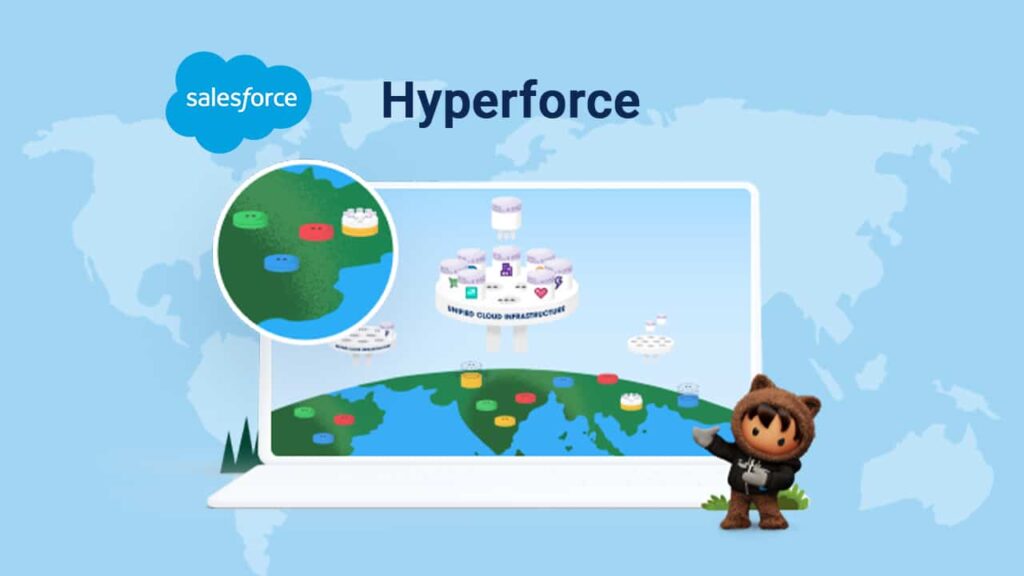
Salesforce Hyperforce is the next-generation Salesforce infrastructure architecture built for the public cloud. Salesforce describes Hyperforce as an infrastructure platform composed of code rather than traditional physical hardware, allowing Salesforce applications and services to be delivered more rapidly and reliably across global regions.
Hyperforce provides a common infrastructure foundation for Salesforce applications and product clouds. Its architecture incorporates cloud-native principles such as infrastructure as code, multiple availability zones, zero-trust security, automation, and elastic capacity.
For businesses, the importance of Salesforce Hyperforce goes beyond infrastructure modernization. It enables Salesforce to expand its geographic footprint, support regional data-residency requirements, and build a more scalable foundation for Salesforce Platform, Customer 360, Data 360, Agentforce, and other cloud services.
Public Cloud Architecture
Hyperforce uses modern public-cloud infrastructure to provide Salesforce with greater geographic reach and infrastructure elasticity.
Data Residency
Hyperforce gives Salesforce more flexibility to deliver services in regional infrastructure and support applicable data-residency requirements.
Cloud Scalability
Elastic public-cloud infrastructure helps Salesforce support changing workloads and global demand.
Built-In Security
Hyperforce incorporates security principles such as zero trust, encryption, authentication, authorization, and least privilege.
Why Did Salesforce Launch Hyperforce?
Salesforce needed an infrastructure architecture capable of supporting a globally distributed customer base, rapidly expanding cloud services, regional data requirements, and increasing demand for scalable digital platforms.
Hyperforce was designed around public-cloud principles rather than simply moving existing infrastructure into the cloud. Salesforce describes the architecture as a fundamental modernization based on immutable infrastructure, multiple availability zones, zero-trust security, infrastructure as code, and a clean-slate approach.
Want the full strategic background? Read Why Salesforce Launched Hyperforce for a deeper look at the reasons behind Salesforce’s Hyperforce strategy.
Why Was There a Need for Salesforce Hyperforce?
The need for Salesforce Hyperforce can be understood through several infrastructure and enterprise requirements that became increasingly important as Salesforce expanded globally.
Global Data Residency Requirements
Organizations operating across countries increasingly need control over where customer data is stored and processed. Hyperforce gives Salesforce greater flexibility to deploy services in regional infrastructure and support applicable data-residency requirements.
Global Cloud Scale
Salesforce needed infrastructure capable of expanding into additional regions more efficiently while supporting growing customer workloads and changing capacity requirements.
Modern Cloud Architecture
Public-cloud infrastructure provides Salesforce with cloud-native capabilities such as elasticity, automation, infrastructure as code, and multi-zone resilience.
Security and Compliance
Modern enterprise environments require security and compliance to be incorporated throughout the infrastructure architecture rather than treated as an afterthought.
Salesforce Hyperforce Features
Salesforce Hyperforce features are built around cloud-native infrastructure, scalability, security, availability, and regional deployment. Key Hyperforce capabilities include:
1. Trust and Security
Security is incorporated into the Hyperforce architecture through zero-trust principles, authentication, authorization, least-privilege access, and encryption. Salesforce states that Hyperforce encrypts data at rest and in transit as part of its architecture.
2. Regional Data Residency
Hyperforce gives Salesforce greater flexibility to deploy services in regional infrastructure, providing customers with more choice and control over applicable data-residency requirements.
3. Elastic Cloud Infrastructure
Public-cloud elasticity allows Salesforce to adjust infrastructure capacity based on changing workloads and demand. This provides an infrastructure foundation designed for large-scale Salesforce workloads.
4. Multi-Zone Availability
Hyperforce regions are designed across multiple availability zones or equivalent fault domains to reduce dependency on a single infrastructure location and improve resilience.
5. Infrastructure as Code
Hyperforce manages infrastructure through code and automation, helping Salesforce standardize infrastructure deployment, validation, testing, and changes.
6. Zero Trust Architecture
Hyperforce applies a zero-trust security model in which requests are authenticated and authorized rather than automatically trusted based on network location.
7. High Availability
Hyperforce uses multiple fault domains within regions to support resilience and reduce the impact of individual infrastructure failures.
8. Global Cloud Deployment
Hyperforce allows Salesforce to establish infrastructure in regions around the world more efficiently, supporting its global platform and regional customer requirements.
Salesforce Hyperforce Benefits for Businesses
The benefits of Salesforce Hyperforce are primarily connected to the infrastructure capabilities it provides Salesforce and, consequently, to the services available to customers.
- Greater scalability: Public-cloud infrastructure provides a foundation designed to accommodate changing Salesforce workloads.
- Improved geographic reach: Salesforce can deploy infrastructure across more regions to support global customers.
- Data residency flexibility: Regional deployment can provide more options for organizations with applicable data-location requirements.
- Modern security architecture: Zero-trust principles and encryption are built into the Hyperforce architecture.
- Resilience: Multi-zone infrastructure helps reduce dependency on individual infrastructure locations.
- Faster infrastructure deployment: Infrastructure as code and automation allow Salesforce to standardize and automate infrastructure operations.
- Cloud-native innovation: Hyperforce gives Salesforce a modern foundation for continued development across its platform and product clouds.
- Enterprise-scale infrastructure: Hyperforce is designed to support large and geographically distributed Salesforce environments.
Which Public Cloud Providers Does Salesforce Hyperforce Use?
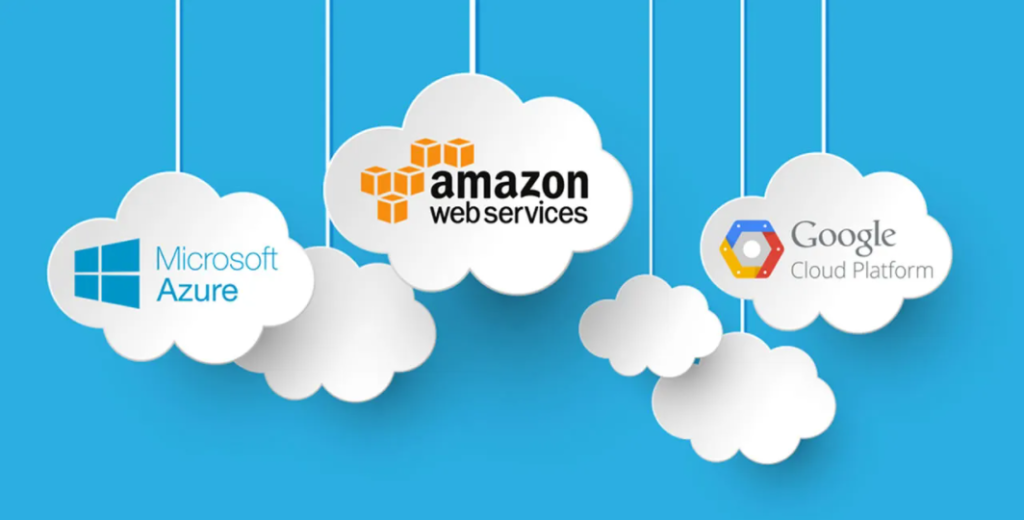
Salesforce Hyperforce is built on public-cloud infrastructure. Salesforce’s current documentation states that Hyperforce is available on Amazon Web Services (AWS) and is beginning to expand to Google Cloud Platform (GCP). Salesforce manages infrastructure placement based on technical and operational considerations.
Therefore, it is more accurate to describe Hyperforce as Salesforce’s public-cloud infrastructure architecture rather than saying customers simply select AWS, Azure, or Google Cloud for their Salesforce org.
Is Salesforce Hyperforce Backward Compatible?
Salesforce has designed Hyperforce to support feature parity for organizations moving from Salesforce-managed first-party infrastructure, although the exact availability of products and features can depend on the specific Hyperforce environment and cloud provider. Salesforce’s current Hyperforce FAQ notes that customers moving to Hyperforce experience feature parity regardless of the public-cloud provider, while some products or features may initially differ on GCP.
This means organizations should still validate their own integrations, customizations, authentication mechanisms, network controls, and business-critical processes rather than assuming that every external dependency will automatically require no changes.
How to Check if Your Salesforce Organization Is Running on Hyperforce
If you want to determine whether your Salesforce organization is already running on Salesforce Hyperforce, begin by checking your Salesforce organization information and then use Salesforce’s current Hyperforce resources for confirmation.
- Log in to your Salesforce organization.
- Open Setup.
- Search for Company Information.
- Open the Company Information page.
- Review your organization and instance information.
- Use Salesforce’s Hyperforce migration and org-specific guidance to confirm your infrastructure status.
Salesforce also provides Hyperforce Assistant to help organizations understand and prepare for applicable migration requirements.
Salesforce Hyperforce Migration: What Should You Prepare?
Moving to Hyperforce can involve more than the Salesforce org itself. Integrations, APIs, network controls, authentication, certificates, external applications, and operational processes should all be reviewed.
Read the Complete Salesforce Hyperforce Migration Best Practices Guide →
Salesforce Hyperforce Migration Preparation Checklist
| Area | What to Review |
|---|---|
| Salesforce URLs | Identify hard-coded instance URLs and use appropriate Salesforce domain-based URLs. |
| Integrations | Review APIs, middleware, ERP, marketing, data, payment, and external applications. |
| Network | Review firewalls, IP allowlists, DNS, proxies, and connectivity dependencies. |
| Security | Review authentication, certificates, encryption, access controls, and compliance requirements. |
| Customizations | Review Apex, Lightning components, flows, integrations, and custom applications. |
| Data | Review data residency, sensitive data, regional requirements, and connected services. |
| Testing | Test critical business processes and connected systems before and after migration. |
Salesforce Hyperforce Use Cases Across Industries
Salesforce Hyperforce use cases vary depending on the Salesforce products, regional requirements, integrations, and compliance obligations of each organization.
Healthcare
Support regional data requirements, connected healthcare workflows, and secure customer or patient-related processes.
Financial Services
Support regulated customer data, regional requirements, financial-service workflows, and enterprise CRM operations.
Retail
Support customer engagement, commerce, service, marketing, and data-intensive Salesforce operations.
Manufacturing
Support sales, service, partner, supply-chain-connected, and global customer operations.
Education
Support student, faculty, alumni, and administrative Salesforce workflows across regions.
Real Estate
Support lead management, property workflows, customer engagement, and geographically distributed teams.
Related Salesforce Hyperforce Resources
Why Salesforce Launched Hyperforce
Understand the infrastructure, scalability, data residency, security, and cloud modernization reasons behind Salesforce Hyperforce.
Salesforce Hyperforce Migration Best Practices
Explore Salesforce Hyperforce migration preparation, integration checks, security considerations, testing, and post-migration validation.
Salesforce Hyperforce FAQs
What is Salesforce Hyperforce?
Salesforce Hyperforce is Salesforce’s next-generation infrastructure architecture built for the public cloud. It is designed to support scalability, security, availability, compliance, and regional data residency across Salesforce services.
What is Salesforce Hyperforce architecture?
Salesforce Hyperforce architecture is a cloud-native infrastructure model based on public-cloud services, infrastructure as code, multiple availability zones, zero-trust security, automation, and scalable infrastructure.
Why did Salesforce launch Hyperforce?
Salesforce launched Hyperforce to create a modern public-cloud infrastructure foundation capable of supporting global scale, regional data residency, security, availability, and continued Salesforce platform innovation. Read why Salesforce launched Hyperforce.
What are the main Salesforce Hyperforce features?
The main Salesforce Hyperforce features include public-cloud infrastructure, elastic scalability, regional data residency, zero-trust security, encryption, infrastructure as code, multi-zone availability, automation, and global deployment capabilities.
What are the benefits of Salesforce Hyperforce?
Salesforce Hyperforce benefits include a modern cloud infrastructure foundation, greater scalability, improved geographic reach, support for regional data residency, cloud-native security architecture, multi-zone resilience, and faster infrastructure deployment.
Does Salesforce Hyperforce improve data residency?
Hyperforce gives Salesforce more choice and control over regional infrastructure and data residency. However, data residency depends on the specific Salesforce services, region, configuration, and applicable requirements.
Which cloud provider does Salesforce Hyperforce use?
Salesforce’s current documentation states that Hyperforce is available on Amazon Web Services (AWS) and is beginning to expand to Google Cloud Platform (GCP). Salesforce manages infrastructure placement based on technical and operational factors.
Is Salesforce Hyperforce the same as Salesforce CRM?
No. Salesforce Hyperforce is the infrastructure architecture behind eligible Salesforce services. Salesforce CRM products and applications operate on top of the underlying infrastructure.
How do I know if my Salesforce org is on Hyperforce?
Administrators can review Salesforce Setup and Company Information and use Salesforce’s current Hyperforce resources and Hyperforce Assistant to confirm the infrastructure status and applicable migration guidance.
How does Salesforce Hyperforce affect integrations?
Organizations should review integrations for hard-coded Salesforce URLs, IP allowlists, network dependencies, certificates, authentication, APIs, middleware, and external applications. These dependencies should be tested as part of Hyperforce migration preparation.
What is Salesforce Hyperforce migration?
Salesforce Hyperforce migration is the transition of an eligible Salesforce organization or service from Salesforce’s previous infrastructure to Hyperforce public-cloud infrastructure. Salesforce coordinates the underlying infrastructure migration, while customers need to prepare their technical environment and connected systems.
What are the challenges of Salesforce Hyperforce migration?
Common challenges include integration dependencies, hard-coded instance URLs, network and IP restrictions, certificate dependencies, authentication, security requirements, testing, and post-migration validation.
How can I prepare for Salesforce Hyperforce migration?
Start by reviewing Salesforce integrations, APIs, network controls, IP allowlists, certificates, authentication, custom applications, data-residency requirements, and critical business workflows. Salesforce’s Hyperforce Assistant can also provide organization-specific preparation guidance.
Where can I read Salesforce Hyperforce migration best practices?
Read Kizzy Consulting’s Salesforce Hyperforce Migration Best Practices guide for a detailed migration checklist covering assessment, security, integrations, testing, monitoring, and post-migration validation.
Need Help With Salesforce Hyperforce Migration?
Prepare your Salesforce environment for Hyperforce with integration assessment, migration planning, technical validation, and Salesforce consulting support.
Conclusion: Understanding Salesforce Hyperforce
Salesforce Hyperforce is a major evolution of Salesforce infrastructure, moving the platform toward a modern public-cloud architecture designed for global scale, security, resilience, and regional data requirements.
For businesses, the most important point is that Hyperforce is more than a change in where Salesforce infrastructure runs. It provides the foundation for Salesforce’s continued expansion across regions and its evolution of cloud services.
If you are researching the strategic reasons behind Hyperforce, read Why Salesforce Launched Hyperforce. If your organization is preparing for the transition, use the detailed Salesforce Hyperforce Migration Best Practices guide.
Kizzy Consulting
Kizzy Consulting is a Salesforce consulting partner helping organizations with Salesforce implementation, integration, migration, automation, and AI transformation.