Salesforce for Real Estate: CRM, Property Management & Automation
⏱ 5 min read
SALESFORCE FOR REAL ESTATE
Discover how Salesforce can help real estate firms centralize leads, manage properties, automate sales processes, improve client engagement, and turn property data into actionable insights.
Quick Answer
Salesforce for real estate provides a connected CRM foundation for managing prospects, clients, properties, opportunities, communications, activities, and sales processes. Real estate firms can integrate lead sources, automate follow-ups, organize property information, create dashboards, and connect AI and data capabilities to improve operational visibility and customer experiences.
Introduction
Real estate businesses manage a constant flow of leads, property information, client conversations, appointments, sales activities, documents, and follow-ups. When these processes operate across disconnected spreadsheets, email inboxes, messaging applications, property databases, and other tools, teams can struggle to maintain a consistent view of every opportunity.
A modern real estate CRM can bring these processes together. Salesforce provides a centralized platform where real estate teams can manage lead and client information, track interactions, automate repetitive work, monitor opportunities, and access business insights. Salesforce’s current real estate CRM guidance specifically highlights lead management, centralized client information, automation, collaboration, analytics, and AI-powered workflows.
For real estate firms looking to move beyond basic CRM functionality, Salesforce can also connect customer data, property information, analytics, and AI capabilities. Current Salesforce real estate solutions position Data 360 and Agentforce as part of this connected architecture.
Common Pain Points Faced by Real Estate Firms
Real estate teams often need to coordinate information across multiple departments, properties, agents, brokers, marketing channels, and customer touchpoints. Common operational challenges include:
Fragmented Lead Sources
Leads may arrive through websites, email, phone calls, campaigns, portals, events, referrals, and other channels.
Scattered Property Information
Property details, availability, preferences, pricing, and client requirements can become difficult to manage when stored across disconnected systems.
Manual Follow-Ups
Repetitive calls, emails, reminders, assignments, and status updates can consume valuable agent and sales-team time.
Limited Pipeline Visibility
Without centralized opportunity information, managers can struggle to understand pipeline health, lead movement, and team performance.
Inconsistent Client Experiences
When client information is distributed across systems, different team members may lack the context needed for timely and relevant conversations.
Manual Reporting
Teams may spend significant time compiling reports instead of using real-time dashboards to monitor important business metrics.
Salesforce Real Estate Management Solution
Salesforce can be configured as a central platform for real estate sales, client relationship management, property-related processes, marketing, service, reporting, and automation.
The goal is not simply to replace spreadsheets with another database. A well-designed Salesforce implementation connects the flow of information from lead generation to qualification, property matching, client engagement, opportunity management, closing, and post-sale relationship management.
Lead Management
Capture, qualify, assign, nurture, and track leads across the sales lifecycle.
Property Management
Organize property records, availability, specifications, preferences, and related information.
Client Management
Maintain a connected view of client interactions, requirements, activities, and opportunities.
Sales Automation
Automate assignments, reminders, notifications, follow-ups, and other repetitive workflows.
1. Streamlined Lead Generation
Lead generation is central to real estate sales. Leads can originate from websites, email campaigns, phone calls, advertisements, property portals, events, referrals, and other sources.
Salesforce can provide a centralized place to capture and manage these prospects. Lead routing and workflow automation can help ensure that new inquiries are assigned to the appropriate team members and followed up consistently.
Typical workflow:
Lead Capture → Qualification → Assignment → Follow-Up → Property Matching → Opportunity → Closing
Lead Capture → Qualification → Assignment → Follow-Up → Property Matching → Opportunity → Closing
This centralized approach aligns with Salesforce’s current real estate CRM guidance, which emphasizes bringing lead and client information together and automating lead management activities.
2. Simplified Client Property Reservations
Property reservations can involve multiple steps, including checking availability, recording client details, confirming requirements, updating property status, and communicating with internal teams.
Salesforce can centralize these activities so relevant teams can work from the same information. Reservation workflows can be configured around the firm’s business rules and approval requirements.
Potential Reservation Workflow
- Client expresses interest in a property.
- Agent verifies property availability.
- Client and property details are associated.
- Reservation workflow is initiated.
- Required approvals or documentation are completed.
- Property status is updated.
- Relevant teams and the client receive appropriate notifications.
3. Centralized Property Management
A real estate CRM should provide more than contact management. Property information needs to be connected to the clients, leads, agents, opportunities, activities, and transactions associated with it.
Salesforce can be configured to maintain structured property information and connect it to relevant business processes. Depending on the organization’s requirements, integrations can also connect Salesforce with external property, ERP, marketing, finance, or operational systems.
Property Details
Specifications, location, pricing, status, and other relevant attributes.
Availability
Track available, reserved, sold, leased, or otherwise relevant property states.
Client Preferences
Connect buyer or tenant requirements to relevant property information.
Related Activities
Connect calls, emails, appointments, tasks, opportunities, and other activities.
4. Stronger Client-Agent Relationships
Real estate is relationship-driven. Agents need access to previous conversations, property interests, appointments, requirements, preferences, and opportunity history to provide relevant service.
Salesforce can create a connected client profile that gives authorized users access to the information they need. This allows agents to spend less time searching across systems and more time engaging with clients.
Salesforce’s current real estate CRM guidance emphasizes centralized client information and interaction history as a foundation for more personalized customer experiences.
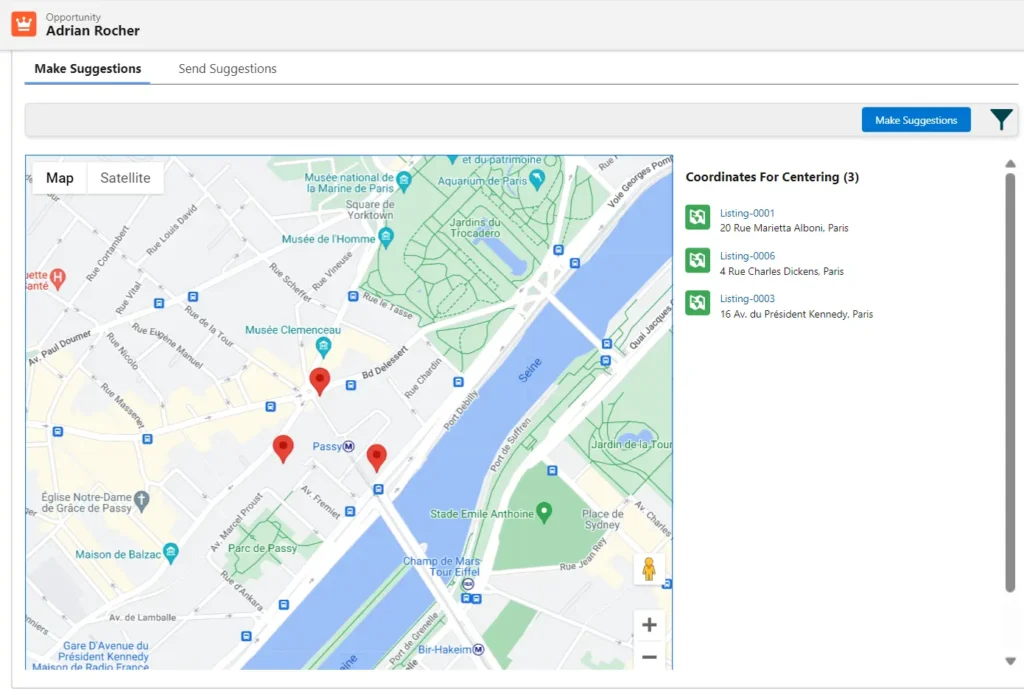
5. Property Suggestions Based on Client Requirements
Finding the right property often requires comparing client requirements with available inventory. A structured Salesforce solution can capture preferences and use those attributes to help agents identify relevant properties.
Instead of manually searching through disconnected property records, agents can work with structured information and configurable matching logic to narrow down suitable options.
Example Matching Criteria
Location
Budget
Property Type
Bedrooms
Size
Amenities
Availability
Budget
Property Type
Bedrooms
Size
Amenities
Availability
6. Real-Time KPI Dashboards for Real Estate
Real estate managers need visibility into pipeline activity, lead conversion, property performance, sales activity, agent productivity, and other operational metrics.
Salesforce dashboards and reporting can bring these metrics into a centralized view, helping leadership monitor performance and identify areas that require attention.
Lead Conversion
Monitor movement from inquiry to qualified opportunity.
Pipeline
Track opportunity stages and potential revenue.
Agent Activity
Understand calls, meetings, tasks, follow-ups, and opportunities.
Property Performance
Analyze property-related activity and sales performance.
7. Automated Real Estate Sales Process
A real estate sales cycle involves multiple activities between the first inquiry and closing. Salesforce automation can help standardize these steps and reduce repetitive administrative work.
Lead Capture
Capture prospects from connected channels.
Lead Assignment
Route leads according to defined business rules.
Qualification
Track requirements, preferences, budget, and buying intent.
Property Matching
Connect client requirements with relevant properties.
Follow-Up
Automate appropriate reminders, tasks, notifications, and communications.
Closing & Post-Sale
Track final activities and continue the client relationship after the transaction.
See Salesforce in a Real Estate Use Case
Explore how Salesforce can support real estate operations, including agent scheduling and connected customer workflows.
AI and Agentforce for Real Estate
Salesforce’s current real estate strategy increasingly combines CRM data with AI agents. Agentforce can support tasks such as lead qualification, customer inquiries, scheduling, document-related workflows, and other business processes when appropriately configured and governed.
For example, Salesforce describes real estate use cases where AI agents can help schedule property tours, qualify incoming leads, prepare meeting information, and respond to support requests.
Lead Qualification
Handle initial inquiries and help qualify prospects.
Property Tours
Support scheduling and coordination of property visits.
Client Communications
Assist with relevant customer interactions and follow-up workflows.
Agent Productivity
Reduce repetitive administrative work and surface relevant information.
In May 2026, Salesforce reported that Tata Realty deployed Agentforce for customer engagement and saw improvements including faster first response times, higher lead qualification, and increased conversion rates. These are customer-specific reported results and should not be treated as universal outcomes.
Data 360: Connecting Property and Customer Data
Real estate organizations often have valuable information spread across CRM records, property systems, marketing platforms, ERP systems, portals, spreadsheets, and other applications.
Salesforce Data 360 can help connect and activate data across systems, supporting unified customer profiles and more contextual AI experiences. Salesforce’s current real estate architecture specifically describes using Data 360 to connect portfolio, lease, and facility information from systems such as Yardi, Procore, and ERP environments.
Connected Real Estate Data
Customer Data + Property Data + Deal Data + Marketing Data + Operational Data → Connected Insights → Automation & AI
Benefits of Salesforce for Real Estate
Centralized Information
Bring lead, client, property, opportunity, and activity information into a connected platform.
Faster Follow-Up
Automation can reduce manual steps and help teams respond to new opportunities consistently.
Better Client Visibility
Give authorized teams a more complete view of client interactions, preferences, activities, and opportunities.
Data-Driven Decisions
Use dashboards and analytics to understand pipeline, lead activity, property performance, and operational metrics.
Scalable Automation
Automate repetitive processes while maintaining appropriate human oversight for important decisions.
AI-Ready Operations
Build a connected data foundation that can support appropriate AI and Agentforce use cases.
Why Choose Kizzy Consulting for Salesforce Real Estate Implementation?
A real estate Salesforce implementation needs to reflect the firm’s actual sales processes, property workflows, integrations, reporting requirements, and customer journey. Kizzy Consulting brings Salesforce implementation and integration experience to help organizations design solutions around those requirements.
Real Estate-Focused Solutions
Build workflows around lead management, property information, client engagement, reservations, and sales processes.
Salesforce Integration
Connect Salesforce with relevant third-party systems and business applications where required.
Data & Automation
Design connected data and automated processes that support the operational needs of real estate teams.
Scalable Architecture
Build a Salesforce foundation that can evolve with new properties, teams, processes, integrations, and AI use cases.
Need Help With Salesforce Implementation for Your Real Estate Firm?
Build a connected Salesforce solution for real estate lead management, property workflows, automation, integrations, dashboards, and AI.
Frequently Asked Questions About Salesforce for Real Estate
How can Salesforce help real estate companies?
Salesforce can help real estate companies centralize lead and client information, manage opportunities, organize property-related data, automate follow-ups, integrate business systems, create dashboards, and support AI-powered workflows.
Can Salesforce be used as a real estate CRM?
Yes. Salesforce can be configured for real estate CRM use cases including lead capture, contact management, opportunity tracking, client communications, property workflows, reporting, and automation. Salesforce currently provides dedicated real estate CRM guidance and solutions.
Can Salesforce integrate with property management systems?
Salesforce can integrate with external systems through APIs, integration platforms, connectors, and other appropriate integration architectures. The specific approach depends on the property management platform, data requirements, security model, and business processes.
Can Salesforce automate real estate lead follow-up?
Yes. Salesforce automation can support lead assignment, reminders, tasks, notifications, communications, qualification workflows, and other repetitive processes. AI capabilities can also support certain lead qualification and customer interaction use cases.
Can Salesforce help real estate agents recommend properties?
Yes. A Salesforce solution can capture client preferences and connect them with structured property information. Matching logic can then help agents identify properties that align with defined requirements.
How can Agentforce be used in real estate?
Salesforce describes Agentforce real estate use cases including lead qualification, property-tour scheduling, customer inquiries, meeting preparation, and support workflows. The appropriate use cases depend on the organization’s data, processes, governance, and automation requirements.
Is Salesforce suitable for both residential and commercial real estate?
Salesforce can be configured for different real estate operating models, including residential and commercial organizations. The architecture and workflows should be designed around the firm’s property lifecycle, sales model, client relationships, integrations, and operational requirements.
Conclusion
Real estate organizations need connected systems that can keep pace with lead volume, property information, client expectations, and increasingly complex sales processes. Salesforce can provide a centralized foundation for managing these processes while supporting automation, analytics, integration, and AI.
From lead generation and property management to client engagement, property recommendations, KPI dashboards, reservations, and automated selling processes, Salesforce can be configured around the specific operating model of a real estate firm.
The next stage of real estate CRM is increasingly connected. By combining Salesforce CRM with Data 360, analytics, integrations, and Agentforce where appropriate, organizations can create a more unified environment for people, property data, automation, and AI.
Ready to Transform Your Real Estate Operations With Salesforce?
Kizzy Consulting can help design Salesforce solutions for real estate CRM, property workflows, integrations, automation, dashboards, Data 360, and Agentforce.
Email: [email protected]