Salesforce Stripe Integration: Subscriptions, Invoicing & Webhooks
⏱ 3 min read
Salesforce + Stripe Integration
A practical guide to integrating Stripe APIs and Webhooks with Salesforce for subscription management, invoicing, payments, and bidirectional data synchronization.
Introduction to Salesforce Stripe Integration
Incorporating Stripe APIs and Webhooks within Salesforce empowers businesses to efficiently handle subscription management and invoice processes. By leveraging Stripe’s robust APIs, companies can integrate subscription features directly into Salesforce.
This integration facilitates streamlined subscription handling, enabling users to manage customer subscriptions, create invoices, and handle payments within the Salesforce environment. By combining Stripe APIs, Salesforce automation, and Webhooks, organizations can create a more connected subscription and payment workflow.
For businesses managing recurring payments, the combination of Salesforce and Stripe can provide greater visibility into subscription lifecycles while helping teams manage invoicing and payment-related processes from Salesforce.
Executive Quick Answer: How Does Salesforce Stripe Integration Work?
A Salesforce Stripe integration can connect customers, products, prices, subscriptions, invoices, and payment information between the two systems. Stripe APIs can be used to create or update payment objects, while Stripe Webhooks can send real-time event notifications back to Salesforce when relevant events occur.
Exploring Stripe APIs, Salesforce Integration & Subscriptions
While working on Stripe and Salesforce integration for customers, payment methods, and payments, subscription and invoicing capabilities become an important part of the payment ecosystem.
The integration can use Webhooks and REST APIs to synchronize subscription and invoice-related information between Stripe and Salesforce. These capabilities can be combined with Salesforce automation to support business processes around recurring payments.
Key Use Cases for Salesforce Stripe Integration
01
Manage Subscriptions in Salesforce
Create and manage subscription information within Salesforce and connect it with Stripe payment processes.
02
Receive Stripe Invoice & Payment Updates
Use Webhooks to send invoice and payment updates to Salesforce whenever recurring subscription transactions are processed.
03
Automate Failed Payment Workflows
Trigger Salesforce business logic around failed payments so agents can follow up with customers.
04
Sync Stripe Data With Salesforce
Create or update subscriptions, invoices, payments, and customer records in Salesforce based on activity in Stripe or connected systems.
Bidirectional Sync for Salesforce Subscriptions and Stripe
Once the basic Salesforce Stripe integration is established, subscription data can be modeled in Salesforce and synchronized with Stripe. The following approach describes the original implementation pattern.
- To connect Stripe with Salesforce and integrate customers, payment methods, and payments, start with the underlying Stripe Salesforce connectivity.
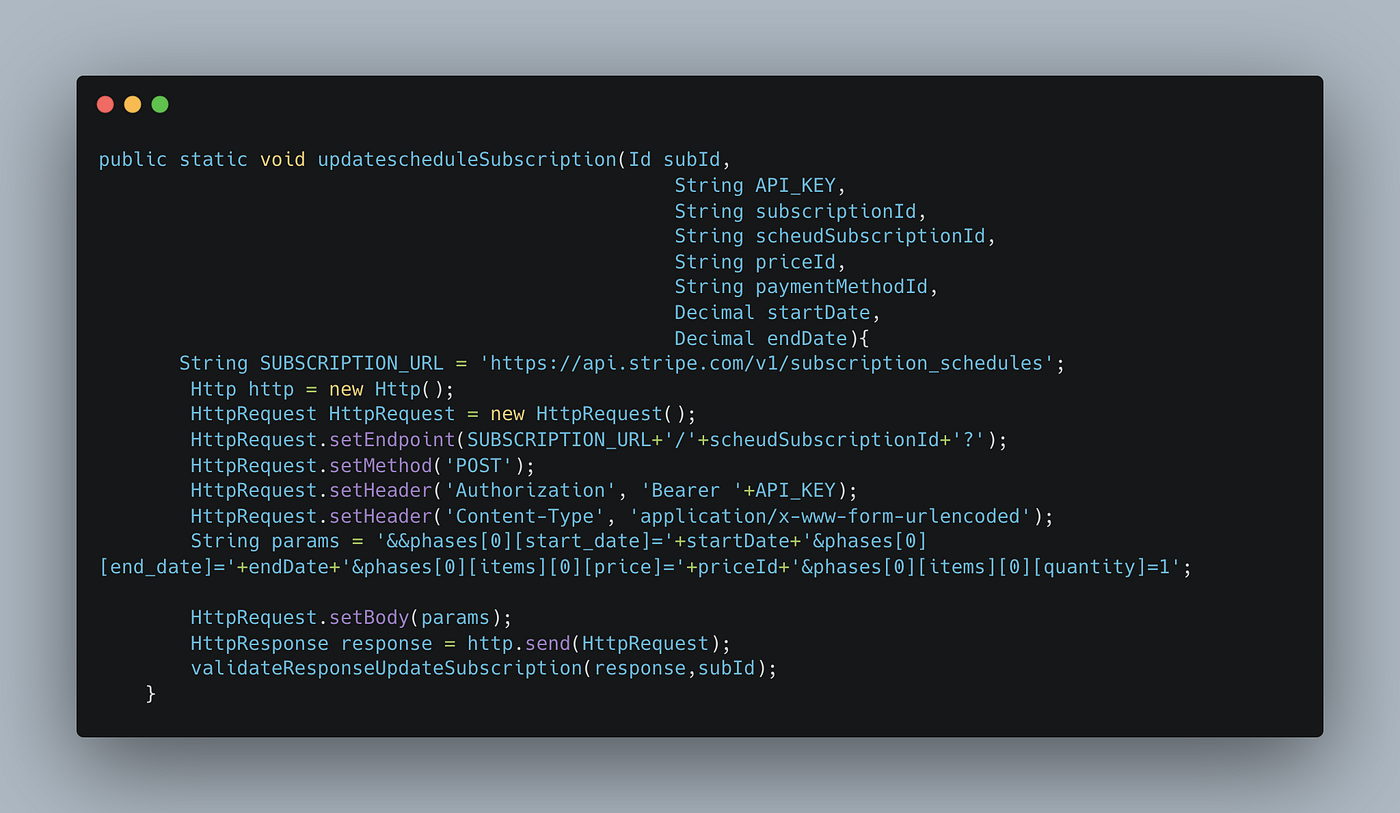
- Create a custom Subscription object in Salesforce related to the Account or customer, with fields such as start date, end date, and Stripe subscription or schedule ID.
- Configure products and prices in both Stripe and Salesforce because they are required when creating subscriptions.
- Use Salesforce triggers or automation to call the relevant Stripe Schedule API endpoint and create a schedule in Stripe.
Using Stripe Subscription Schedules With Salesforce
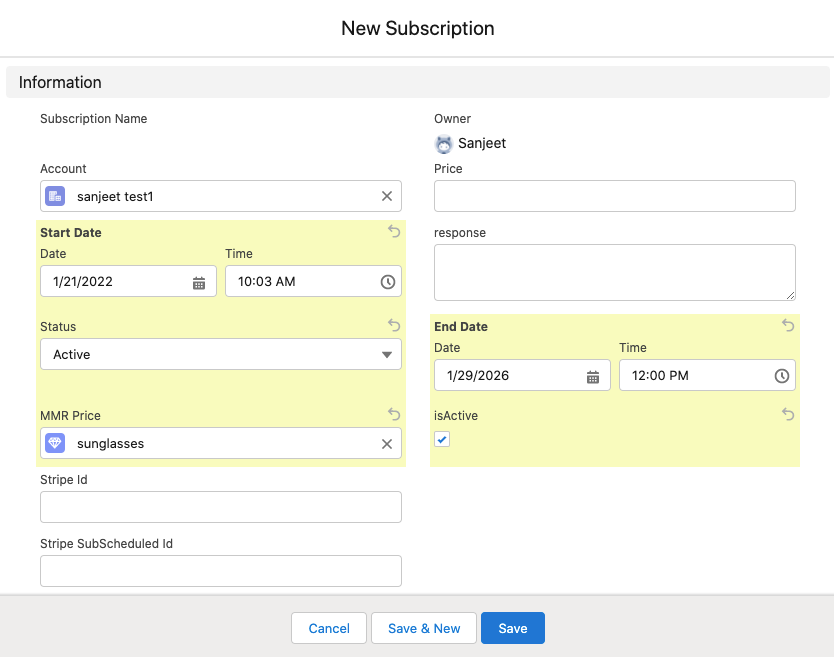
The original implementation used the Stripe Schedule API endpoint from Salesforce automation. A schedule can be useful when a subscription needs to be modified over its lifecycle.
The implementation approach recommended using a schedule rather than directly relying on the subscription API when schedule-based modifications were required.
Important: Products need to be configured in Stripe for subscription workflows.

Sync Stripe Invoices and Payments Back to Salesforce
When a recurring subscription is processed, Stripe can generate invoice and payment records. Stripe Webhooks can then be used to communicate relevant events to a Salesforce endpoint, allowing invoice and payment information to be synchronized back into Salesforce.
What Are Stripe Webhooks?
Webhooks are a way for web applications to communicate with each other. They allow an application to send data to another application in response to a specific event.
In a Stripe Salesforce integration, Webhooks can be used to notify Salesforce when events occur in Stripe, allowing Salesforce automation to process the incoming information.
Steps to Configure Stripe Webhooks
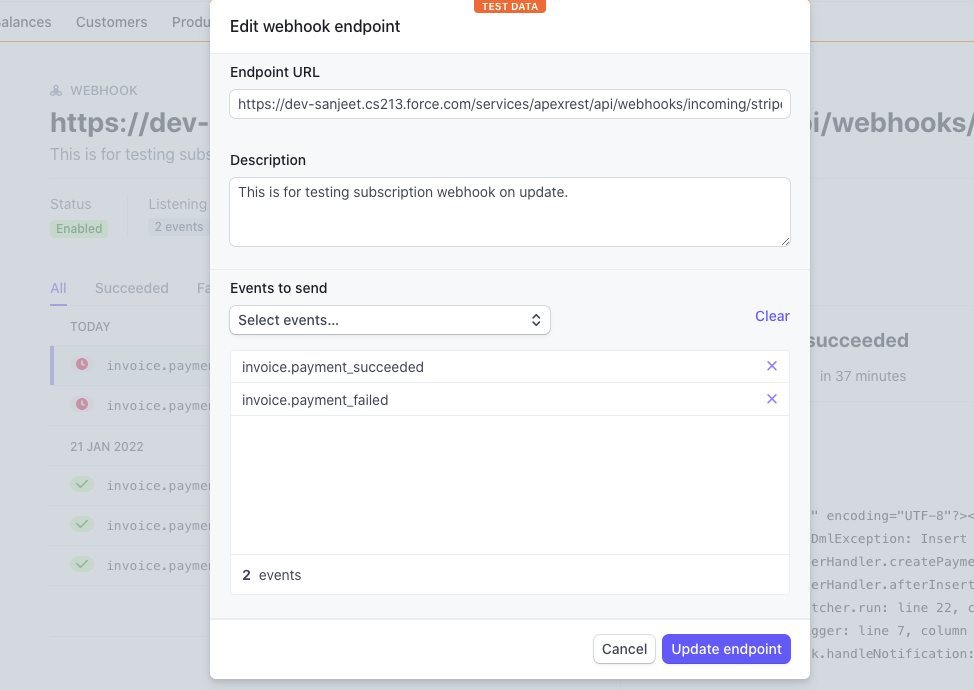
- Go to Developers → Webhooks and select Add endpoint.
- Enter the endpoint where you want to receive the Stripe Webhook.
- Select the events that should trigger the Webhook.
- After configuration, when a selected event occurs, Stripe sends the relevant payload to the configured endpoint.
Salesforce Stripe Integration Architecture
Salesforce
Stores customer, subscription, invoice, payment, and business-process information.
Stripe APIs
Enable Salesforce or connected systems to interact with Stripe payment resources.
Stripe Webhooks
Send event-driven information from Stripe to a configured endpoint.
Salesforce Automation
Processes incoming payment events and triggers business workflows.
Salesforce Stripe Integration Code Reference
The original implementation also referenced a GitHub repository containing Salesforce code related to the Stripe integration, including subscription and invoicing functionality.
Salesforce Payment Automation With Stripe
If your business needs a more structured Salesforce payment workflow, explore Kizzy Consulting’s ChargeEasy Salesforce and Stripe payment solution for a connected approach to payment processing and Salesforce workflows.
Need Salesforce Stripe Integration?
Talk to Kizzy Consulting about Salesforce integration, payment automation, APIs, Webhooks, subscriptions, and connected business workflows.
Frequently Asked Questions About Salesforce Stripe Integration
What is Salesforce Stripe integration?
Salesforce Stripe integration connects Salesforce with Stripe so businesses can synchronize customer, payment, subscription, invoice, and related transaction information between the systems.
How do Stripe Webhooks work with Salesforce?
Stripe Webhooks send event-driven payloads to a configured endpoint. Salesforce can receive and process those events to update records or trigger business logic.
Can Salesforce manage Stripe subscriptions?
Salesforce can be used as the business-process layer for subscription information while Stripe handles payment-related resources. APIs and Webhooks can connect subscription activity between the systems.
How can Salesforce and Stripe sync invoice and payment data?
Stripe can generate invoice and payment events, and Webhooks can send those events to Salesforce. Salesforce automation can then process the payload and update the relevant records.
What are Stripe APIs used for in Salesforce integration?
Stripe APIs can allow an integrated application to create, retrieve, or update Stripe resources such as customers, products, prices, subscriptions, and payment-related objects.
What is bidirectional Salesforce Stripe synchronization?
Bidirectional synchronization means relevant data can move between Salesforce and Stripe. For example, Salesforce may initiate or update a payment-related resource while Stripe can send transaction events back through Webhooks.
Kizzy Consulting: Salesforce Integration & Automation
Kizzy Consulting is a Salesforce Ridge Consulting Partner in the USA and has successfully implemented 100+ Salesforce projects for 100+ clients across sectors including Financial Services, Insurance, Retail, Sales, Manufacturing, Real Estate, Logistics, and Healthcare in countries including the US, Europe, and Australia.
To discuss your Salesforce integration requirements, email [email protected] or contact Kizzy Consulting.